
What is a Diffusion Model?
A diffusion model is a type of generative AI architecture designed to create highly realistic and contextually relevant digital content, including images, video, audio, 3D assets, and synthetic data.
Unlike traditional AI systems that primarily retrieve, classify, or recombine existing information, diffusion models learn the underlying patterns, structures, and relationships within large datasets. This allows them to generate entirely new content from scratch while maintaining high levels of visual and structural quality.
For enterprise organizations, diffusion models represent a significant advancement in AI-driven content generation because they enable scalable production of creative and operational assets without relying exclusively on manual design workflows.
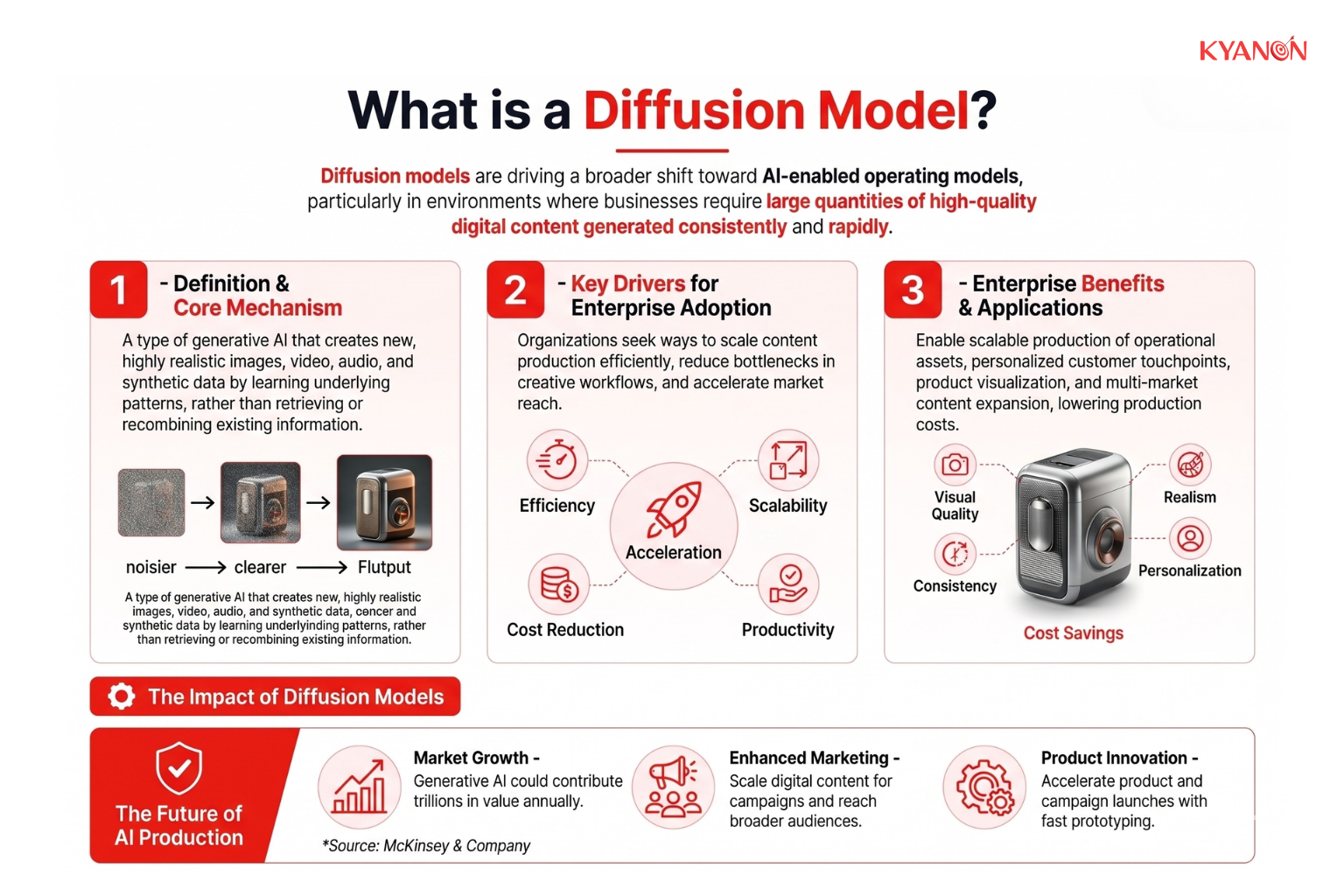
The growing enterprise interest in diffusion models is driven by a broader shift toward AI-enabled operating models across commerce, media, marketing, product development, and customer experience functions.
Organizations are increasingly looking for ways to:
- Scale digital content production efficiently.
- Reduce operational bottlenecks in creative workflows.
- Accelerate product and campaign launches.
- Improve personalization across customer touchpoints.
- Support multilingual and multi-market expansion.
- Lower production costs while increasing output volume.
Diffusion models are particularly effective in environments where businesses require large quantities of high-quality visual or synthetic content generated consistently and rapidly.
Generative AI has become one of the fastest-accelerating segments of enterprise AI investment, with rapid improvements in model quality, multimodal capabilities, and commercial adoption across industries. Research from McKinsey & Company further estimates that generative AI could contribute between $2.6 trillion and $4.4 trillion annually across industries, with substantial impact in marketing, product development, customer operations, and software engineering.
How a Diffusion Model Works
A diffusion model works by learning how data is structured and then reconstructing that structure from random noise. Instead of storing or copying existing images, the model identifies statistical patterns across massive datasets and uses those patterns to generate entirely new outputs.
From an enterprise perspective, the significance of diffusion models lies in their ability to generate high-quality digital assets at scale while reducing manual production effort. This makes them increasingly valuable for marketing automation, product visualization, creative operations, synthetic data generation, and digital commerce experiences.
The architecture typically operates through three core stages.
Forward Diffusion Process
In the first stage, the model intentionally adds noise to training data over multiple steps until the original content becomes indistinguishable from random noise.
This process allows the system to learn how information degrades and how underlying patterns are structured. Rather than memorizing images or files, the model learns the probability distribution behind the data itself.
For business leaders, this is an important distinction because it enables scalable content generation rather than simple asset replication. The result is a more flexible AI capability that can support enterprise-scale personalization, automation, and creative production workflows.
Reverse Denoising Process
Once the model understands how data becomes noisy, it learns how to reverse the process.
Starting from random noise, the system gradually reconstructs meaningful content step by step until a coherent image, audio file, or other output is produced.
This reverse generation process is what enables diffusion models to create highly realistic and contextually accurate outputs. Compared with earlier generative AI approaches, diffusion models are widely recognized for producing stronger visual quality and greater consistency across generated assets.
According to the Stanford AI Index, advances in foundation models and generative AI architectures are accelerating enterprise adoption of AI-generated content and multimodal applications across industries.
Latent Space Optimization
One of the biggest operational challenges in generative AI is computational cost. Processing high-resolution data directly can require significant infrastructure investment and create scalability limitations.
To improve efficiency, modern diffusion models often compress data into a smaller mathematical representation before generation begins. The model performs most of its processing within this compressed environment and later reconstructs the final high-resolution output.
For enterprises, this optimization significantly reduces infrastructure demands while improving scalability and deployment feasibility. This is particularly important for organizations seeking to move beyond experimentation into production-grade AI systems that can support real business workloads.
Industry research consistently shows that organizations achieve greater value from AI when they focus on scalable operational integration rather than isolated experimentation. Successful implementation depends not only on model capability, but also on architecture efficiency, governance, workflow integration, and long-term maintainability.
As adoption grows, enterprises increasingly prioritize technology partners that can combine strategic advisory expertise with practical engineering execution. The goal is no longer simply deploying AI models, but building scalable, maintainable, and enterprise-ready systems that align with long-term operational and commercial objectives.

Diffusion Model vs Generative Adversarial Network (GAN)
Both diffusion models and Generative Adversarial Networks (GANs) are designed to generate synthetic content such as images, video, audio, and design assets. However, they are built on fundamentally different architectures, resulting in distinct operational, cost, and scalability implications for enterprise adoption.
For enterprise leaders, the decision is not simply about model performance. It is about selecting the right generation framework based on business priorities such as output quality, infrastructure efficiency, deployment speed, governance requirements, and long-term scalability.
Recent enterprise AI trends increasingly favor diffusion-based systems for high-value creative and multimodal workloads because of their superior quality, controllability, and reliability at scale. At the same time, GANs remain relevant for latency-sensitive use cases where real-time generation speed is more important than maximum fidelity.
Dimension | Diffusion Model | Generative Adversarial Network (GAN) |
| Training stability | High (minimizes objective loss directly) | Low (prone to mode collapse) |
Output diversity | High | Low to Medium |
| Inference latency | Slow (requires multi-step iterations) | Fast (single-pass generation) |
Computational cost | High | Medium |
| Best for | High-fidelity, diverse visual content generation | Real-time generation, single-domain synthesis |
When to Consider a Diffusion Model
Consider a Diffusion Model if:
- Your organization requires high-volume, diverse visual asset generation for marketing campaigns and e-commerce listings, and manual graphic design is creating a time-to-market bottleneck.
- You need to fine-tune AI outputs to strictly adhere to proprietary brand guidelines, product styling, or specific intellectual property constraints.
- Your current creative workflows demand highly complex text-to-image conditional generation that requires precise control over composition and style.
It may not be the right priority if:
- Your application demands real-time, zero-latency inference (e.g., live video game asset rendering or instant interactive avatars) where the iterative denoising process is too slow.
Why Diffusion Models Matter for E-commerce & Media
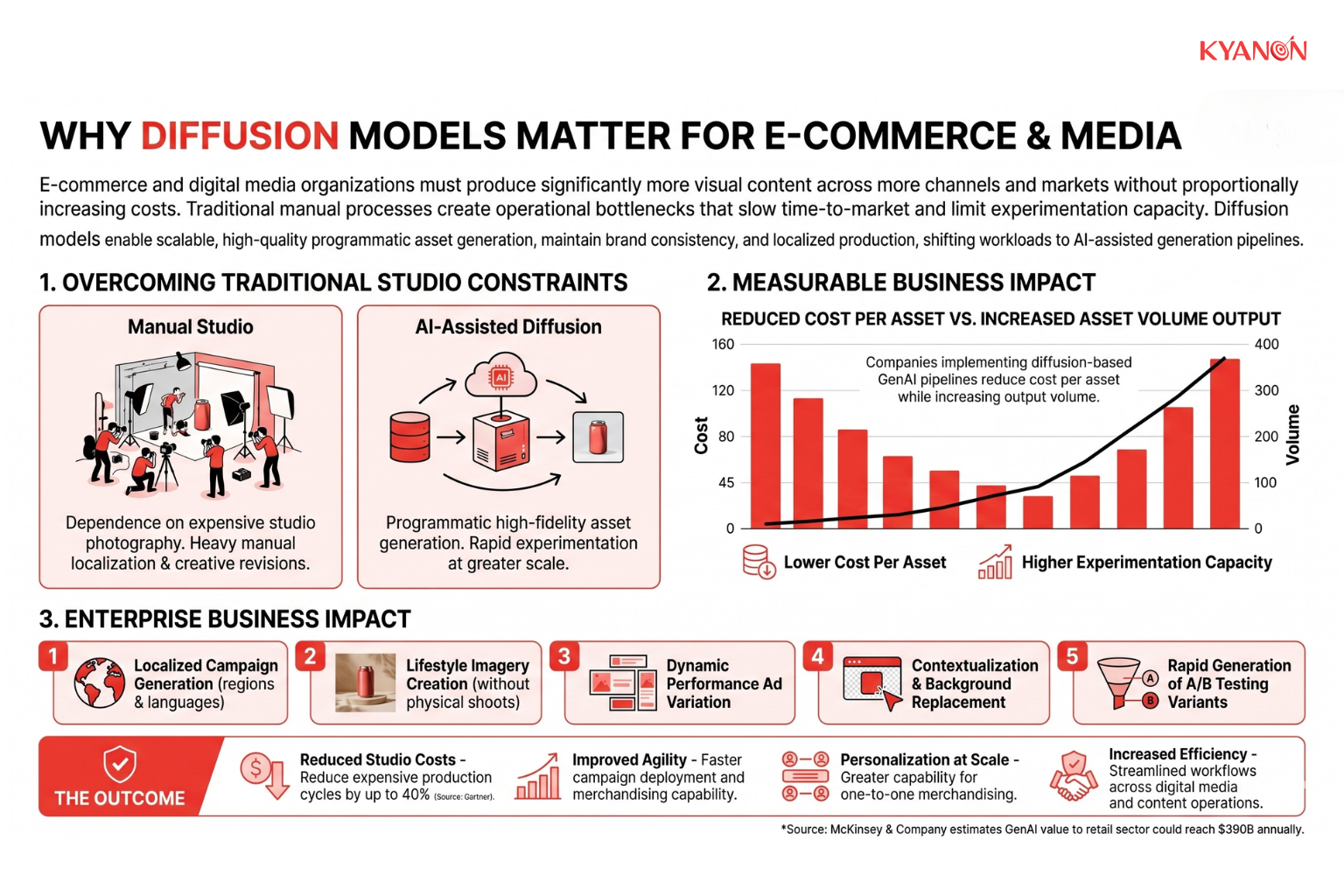
E-commerce and digital media organizations are under increasing pressure to produce significantly more visual content across more channels, markets, and customer segments, without proportionally increasing creative production costs.
Traditional content production models often struggle to scale. Studio photography, localization workflows, creative revisions, and campaign asset generation remain heavily dependent on manual processes, creating operational bottlenecks that slow time-to-market and limit experimentation capacity.
Diffusion models are changing this operating dynamic. Rather than scaling creative output through larger production teams alone, enterprises can shift part of the workload toward AI-assisted generation pipelines. This enables organizations to produce high-quality visual assets programmatically and at significantly greater scale while maintaining brand consistency and localization requirements.
For enterprise leaders, the value proposition is not simply “AI-generated images.” The strategic advantage is operational scalability.
Business Impact for Enterprise Teams
Diffusion-based generative AI systems can support a broad range of enterprise content operations:
- Localized campaign creative generation across regions and languages.
- Product lifestyle imagery creation without repeated physical photo shoots.
- Dynamic advertising asset variation for performance marketing.
- Automated background replacement and contextualization.
- Rapid generation of A/B testing variants for conversion optimization.
- Faster launch cycles for large SKU catalogs and seasonal campaigns.
Operational Benefits Beyond Content Creation
For executive teams, the impact extends beyond marketing productivity.
Diffusion models can contribute to broader operational improvements:
- Reduced dependency on expensive studio production cycles.
- Faster experimentation and optimization across digital channels.
- Improved merchandising agility for commerce teams.
- Greater personalization capabilities at scale.
- Increased efficiency in content operations and creative workflows.
- Shorter campaign deployment timelines.
Organizations integrating generative AI into marketing workflows are seeing measurable reductions in production costs while significantly increasing creative testing capacity. Gartner reported that generative AI adoption in marketing operations can reduce studio production costs by up to 40% while enabling substantially higher volumes of campaign asset experimentation.
Similarly, research from McKinsey & Company estimates that generative AI could add between $240 billion and $390 billion annually in value to the retail sector, with marketing and sales among the highest-impact functional areas.
Common Misconceptions
Misconception 1: “Diffusion models always outperform GANs in speed.”
Reality: While diffusion models provide superior image quality and stability compared to Generative Adversarial Networks (GANs), they are notoriously slow and computationally expensive at inference time due to the iterative nature of the denoising process.
Misconception 2: “The model simply reverses noise step-by-step like an undo button.”
Reality: The model does not execute a simple 1-to-1 reversal; it is trained to predict the total noise added to the original image. During generation, it iteratively refines the image by predicting the score function of the data distribution, effectively computing how to move from a noisy state toward a high-density, cleaner data point.
Misconception 3: “Diffusion models are inherently creative and always generate 100% original data.”
Reality: Diffusion models act as complex pattern-matching and optimization algorithms without human understanding. They can, and often do, memorize training data, meaning their ability to generalize depends on having a large enough dataset rather than an inherent guarantee of originality.
How Kyanon Digital Applies Diffusion Models
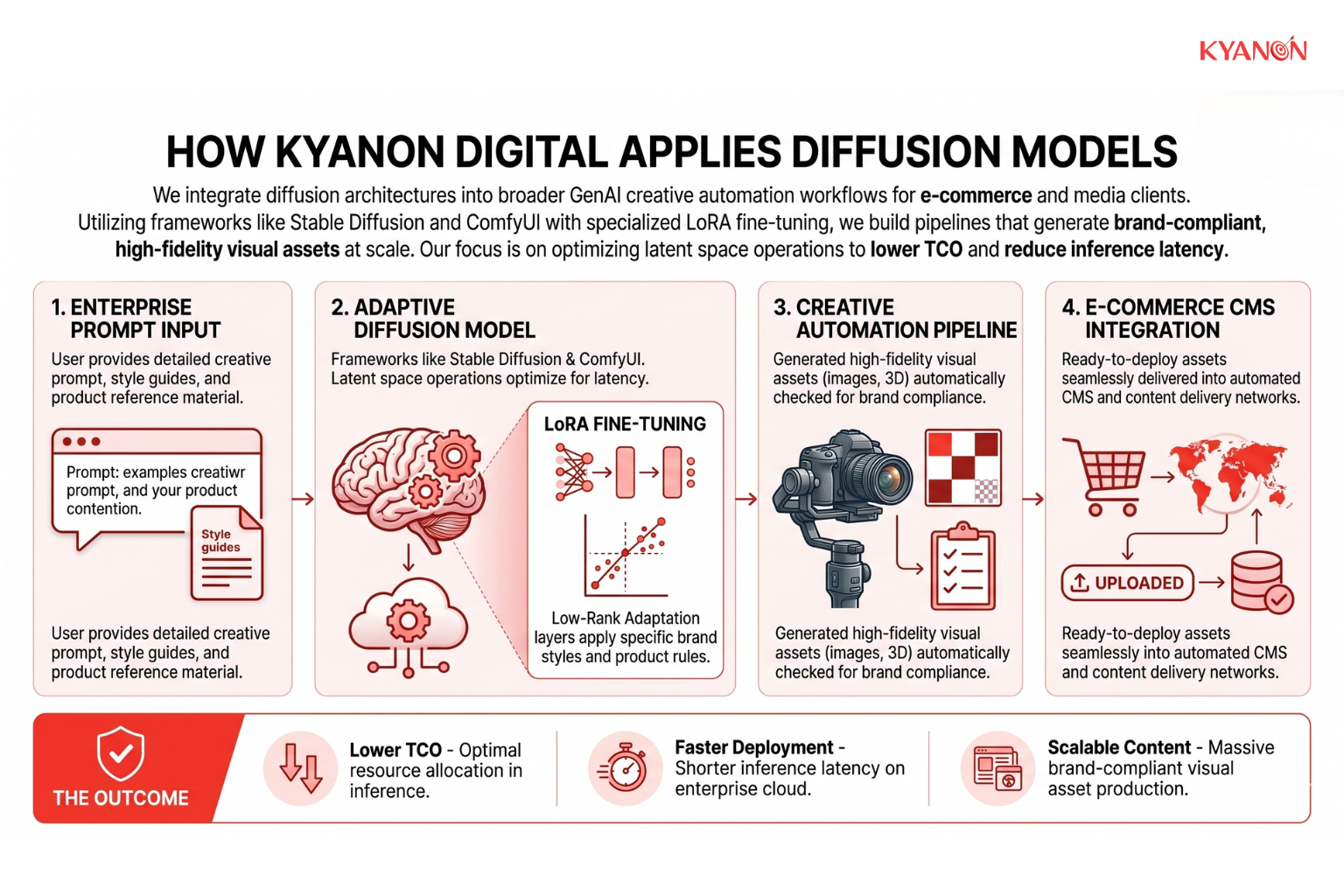
Kyanon Digital integrates diffusion architectures into broader GenAI creative automation workflows for e-commerce and media clients across Southeast Asia and the US. We utilize frameworks like Stable Diffusion and ComfyUI alongside specialized LoRA (Low-Rank Adaptation) fine-tuning to construct pipelines that generate brand-compliant, high-fidelity visual assets at scale. Our approach emphasizes optimizing the latent space operations to lower total cost of ownership (TCO) and reduce inference latency on enterprise cloud environments.
→ Explore our Generative AI Consulting services.

 Create project brief with AI