
What are merchandising rules?
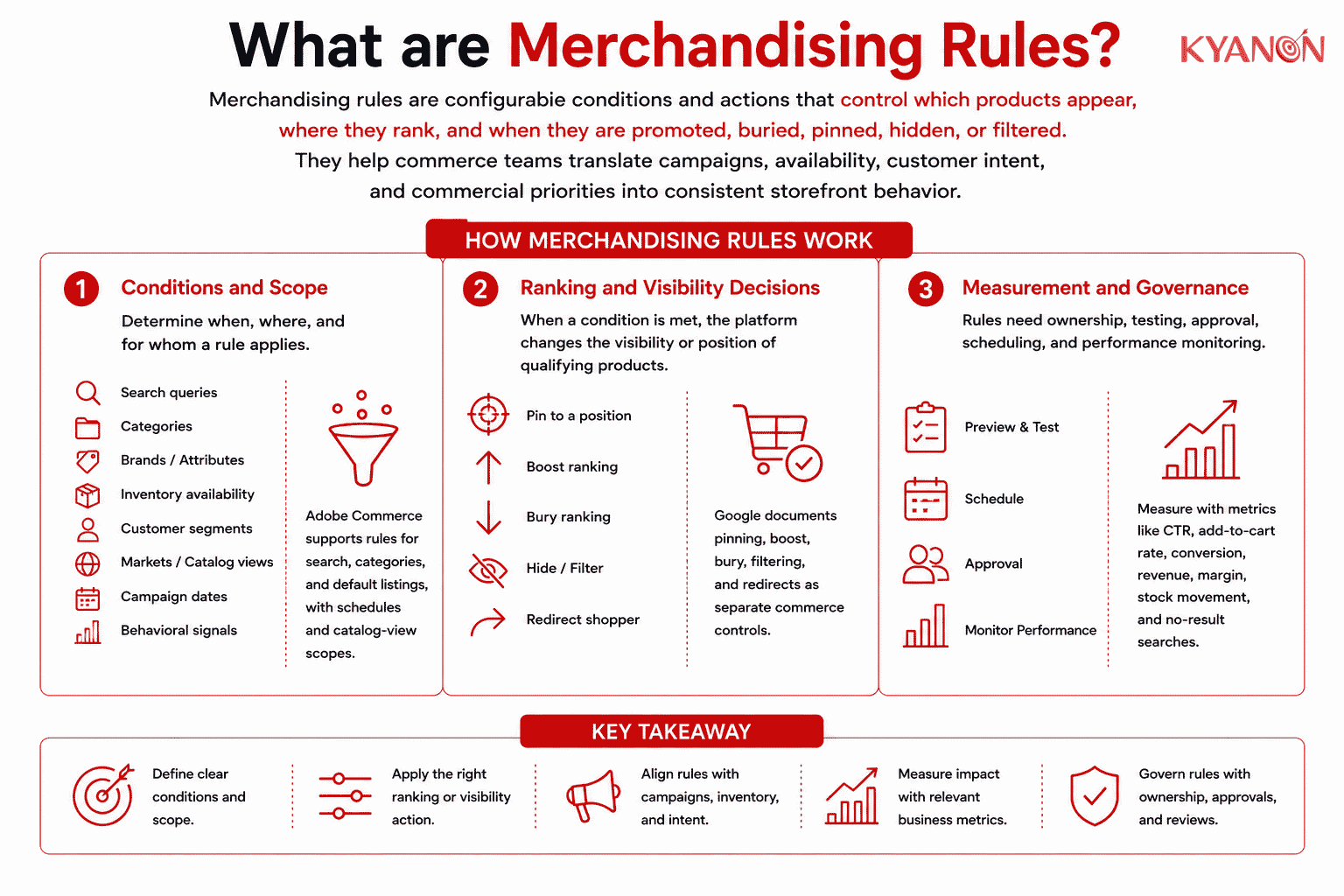
Merchandising rules are configurable conditions and actions that control which products appear, where they rank, and when they are promoted, buried, pinned, hidden, or filtered across search and category experiences.
Adobe Commerce defines search merchandising as rules that combine logic with actions to shape product discovery. These controls allow commerce teams to translate campaigns, availability, customer intent, and commercial priorities into consistent storefront behavior.
How merchandising rules work
Merchandising rules work by evaluating defined conditions, selecting affected products, and applying ranking or visibility actions when those conditions are met.
The mechanism allows business teams to apply catalog, inventory, campaign, customer, and search priorities consistently without manually rearranging every product list.
Conditions and scope
Conditions determine when, where, and for whom a rule applies.
Common conditions include:
- Search queries
- Product categories
- Brands or product attributes
- Inventory availability
- Customer segments
- Markets or catalog views
- Campaign dates
- Behavioral signals
Adobe Commerce supports rules for search queries, category pages, and default product listings, with optional schedules and catalog-view scopes.
Ranking and visibility decisions
When a condition is satisfied, the platform changes the visibility or position of qualifying products.
The action may assign an exact position, change ranking weight, restrict the result set, remove an item, or redirect the shopper to a more relevant page. Google documents pinning, boost-and-bury controls, filtering, and redirects as separate commerce-serving controls.
Measurement and governance
Merchandising rules require ownership, testing, approval, scheduling, and performance monitoring because inventory, customer demand, and campaign priorities change.
Teams should assess rules using metrics aligned with their purpose, such as click-through rate, product discovery, add-to-cart rate, conversion, revenue, margin, stock movement, or no-result searches.
Adobe provides rule previews, date ranges, testing, and publishing controls, while Google’s merchandising console supports creator and approver workflows for selected controls.

What are the main types of merchandising rules?
The main merchandising rules control whether a product is fixed, promoted, demoted, included, excluded, or recommended within a digital commerce experience.
Rule type | What it does | Typical business use |
Pinning | Fixes a product in a specific position, regardless of the default ranking. | Place a new launch or campaign product at the top of a category |
| Boosting | Increases a product’s ranking without guaranteeing an exact position. | Prioritize seasonal, popular, well-rated, or in-stock products |
Burying | Moves a product lower while keeping it available to shoppers. | Reduce visibility for low-stock, off-season, or less relevant items |
| Including or filtering | Limits results to products that meet defined attributes or eligibility rules. | Show only products available in a market, campaign, or customer segment |
Hiding or excluding | Removes selected products from a search or category experience. | Suppress unavailable, restricted, or unsuitable products |
| Redirecting | Sends a qualifying search query to a selected landing page. | Direct “Black Friday” searches to a campaign collection |
Recommendation rules | Presents complementary, substitute, or bundled products in a defined context. | Show a laptop sleeve or mouse with a laptop |
Adobe Commerce documents pin, boost, bury, and hide as core manual merchandising actions, while Google’s commerce controls also support filtering, redirects, and query-based product controls.
Recommendation rules overlap with recommendation engines but are not identical. A merchandising rule can manually define which products should appear together, while a recommendation engine predicts related products from behavioural, contextual, or similarity data.
In-store vs. eCommerce merchandising rules
In-store merchandising controls physical placement and presentation, while eCommerce merchandising controls digital visibility, ranking, filtering, and recommendations.
In-store merchandising | eCommerce merchandising |
| Uses shelves, endcaps, signage, and planograms | Uses search results, category pages, carousels, and product pages |
Prioritizes physical position and shopper flow | Prioritizes relevance, navigation, ranking, and customer intent |
| Changes require physical store execution | Rules can be scheduled or updated through platform controls |
Availability depends on local store inventory | Ranking can use inventory across channels or locations |
| Performance is measured through store and category sales | Performance can include clicks, add-to-cart, conversion, revenue, and margin |
The underlying commercial principles remain similar: present the right products at the right time, price, quantity, and context. However, digital rules must also account for search intent, customer data, inventory signals, and algorithmic ranking.
Adobe Commerce allows merchandisers to combine intelligent ranking with manual actions and schedule rules for campaigns or seasonal periods.
Merchandising rules vs. recommendation engine
Merchandising rules apply explicit business logic to product presentation, while recommendation engines predict which products are likely to be relevant to a particular customer or context.
Dimension | Merchandising rules | Recommendation engine |
Primary purpose | Control product visibility and ranking | Predict products a user may prefer |
| Decision logic | Explicit conditions and actions | Statistical, behavioral, or machine-learning models |
Main inputs | Campaigns, inventory, attributes, queries, dates, and business priorities | Browsing, purchases, similarity, context, and customer behavior |
| Typical output | Pinned, boosted, buried, hidden, filtered, or redirected results | Ranked product recommendations |
Personalization | Optional and usually segment- or context-based | Often customer- or session-specific |
| Business control | High direct control over defined outcomes | Indirect control through objectives, features, and constraints |
Explainability | Usually clear because each action is tied to a rule | May require model explanation and monitoring |
| Learning capability | Does not improve unless rules or inputs change | Can adapt as new behavioral data becomes available |
Best fit | Promotions, launches, availability rules, contractual priorities, and category curation | Cross-sell, personalized discovery, substitutes, and next-best-product selection |
The two capabilities are complementary: recommendation models can generate a baseline ranking, while merchandising rules apply commercial guardrails or targeted overrides. Google and Adobe both document merchandising controls that operate alongside search or recommendation ranking rather than replacing it completely.
When to consider merchandising rules
Merchandising rules should be considered when default search or category ranking cannot consistently reflect product relevance, inventory conditions, campaigns, and commercial priorities.
Consider merchandising rules if:
- Large product lists require active curation. High-priority, available, or newly launched products are difficult to find.
- Campaign changes depend on development work. Merchandisers need to schedule or adjust product placement without repeated code releases.
- Search relevance conflicts with commercial requirements. Relevant results must remain visible while selected products receive additional exposure.
- Different categories or markets require different logic. Assortments, campaigns, inventory, and shopper behavior vary by region or storefront.
- AI ranking needs business guardrails. Automated decisions must respect availability, compliance, supplier agreements, or campaign commitments.
It may not be the right priority if:
- The catalog is small enough to manage manually.
- Product attributes and inventory data are unreliable.
- The business has not defined clear merchandising objectives.
- Teams cannot measure how ranking changes affect discovery and conversion.
Merchandising rules should operationalize an agreed strategy; they cannot correct unclear taxonomy, poor catalog data, or an irrelevant product assortment.
Why merchandising rules matter for eCommerce
Merchandising rules matter because product order determines which items shoppers notice, compare, and consider before leaving a search or category page.
Rules allow retailers to control visibility without abandoning relevance. They can support product launches, seasonal campaigns, inventory movement, brand commitments, and customer-specific experiences while preventing unavailable or unsuitable products from dominating results.
A 2026 industry-scale A/B study of whole-page eCommerce search optimization reported a 1.86% improvement in brand relevance and a statistically significant 0.05% revenue increase. The framework evaluated product relevance together with page position and visual presentation, showing that merchandising outcomes depend on the complete product-list experience rather than item relevance alone.
The results are specific to the tested platform and should not be treated as a universal benchmark. They demonstrate why product placement changes should be evaluated through controlled tests using metrics such as click-through rate, add-to-cart rate, conversion, revenue, margin, and inventory movement.
Common misconceptions about merchandising rules
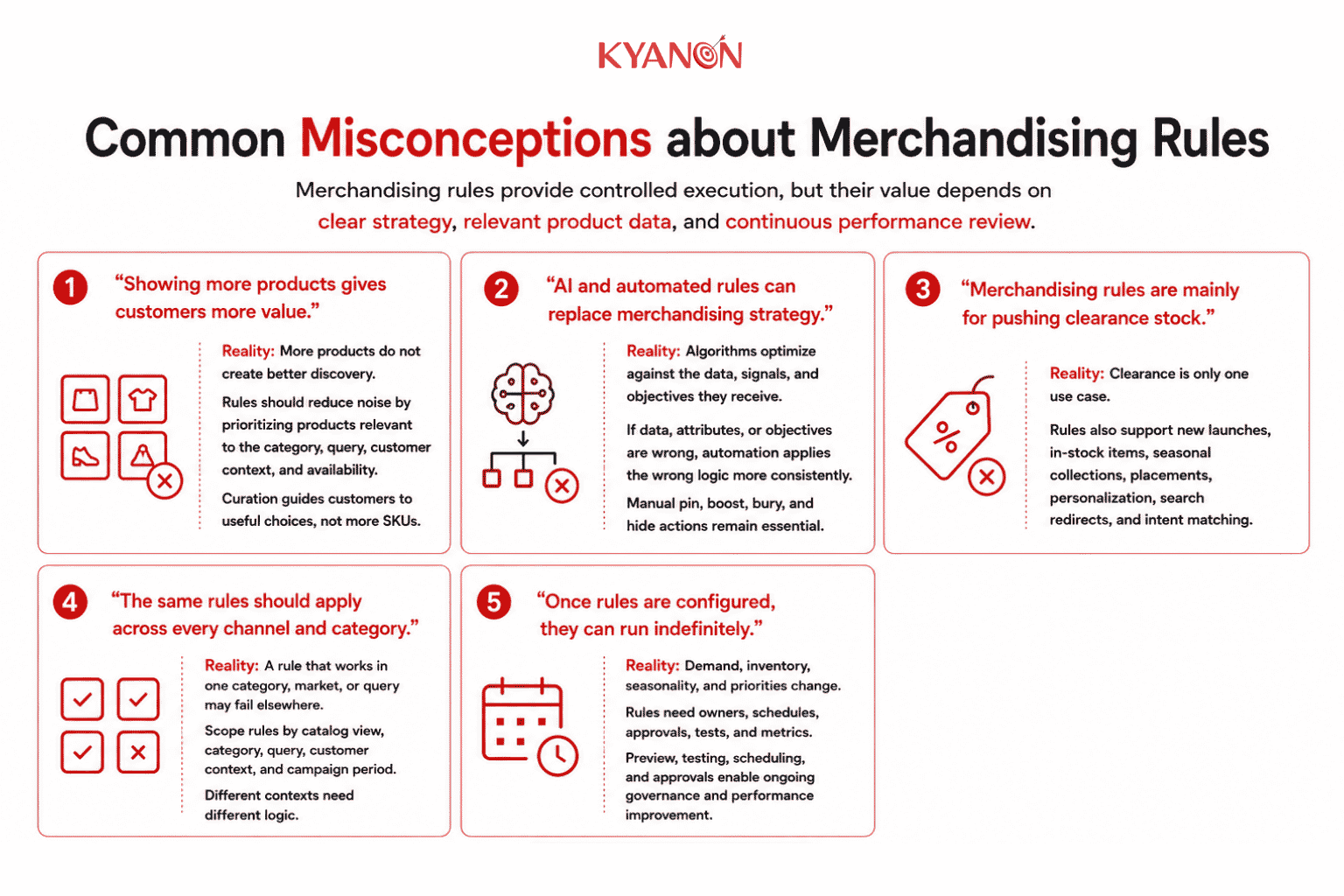
Merchandising rules provide controlled execution, but their value depends on clear strategy, relevant product data, and continuous performance review.
“Showing more products gives customers more value.”
Reality: More products do not automatically create better discovery.
Rules should reduce visual and decision noise by prioritizing products relevant to the category, query, customer context, and current availability. Curation should guide customers toward useful choices rather than maximize the number of visible SKUs.
“AI and automated rules can replace merchandising strategy.”
Reality: Algorithms optimize against the data, signals, and objectives they receive.
If the catalog structure, product attributes, or business objective is wrong, automation applies the wrong logic more consistently. Adobe’s merchandising model retains manual pin, boost, bury, and hide actions alongside intelligent behavioral ranking.
“Merchandising rules are mainly for pushing clearance stock.”
Reality: Clearance is only one use case.
Rules can support new-product launches, in-stock products, seasonal collections, contractual placements, personalized categories, search redirects, and customer-intent matching. Google’s commerce controls include pinning, boosting, burying, filtering, synonyms, facets, and redirects.
“The same rules should apply across every channel and category.”
Reality: A rule relevant to one category, market, or search query may create poor results elsewhere.
Merchandising logic should be scoped by catalog view, category, query, customer context, and campaign period. Adobe allows separate rules for default listings, category pages, and qualifying searches.
“Once rules are configured, they can run indefinitely.”
Reality: Customer demand, inventory, seasonality, and campaign priorities change.
Rules should have owners, schedules, approval controls, test cases, and performance metrics. Both Adobe and Google provide preview, testing, scheduling, or approval capabilities because merchandising decisions require ongoing governance.
How Kyanon Digital applies merchandising rules
Kyanon Digital implements manual and AI-assisted merchandising within eCommerce platform builds, aligning product ranking with customer intent, catalog structure, inventory, campaigns, and commercial priorities.
Implementations may combine:
- Search and category merchandising rules
- Pin, boost, bury, hide, and filter controls
- Seasonal and product-launch scheduling
- Inventory-aware product ranking
- Category-specific sorting logic
- Search relevance and synonym management
- AI-driven recommendations and personalization
- Product catalog and PIM integration
- Merchandising dashboards and approval workflows
- A/B testing and performance analytics
Kyanon Digital’s Magento capabilities include visual merchandising tools, seasonal campaign automation, advanced search, navigation, personalization, and catalog integration. Its broader omnichannel eCommerce offering also covers smart search, AI-driven recommendations, inventory optimization, and enterprise-system connectivity.
The implementation focus is not the number of rules configured. It is whether product-ranking decisions remain relevant, measurable, explainable, and manageable as catalogs, channels, and markets expand.
→ Explore more of Kyanon Digital Omnichannel eCommerce Solutions and Magento eCommerce Development Services.

 Create project brief with AI