
What is a Product Catalog?
A Product Catalog is a structured database that centralizes all sellable products, organizing essential attributes, variant hierarchies, pricing information, digital assets, and commercial metadata to power customer-facing shopping experiences. It serves as the single source of truth for merchandising, ensuring consistent product information is delivered across websites, mobile apps, marketplaces, social commerce channels, and in-store digital touchpoints.
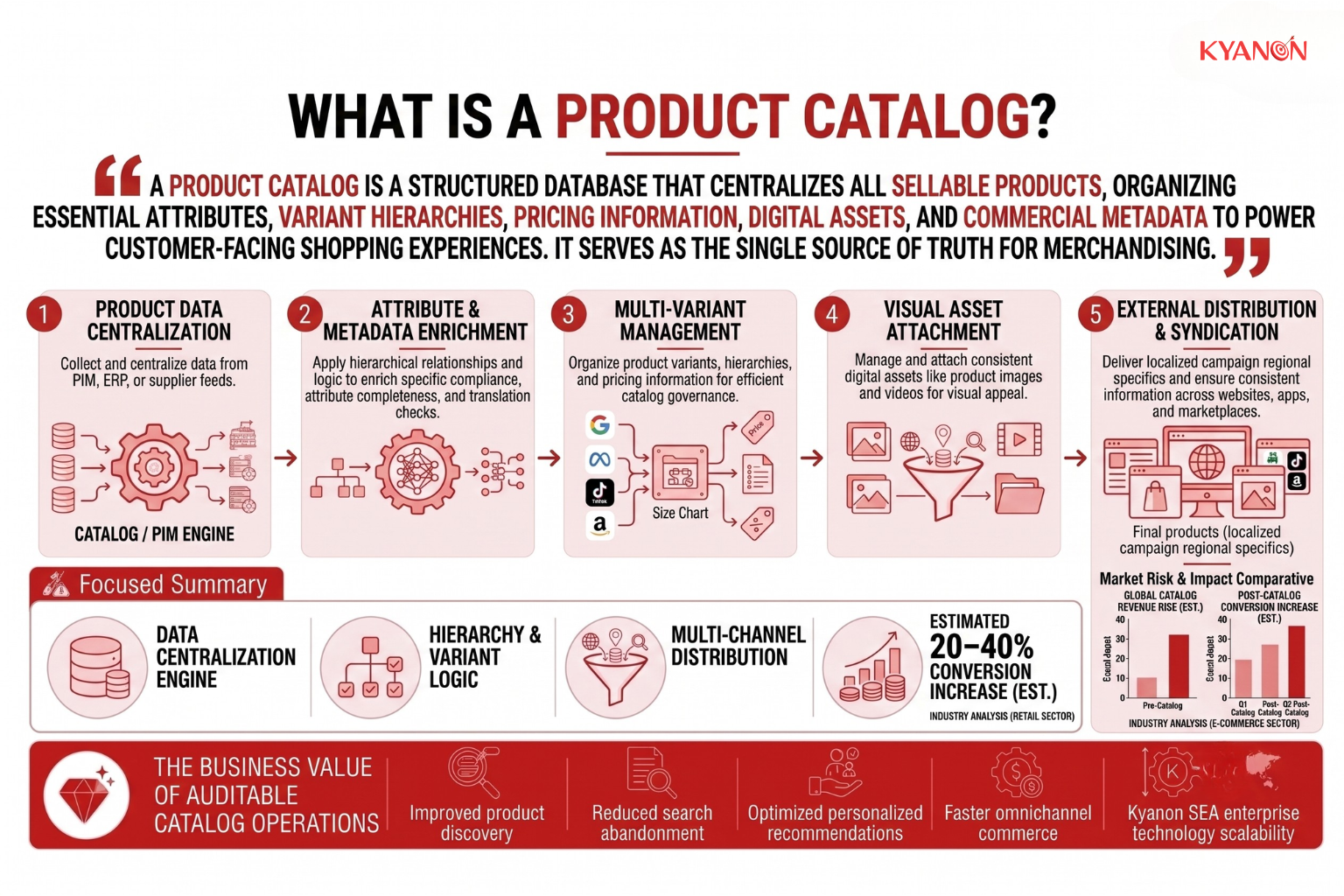
Rather than simply listing products, a product catalog defines how products are presented, discovered, and managed throughout the customer journey. It determines how merchandise is categorized, indexed by search engines, filtered through faceted navigation, recommended by personalization engines, and displayed within category pages, product detail pages, and promotional campaigns.
How a Product Catalog Works
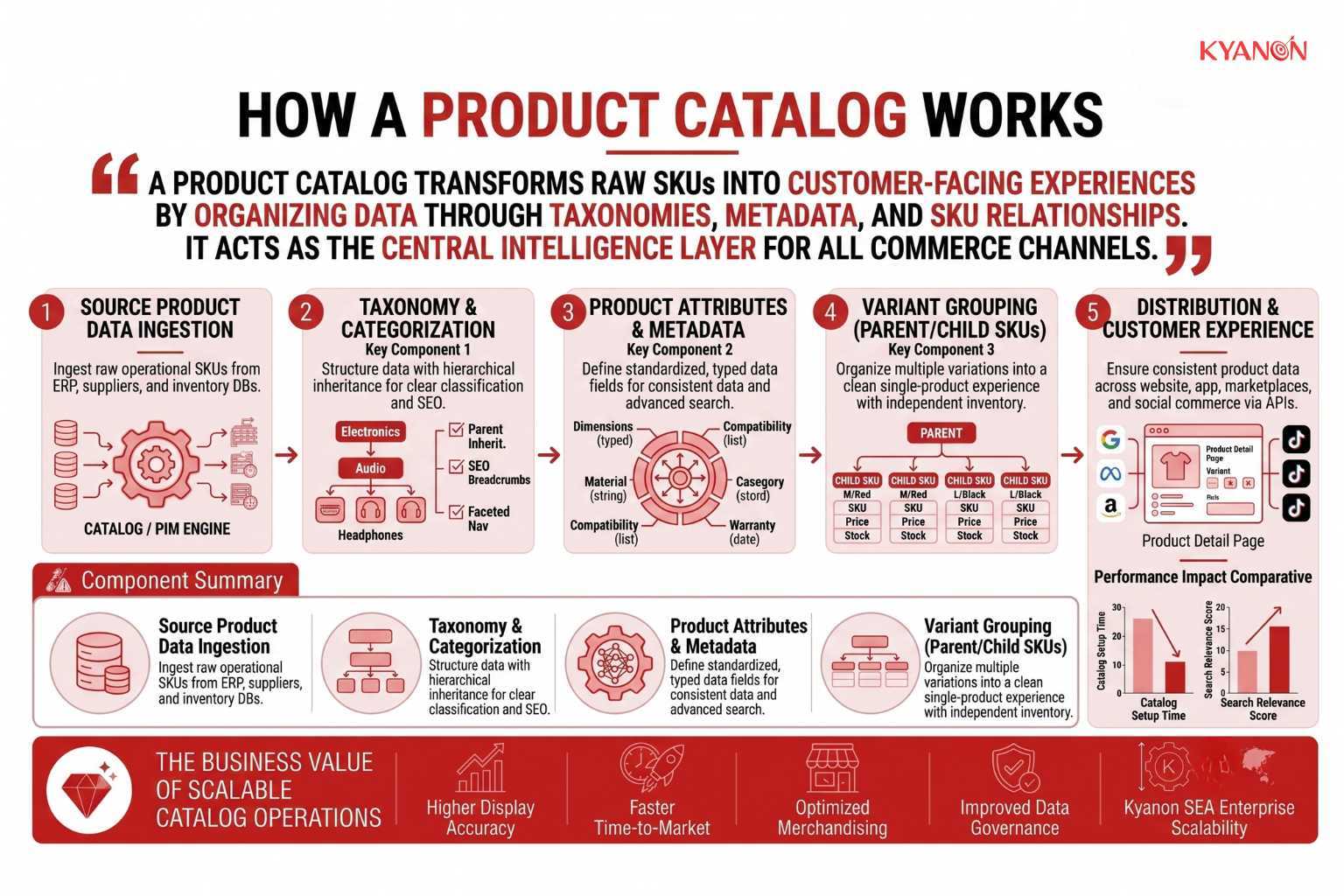
A product catalog transforms raw operational SKUs into customer-facing product experiences by organizing data through structured relationships, standardized taxonomies, and normalized metadata. Rather than simply storing product records, it acts as the intelligence layer that enables search engines, recommendation systems, merchandising tools, and storefront applications to accurately retrieve, rank, and display products based on customer intent.
In modern commerce architectures, this process is typically powered by a centralized Product Information Management (PIM) system. The PIM ingests product information from ERP systems, suppliers, and inventory databases, enriches it with customer-friendly content and digital assets, and distributes consistent product data across websites, mobile apps, marketplaces, social commerce channels, and other sales touchpoints through APIs.
Taxonomy and Categorization
A well-designed taxonomy provides several benefits:
- Hierarchical inheritance: Child categories inherit structural rules and attributes from parent categories, ensuring consistent data organization.
- Clear product classification: Each product belongs to a single primary category path (for example, Electronics → Audio → Headphones), preventing duplicate indexing and improving catalog governance.
- Faceted navigation: Category hierarchies provide the foundation for storefront menus, filter panels, and product discovery.
- SEO optimization: Structured category paths automatically generate breadcrumb navigation and schema markup, helping search engines better understand site architecture.
Product Attributes and Metadata
Attributes define the structured characteristics that describe each product, such as dimensions, material, voltage, color, compatibility, or warranty information. Unlike free-text descriptions, these standardized fields allow applications to understand and process product information programmatically.
A robust attribute model enables:
- Typed data fields (Boolean, numeric, date, text, enumerated values) that improve data consistency.
- Advanced faceted search, allowing customers to filter products by multiple criteria simultaneously.
- Automatic specification tables generated from structured product data rather than manually maintained content.
- Localization support, enabling measurements, languages, currencies, and regional specifications to adapt dynamically for different markets.
Because metadata is normalized, search engines and AI-powered recommendation systems can retrieve products based on precise customer intent rather than relying solely on keyword matching.
Variant Grouping (Parent/Child SKUs)
Many products exist in multiple variations, such as different sizes, colors, storage capacities, or materials. Rather than displaying every variation as an independent product, modern catalogs organize these items using a parent-child relationship.
Database structure for product variants
Database Level | Purpose | Example |
| Parent Product | Non-purchasable product definition containing shared information | Brand, product name, description, images, care instructions |
Child SKU | Purchasable inventory record | Medium / Green / Inventory: 42 |
| Child SKU | Purchasable inventory record | Large / Black / Inventory: 12 |
This architecture provides several advantages:
- Consolidates multiple variants into a single product detail page, creating a cleaner shopping experience.
- Reduces duplicate search results and improves product discoverability.
- Allows each SKU to maintain independent inventory, pricing, warehouse location, and fulfillment status.
- Simplifies merchandising while enabling customers to switch between variants without leaving the page.
By combining structured taxonomy, standardized attributes, and intelligent SKU relationships, a product catalog becomes the foundation for scalable digital commerce. It enables accurate search, personalized recommendations, consistent merchandising, and seamless product experiences across every customer touchpoint.

Product Catalog vs Enterprise Resource Planning (ERP)
Although both systems manage product information, they serve fundamentally different purposes within a modern commerce architecture. An Enterprise Resource Planning (ERP) system manages products as operational assets for procurement, manufacturing, inventory, finance, and supply chain operations. A Product Catalog, often powered by a Product Information Management (PIM) platform, transforms those operational records into customer-ready product experiences that support discovery, merchandising, and conversion.
Rather than competing technologies, ERP and Product Catalog systems are complementary. The ERP acts as the operational source of truth for inventory and financial data, while the Product Catalog enriches that information with marketing content, digital assets, product relationships, and localized metadata before distributing it across customer-facing channels.
Comparison of product catalog and ERP systems
Dimension | Product Catalog (PIM) | Enterprise Resource Planning (ERP) |
| Primary purpose | Drive product discovery, merchandising, sales, and consistent customer experiences across channels | Manage inventory, procurement, manufacturing, finance, and fulfillment operations |
Primary users | Customers, merchandisers, marketers, e-commerce teams | Procurement, warehouse, finance, accounting, and supply chain teams |
| Data type | Rich product descriptions, images, videos, SEO metadata, attributes, variants, localized content, cross-sell relationships | SKU identifiers, Bill of Materials (BOM), supplier information, warehouse locations, inventory levels, cost of goods, tax profiles |
Data model | Hierarchical product relationships with categories, variants, filters, bundles, and merchandising rules | Relational operational records optimized for inventory control, accounting, and logistics |
| Update frequency | High, frequent updates for promotions, pricing, product content, SEO, digital assets, and merchandising campaigns | Lower, primarily updated when inventory, suppliers, manufacturing costs, or new SKUs change |
Primary integrations | E-commerce storefronts, headless CMS, mobile apps, marketplaces, search engines, recommendation systems | Warehouse Management Systems (WMS), Order Management Systems (OMS), accounting platforms, manufacturing, and supply chain software |
When to Consider Product Catalog Restructuring
Consider upgrading your catalog architecture if:
- Your site search engine returns zero results for synonymous queries because critical product specifications are hardcoded into unstructured HTML text blocks rather than filterable metadata.
- You are expanding operations into cross-border commerce and require localized taxonomy trees to comply with regional format regulations and translation requirements.
- Your digital merchandising team spends excessive operational hours manually duplicating and formatting SKU data to meet the disparate requirements of different marketplace vendor portals.
It may not be the right priority if:
- Your organization operates a localized, single-channel B2B procurement portal featuring fewer than 50 non-variant SKUs, with no projected requirement for digital multi-channel expansion.
Why a Product Catalog Matters for Retail
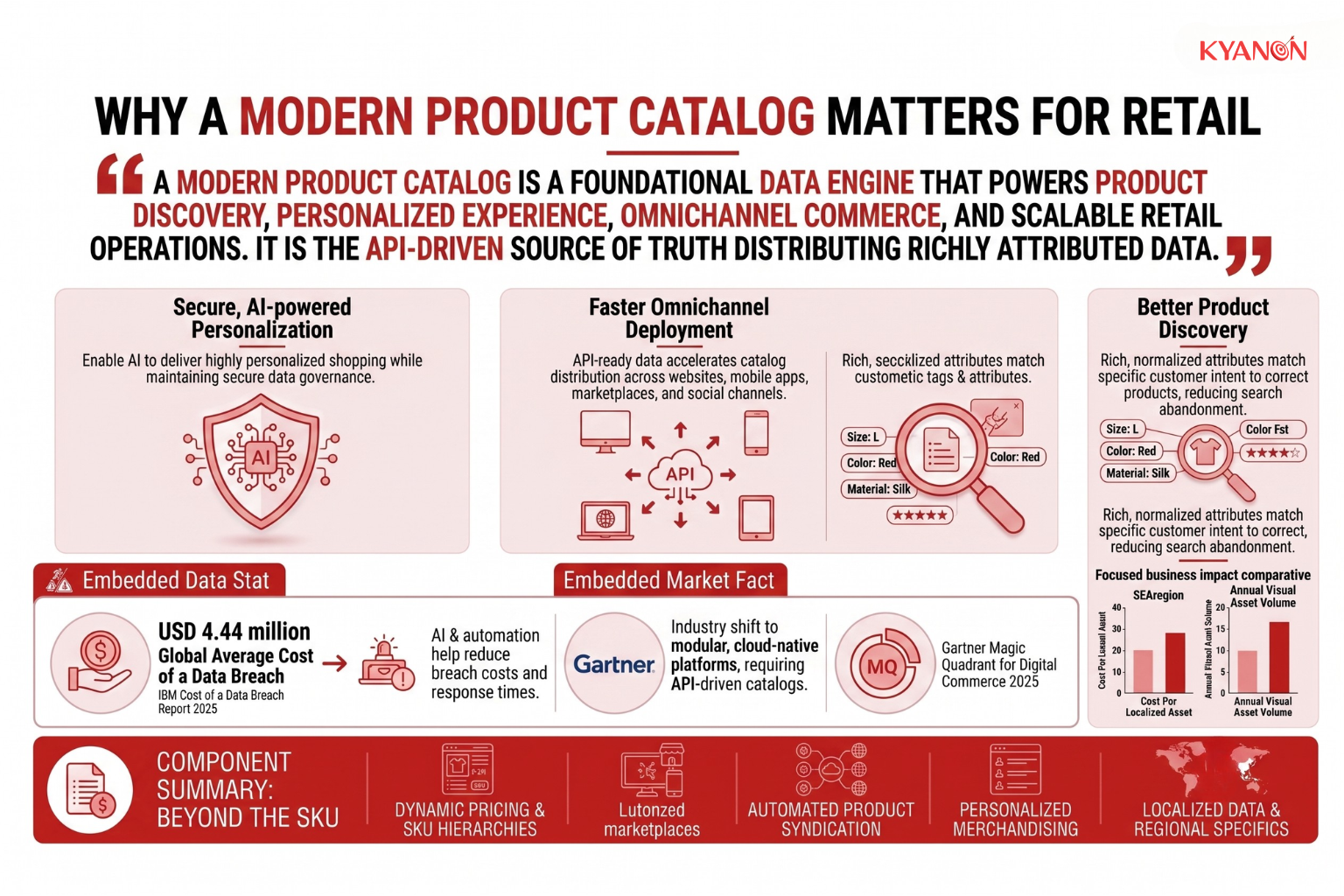
A modern Product Catalog is far more than a repository of SKUs. It serves as the foundational data engine that powers product discovery, personalized shopping experiences, omnichannel commerce, and scalable digital operations. A well-structured catalog enables retailers to support dynamic pricing, automate product syndication across multiple sales channels, and expose richly attributed product data that improves both customer experience and operational efficiency.
As retailers expand across websites, mobile apps, marketplaces, and social commerce platforms, the Product Catalog becomes the central source of product information distributed through APIs. Next-generation commerce organizations are increasingly adopting modular, API-driven architectures that place structured product data at the center of their digital transformation strategies.
Retailers relying on fragmented spreadsheets or inconsistent product data often face poor search experiences, inefficient merchandising, and slower expansion across sales channels. A modern Product Catalog addresses these challenges by delivering several key business benefits:
- Secure, AI-powered personalization: According to the IBM Cost of a Data Breach Report 2025, the global average cost of a data breach reached USD 4.44 million. The report also shows that AI and automation help reduce breach costs and response times. Clean, standardized product data enables AI-driven personalization while supporting stronger data governance and security.
- Faster omnichannel deployment: The Gartner Magic Quadrant for Digital Commerce 2025 highlights the industry’s shift toward composable, cloud-native commerce platforms. Structured, API-ready catalog data allows retailers to efficiently distribute product information across websites, mobile apps, marketplaces, and other digital channels.
- Better product discovery: Rich product attributes help search engines and on-site search match highly specific customer queries to the correct products. Without normalized data, these high-intent searches often return irrelevant or empty results, increasing search abandonment.
Common Misconceptions
We only need to update it when we launch new items
A catalog requires continuous enrichment. Accurate sizing, real-time inventory counts, fluctuating regional pricing, and localized translations must update constantly to avoid customer frustration and cart abandonment.
The ERP or inventory software is our Product Catalog
Enterprise Resource Planning (ERP) systems hold raw operational data like SKUs, cost goods, and warehouse locations. They lack the emotional, customer-facing content, like rich descriptions, high-resolution videos, compatibility guides, and marketing copy, needed to convert shoppers.
One standard catalog version works for all sales channels
Each marketplace has strict, unique format requirements. What works for your direct website will fail on Amazon or Instagram due to differing character limits, category structures, image ratios, and required attribute tags.
Customers only care about the image and the price
Modern shoppers rely on deep filtering. If your catalog lacks clean, structured metadata (like exact material, power voltage, or specific compatibility tags), your products will not appear when users filter down their search results.
How Kyanon Digital Applies Product Catalog Architectures
Kyanon Digital designs modular Product Catalog architectures that help enterprise retailers separate customer-facing merchandising from backend operational systems. By combining a centralized Product Information Management (PIM) platform with event-driven integrations and Headless Commerce, we enable retailers across Southeast Asia to scale digital commerce while reducing maintenance complexity and improving storefront performance.

As digital commerce continues to grow across Southeast Asia, retailers must manage increasingly complex product data across multiple channels. Kyanon Digital addresses these challenges by building Product Catalog architectures that support:
- Omnichannel product distribution: A centralized product repository publishes consistent product information across websites, mobile apps, and regional marketplaces such as Shopee, Lazada, and TikTok Shop.
- Large-scale SKU management: Parent-child product models efficiently manage thousands of product variants without degrading search or browsing performance.
- Localization at scale: Catalog services dynamically deliver localized languages, currencies, and regional product information for different markets from a single data source.
Explore our Ecommerce services:

 Create project brief with AI