
What is order management (CX)?
Order management (CX) is the coordination of order information and workflows so customers receive dependable promises, fulfillment, status updates, and post-purchase service throughout the order lifecycle.
IBM defines order management as tracking orders from inception through fulfillment while managing the people, processes, and data connected to the order.
From a CX perspective, the key issue is whether the customer promise and operational order state remain aligned from purchase through delivery, changes, returns, and refunds.
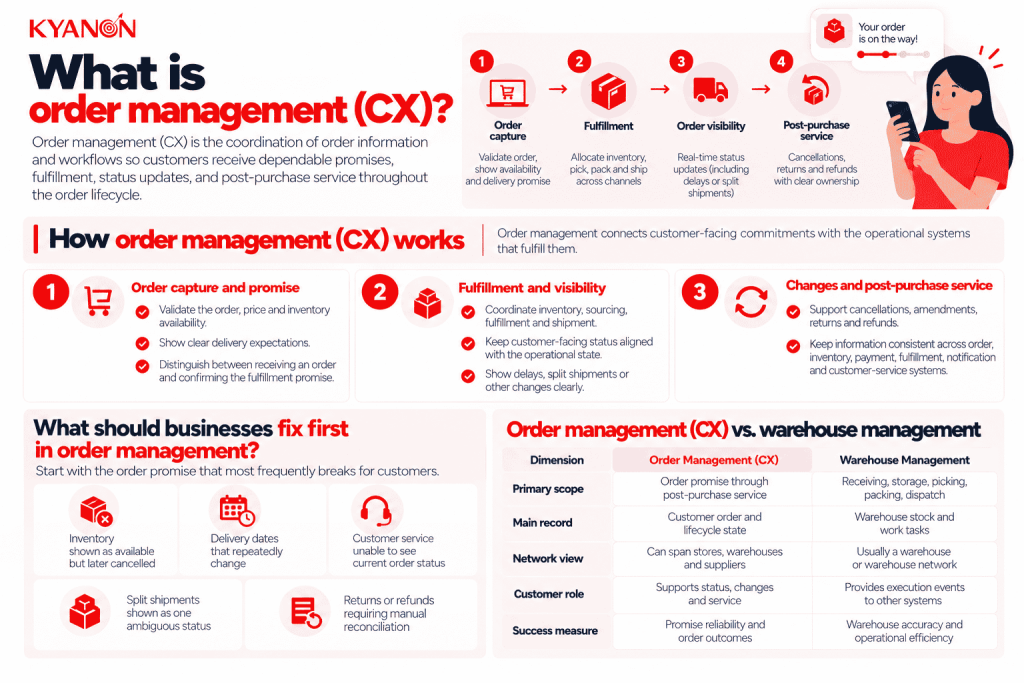
How order management (CX) works
Order management connects customer-facing commitments with the operational systems responsible for fulfilling them.
Order capture and promise
Validate the order and present appropriate availability, price, and delivery expectations.
Where further checks are required, distinguish between receiving an order and confirming that the fulfillment promise can be met.
Fulfillment and visibility
Coordinate inventory allocation, sourcing, fulfillment, shipment, and exceptions across relevant systems.
Customer-facing order visibility should reflect the authoritative operational state, including delays, split shipments, or other changes.
Changes and post-purchase service
Support permitted cancellations, amendments, returns, and refunds with clear ownership.
Changes should remain consistent across order, inventory, payment, fulfillment, notification, and customer-service systems.

What should businesses fix first in order management?
Start with the order promise that most frequently breaks for customers.
Common signals include:
- Inventory shown as available but later cancelled
- Delivery dates that repeatedly change
- Customer service unable to see current order status
- Split shipments shown as one ambiguous status
- Returns or refunds requiring manual reconciliation
Identify which system owns the affected state and where information becomes delayed or inconsistent before deciding to replace the OMS.
The first investment may be better order-state integration or exception handling rather than a new platform.
Order management (CX) vs. warehouse management
Order management coordinates the customer’s order across its lifecycle; warehouse management controls inventory handling and execution within warehouse operations.
| Dimension | Order Management (CX) | Warehouse Management |
Primary scope | Order promise through post-purchase service | Receiving, storage, picking, packing, dispatch |
| Main record | Customer order and lifecycle state | Warehouse stock and work tasks |
Network view | Can span stores, warehouses, and suppliers | Usually a warehouse or warehouse network |
| Customer role | Supports status, changes, and service | Provides execution events to other systems |
Success measure | Promise reliability and order outcomes | Warehouse accuracy and operational efficiency |
When to consider order management (CX)
Consider improving order management when:
- Customer-facing order information conflicts with operational status
- Split fulfillment, cancellations, or returns require manual reconciliation
- New channels create inconsistent order states
- Service teams spend significant effort investigating order exceptions
- Increasing order volume creates more coordination work
It may not be the right priority if:
A large OMS replacement may be unnecessary when targeted integration or workflow improvements can resolve the actual problem. Assess order complexity, growth, and existing system limitations before replatforming.
Why order management matters for customer experience
Order management is a CX capability because an order turns a commercial promise into an operational obligation.
Customers experience failures when inventory, fulfillment, delivery, service, and refund systems disagree about what is happening.
For example, a split order should show the status and delivery expectation for each shipment. If one item is cancelled, the refund, inventory, notification, and customer-service view should reflect the same change. The goal is not simply more order visibility. It is a reliable order state across the customer journey.
Case study: How did Kyanon Digital unify order management for a large retail group?
Explore Kyanon Digital’s integrated commerce case study for Thailand’s largest retail group.
Kyanon Digital helped a large Thailand retail group modernize the commerce infrastructure supporting high-volume omnichannel operations.
- Challenges: Legacy systems, disconnected channels, and complex multi-source fulfillment created operational silos as digital demand increased.
- Solutions: KD implemented a microservices-based architecture with a core engine coordinating inventory, pricing, promotions, and order routing across owned and marketplace channels.
- Results & impacts: The platform supports 26,000+ SKUs across six digital channels, real-time inventory visibility across nine stores, and 8,000+ orders per day.
The case demonstrates how reliable order experiences depend on coordinated inventory, order routing, fulfillment, and channel operations.
Common misconceptions
“Order management starts only after checkout.”
Reality: Inventory availability and delivery promises can influence the buying decision before an order is placed. Their reliability depends on the underlying operational data.
“The warehouse system covers the whole order journey.”
Reality: Warehouse execution is one part of the lifecycle. Payment, sourcing, customer changes, cross-location fulfillment, returns, and service may require broader order coordination.
“More tracking events mean better order visibility.”
Reality: More events do not help if they are delayed, contradictory, or unclear. Useful visibility depends on reliable order state and customer-relevant expectations.
How Kyanon Digital applies order management (CX)
Kyanon Digital implements order-management capabilities as part of connected commerce and omnichannel platforms, integrating order capture with inventory, fulfillment, delivery, and customer-facing experiences.
The work can include order-state integration, fulfillment routing, inventory synchronization, exception workflows, and connections with commerce, ERP, warehouse, marketplace, and service systems.
The objective is to keep the customer promise aligned with operational reality throughout the order lifecycle.
Explore Kyanon Digital’s omnichannel ecommerce services.

 Create project brief with AI