
What is Purchase Experience?
The purchase experience encompasses the complete digital customer journey from initial product discovery and transactional evaluation through checkout execution, payment verification, and transparent post-purchase tracking.

How Purchase Experience Works
Modern purchase experiences use modular digital commerce architectures to connect product discovery, checkout, order management, and fulfillment into one seamless customer journey.
Instead of treating checkout as a standalone step, businesses can connect each stage through flexible commerce services. This helps reduce customer effort while supporting multiple channels, payment methods, and fulfillment models.

Conversational Discovery and Intent Matching
Purchase journeys increasingly begin outside traditional product catalogs. AI answer engines, shoppable media, and personalization services can interpret customer intent and surface relevant products directly within the interaction.
Key capabilities include:
- Natural-language product discovery
- Contextual recommendations
- Personalized product selection
- Commerce-enabled media and content
AI answer engines help customers find products using natural-language queries, while personalization services use customer context and behavior to make recommendations more relevant.
From a CX perspective, this reduces the effort required to move from “I need something” to “this is the right product for me.”
Frictionless Transaction and Checkout Orchestration
Once a customer selects a product, API-driven commerce services coordinate the transactional workflow behind the checkout experience.
Payment processing, tax calculation, shipping, promotions, and order validation can operate as decoupled services. This allows businesses to change or extend individual commerce capabilities without rebuilding the entire customer-facing experience.
Capability | Purpose |
| Multiple payment methods | Support cards, digital wallets, and local payment options |
Guest checkout | Reduce friction caused by account creation or login |
| Dynamic tax and shipping | Calculate costs based on customer and order context |
Headless checkout | Deliver consistent checkout experiences across web, mobile, and other channels |
Headless checkout separates the customer-facing interface from backend commerce systems. This gives businesses more flexibility to design and optimize the checkout experience across different touchpoints.
The CX outcome is a checkout journey with fewer unnecessary steps and more flexibility to adapt to customer and channel requirements.
Post-Purchase Fulfillment and Visibility
The purchase experience does not end when payment is authorized. Distributed Order Management Systems (DOMS) and fulfillment services coordinate what happens after the transaction.
These systems can manage:
- Inventory reservation and allocation
- Order processing
- Fulfillment coordination
- Shipment tracking
- Customer notifications
Real-time APIs connect these processes so customers and operational teams can see how an order is progressing:
Order Confirmed → Inventory Allocated → Fulfillment Initiated → Shipment Tracked → Delivery Completed
From a CX perspective, real-time visibility reduces uncertainty after purchase. Customers know what is happening with their order, while businesses gain better visibility into fulfillment performance and potential issues.
The result is a purchase journey that connects customer intent, transaction, and fulfillment through modular commerce services, creating a more flexible and consistent experience across the entire customer journey.

Comparative Analysis: Purchase Experience vs. Traditional Storefront Browsing
| Dimension | Traditional Storefront Browsing | Modern Purchase Experience | Business Impact |
| Primary Entry Point | Hard-coded website homepages and category trees | Shoppable media, social feeds, and AI answer engines | Captures high-intent buyers immediately at the point of inspiration |
| Discovery Model | Manual search filtering and catalog browsing | Contextual intent matching and dynamic personalization | Accelerates time-to-conversion and reduces bounce rates |
| Checkout Architecture | Monolithic multi-step web forms | API-first composable checkout and one-click wallets | Drastically decreases shopping cart abandonment |
| System Engagement | Static self-directed user interactions | Agentic-ready workflows and automated negotiation APIs | Enables seamless automated purchases by AI agents |
| Cost Efficiency | High user acquisition funnel drop-offs | High conversion efficiency across distributed channels | Lowers acquisition costs (CAC) while scaling total volume |
Why Purchase Experience Matters
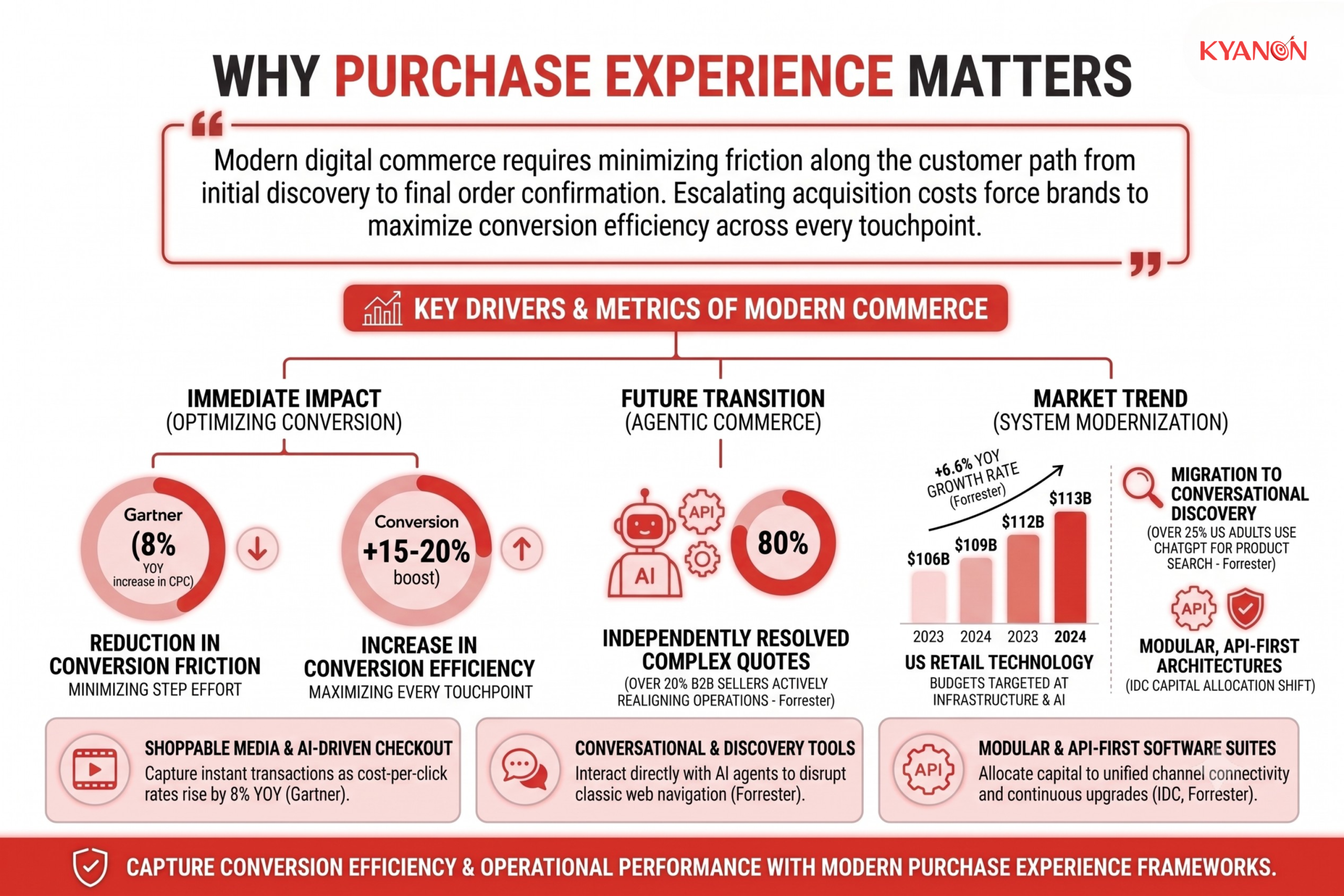
Scalable digital commerce requires minimizing friction along the customer path from initial discovery to final order confirmation. Escalating acquisition costs force brands to maximize conversion efficiency across every touchpoint. According to Gartner, digital commerce leaders face intense bottom-line pressure as advertising cost-per-click rates maintain an 8% year-over-year increase, driving adopting brands toward shoppable media and AI-driven checkout architectures to capture instant transactions.
As consumer behavior transitions away from traditional storefronts, initial touchpoints are migrating toward conversational platforms and autonomous tools. Forrester reports that over 25% of US online adults actively used ChatGPT to discover and search for products in a single month, demonstrating how interactive engines disrupt classic web navigation. This shifts the purchase journey from self-directed site browsing toward automated discovery environments where software interfaces evaluate product specifications and options directly.
This architectural shift expands past basic search into fully automated procurement workflows where platforms interact directly with intelligent software agents. According to Forrester, over 20% of B2B sellers are actively realigning backend operations to support automated, agent-led quote negotiations and agentic commerce workflows. Concurrently, unified transaction standards across global platforms permit users to execute complete purchases across external generative AI platforms or native environments.
To support these multi-channel transaction pathways without disrupting operational performance, enterprises are modernizing their underlying systems. IDC notes that capital allocation is shifting toward modular, API-first software suites that enable continuous upgrades to storefronts and order management logic. Capital investment data from Forrester reveals that US retail technology budgets expanded to $113 billion, representing a 6.6% year-over-year growth rate explicitly targeted at infrastructure modernization, AI tools, and unified channel connectivity.
Common Misconceptions
Customers buy products
Customers buy confidence and clarity. Buyers care about feeling secure that a company understands their needs and provides an intuitive, trustworthy checkout process.
Purchase experience is just customer service
It encompasses the entire journey. It covers everything from initial brand discovery and web layout to transaction security and transparent post-purchase tracking.
More technology always improves the experience
Only helpful technology improves the experience. Overloading a checkout process with unnecessary automated features, complex steps, or chatbots actually adds user friction.
Online purchases are purely driven by lower prices
Purchases are heavily driven by convenience. Over half of consumers emphasize that convenience and effortless navigation heavily impact their ultimate brand selection over minor cost differences.
How Kyanon Digital Applies Purchase Experience

Kyanon Digital optimizes purchase experiences for enterprise clients by engineering high-performance storefronts, streamlined checkout architectures, and data-driven conversion strategies. Our team integrates modular digital commerce engines, conducts continuous A/B testing, and optimizes user journeys to eliminate transactional friction and maximize lifetime value.
Explore our services:

 Create project brief with AI