
What is Unified Commerce?
Unified commerce is a retail architecture that consolidates all customer-facing channels, transaction interfaces, and back-office operations into a single, centralized software platform that maintains one real-time source of truth for inventory, customer, product, pricing, and order data. Rather than synchronizing information between multiple disconnected systems, unified commerce enables every channel to operate directly on the same underlying data model, ensuring that all business functions reference identical, continuously updated information.
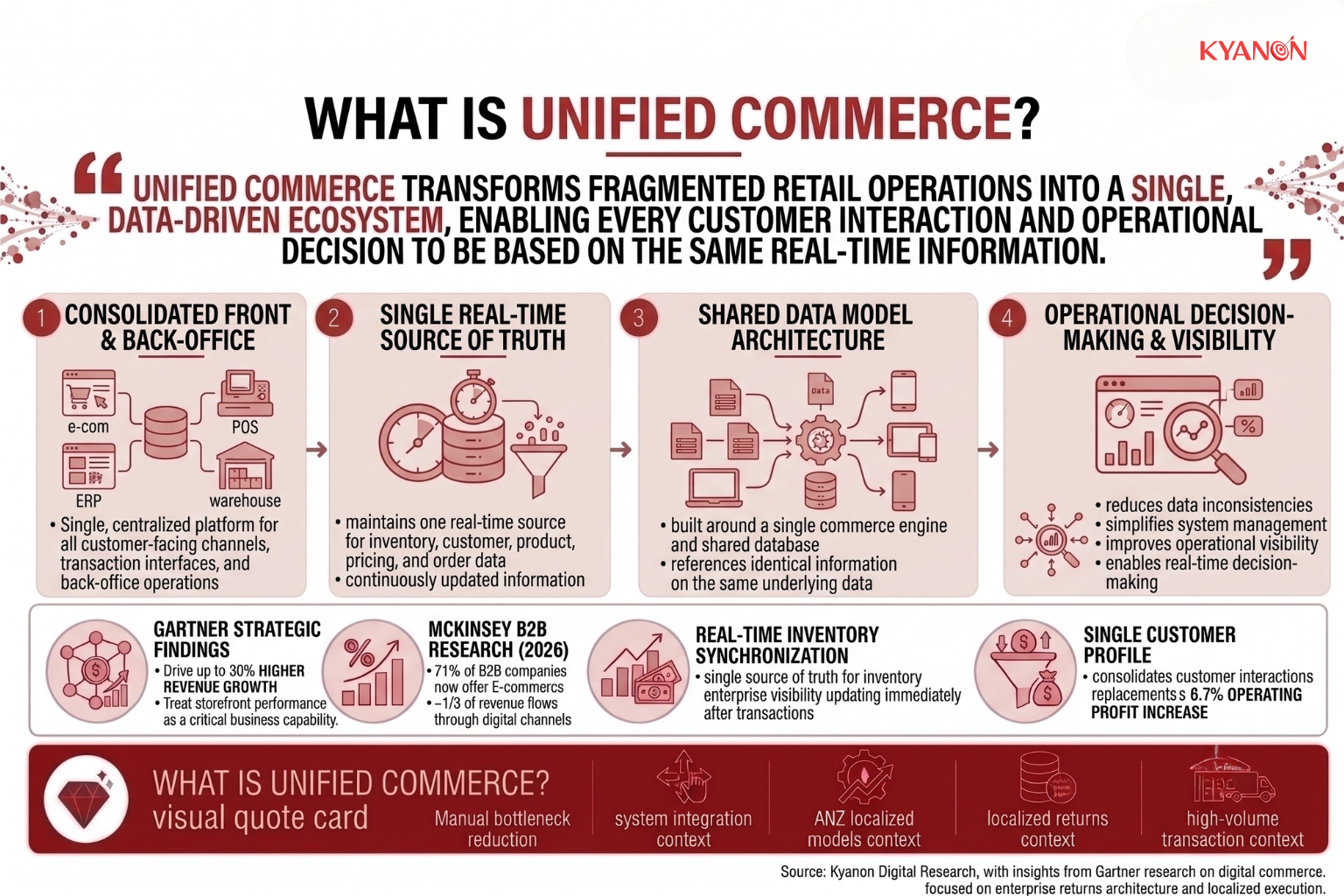
Unlike traditional omnichannel environments, which often integrate multiple independent systems through APIs and middleware, unified commerce is built around a single commerce engine and shared database. This architectural approach reduces data inconsistencies, simplifies system management, improves operational visibility, and enables real-time decision-making across the entire retail operation.
As retailers expand across multiple markets, sales channels, and fulfillment models, including click-and-collect, ship-from-store, endless aisle, and marketplace commerce, unified commerce has become the foundational architecture that supports consistent customer experiences while improving inventory accuracy, operational efficiency, and enterprise scalability.
How Unified Commerce Works
Unlike traditional retail environments that maintain separate databases for e-commerce, physical point-of-sale (POS) systems, and mobile applications, a unified commerce platform processes every transaction through a single backend engine and shared database. Every interaction, whether it originates from an online storefront, mobile app, smart kiosk, marketplace, or in-store checkout, reads from and writes to the same real-time data foundation.
Because all channels operate on the same transactional database, retailers eliminate the synchronization delays and data inconsistencies common in legacy omnichannel architectures. Inventory availability, customer history, and order status remain consistent across every touchpoint in real time.

Centralized Order Management System (OMS)
The Order Management System (OMS) serves as the operational brain of the unified commerce platform. Rather than allocating inventory separately for online and in-store sales, it treats enterprise-wide inventory as a single shared stock pool and intelligently orchestrates fulfillment across all locations.
Its capabilities include:
- Intelligent order routing to determine whether an order should ship from a warehouse, distribution center, or nearby retail store.
- Dynamic fulfillment optimization that reallocates orders between locations to reduce shipping costs and delivery times.
- Cross-channel returns that allow products purchased online to be returned or exchanged in physical stores without manual reconciliation.
Real-Time Inventory Synchronization
This module provides the single source of truth for inventory across the enterprise by updating stock levels immediately after every transaction, eliminating the need for hourly or overnight batch synchronization.
Key capabilities include:
- Immediate inventory updates, ensuring products sold in-store are instantly reflected as unavailable online when stock reaches zero.
- Overselling prevention, reducing the need for inventory buffers maintained to compensate for synchronization delays.
- Enterprise-wide inventory visibility, allowing stores, warehouses, customer service teams, and digital channels to reference the same live stock information.
Single Customer Profile Engine
The customer profile engine consolidates all customer interactions into a unified identity, replacing separate online and offline customer records with a single comprehensive profile.
This unified profile combines:
- Online browsing behavior and purchase history.
- Mobile app interactions and email engagement.
- In-store transactions and loyalty activity.
- Customer preferences, rewards, and service history.
As a result, loyalty points earned in-store become immediately available online, while customer service representatives and store associates gain access to the same up-to-date customer information, enabling more personalized service regardless of where the interaction takes place.

Unified Commerce vs Omnichannel Commerce
Omnichannel commerce links separate frontend systems together via custom integrations and middleware, while unified commerce manages all channels natively through a single platform.
Dimension | Omnichannel Commerce | Unified Commerce |
| Data Architecture | Disconnected databases linked via APIs | Single database for all operational channels |
Inventory Tracking | Batched syncs; high risk of inventory lag | Instant, real-time inventory updates |
| Customer Experience | Channel-specific logins and siloed histories | Single customer profile across all touchpoints |
System Maintenance | High; requires monitoring multiple custom integrations | Low; managed within a single, unified platform |
| Total Cost of Ownership (TCO) | Increases with each new channel integrated | Predictable and streamlined as channels scale |
When to Consider Unified Commerce
Shifting to a unified architecture is essential when operational silos begin to degrade the physical and digital customer experience.
Consider Unified Commerce if:
- Your customer service agents cannot view in-store purchase histories, or your storefront displays incorrect stock availability to online shoppers.
- You plan to roll out hybrid fulfillment options such as click-and-collect, endless aisle services, or cross-channel returns over the next 12 months.
- The maintenance cost of custom integrations, middleware, and API patches between your separate POS, e-commerce, and ERP platforms is driving up your overall IT budget.
It may not be the right priority if:
- Your brand operates strictly through a single digital storefront with no immediate plans to expand into physical retail, marketplaces, or multi-channel wholesale.
Why Unified Commerce Matters for Retail Enterprises
Unified commerce transforms fragmented retail operations into a single, data-driven ecosystem, enabling every customer interaction and operational decision to be based on the same real-time information. By eliminating data silos across stores, e-commerce platforms, warehouses, and customer service channels, retailers gain end-to-end visibility over inventory, orders, and customer activity while significantly reducing operational friction.
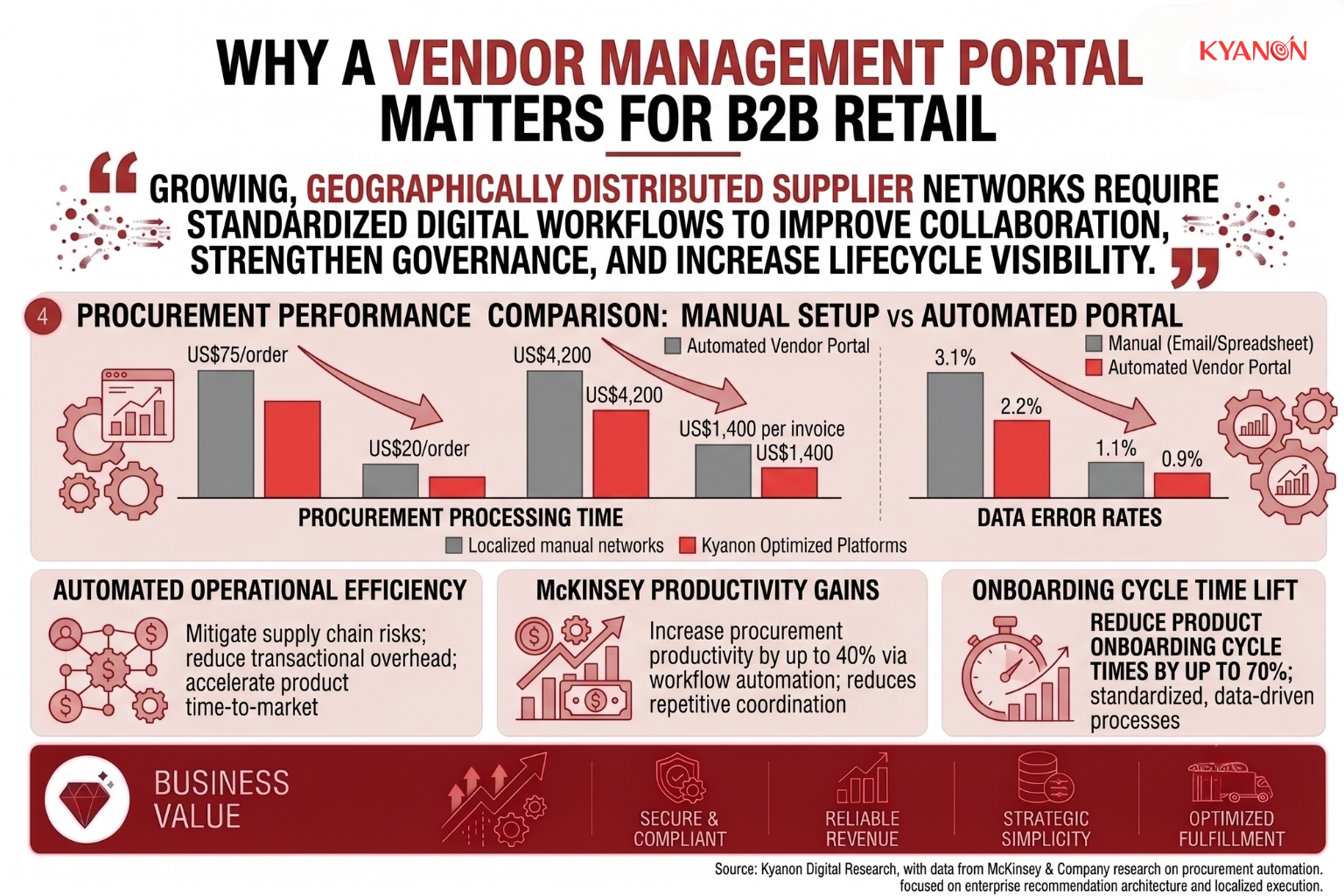
This unified data foundation delivers measurable business value. According to McKinsey, retailers can reduce technology operating costs by up to 20%, accelerate time-to-market by as much as three times, and increase personalization-driven revenue by up to 40%. It also prepares the technology stack for the next generation of AI-powered commerce, with agentic AI expected to facilitate between $3 trillion and $5 trillion in commerce by 2030.
Beyond efficiency, unified commerce strengthens every aspect of retail operations. It enables more accurate inventory allocation, faster fulfillment, consistent customer experiences across all channels, and more reliable demand forecasting. As retailers expand across physical locations, digital channels, and international markets, a single source of truth becomes essential for improving profitability, enabling AI-driven decision-making, and delivering seamless omnichannel experiences.
Common Misconceptions
Deploying a unified system requires a cultural shift in how operational departments collaborate, rather than just an IT upgrade.
Unified commerce is just omnichannel with a better frontend
Omnichannel relies on stitching together separate backends (like a POS and an e-commerce platform) using APIs and batch file transfers, which often causes data lag. Unified commerce completely removes these separate databases, running all operations out of one shared backend engine from day one.
Implementing a unified platform will instantly automate our workflows out-of-the-box
Software is only an enabler. If your internal operational incentives, warehouse workflows, and store associate training remain siloed by channel, new technology will not resolve operational friction.
How Kyanon Digital Applies Unified Commerce
Kyanon Digital builds unified commerce architectures for enterprise retail clients seeking to eliminate channel silos and reduce their platform maintenance costs. Leveraging our deep implementation expertise across Southeast Asia, we replace legacy point-to-point connections with unified data pipelines.
By integrating centralized inventory control, unified order management, and cross-channel loyalty engines, we help enterprises across Vietnam, Singapore, Thailand, and the ANZ region deliver consistent customer experiences while optimizing their technology budgets.
Explore our Ecommerce services:

 Create project brief with AI