
What is Overfitting Prevention?
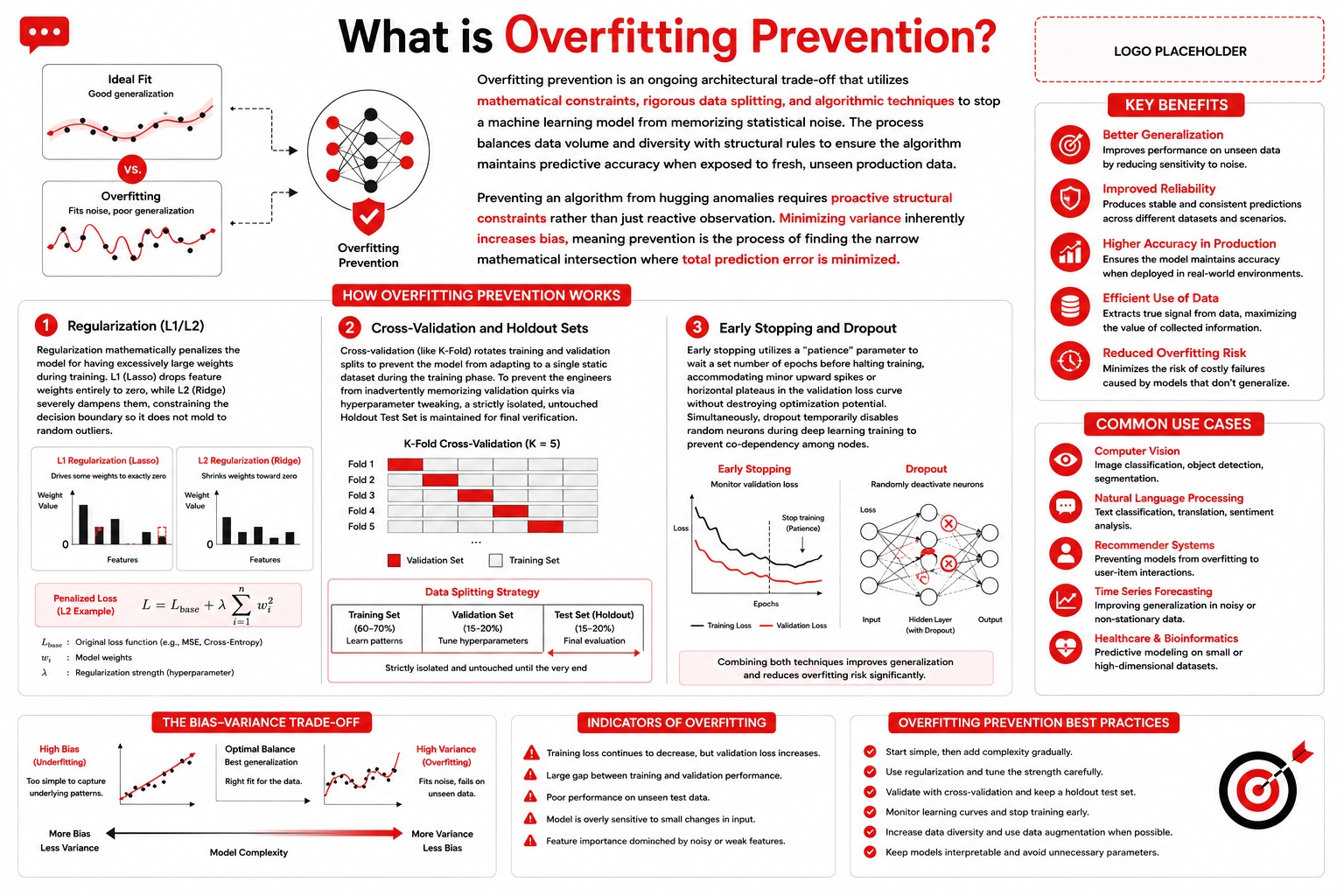
Overfitting prevention is an ongoing architectural trade-off that utilizes mathematical constraints, rigorous data splitting, and algorithmic techniques to stop a machine learning model from memorizing statistical noise. The process balances data volume and diversity with structural rules to ensure the algorithm maintains predictive accuracy when exposed to fresh, unseen production data.
How Overfitting Prevention Works
Preventing an algorithm from hugging anomalies requires proactive structural constraints rather than just reactive observation. Minimizing variance inherently increases bias, meaning prevention is the process of finding the narrow mathematical intersection where total prediction error is minimized.
Regularization (L1/L2)
Regularization mathematically penalizes the model for having excessively large weights during training. L1 (Lasso) drops feature weights entirely to zero, while L2 (Ridge) severely dampens them, constraining the decision boundary so it does not mold to random outliers.
Cross-Validation and Holdout Sets
Cross-validation (like K-Fold) rotates training and validation splits to prevent the model from adapting to a single static dataset during the training phase. To prevent the engineers from inadvertently memorizing validation quirks via hyperparameter tweaking, a strictly isolated, untouched Holdout Test Set is maintained for final verification.
Early Stopping and Dropout
Early stopping utilizes a “patience” parameter to wait a set number of epochs before halting training, accommodating minor upward spikes or horizontal plateaus in the validation loss curve without destroying optimization potential. Simultaneously, dropout temporarily disables random neurons during deep learning training to prevent co-dependency among nodes.

Overfitting Prevention vs Underfitting Prevention
Both methodologies manage the Bias-Variance Tradeoff but apply opposite engineering tactics to push the model toward optimal generalization.
Dimension | Overfitting Prevention | Underfitting Prevention |
| Primary Goal | Minimize high variance | Minimize high bias |
Model Complexity | Constrain or reduce parameters | Increase parameters or layers |
| Feature Engineering | Feature selection/removal | Feature expansion/creation |
Regularization Level | High (L1/L2 penalties active) | Low or disabled |
| Training Duration | Shorter (Early stopping applied) | Longer (Extended epoch limits) |
When to Consider Overfitting Prevention
Consider Overfitting Prevention if:
- Your model achieves near-perfect accuracy on historical training logs but fails to predict outcomes accurately on live production data.
- You are training a highly parameterized deep neural network on a dataset with limited samples.
- The gap between your training error metric and validation error metric is actively widening during the training loop.
It may not be the right priority if:
- Your algorithm yields high error rates on both the training set and the validation set, indicating that it lacks the necessary mathematical complexity to learn the baseline patterns.
Why Overfitting Prevention Matters for Enterprise AI
Overfitting prevention matters for enterprise AI because it is the difference between a model that works in a controlled lab environment and one that survives in production. In an enterprise setting, an unprevented overfit model acts as a financial and operational liability. It gives leadership false confidence by showing flawless accuracy during internal testing, only to suffer a catastrophic drop in performance the moment it encounters live customer data.
Common Misconceptions
Technical leaders often rely on oversimplified tactics to correct model performance, which can actively degrade the algorithm’s capability.
“More data” always automatically fixes overfitting.
Reality: Flooding a model with low-quality, biased, or redundant data will not prevent overfitting. If you add 10,000 new rows of training data, but those rows contain high amounts of statistical noise or mirror the exact same bias as your current pool, an unconstrained model will simply memorize the new noise too.
Strong regularization (L1/L2) is always the best primary defense
Reality: Cranked-up regularization acts as a mathematical sledgehammer that can flatten valid complex features. If applied too aggressively to non-linear, high-dimensional datasets, regularization prevents the model from discovering genuine, complex relationships, killing its underlying business utility.
Early stopping should be triggered the instant validation loss ticks upward
Reality: Real-world validation loss curves are volatile and don’t cleanly mirror textbook charts. During deep learning training, validation loss frequently experiences minor upward spikes or horizontal plateaus before plunging down to a much deeper, better global minimum. Triggering early stopping prematurely based on a single-epoch tick destroys optimization potential.
How Kyanon Digital Applies Overfitting Prevention
Kyanon Digital applies regularization, dropout, cross-validation, and early stopping in enterprise model development to ensure AI systems perform reliably on real-world inputs beyond training data. Operating across Vietnam, Singapore, Thailand, and ANZ, our data engineering teams strictly manage the bias-variance tradeoff to deploy algorithms that maintain high predictive accuracy in volatile production environments. This disciplined implementation practice directly supports measurable outcomes, protecting client conversion rates and lowering TCO by avoiding constant model retraining cycles.
Explore our AI services:

 Create project brief with AI