
What is a Payment Service Provider (PSP)?
A Payment Service Provider (PSP) is a third-party company that enables businesses to accept electronic payment methods such as credit cards, debit cards, and digital wallets. A PSP can manage much of the payment transaction lifecycle, from collecting payment information and processing authorization to facilitating settlement into the merchant’s account. (PayPal)
For businesses, a PSP provides a centralized connection between the commerce platform and the payment infrastructure required to accept, process, and manage customer payments.
In simple terms: a PSP reduces the need for a business to integrate separately with payment gateways, processors, acquiring services, and individual payment methods.
Popular examples of Payment Service Providers
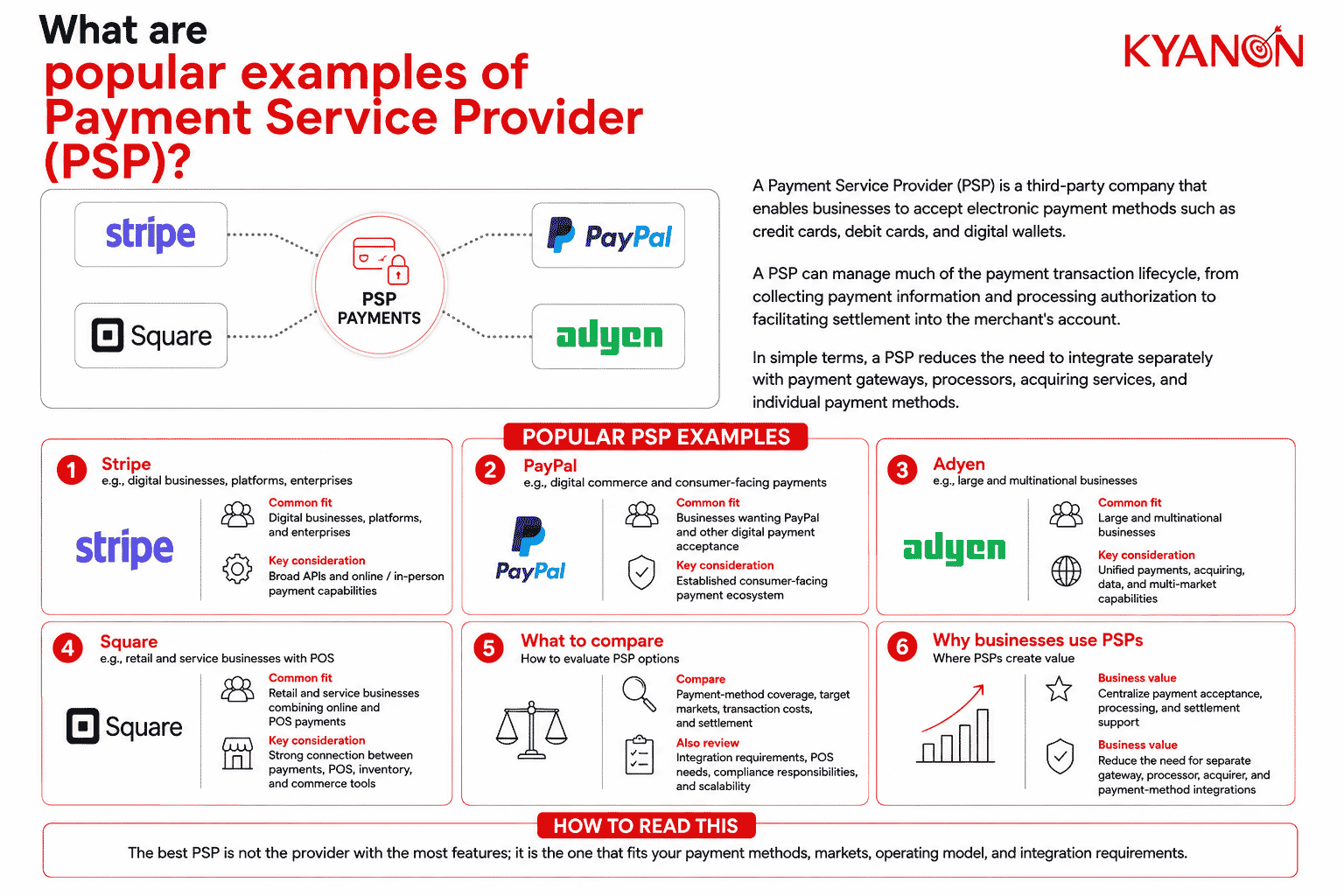
Popular PSPs include Stripe, PayPal, Adyen, and Square, but each provider is positioned for different payment requirements, markets, and commerce models.
| PSP | Common fit | Key consideration |
Stripe | Digital businesses, platforms, and enterprises | Broad APIs and online/in-person payment capabilities |
| PayPal | Businesses wanting PayPal and other digital payment acceptance | Established consumer-facing payment ecosystem |
Adyen | Large and multinational businesses | Unified payments, acquiring, data, and multi-market capabilities |
| Square | Retail and service businesses combining online and POS payments | Strong connection between payments, POS, inventory, and commerce tools |
- Stripe supports online and in-person payments and provides payment infrastructure for businesses ranging from startups to global enterprises.
- PayPal provides payment services that allow businesses to accept payment methods including cards and digital wallets while managing much of the transaction process.
- Adyen is positioned around enterprise payments, combining payments, data, acquiring capabilities, and financial services on a single platform for businesses operating across markets and channels.
- Square combines online payment acceptance with point-of-sale capabilities and can connect payments with sales, inventory, and customer data, making it particularly relevant to businesses operating both physical and digital channels.
- The best PSP is therefore not simply the provider with the most features; businesses should compare payment-method coverage, target markets, transaction costs, settlement, integration requirements, POS needs, compliance responsibilities, and scalability.

How a Payment Service Provider (PSP) works
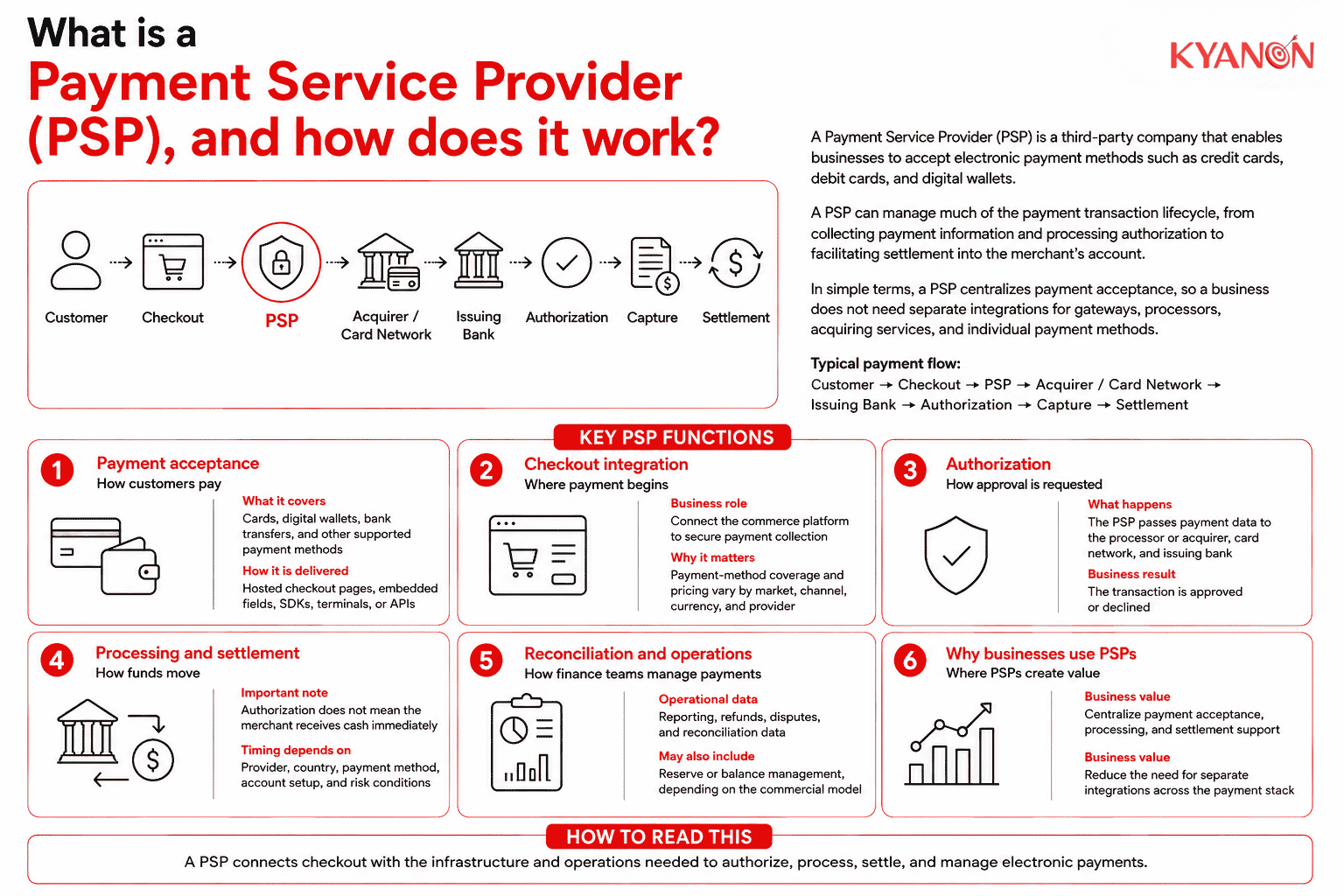
A PSP connects the customer checkout with the financial infrastructure required to authorize, process, and settle a payment. Depending on the provider, one platform may combine payment collection, processing, acquiring connectivity, fraud controls, payment methods, reporting, and settlement.
A typical payment flow is:
Customer → Checkout → PSP → Acquirer / Card Network → Issuing Bank → Authorization → Capture → Settlement
The exact flow varies by payment method and PSP architecture, but the business objective is the same: provide a controlled way to move a customer payment from checkout to successful settlement.
Payment acceptance and checkout
The PSP provides the interface or integration through which a commerce platform accepts cards, digital wallets, bank transfers, or other supported payment methods. Depending on the provider, payment details may be collected through hosted checkout pages, embedded fields, SDKs, terminals, or APIs.
The payment-method portfolio matters because availability and pricing can differ materially across markets, channels, currencies, and providers.
Authorization and processing
The PSP passes payment instructions into the processing and acquiring infrastructure required for authorization. For card transactions, information moves between the merchant, processor or acquirer, card network, and issuing bank before an approval or decline is returned.
A PSP may perform several of these roles itself or connect the merchant to other regulated participants.
Settlement, reconciliation and payment operations
An authorized transaction does not mean the merchant receives cash immediately. Captured transactions still move through settlement and payout processes, with timing determined by the provider, country, payment method, account configuration, and risk conditions.
PSP platforms can also provide transaction reporting, refunds, disputes, reconciliation data, and reserve or balance management depending on the commercial model.
Payment Service Provider (PSP) vs. Merchant Account
A PSP is a payment-service relationship or platform. At the same time, a merchant account is a specialized account used to receive and settle electronic-payment funds before they reach the merchant’s normal business bank account.
The two concepts are related but not interchangeable. Some PSPs give merchants access to payment acceptance without requiring them to establish a separate dedicated merchant account, while other payment models retain a direct merchant-account relationship.
| Dimension | Payment Service Provider (PSP) | Dedicated Merchant Account |
Primary role | Provides payment acceptance and related services | Provides an account for processing and settling merchant transactions |
| Scope | May include gateway, processing, acquiring, payment methods, risk and reporting | Primarily the merchant’s acquiring and settlement relationship |
Account structure | May use a payment-facilitator/shared-account model or another acquiring structure | Assigned specifically to an individual merchant |
| Onboarding | Can simplify onboarding when the provider manages merchant enrollment | Usually involves direct underwriting by the acquiring provider |
Integration | Often provides one integration for multiple payment capabilities | May require separate gateway, processor or technical integrations |
| Pricing | Can use blended, fixed, custom or Interchange++ models | Commercial terms are negotiated with the acquiring/processing providers |
Operational control | More payment functions can be abstracted behind the provider | Greater direct ownership of acquiring relationships and configuration |
| Best fit | Businesses prioritizing faster payment integration, multiple methods or multiple markets | Businesses requiring direct acquiring relationships or specific commercial control |
The shared-account model applies specifically to payment-facilitator or aggregation structures; it should not be treated as a defining feature of every company described as a PSP. Visa describes payment facilitators as allowing businesses to operate under a shared acquiring account, while dedicated merchant accounts are established for individual merchants.
When to consider a Payment Service Provider (PSP)
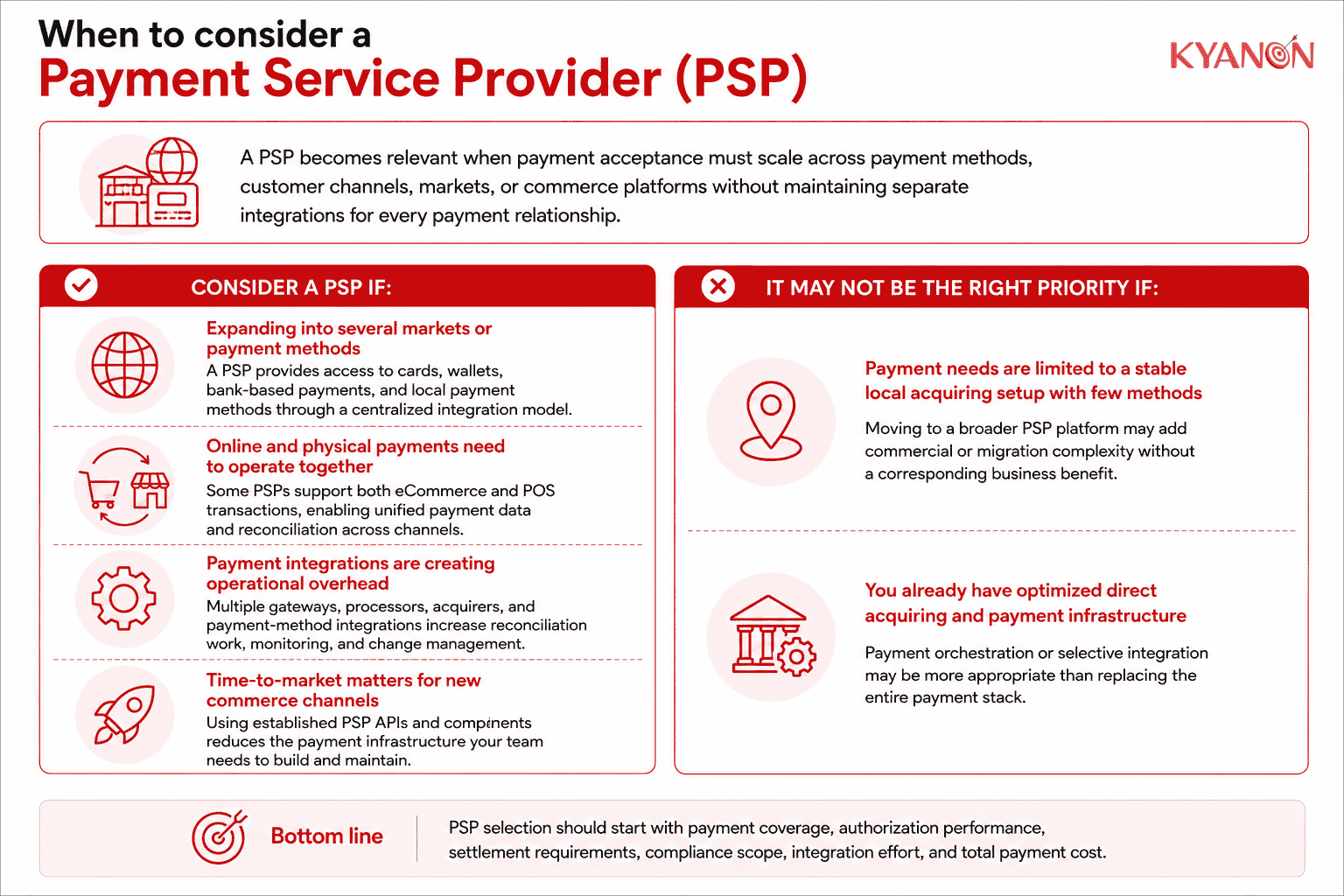
A PSP becomes relevant when payment acceptance must scale across payment methods, customer channels, markets, or commerce platforms without maintaining separate integrations for every payment relationship.
Consider a Payment Service Provider (PSP) if:
- You are expanding into several markets or payment methods. A PSP can provide access to cards, wallets, bank-based payments, and local payment methods through a more centralized integration model.
- Online and physical payments need to operate together. Some PSPs support both eCommerce and point-of-sale transactions, allowing payment data and reconciliation processes to be managed across channels.
- Payment integrations are creating operational overhead. Separate gateways, processors, acquiring relationships, and payment-method integrations can increase reconciliation, monitoring, and change-management requirements.
- Time-to-market matters when adding a new commerce channel. Using established PSP APIs and payment components can reduce the amount of payment infrastructure that must be built and maintained internally.
It may not be the right priority if:
- Your payment requirements are limited to a stable local acquiring setup with few payment methods. Moving to a broader PSP platform may add commercial or migration complexity without a corresponding business benefit.
- Your organization already has optimized direct acquiring relationships and payment infrastructure. In that case, payment orchestration or selective integration may be more appropriate than replacing the complete payment stack.
PSP selection should therefore start with payment coverage, authorization performance, settlement requirements, compliance scope, integration effort, and total payment cost rather than provider brand alone.
Why a Payment Service Provider (PSP) matters for eCommerce
A PSP is commercially significant because payment-method coverage, authorization, settlement, fees, fraud controls, and channel integration directly influence checkout performance and payment operating costs.
The payment mix is becoming more diverse across markets and channels. The Bank for International Settlements reported in 2026 that retail payments have digitalized rapidly across both advanced and emerging economies, while the dominant payment rails differ by market: cards remain particularly important in advanced economies, whereas account-to-account payments play a larger role in many emerging markets.
Consumer behavior shows the same shift at the market level. The Reserve Bank of Australia’s 2025 Consumer Payments Survey, published in 2026, found that 43% of consumers used a mobile device for a contactless payment during the survey week, up from 35% in 2022.
In Southeast Asia, Ipsos’ 2026 Indonesia research found that 86% of surveyed digital-wallet users used wallets for online shopping, while wallet use also extended into food and beverage, bills, transfers, and offline retail.
For eCommerce leaders, the implication is not to add every available payment method. Payment architecture should prioritize the methods customers use in each market, alongside transaction economics, settlement requirements, integration complexity, and operational cost.
Common misconceptions about Payment Service Provider (PSP)
A PSP can reduce payment-infrastructure complexity, but it does not automatically eliminate merchant-account considerations, PCI DSS responsibilities, settlement delays, reserves, or differences in transaction pricing.
“Setting up a PSP is the same as opening a merchant account.”
Reality: A PSP and a merchant account serve different roles. A merchant account is an account used for accepting and settling electronic payments, whereas a PSP provides payment services and may give the business access to merchant-account functionality as part of a broader platform.
Some PSPs operate using payment-facilitator or aggregation models in which merchants share an acquiring relationship, but this structure is not universal across all PSPs.
For a CTO or Head of eCommerce, the procurement question should therefore be who owns the acquiring relationship, merchant identification, underwriting, settlement, and payment data flow, not simply whether the vendor calls itself a PSP.
“PSPs all charge roughly 2.9% + $0.30.”
Reality: PSP pricing is not standardized. Pricing can vary by provider, payment method, card type, transaction channel, merchant location, customer location, transaction volume, and commercial agreement.
Providers can also use different pricing structures. Adyen, for example, publishes both payment-method-specific pricing and Interchange++ pricing, under which interchange costs are passed through separately rather than hidden inside one universal flat rate.
For high-volume organizations, transaction fee optimization should evaluate total payment cost by market, method and transaction profile rather than comparing headline percentages alone.
“Once we use a PSP, PCI DSS is completely the provider’s problem.”
Reality: Outsourcing payment-data functions can reduce a merchant’s PCI DSS scope, but it does not automatically remove the merchant’s validation and security responsibilities. PCI SSC states that Self-Assessment Questionnaires apply according to specific eligibility criteria, and SAQ A is intended only for eligible environments.
PCI DSS v4.0.1 also introduced additional eCommerce eligibility requirements effective 1 April 2025, including confirmation that the merchant’s webpage is not susceptible to payment-page script attacks.
For IT leadership, the correct question is therefore which PCI DSS responsibilities remain with our environment after the PSP integration, not whether PCI DSS disappears.
“Once the payment succeeds, the money reaches our bank account immediately.”
Reality: Authorization and payout are separate stages. Payout availability depends on the provider, payment method, country, industry, risk profile, and configured payout schedule.
Stripe, for example, states that an initial payout is typically scheduled 7–14 days after the first successful payment, after which payouts follow the account’s configured schedule. Instant-payout products may operate differently.
Reserves are also not automatically imposed on every merchant. Braintree states that a reserve may be established depending on the risk associated with the merchant’s business model and can involve withholding part of transaction revenue.
For finance and technology leaders, settlement timing, reserve policy and cash-flow impact should be reviewed during PSP selection rather than after launch.
“PSPs are only relevant to eCommerce.”
Reality: Some payment platforms support both online and in-person payment acceptance, including POS and mobile-payment environments; other providers specialize in only one channel.
Adyen’s Singapore research found that 35% of businesses still used separate payment platforms for online and in-store transactions, illustrating the payment fragmentation that omnichannel architectures may need to address.
A unified PSP architecture can therefore be relevant to retailers, hospitality groups, service businesses, and other organizations that need payment activity reconciled across digital and physical channels.
How Kyanon Digital applies Payment Service Providers
Kyanon Digital integrates payment capabilities into B2C and B2B commerce platforms, marketplaces, mobile commerce applications, omnichannel ecosystems, and custom commerce solutions. Its digital commerce architecture connects payments with checkout, refunds, POS, ERP, OMS, inventory, loyalty, analytics, and other enterprise systems rather than treating the PSP as an isolated checkout plugin.
For PSP integrations such as Stripe, Adyen, and PayPal, the implementation focus is on selecting the appropriate payment flow, connecting the provider with the commerce platform and surrounding systems, controlling payment and refund states, and ensuring that the architecture can support future channels or markets without unnecessarily increasing integration complexity.
The relevant business outcomes are checkout reliability, faster payment-method rollout, lower integration overhead, clearer reconciliation, and better control of total payment cost rather than the PSP integration itself.
→ Explore Kyanon Digital’s Digital Commerce services for commerce platform, checkout, payment, POS, and enterprise-system integration.

 Create project brief with AI