
What is PCI DSS Compliance?
PCI DSS (Payment Card Industry Data Security Standard) Compliance refers to meeting a globally recognized set of security requirements designed to protect cardholder data throughout the payment lifecycle. Any organization that accepts, processes, stores, or transmits payment card information, regardless of size or transaction volume, is expected to comply with PCI DSS.
Developed by the PCI Security Standards Council, which was founded by major payment brands including Visa Inc., Mastercard, American Express, Discover Financial Services, and JCB Co., Ltd., the standard establishes a baseline framework for safeguarding sensitive payment information and reducing the risk of data breaches, identity theft, and payment fraud.
Unlike a law or government regulation, PCI DSS is a contractual requirement enforced through payment card brands and acquiring banks. Organizations that fail to comply may face financial penalties, increased transaction fees, mandatory security audits, or even the loss of their ability to process card payments.
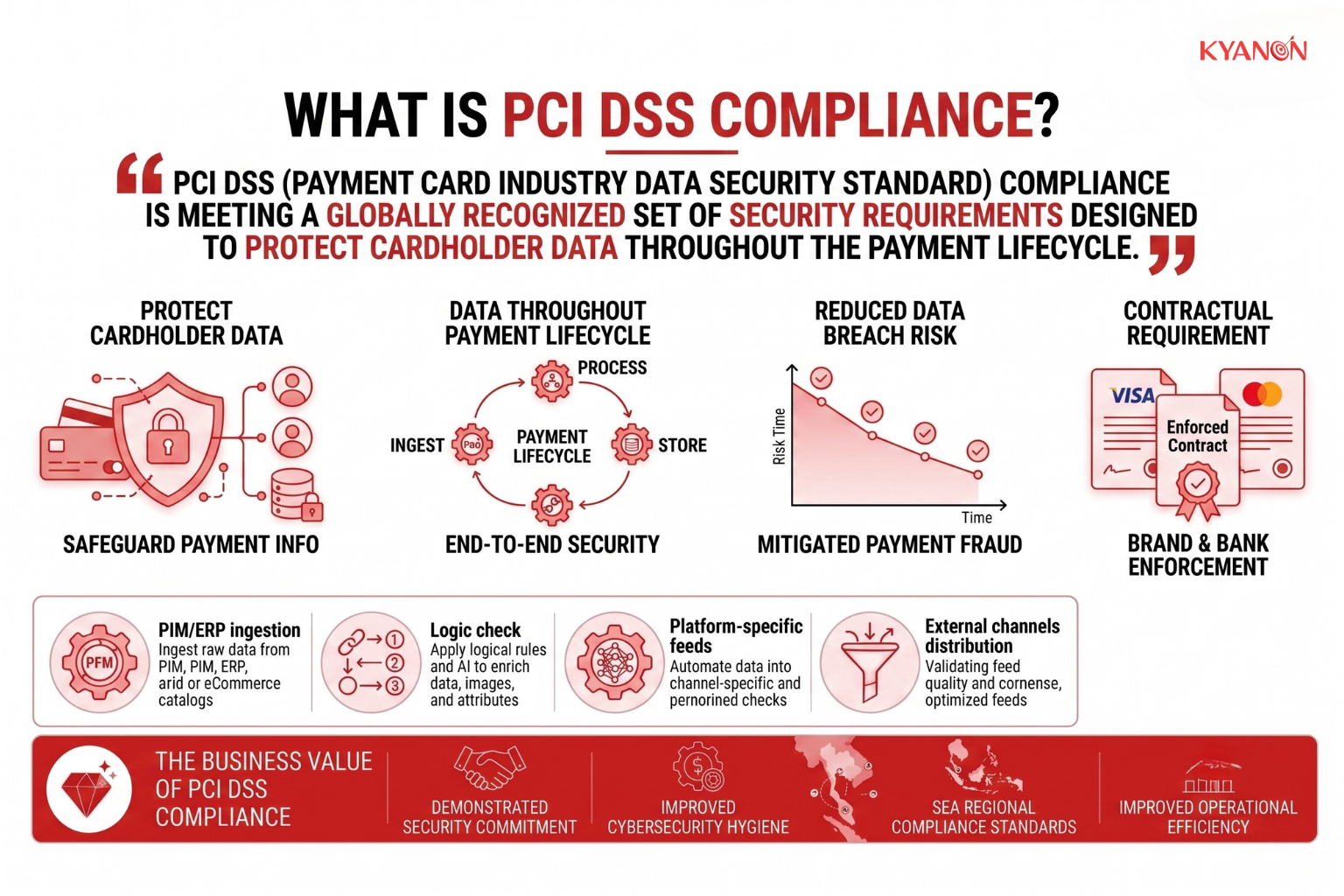
As payment systems become increasingly digital, cybercriminals continue to target businesses that handle payment card information. A single compromised payment environment can expose thousands of customer records, resulting in financial losses, legal liabilities, reputational damage, and operational disruption.
PCI DSS provides organizations with a standardized security framework that helps:
- Protect cardholder data from unauthorized access and theft.
- Reduce the likelihood of payment fraud and data breaches.
- Improve overall cybersecurity hygiene across payment environments.
- Demonstrate security commitment to customers, partners, and financial institutions.
- Meet contractual obligations required by card brands and payment processors.
How PCI DSS Compliance Works
PCI DSS compliance is not a one-time certification but a continuous security lifecycle. Under PCI DSS v4.0.1, organizations are expected to continuously assess their payment environment, immediately identify vulnerabilities, and report their security posture through regular testing and validation. This ongoing approach replaces point-in-time compliance with year-round technical and administrative controls.
The framework is built around 12 core security requirements organized into six control objectives, covering network security, data protection, access management, vulnerability management, monitoring, and security governance. Depending on annual transaction volume and payment environment, organizations validate compliance through Self-Assessment Questionnaires (SAQs), Approved Scanning Vendor (ASV) vulnerability scans, or formal assessments conducted by Qualified Security Assessors (QSAs).
Secure Network Configuration
Organizations must establish and maintain secure network boundaries that isolate the Cardholder Data Environment (CDE) from untrusted networks while minimizing potential attack surfaces. Core practices include:
- Deploying stateful firewalls at all CDE ingress and egress points.
- Segmenting the CDE using VLANs and access control lists (ACLs).
- Removing or changing all vendor-supplied default usernames, passwords, and unnecessary services before deployment.
- Preventing dual-homed systems that bridge secure payment environments with unsecured corporate or guest networks.
Data Encryption and Protection
PCI DSS requires cardholder data to remain protected throughout its entire lifecycle, whether stored or transmitted. Organizations typically achieve this through:
- Encrypting data in transit using modern protocols such as TLS 1.2 or TLS 1.3.
- Protecting stored Primary Account Numbers (PANs) through encryption, tokenization, truncation, or irreversible hashing.
- Implementing secure cryptographic key management with regular key rotation and dual-control procedures.
- Permanently deleting Sensitive Authentication Data (SAD), including CVV and PIN information, immediately after transaction authorization.
Access Control and Auditing
Only authorized personnel with a legitimate business need should have access to payment systems. PCI DSS emphasizes continuous monitoring to detect unauthorized activity and maintain accountability through:
- Enforcing the principle of least privilege.
- Assigning unique, individual user IDs for all system access.
- Continuously collecting and analyzing logs through Security Information and Event Management (SIEM) platforms.
- Protecting physical payment infrastructure with security controls such as badges, locks, biometric authentication, and video surveillance.
Together, these controls create a layered security framework that helps organizations protect payment data, reduce the risk of breaches, and maintain ongoing PCI DSS compliance rather than simply passing an annual assessment.

Self-Managed PCI DSS Compliance vs PSP-Managed Tokenization
Organizations can either build and maintain their own PCI DSS-compliant payment infrastructure or reduce their compliance burden by using a Payment Service Provider (PSP) such as Stripe, Adyen, or PayPal. The primary architectural difference is PCI scope reduction.
In a self-managed infrastructure, payment card data flows directly through the merchant’s servers, applications, and databases, making the entire environment part of the Cardholder Data Environment (CDE). As a result, the organization is responsible for securing every system that stores, processes, or transmits cardholder data.
With PSP-managed tokenization, customers enter payment details directly into the PSP’s hosted payment page, embedded payment frame, or secure mobile SDK. The merchant never handles the actual card number, receiving only a non-sensitive token instead. Because sensitive card data bypasses the merchant’s infrastructure, the PCI DSS audit scope, operational overhead, and breach liability are significantly reduced.
Comparison of self-managed infrastructure and PSP-managed tokenization
Dimension | Self-Managed Infrastructure | PSP-Managed Tokenization |
| Primary architecture | Card data flows directly through the merchant’s servers, APIs, and databases. | Card data bypasses merchant systems through hosted payment pages, embedded payment fields, or secure SDKs. |
PCI DSS audit scope | Maximum scope, all connected servers, networks, endpoints, and applications are subject to PCI DSS controls. | Minimal scope, merchant infrastructure remains largely outside the Cardholder Data Environment (CDE). |
| Compliance validation | Typically requires SAQ D or a full Report on Compliance (RoC) with hundreds of security controls. | Usually eligible for SAQ A or SAQ A-EP, significantly reducing validation requirements. |
Data possession | Merchant stores or manages encrypted Primary Account Numbers (PANs). | Merchant stores only non-sensitive payment tokens, while the PSP securely stores the PAN. |
| Implementation complexity | High – requires building and maintaining secure payment infrastructure and encryption systems. | Low – payment security infrastructure is provided by the PSP. |
Maintenance overhead | Continuous monitoring, vulnerability management, quarterly ASV scans, penetration testing, and security updates. | Most payment security maintenance, certifications, and infrastructure management are handled by the PSP. |
| Financial liability | Merchant bears primary responsibility for breaches, including forensic investigations, fines, and card replacement costs. | Liability is significantly reduced because the PSP secures and stores the underlying payment data. |
For most businesses, especially small and mid-sized organizations, PSP-managed tokenization provides the fastest path to PCI DSS compliance by dramatically reducing compliance scope, operational costs, and security responsibilities. In contrast, self-managed PCI DSS infrastructure is generally reserved for large enterprises with specialized payment requirements, dedicated security teams, and the resources to maintain full compliance year-round.
When to Consider PCI DSS Compliance Scope Reduction
Evaluating compliance scope is necessary whenever an architecture routes transaction data through internal systems.
Consider reviewing your compliance architecture if:
- Your e-commerce platform captures raw card details directly on application servers to control the native checkout experience.
- You are migrating from a hosted payment page to a direct API integration to support multi-channel transactions across mobile apps and web.
- Your operational architecture requires routing transaction data through internal customer service tools or custom Point of Sale (POS) environments.
It may not be the right priority if:
- You fully outsource payment processing using hosted iframes or redirect models where the raw card data never touches your application servers or internal network.
Why PCI DSS Compliance Matters for Retail and E-commerce
Failing to secure payment infrastructure exposes organizations to financial penalties, legal liabilities, reputational damage, and even the termination of merchant processing accounts. For retailers and e-commerce businesses, PCI DSS compliance is no longer just a regulatory requirement, it serves as the foundation for protecting revenue, maintaining customer trust, and ensuring business continuity.
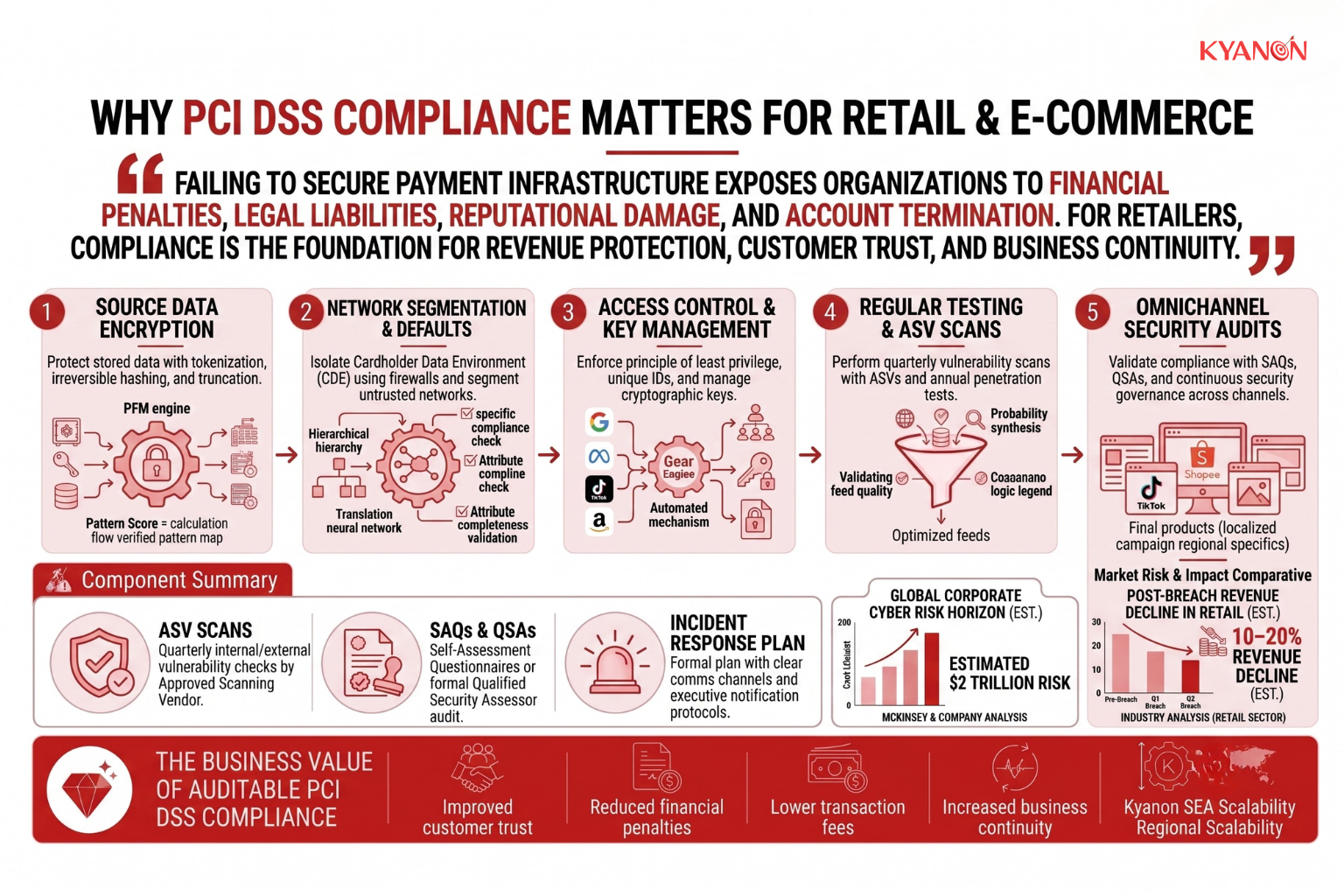
The consequences of payment security failures extend far beyond compliance fines.
- Growing cyber risk exposure: According to McKinsey & Company, organizations face an estimated $2 trillion corporate cyber risk horizon as increasingly sophisticated attacks target digital businesses. This makes payment security a strategic business priority rather than solely an IT responsibility.
- Revenue loss after breaches: Industry analysis shows retailers experiencing major payment data breaches often see significant revenue declines in the quarters following public disclosure, accompanied by substantial customer churn as consumers shift to competitors they perceive as more secure.
- Delayed incident response: McKinsey also reports that 44% of cybersecurity teams still rely on informal communication methods, such as emails or memos, to notify executives during security incidents. These communication bottlenecks can slow containment efforts and increase business impact.
Common Misconceptions
We are too small to worry about compliance
The standard applies to any entity that processes, stores, or transmits cardholder data, regardless of transactional volume or company size. Smaller businesses are heavily targeted precisely because hackers know they lack mature cybersecurity teams.
We outsource our payment processing, so we are exempt
While using third-party providers transfers part of the workflow, ultimate accountability remains with the merchant. You still must ensure your provider maintains compliance and that your system endpoints do not intercept or compromise data before it transfers.
We don’t store credit card data, so it doesn’t apply to us
Reality: Storage is only one facet. If a transaction passes through your network, servers, phone lines, or web forms for even a millisecond, you are transmitting and processing it, putting your entire environment directly into the scope of compliance.
Everything is encrypted, so we are automatically compliant
Even if account data is fully encrypted, the systems that transmit it or host the decryption keys are still vulnerable. PCI DSS dictates strict rules around encryption key management, network segmentation, and access controls.
How Kyanon Digital Applies PCI DSS Compliance
Kyanon Digital helps enterprise retailers achieve PCI DSS compliance by architecting payment systems that minimize exposure to sensitive cardholder data. Rather than processing payment information within the merchant’s infrastructure, we leverage certified Payment Service Providers (PSPs), advanced tokenization, and structural network isolation to decouple payment payloads from the core application layer.
For businesses operating in Southeast Asia’s rapidly evolving digital commerce landscape, this approach enables secure support for diverse payment channels while reducing compliance complexity. Leading payment organizations increasingly adopt API-first, modular architectures to accelerate innovation, simplify infrastructure, and securely integrate new payment methods.
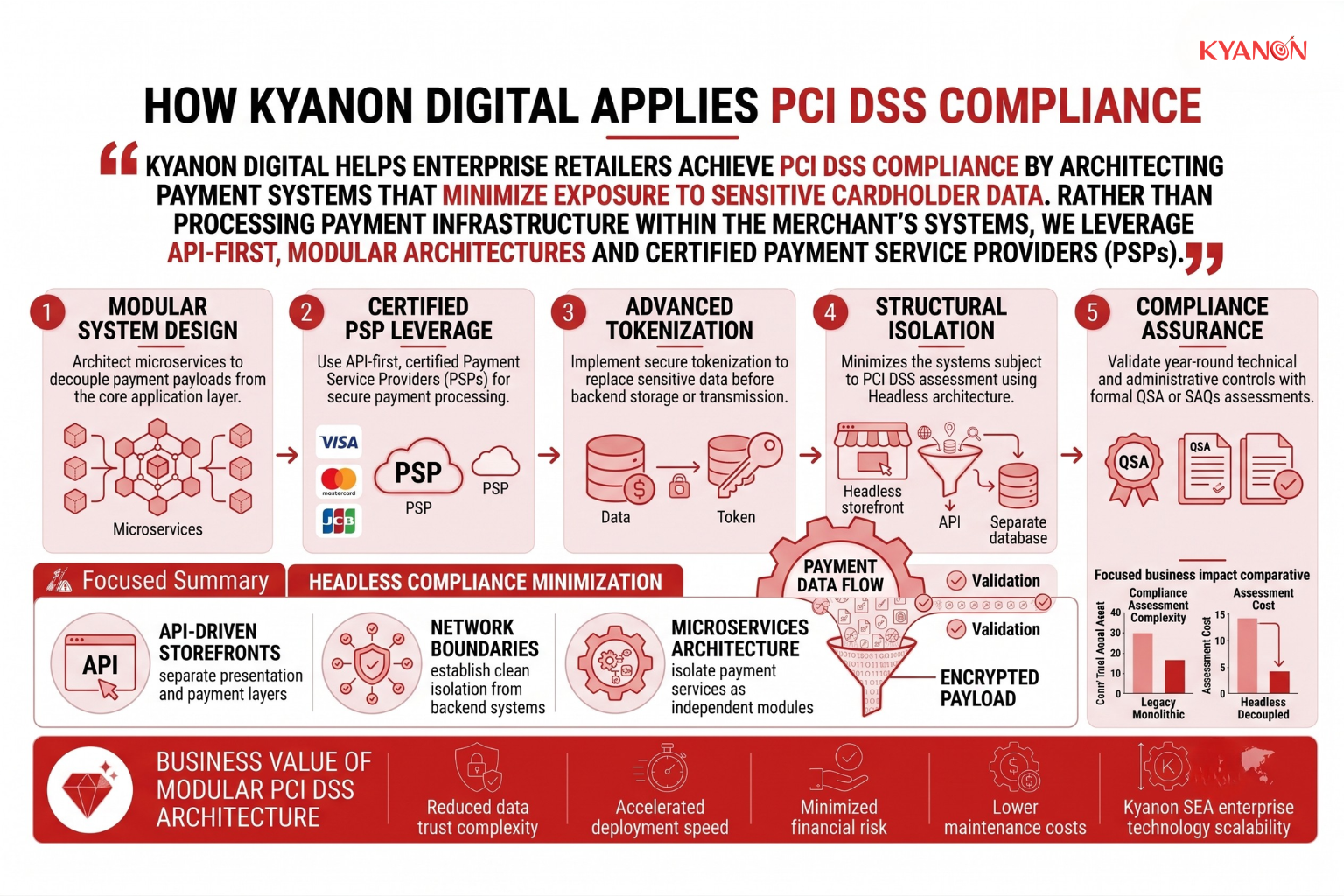
Kyanon Digital minimizes this scope through a headless commerce architecture by:
- Separating presentation and payment layers using API-driven storefronts and backend services.
- Establishing clean network boundaries so content management systems, product catalogs, and customer-facing applications never directly interact with payment processing infrastructure.
- Isolating payment services as independent microservices, allowing organizations to modernize payment capabilities without increasing compliance complexity.
This architectural separation reduces the systems subject to PCI DSS assessment while improving scalability, deployment speed, and long-term maintainability.
Explore our Ecommerce services:

 Create project brief with AI