
What is payment orchestration?
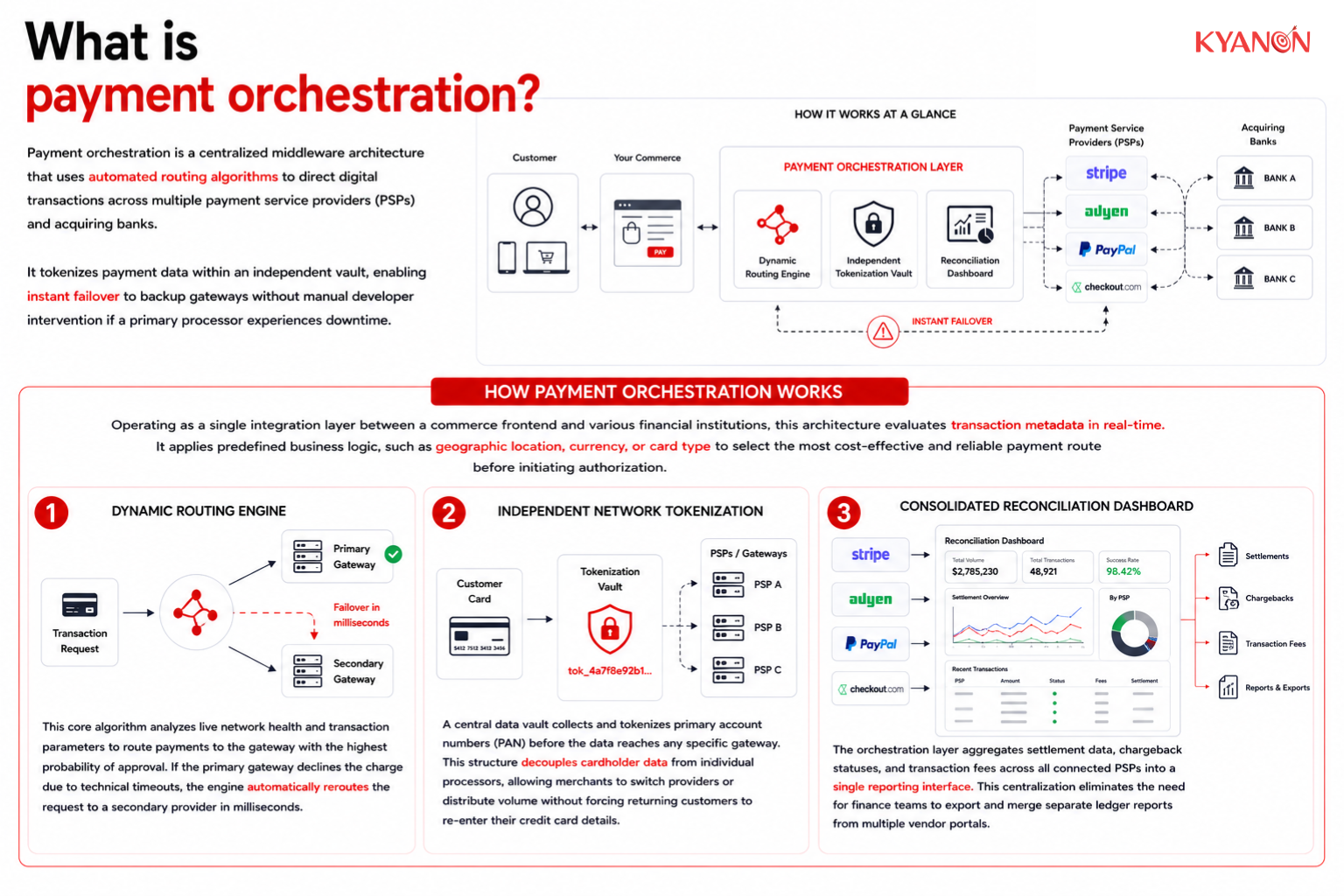
Payment orchestration is a centralized middleware architecture that uses automated routing algorithms to direct digital transactions across multiple payment service providers (PSPs) and acquiring banks. It tokenizes payment data within an independent vault, enabling instant failover to backup gateways without manual developer intervention if a primary processor experiences downtime.
How payment orchestration works
Operating as a single integration layer between a commerce frontend and various financial institutions, this architecture evaluates transaction metadata in real-time. It applies predefined business logic, such as geographic location, currency, or card type to select the most cost-effective and reliable payment route before initiating authorization.
Dynamic routing engine
This core algorithm analyzes live network health and transaction parameters to route payments to the gateway with the highest probability of approval. If the primary gateway declines the charge due to technical timeouts, the engine automatically reroutes the request to a secondary provider in milliseconds.
Independent network tokenization
A central data vault collects and tokenizes primary account numbers (PAN) before the data reaches any specific gateway. This structure decouples cardholder data from individual processors, allowing merchants to switch providers or distribute volume without forcing returning customers to re-enter their credit card details.
Consolidated reconciliation dashboard
The orchestration layer aggregates settlement data, chargeback statuses, and transaction fees across all connected PSPs into a single reporting interface. This centralization eliminates the need for finance teams to export and merge separate ledger reports from multiple vendor portals.

Payment Orchestration vs Multi-Gateway Integration
Both approaches involve connecting to more than one payment processor, but they differ completely in automation capability and developer maintenance overhead.
Dimension | Payment Orchestration | Multi-Gateway Integration |
| Failover mechanism | Automated real-time routing | Manual code deployment |
PCI compliance burden | Low (Handled by independent vault) | Medium to High (Depends on integration method and token strategy) |
| Developer maintenance | Minimal (One API to maintain) | Extensive (Multiple separate APIs to update) |
Checkout latency | Slightly Higher (Due to extra middleware routing layer) | Lower (Direct API calls, but prone to timeouts if primary fails) |
| Best for | High-volume cross-border commerce | Simple regional deployments with a fallback |
When to consider payment orchestration
Evaluating payment orchestration requires assessing your current transaction volume, international footprint, and reliance on single financial institutions.
Consider payment orchestration if:
- Your e-commerce platform is expanding into new international markets and requires local acquiring banks to avoid high cross-border transaction fees.
- Your business suffers revenue loss from false declines or technical timeouts because your single payment gateway lacks automatic failover capabilities.
- Your finance team spends excessive time manually reconciling settlement data from four different payment providers at the end of each month.
It may not be the right priority if:
- Your operation processes low transaction volumes exclusively within a single domestic market where a single payment service provider covers all preferred payment methods.
Why payment orchestration matters for E-commerce
Payment orchestration is critical for e-commerce because it directly protects revenue from technical failures, slashes processing fees, and optimizes conversion rates during global expansion. Relying on a single payment gateway introduces a critical point of failure.
Payment orchestration eliminates this vulnerability by decoupling your checkout page from individual payment processors, ensuring that your digital storefront remains operational and profitable even during major network outages.
Common misconceptions
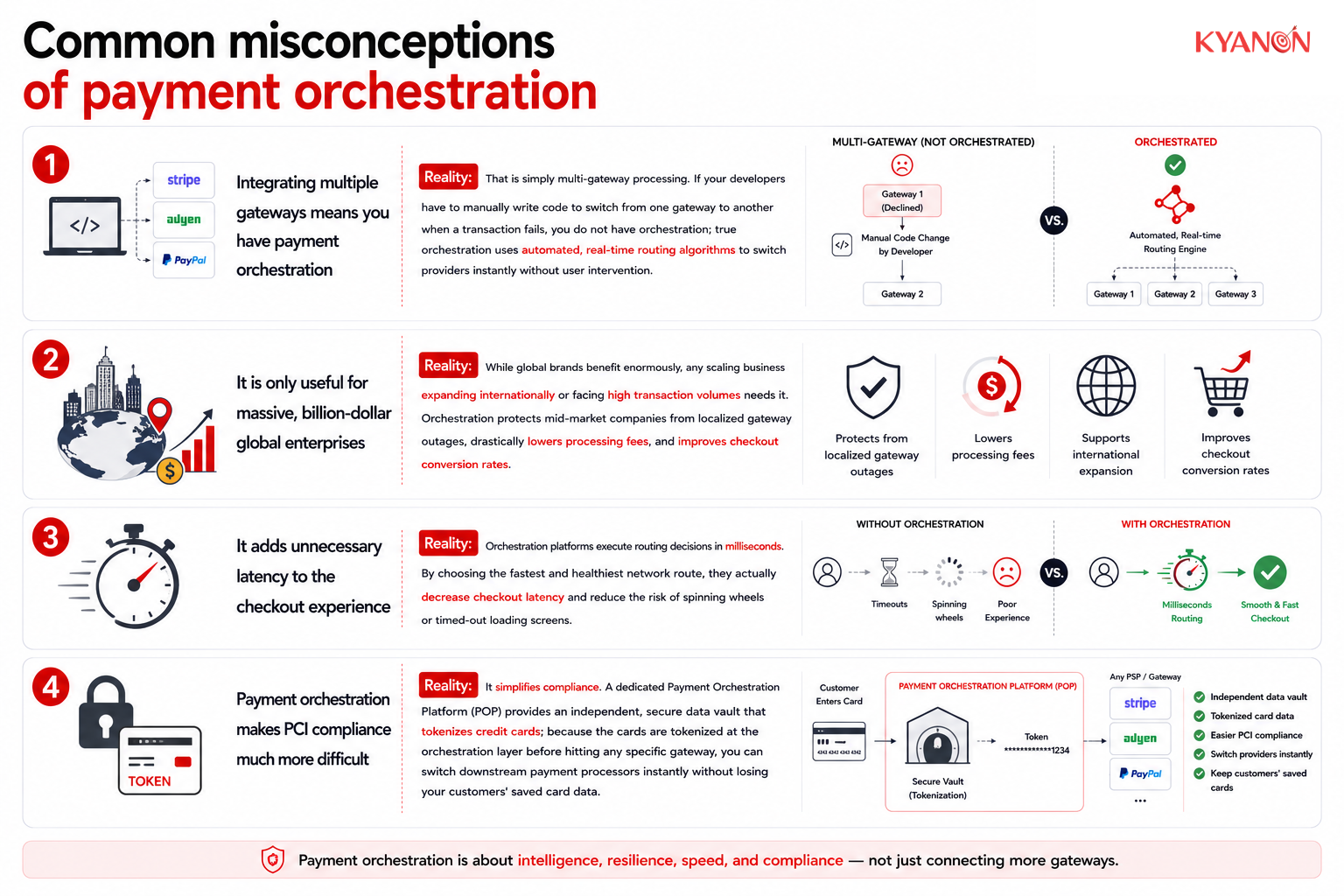
Integrating multiple gateways means you have payment orchestration
Reality: That is simply multi-gateway processing. If your developers have to manually write code to switch from one gateway to another when a transaction fails, you do not have orchestration; true orchestration uses automated, real-time routing algorithms to switch providers instantly without user intervention.
It is only useful for massive, billion-dollar global enterprises
Reality: While global brands benefit enormously, any scaling business expanding internationally or facing high transaction volumes needs it. Orchestration protects mid-market companies from localized gateway outages, drastically lowers processing fees, and improves checkout conversion rates.
It adds unnecessary latency to the checkout experience
Reality: Orchestration platforms execute routing decisions in milliseconds. By choosing the fastest and healthiest network route, they actually decrease checkout latency and reduce the risk of spinning wheels or timed-out loading screens.
Payment orchestration makes PCI compliance much more difficult
Reality: It simplifies compliance. A dedicated Payment Orchestration Platform (POP) provides an independent, secure data vault that tokenizes credit cards; because the cards are tokenized at the orchestration layer before hitting any specific gateway, you can switch downstream payment processors instantly without losing your customers’ saved card data.
How Kyanon Digital applies payment orchestration
Kyanon Digital implements payment orchestration architectures for enterprise clients needing multi-PSP flexibility across Southeast Asia, ANZ, and European markets. Our engineering teams integrate independent token vaults and dynamic routing engines into existing composable commerce frameworks, reducing transaction costs and ensuring high availability during peak sales events.
Explore our services:

 Create project brief with AI