
What is PyTorch?
PyTorch is an open-source deep learning framework designed to streamline the development, training, and deployment of machine learning models. Known for its flexibility and ease of use, it features dynamic computation graphs that allow developers to build, test, and modify models efficiently during experimentation. Its seamless integration with Python and extensive developer-friendly tools make it a popular platform for creating scalable AI and deep learning applications.
Adopted by researchers and enterprises worldwide, PyTorch powers a wide range of AI workloads, including natural language processing, computer vision, reinforcement learning, and generative AI. The framework offers a rich ecosystem of libraries and supports high-performance execution across CPUs, GPUs, and specialized accelerators. With capabilities for distributed training, cloud deployment, and edge-device inference, PyTorch enables organizations to move AI models from experimentation to production with greater speed and efficiency. (PyTorch)
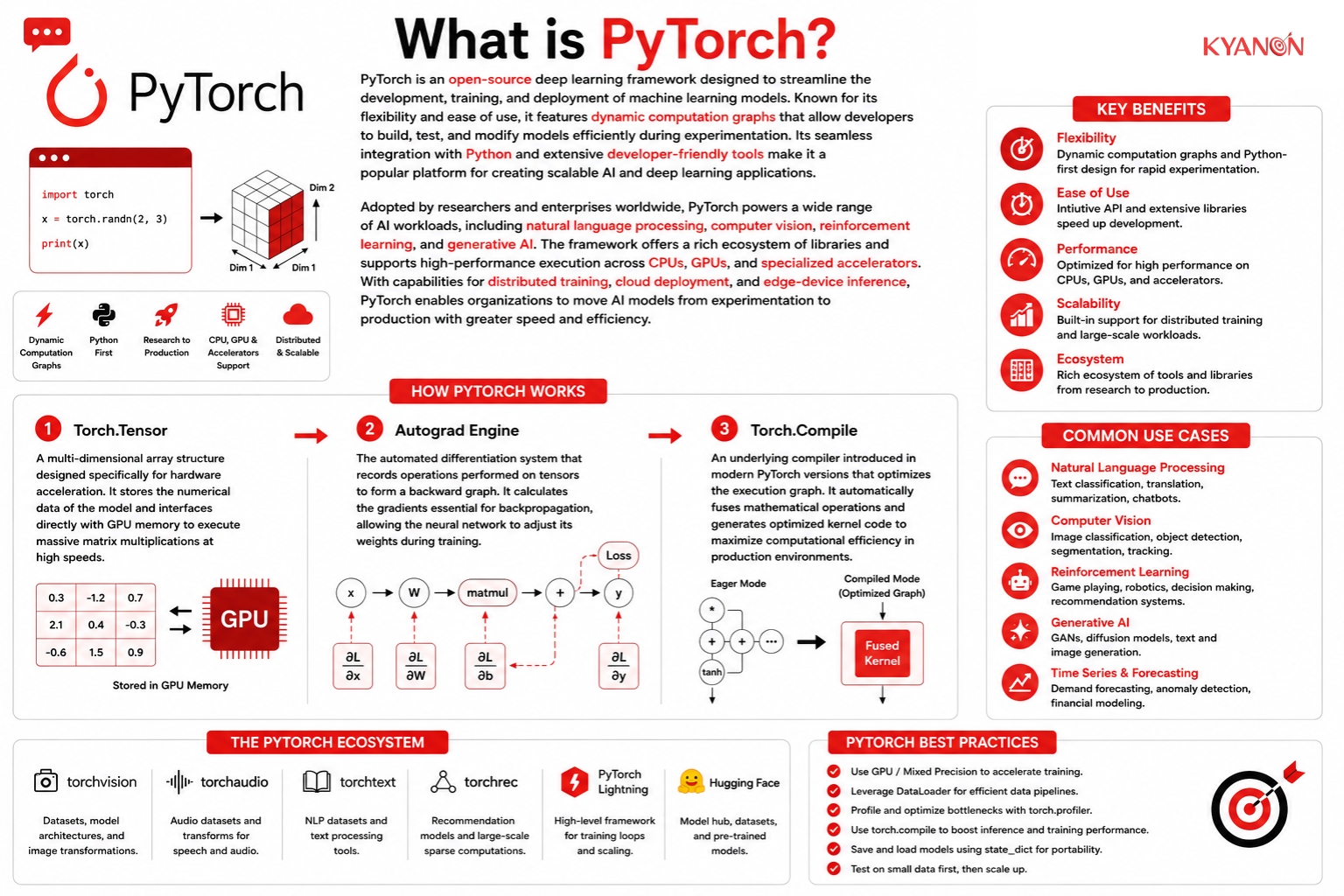
How PyTorch works
PyTorch processes mathematical operations through multidimensional array structures known as tensors, functioning as a hardware-accelerated alternative to standard data arrays. The framework executes these tensor operations on Graphics Processing Units (GPUs) and utilizes automated differentiation engines to calculate the gradients required for training machine learning algorithms.
Torch.Tensor
A multi-dimensional array structure designed specifically for hardware acceleration. It stores the numerical data of the model and interfaces directly with GPU memory to execute massive matrix multiplications at high speeds.
Autograd Engine
The automated differentiation system that records operations performed on tensors to form a backward graph. It calculates the gradients essential for backpropagation, allowing the neural network to adjust its weights during training.
Torch.Compile
An underlying compiler introduced in modern PyTorch versions that optimizes the execution graph. It automatically fuses mathematical operations and generates optimized kernel code to maximize computational efficiency in production environments.

PyTorch vs TensorFlow
Both frameworks support the end-to-end development of deep learning models, but they differ in their computational graph execution and primary design philosophies.
|
Dimension |
PyTorch | TensorFlow |
| Computation Graph | Dynamic (Eager execution) |
Static (Declarative execution) |
|
Debugging Process |
Direct and immediate | Requires separate session compilation |
| Compiler Optimization | Torch.Compile (JIT) |
XLA (Accelerated Linear Algebra) |
|
Deployment Ecosystem |
TorchScript / ONNX integration | TensorFlow Extended (TFX) / TF Serving |
| Primary Audience Focus | Research and custom architectures |
Standardized production pipelines |
When to consider PyTorch
Consider PyTorch if:
- Your engineering team requires the flexibility of dynamic computation graphs to build and test custom computer vision or natural language processing architectures.
- You are deploying large-scale models across cluster networks and need active orchestration APIs like DistributedDataParallel (DDP) to manage memory sharding.
- Your project involves heavy general scientific computing tasks that require GPU-accelerated matrix algebra and optimization algorithms outside of traditional neural networks.
It may not be the right priority if:
- Your organization relies strictly on legacy application environments that demand fully integrated, static, end-to-end deployment pipelines without utilizing external orchestration runtimes.
Why PyTorch matters for enterprise AI
PyTorch is important for enterprise AI because it provides a flexible, open-source framework for building, training, and deploying AI models at scale. Its portability across cloud platforms and hardware environments helps organizations avoid vendor lock-in, accelerate AI development, and support production-ready applications ranging from computer vision and NLP to generative AI. (RedHat)
Common misconceptions
Technical leaders often misinterpret the computational requirements and execution limitations of dynamic neural network frameworks.
PyTorch is slow in production compared to static graph frameworks
Reality: PyTorch achieves high production speeds via compiler optimizations. Historically, the framework relied solely on a dynamic computation graph, which offered debugging flexibility but executed slower at scale. Since the release of PyTorch 2.0, the torch.compile() compiler automatically fuses mathematical operations and generates optimized kernel code for GPUs, matching the execution speed of static engines.
You must deploy PyTorch models using a heavy Python server runtime
Reality: PyTorch allows you to completely strip away Python for deployment. Enterprise environments avoid the memory overhead or threading limitations (GIL) of Python by compiling PyTorch models via TorchScript into a standalone, serialized file. This file can be natively loaded and run inside high-performance C++ or C# applications, or converted via ONNX to run on platform-agnostic engines like ONNX Runtime.
How Kyanon Digital applies PyTorch
Kyanon Digital’s AI engineers develop and train custom deep learning models using PyTorch for enterprise clients across Vietnam, Singapore, Thailand, ANZ, and Nordic Europe. Our implementation teams build specialized architectures for computer vision and NLP tasks, utilizing advanced memory sharding frameworks and DistributedDataParallel (DDP) configurations to ensure efficient multi-GPU scaling. We optimize these trained algorithms for inference via TorchScript or ONNX, delivering measurable improvements in conversion rates and minimizing total cost of ownership (TCO) for large-scale AI applications.
Explore our AI and ML services:

 Create project brief with AI