
What is TensorFlow?
TensorFlow is an open-source machine learning framework developed by Google that enables the creation, training, and deployment of deep neural networks through large-scale numerical computation. It is built to support tensor-based data processing, where information is represented as multi-dimensional arrays, allowing complex mathematical operations to be performed efficiently across high-dimensional datasets.
Beyond its computational foundation, TensorFlow is designed as a production-grade AI ecosystem that supports the full lifecycle of machine learning systems. It enables organizations to scale AI models from experimental research environments into robust production systems deployed across cloud platforms, enterprise infrastructure, and edge devices. This makes it a widely used framework for building real-world AI applications that require both performance and scalability.

How TensorFlow Works
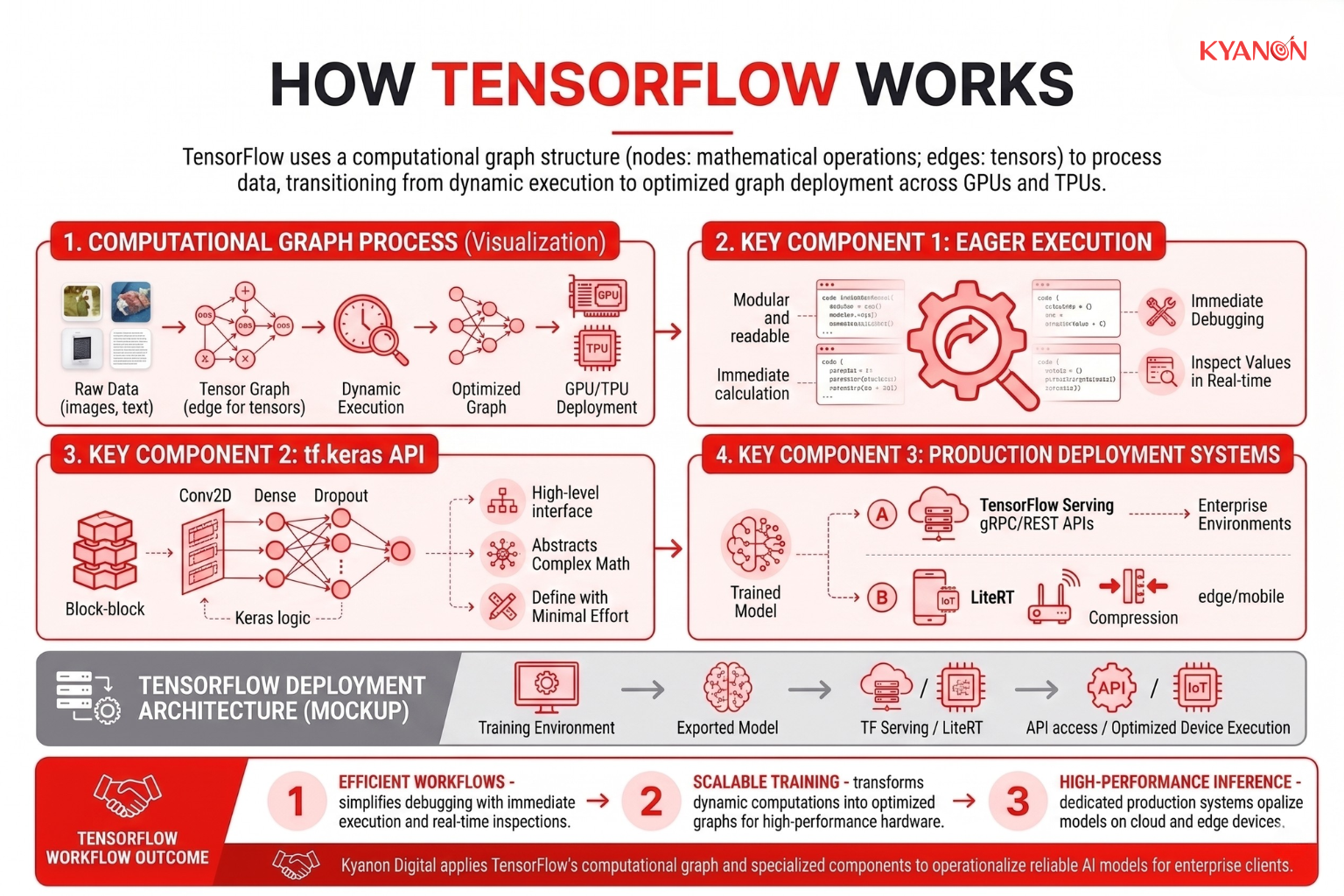
TensorFlow processes data by representing computations as directed graphs, where nodes correspond to mathematical operations and edges represent multidimensional arrays (tensors) flowing between them. This graph-based structure allows machine learning workflows to be defined as interconnected operations that can be executed efficiently and scaled across different hardware environments.
Modern TensorFlow supports dynamic execution, enabling developers to run and validate operations immediately while inspecting tensor values in real time. Once validated, these computations can be transformed into optimized execution graphs and deployed to high-performance hardware such as GPUs and TPUs for scalable training and inference.
Eager Execution
Eager execution is a dynamic execution mode where operations are evaluated immediately as they are defined, returning concrete results instead of building a static computational graph. This approach simplifies debugging and allows engineers to inspect values and model behavior in real time, making early-stage development and experimentation more efficient.
tf.keras API
The tf.keras API is the high-level interface for TensorFlow that standardizes how neural networks are constructed. It abstracts complex mathematical operations into modular components such as layers, loss functions, and optimizers, allowing data scientists and engineers to define and train models with minimal low-level implementation effort.
TensorFlow Serving and LiteRT
TensorFlow provides dedicated production deployment systems to operationalize trained models at scale. TensorFlow Serving is designed for high-throughput, low-latency inference in enterprise environments, supporting model versioning and API-based access via gRPC and REST. For edge and mobile environments, LiteRT (formerly TensorFlow Lite) enables optimized model execution by compressing and adapting models to run efficiently on resource-constrained devices such as smartphones and IoT systems.

TensorFlow vs PyTorch
Both TensorFlow and PyTorch provide enterprise-grade machine learning infrastructure, but they differ significantly in ecosystem maturity, deployment strength, and production scalability. TensorFlow is primarily optimized for large-scale enterprise deployment and end-to-end machine learning operations (MLOps).
Dimension | TensorFlow | PyTorch |
| Primary market dominance | Enterprise production & deployment | Academic AI research & prototyping |
Edge and mobile runtime | Highly mature (LiteRT) | Emerging (ExecuTorch) |
| Deployment infrastructure | TensorFlow Serving (built-in, high scale) | TorchServe (maturing ecosystem) |
High-level API standard | Keras | PyTorch Lightning |
| Distributed training optimization | Native TPU optimization via XLA | PyTorch/XLA (Catching up) |
TensorFlow is best understood as a production-first machine learning framework built for scalability, reliability, and end-to-end operationalization of AI systems. Its ecosystem is tightly integrated to support the full lifecycle of machine learning, from data ingestion and model training to optimized deployment across cloud, server, mobile, and edge environments.
When to Consider TensorFlow
Consider TensorFlow if:
- Your organization requires deploying machine learning models across a highly fragmented hardware ecosystem, including cloud servers, mobile devices, and IoT edge hardware.
- You are building a large-scale MLOps pipeline and need a standardized, end-to-end framework capable of handling data validation, automated training, and versioned serving.
- Your engineering team relies heavily on Google Cloud Platform and intends to train massive foundation models using highly optimized Tensor Processing Unit (TPU) clusters.
It may not be the right priority if:
- Your AI team is primarily focused on rapid academic research or developing heavily customized generative AI prototypes where dynamic computational flexibility and the Hugging Face ecosystem are the absolute priorities.
Why TensorFlow Matters for Enterprise AI
TensorFlow plays a central role in transforming experimental machine learning into scalable enterprise infrastructure by standardizing how organizations ingest data, train models, and operationalize predictions across cloud, edge, and mobile environments. This standardization enables enterprises to move from isolated data science experiments to fully integrated, production-grade AI systems that can be deployed consistently at scale.
According to the McKinsey & Company Global Institute, AI technologies, many of which are built on frameworks like TensorFlow, could generate $2.6 trillion to $4.4 trillion in annual economic value, with a significant share driven by improvements in knowledge work automation, advanced analytics, and data-intensive enterprise workflows. McKinsey also highlights that organizations achieving the greatest value from AI are those that successfully industrialize machine learning, embedding models into core business processes rather than treating them as standalone experiments.

Global financial institutions increasingly rely on TensorFlow’s distributed training capabilities across cloud-based GPU and TPU infrastructures to support real-time fraud detection systems capable of identifying suspicious transactions in milliseconds. In parallel, its edge deployment capabilities allow computer vision and anomaly detection models to run directly within mobile banking applications, enabling offline or low-connectivity inference without requiring continuous cloud access.
This end-to-end infrastructure reduces friction between experimental model development and enterprise IT deployment by standardizing the machine learning lifecycle, from data processing and model training to scalable inference, making AI systems more operationally reliable and easier to integrate into large-scale financial and enterprise environments.
Common Misconceptions
TensorFlow is obsolete and AI teams only use PyTorch or JAX for modern workloads
While academic researchers strongly favor PyTorch for new paper publications, TensorFlow maintains its position as a dominant framework for industrial-scale deployment . Its production-ready ecosystem, particularly TensorFlow Serving and LiteRT, powers critical enterprise workloads and billions of edge devices globally.
TensorFlow forces engineers to build rigid, static computation graphs before any data can be evaluated
This limitation was true for TensorFlow 1.x architectures, which required compiling a session before execution. Modern TensorFlow 2.x defaults to Eager Execution, evaluating operations line-by-line in pure Python to enable standard debugging and faster model iteration.
How Kyanon Digital Applies TensorFlow
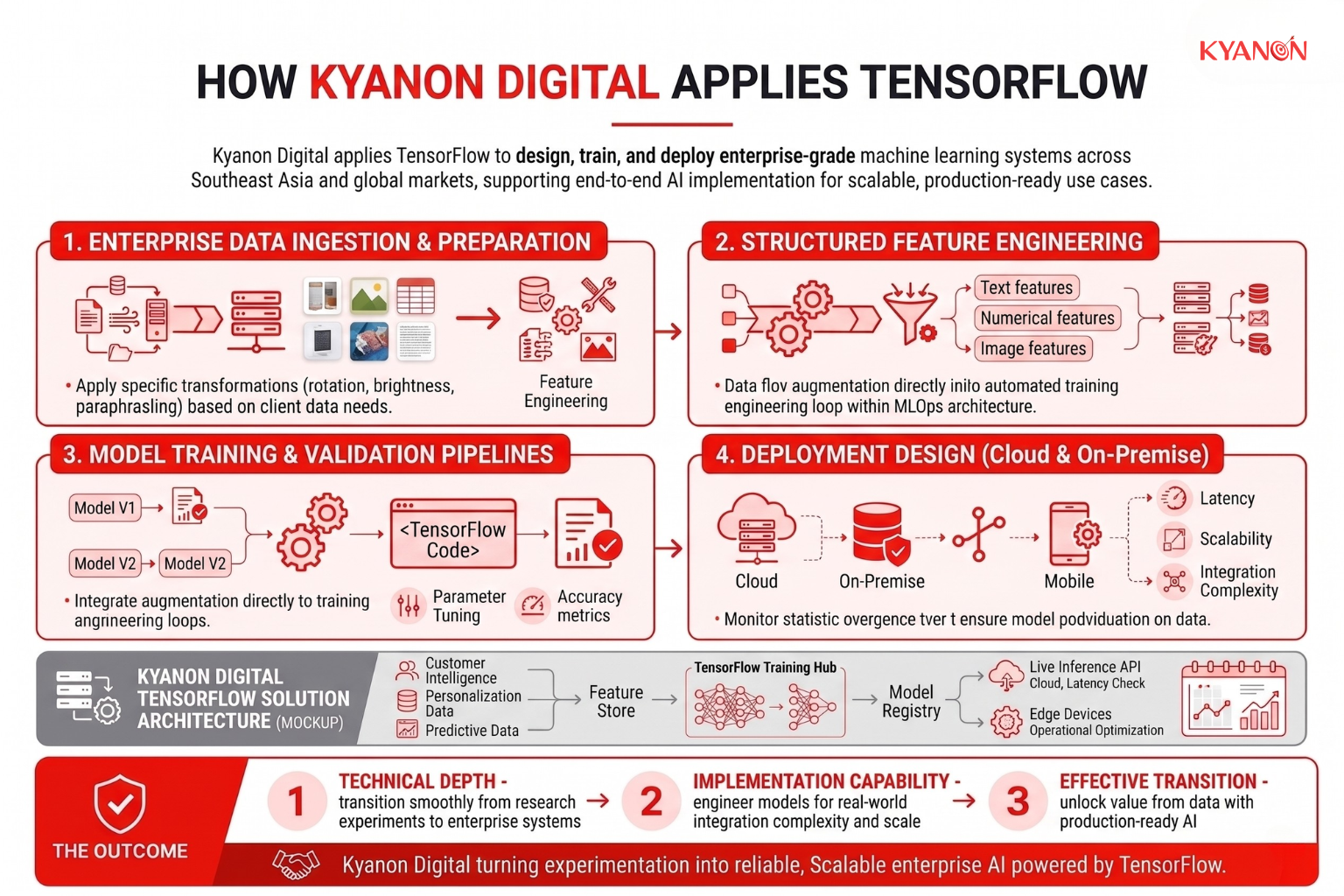
Kyanon Digital applies TensorFlow to design, train, and deploy enterprise-grade machine learning systems across Southeast Asia and global markets, supporting end-to-end AI implementation for use cases such as predictive analytics, customer intelligence, personalization, and operational optimization. The focus is on turning enterprise data into scalable, production-ready machine learning systems that can operate reliably across cloud and enterprise environments.
A key strength of Kyanon Digital lies in its implementation-first engineering approach, where TensorFlow is not treated as an isolated model-building tool but as part of a full production pipeline. This includes structured feature engineering, model training, validation, and deployment design, ensuring models are built with real-world constraints such as latency, scalability, and integration complexity in mind from the outset.
If the goal is to move beyond experimentation and build scalable, production-grade AI powered by TensorFlow, Kyanon Digital provides the technical depth and implementation capability to make that transition effectively.
→ Explore our Machine Learning Development services.

 Create project brief with AI