
What is Quantization (ML)?
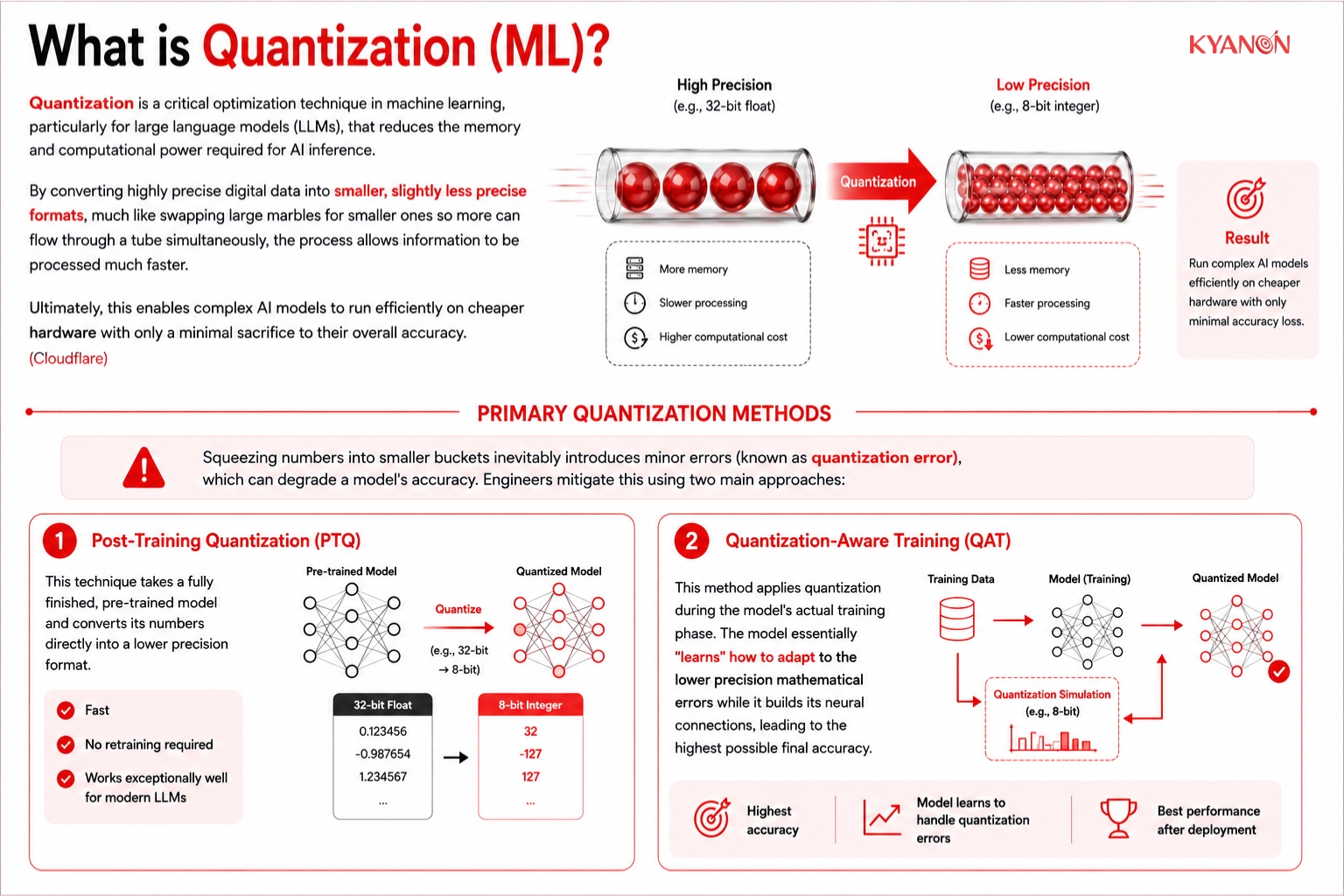
Quantization is a critical optimization technique in machine learning, particularly for large language models (LLMs), that reduces the memory and computational power required for AI inference. By converting highly precise digital data into smaller, slightly less precise formats, much like swapping large marbles for smaller ones so more can flow through a tube simultaneously, the process allows information to be processed much faster. Ultimately, this enables complex AI models to run efficiently on cheaper hardware with only a minimal sacrifice to their overall accuracy. (Cloudflare)
Primary Quantization Methods
Squeezing numbers into smaller buckets inevitably introduces minor errors (known as quantization error), which can degrade a model’s accuracy. Engineers mitigate this using two main approaches:
- Post-Training Quantization (PTQ): This technique takes a fully finished, pre-trained model and converts its numbers directly into a lower precision format. It is fast, requires no retraining, and works exceptionally well for modern LLMs.
- Quantization-Aware Training (QAT): This method applies quantization during the model’s actual training phase. The model essentially “learns” how to adapt to the lower precision mathematical errors while it builds its neural connections, leading to the highest possible final accuracy.

How Quantization (ML) Works
Quantization operates by shrinking the size of the data containers used to store model weights and activations, rather than modifying the fundamental architecture of the neural network. By mathematically converting values from 32-bit floats (FP32) to 8-bit integers (INT8) or lower, the execution engine can process multiple operations simultaneously on specialized hardware.
Scale Factor and Zero-Point Mapping
True quantization calculates a precise Scale Factor (S) and a Zero-Point (Z) offset for each layer or channel of tensors. This mathematical mapping maintains the original statistical distribution and relative distance of the model’s weights, ensuring the network does not suffer extreme accuracy collapse.
Post-Training Quantization (PTQ)
PTQ is an optimization pathway executed after the model is completely finished training. It converts the frozen network weights into lower precision quickly and requires very little calibration data, making it ideal for rapid deployment, though it can cause minor accuracy degradation on smaller models.
Quantization-Aware Training (QAT)
QAT is executed during the active training phase, where the model simulates INT8 precision errors during its forward pass. This allows the backpropagation step to adjust other weights to compensate for the numerical loss, yielding the highest possible accuracy for the final compressed model.
Quantization (ML) vs Model Pruning
Both methodologies act as compression techniques for neural networks, but they target completely independent structural properties of the model.
Dimension | Quantization (ML) | Model Pruning |
| Modification Target | Numerical precision of data types | Structural shape of the network |
Neuron Count | Retains 100% of connections | Removes weak or useless connections |
| Compute Requirement | Needs specific integer execution units | Runs effectively on standard architectures |
Accuracy Preservation | Maintained via calibration (Scale/Zero-Point) | Maintained via iterative retraining |
| Primary Benefit | Reduces memory bandwidth bottleneck | Reduces total number of calculations |
When to Consider Quantization (ML)
Consider Quantization (ML) if:
- Your engineering team must host modern Large Language Models (LLMs) and needs to fit massive parameter counts onto single, cost-effective cloud instances.
- You are deploying computer vision or predictive models directly onto client edge infrastructure with strict hardware and power limitations.
- Your production environment suffers from high inference latency caused by memory bandwidth bottlenecks when processing full 32-bit precision tensors.
It may not be the right priority if:
- Your target execution hardware consists of older CPUs or cloud instances that lack specialized integer execution units, forcing the system to manually cast integers back to FP32, which slows down computation.
Why Quantization (ML) matters for enterprise scale
Compressing neural networks into lower-precision formats is a mandatory engineering requirement for enterprises looking to scale generative AI without incurring unsustainable infrastructure overhead.
According to NVIDIA Developer, Quantization is an essential AI optimization that compresses machine learning models by reducing the numerical precision of weights and activations (e.g., from 32-bit floating-point to 8-bit or 4-bit integers). At enterprise scale, it is the fundamental bridge that transforms AI models from expensive experiments into sustainable, cost-effective, and highly scalable production assets.
Common misconceptions
IT Directors often misunderstand the hardware dependencies and enterprise applications of model compression, leading to misconfigured infrastructure strategies.
Quantization is only useful for putting models on cheap mobile phones
Reality: Quantization is a mandatory, core pillar of cutting-edge cloud server engineering. Hosting modern Large Language Models (LLMs) at full 16-bit or 32-bit precision requires massive arrays of interconnected, highly scarce cloud GPUs. Quantizing these frontier models down to 4-bit or 8-bit formats allows enterprises to fit massive AI models onto single, cheaper cloud instances, slashing inference costs by up to 80%.
A quantized model will run faster on absolutely any hardware
Reality: Quantization only speeds up inference if the target hardware natively supports low-precision matrix math. If you run an INT8 quantized model on an old CPU or a cloud instance that lacks specialized integer execution units (like INT8 tensor cores), the hardware has to manually cast the integers back to FP32 to execute the math. This extra conversion step actually makes the model slower and more computationally expensive.
How Kyanon Digital applies Quantization (ML)
Kyanon Digital applies quantization (ML) when deploying AI on client edge infrastructure or optimizing LLM hosting costs in production for enterprise clients across Singapore, Thailand, and the US. Our deep implementation expertise ensures that models undergo precise Quantization-Aware Training (QAT) or Post-Training Quantization (PTQ) to map weights into optimized 8-bit or 4-bit configurations. By aligning these compressed formats with hardware-accelerated inference engines, we achieve zero-latency execution and drastically reduce the Total Cost of Ownership (TCO) for running complex AI architectures at scale.
Explore our AI & ML services:

 Create project brief with AI