
What is query routing?
Query routing is an architectural mechanism in artificial intelligence systems that analyzes incoming user inputs and dynamically directs them to the most appropriate database, external tool, or specific language model based on intent, complexity, and cost constraints. This selective dispatch process prevents simple factual questions from consuming expensive compute resources.
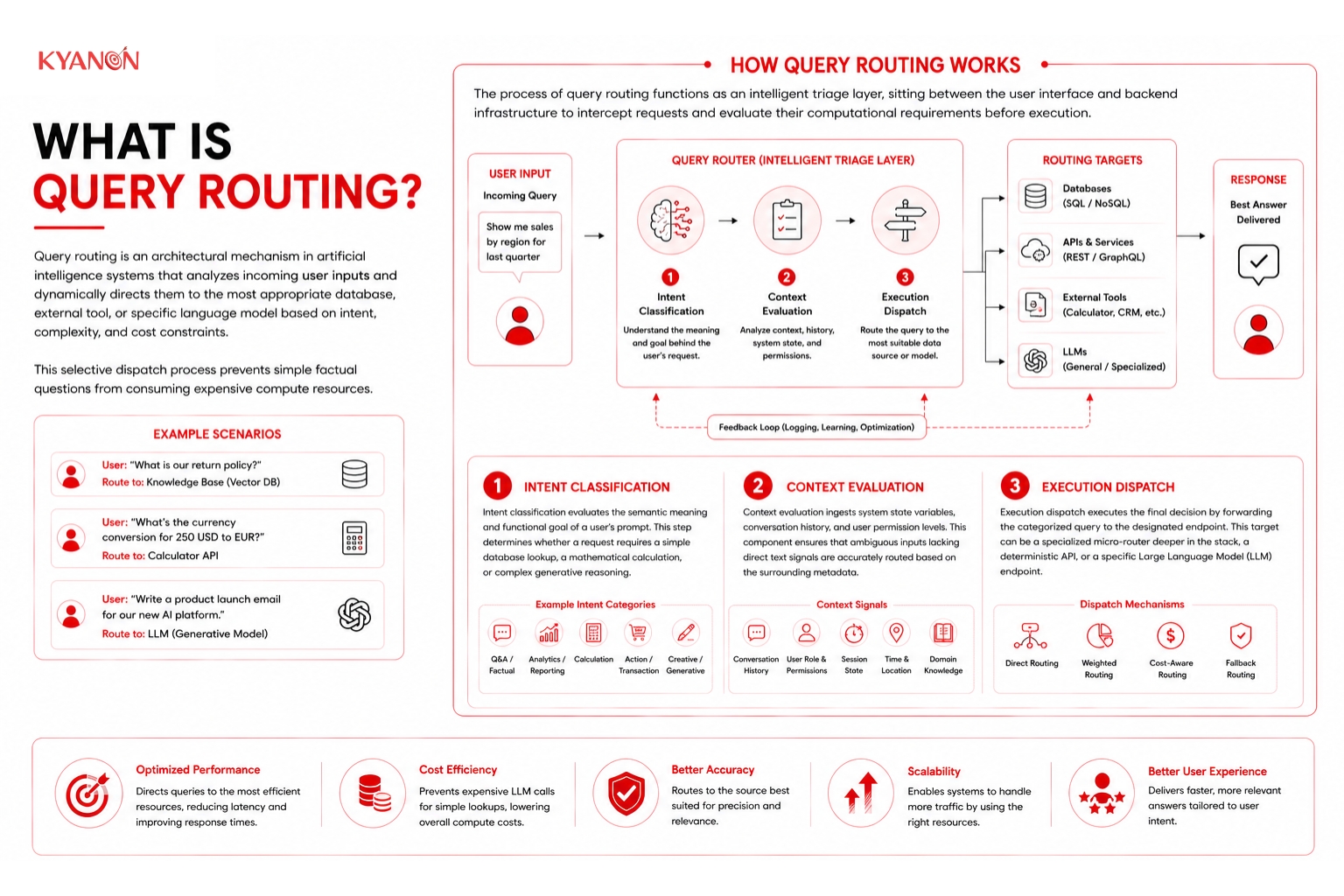
How query routing works
The process of query routing functions as an intelligent triage layer, sitting between the user interface and backend infrastructure to intercept requests and evaluate their computational requirements before execution.
Intent Classification
Intent classification evaluates the semantic meaning and functional goal of a user’s prompt. This step determines whether a request requires a simple database lookup, a mathematical calculation, or complex generative reasoning.
Context Evaluation
Context evaluation ingests system state variables, conversation history, and user permission levels. This component ensures that ambiguous inputs lacking direct text signals, such as a user typing “Show me more details,” are accurately routed based on the surrounding metadata.
Execution Dispatch
Execution dispatch executes the final decision by forwarding the categorized query to the designated endpoint. This target can be a specialized micro-router deeper in the stack, a deterministic API, or a specific Large Language Model (LLM) endpoint.

Query routing vs Query Expansion
Both mechanisms operate during the pre-retrieval processing phase, but they manipulate the data workflow to achieve opposing operational goals.
Dimension | Query routing | Query Expansion |
| Primary function | Directs the query to a specific destination | Adds new vocabulary to the query |
Core objective | Efficiency and cost optimization | Recall and search accuracy improvement |
| Operational layer | Triage and workflow dispatch | Search term augmentation |
Output | A routing decision (e.g., API endpoint URL) | A longer, enriched search string |
| Impact on latency | Decreases (routes to smaller, faster models) | Increases (adds processing steps) |
When to consider query routing
Consider query routing if:
- Your engineering team is deploying a multi-model architecture and API costs are escalating because simple factual questions are being processed by large, expensive language models.
- You are building a complex Retrieval-Augmented Generation (RAG) system where users require both structured SQL data and unstructured document retrieval from a single chat interface.
- Your application experiences severe latency bottlenecks because generic queries are unnecessarily forced through slow generative pipelines instead of fast deterministic rule engines.
It may not be the right priority if:
- Your product is an early-stage MVP utilizing a single, unified backend system where all data resides in one location and cost-per-inference optimization is not yet a priority.
Why query routing matters for enterprise AI
Implementing query routing allows enterprises to decouple query complexity from model size, ensuring that high-cost reasoning engines are strictly reserved for complex operational tasks.
- Drastically Reduces API Costs: Large Language Models are billed per token. By routing basic or repetitive queries to cheaper, specialized models or static caches, companies can slash their production inference bills by 50% or more.
- Minimizes System Latency: Routing simple queries away from heavy vector databases or complex reasoning chains means users get instant answers for easy tasks.
- Prevents Information Overload: In Retrieval-Augmented Generation (RAG), sending a query to every single database at once results in “context poisoning,” where irrelevant data confuses the LLM. Routing ensures the AI only receives context from the exact datastore it needs.
Common misconceptions
We can just use a heavy LLM like GPT-4 to act as our master router for everything
Reality: Generative routers introduce unnecessary latency, high costs, and non-determinism into the infrastructure. Using a heavy language model merely to output a single routing category adds hundreds of milliseconds of delay, and slight prompt formatting changes can break the routing logic entirely.
Vector similarity is a perfect metric for intent routing
Reality: Semantic proximity does not equal functional intent. Queries like “How do I delete my database?” and “Can I recover a deleted database?” are incredibly close in vector space, but they require entirely different tools, permissions, and automated pipelines to resolve safely.
How Kyanon Digital applies query routing
Kyanon Digital implements query routing in enterprise multi-model AI architectures for clients across the US, Nordic Europe, ANZ, and Southeast Asia. Our engineering teams construct tiered routing structures that utilize fast, shallow classifiers at the perimeter to handle broad intent, directing simple queries to cost-effective models while reserving complex logic for larger reasoning engines. This approach guarantees measurable outcomes by minimizing API costs and reducing Total Cost of Ownership (TCO) without sacrificing enterprise response accuracy.
Explore our Generative AI Development services.

 Create project brief with AI