
What is query expansion?
Query expansion is a technique that relaxes or broadens a search query when too few or no results are found, increasing the number of returned results. It ensures users still receive results, even if they are less relevant, rather than an empty response. Unlike UI-configurable search features, it must be implemented programmatically through the API on a per-request basis. (Google Cloud)
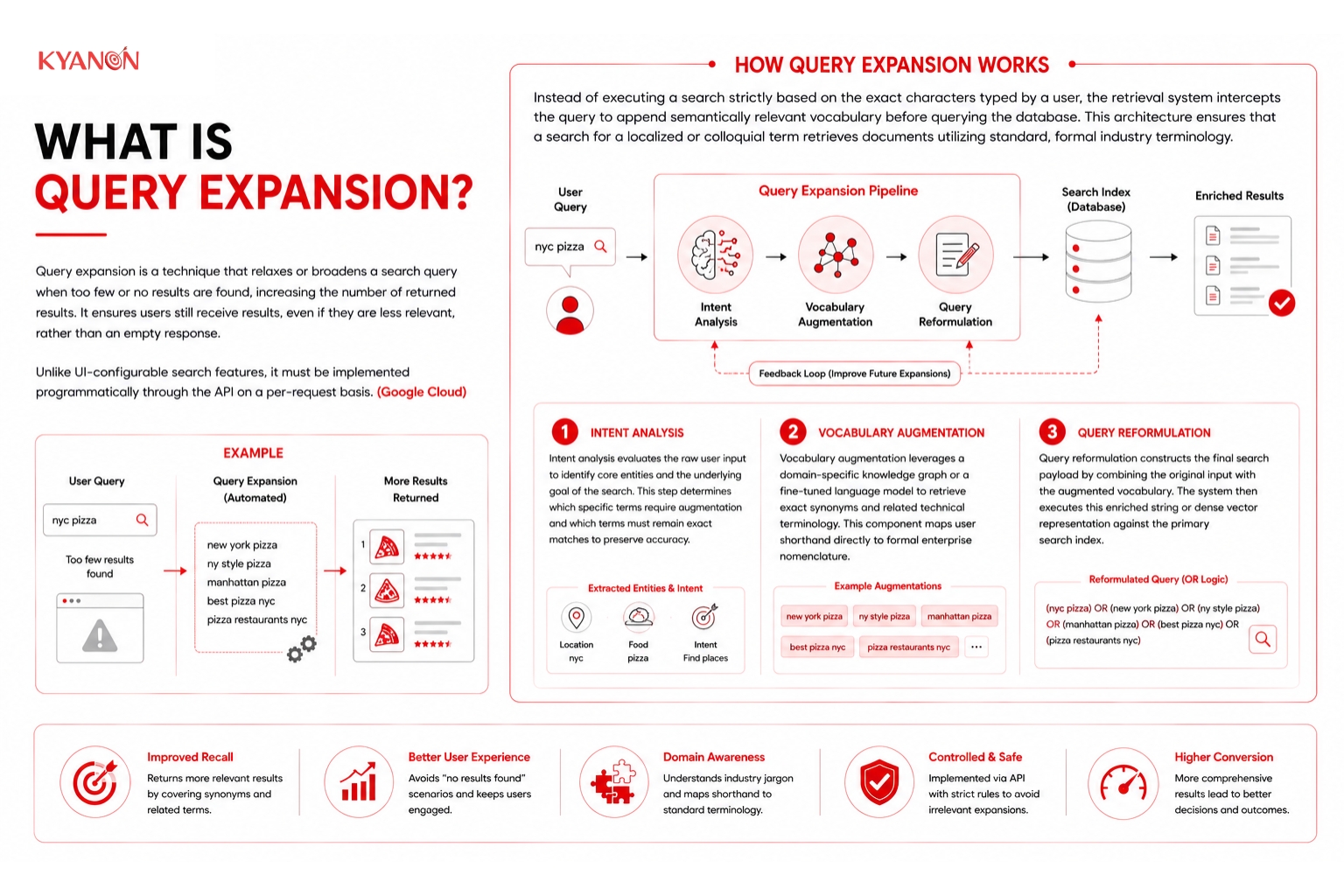
How query expansion works
Instead of executing a search strictly based on the exact characters typed by a user, the retrieval system intercepts the query to append semantically relevant vocabulary before querying the database. This architecture ensures that a search for a localized or colloquial term retrieves documents utilizing standard, formal industry terminology.
Intent Analysis
Intent analysis evaluates the raw user input to identify core entities and the underlying goal of the search. This step determines which specific terms require augmentation and which terms must remain exact matches to preserve accuracy.
Vocabulary Augmentation
Vocabulary augmentation leverages a domain-specific knowledge graph or a fine-tuned language model to retrieve exact synonyms and related technical terminology. This component maps user shorthand directly to formal enterprise nomenclature.
Query Reformulation
Query reformulation constructs the final search payload by combining the original input with the augmented vocabulary. The system then executes this enriched string or dense vector representation against the primary search index.

Query expansion use cases
- E-Commerce Search: If a customer types “running apparel” on a retail site, query expansion adds terms like “jogging shoes,” “dry-fit shirts,” and “athletic shorts” to surface a wider, more accurate product inventory.
- Enterprise Document Retrieval: Companies use it to search through messy internal corporate PDFs, ensuring that a search for a specific legal or financial regulation pulls up documents using historical or alternative internal jargon.
- Large Language Model (LLM) RAG Pipelines: In Retrieval-Augmented Generation (RAG architectures), an LLM is often used to rewrite a short user query into multiple distinct detailed search prompts. This ensures the vector database retrieves the highest quality context before the LLM generates a final answer.
Query expansion vs Query Understanding (AI)
Both mechanisms optimize how a system processes user inputs, but they execute at different stages and serve distinct operational functions.
Dimension | query expansion | Query Understanding (AI) |
| Primary function | Adds new vocabulary to the input | Interprets the structural intent of the input |
Execution phase | Pre-retrieval modification | Query parsing and classification |
| Output | A longer, augmented search string | Categorized intent, entities, and filters |
Best for | Fixing vocabulary mismatches | Handling typos, complex phrasing, and routing |
| Implementation complexity | Moderate (Requires domain dictionaries) | High (Requires NLP and machine learning models) |
When to consider query expansion
Consider query expansion if:
- Your enterprise knowledge base frequently returns zero results because employees utilize different acronyms or regional phrasing compared to the official documentation.
- You are building a Retrieval-Augmented Generation (RAG) system where users submit brief, ambiguous prompts that fail to retrieve the necessary technical context for the LLM.
- Your customer support portal experiences a low self-service deflection rate due to end-users describing technical issues using non-standard terminology.
It may not be the right priority if:
- Your database architecture consists exclusively of highly structured, exact-match identifiers—such as SKUs, transaction IDs, or MAC addresses, where fuzzy matching or synonyms introduce operational noise.
Why query expansion matters for enterprise search
Query expansion is important in enterprise search because it directly improves recall and search robustness when users’ original queries are incomplete, ambiguous, or too narrow.
In practice, it helps enterprise systems avoid “zero-result” or overly sparse result sets by automatically broadening the query, using synonyms, related terms, or semantic variations—so users still get relevant documents even when their input is imperfect. This is especially critical in large enterprise environments where terminology varies across teams, systems, and data sources. (MongoDB)
Common misconceptions
If we use an LLM to inject more synonyms and related terms into the search, we will catch every relevant document and improve recall
Reality: Injecting peripheral concepts causes query drift, which dilutes the original search intent. If a user searches for “How do I rotate AWS access keys safely?” and the system expands it with broad terms like “identity security,” the retrieval engine will pull generic governance documents rather than the precise operational runbook required.
Vector databases understand semantic meaning, so we do not need to worry about precision wording or synonym inflation
Reality: In enterprise and technical environments, a loose synonym is structurally incorrect and highly detrimental. Expanding a precise term like “Term sheet” to a generic “Contract,” or “Rollback” to “Revert,” forces legally and technically flawed content into the final retrieval pipeline.
How Kyanon Digital applies query expansion
Kyanon Digital implements query expansion in enterprise semantic search and RAG builds for clients across the US, ANZ, and Southeast Asia. Our engineering approach integrates domain-specific knowledge graphs with strict boundary controls to improve retrieval accuracy for specialized terminology. This targeted implementation prevents query drift and limits computational overhead, ensuring users access exact technical documentation while optimizing the Total Cost of Ownership (TCO) for the search infrastructure.
Explore our Generative AI Development services.

 Create project brief with AI