
What is Tax Automation?
Tax automation is the use of specialized software to automatically determine, calculate, collect, report, and remit indirect taxes, including sales tax, Value Added Tax (VAT), and Goods and Services Tax (GST), throughout the entire transaction lifecycle. Instead of relying on manually maintained tax tables, spreadsheets, or periodic rule updates, tax automation platforms continuously apply the latest tax regulations based on product classification, customer location, transaction type, exemptions, and jurisdiction-specific requirements.
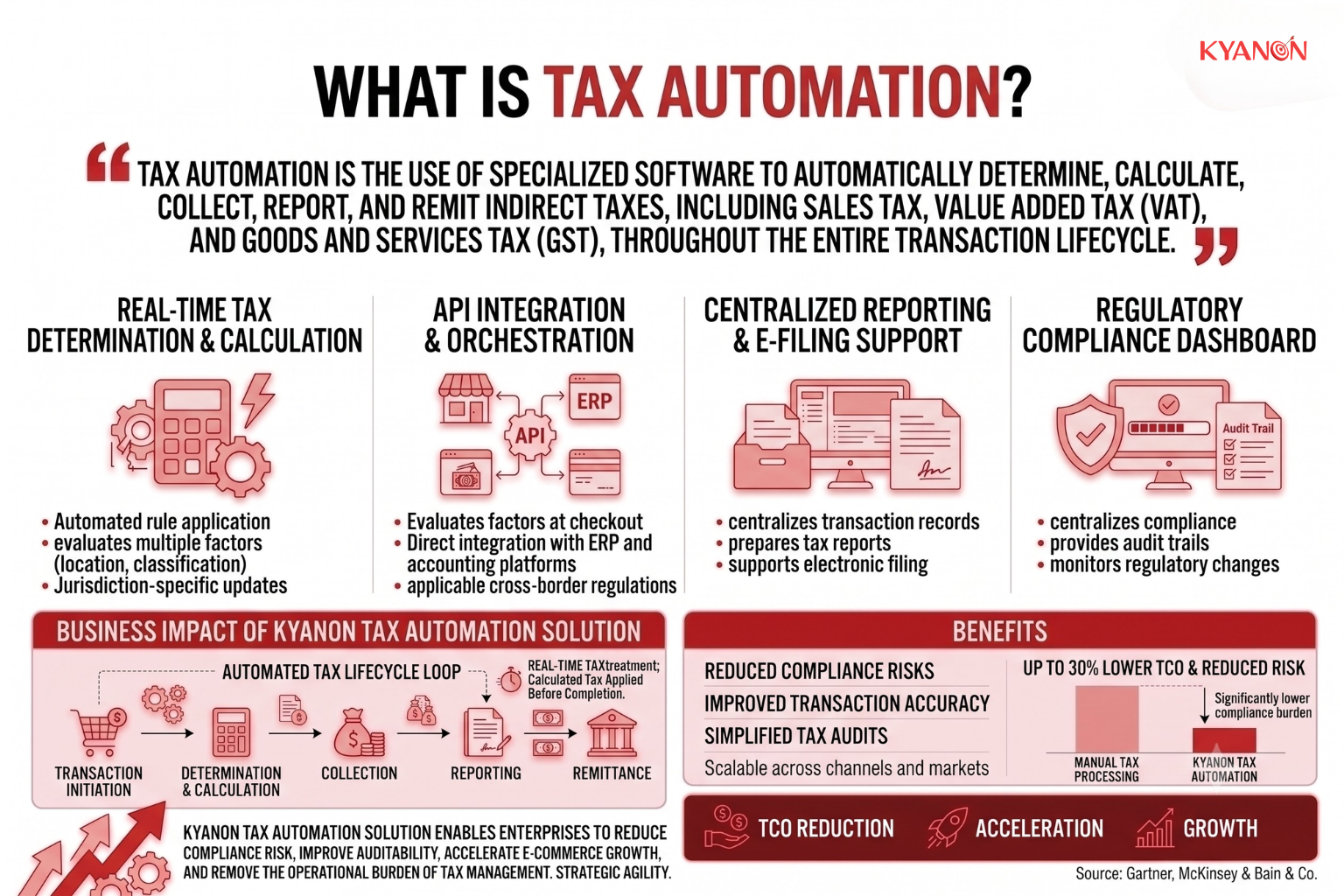
In modern e-commerce environments, tax automation integrates directly with storefronts, ERP systems, payment gateways, marketplaces, and accounting platforms through APIs. During checkout, the system determines the correct tax treatment in real time by evaluating multiple factors such as shipping destination, billing address, product taxability, customer tax status, and applicable cross-border regulations. The calculated tax is then automatically applied before the transaction is completed.
Beyond tax calculation, tax automation also centralizes transaction records, prepares tax reports, supports electronic filing, manages tax registrations, monitors regulatory changes, and, in many cases, automates tax remittance to government authorities. Many enterprise platforms also provide audit trails, compliance dashboards, and document management to simplify tax audits and reduce compliance risks.
How Tax Automation Works
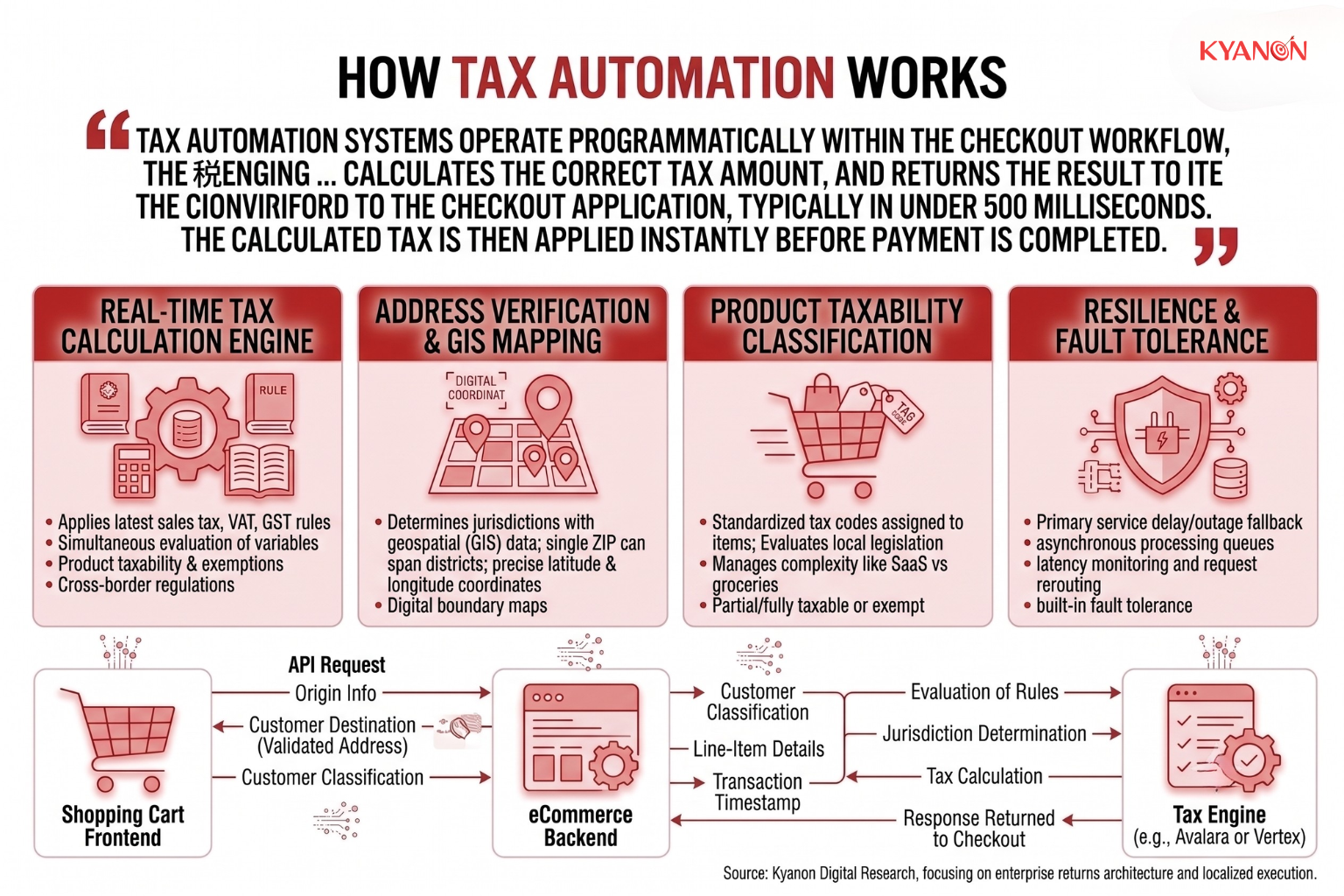
Tax automation systems operate programmatically within the checkout workflow of an e-commerce platform. When a customer initiates a purchase, the platform’s backend sends an API request to the tax engine, transmitting a structured JSON payload containing all transaction data required to determine the correct tax treatment in real time.
The payload typically includes:
- Origin information (warehouse, store, or fulfillment center)
- Customer destination (validated shipping and billing addresses)
- Customer classification (B2C, B2B, tax-exempt, reseller, etc.)
- Line-item details (SKUs, quantities, prices, discounts, and product tax codes)
- Transaction timestamp to lock the applicable tax rules at the moment of purchase
Using these inputs, the tax engine evaluates current tax regulations, determines the applicable jurisdictions, calculates the correct tax amount, and returns the result to the checkout application, typically in under 500 milliseconds. The calculated tax is then applied instantly before payment is completed.
Real-Time Tax Calculation Engine
The calculation engine is the core decision layer of the platform. It continuously applies the latest sales tax, VAT, and GST rules by evaluating multiple transaction variables simultaneously, including geographic jurisdiction, customer type, product taxability, exemptions, tax holidays, and cross-border regulations. Because tax rules are updated centrally, businesses no longer need to manually maintain tax rate tables or jurisdiction mappings.
Address Verification & Geospatial Jurisdiction Mapping
Modern tax automation platforms determine tax jurisdictions using geospatial (GIS) mapping rather than relying solely on postal codes. A single ZIP or postal code may span multiple cities, counties, or special tax districts, and properties on opposite sides of the same street can fall under different tax authorities.
To improve accuracy, the system validates customer addresses, converts them into precise latitude and longitude coordinates, and overlays those coordinates onto digital jurisdiction boundary maps. This spatial mapping ensures the correct state, municipal, and local tax authorities receive the appropriate tax allocation.
Product Taxability Classification
Taxability varies significantly by product category and jurisdiction. The same product may be fully taxable in one location, partially taxable in another, or completely exempt elsewhere. For example, SaaS subscriptions, clothing below certain price thresholds, groceries, digital products, and bundled goods often follow different tax rules.
To manage this complexity, tax automation platforms assign standardized tax codes to every product or service, allowing the calculation engine to automatically apply the appropriate tax treatment based on local legislation.
Resilience & Fault Tolerance
Because tax calculation occurs during live checkout, reliability is essential to avoid disrupting customer purchases. Enterprise tax automation platforms therefore include built-in fault tolerance mechanisms.
If the primary tax service experiences delays or temporary outages, circuit breakers can fall back to predefined tax estimates to prevent checkout failures. Asynchronous processing queues ensure orders continue to flow while transaction records are synchronized for downstream reporting. Latency monitoring automatically reroutes requests when service performance degrades, and post-transaction reconciliation verifies calculations and corrects minor discrepancies before tax reporting and filing.
This architecture allows organizations to maintain both a seamless customer experience and accurate tax compliance, even under high transaction volumes or temporary infrastructure failures.

Tax Automation vs Manual Tax Management
While manual tax management relies on fixed, hard-coded database tables, automated tax software uses real-time API queries to pull dynamically updated rates from cloud-based tax repositories.
Dimension | Manual Tax Management | Tax Automation |
| Deployment Speed | Slow; requires hard-coded tax tables | Fast; integrated via pre-built API connectors |
Calculation Latency | Low, but prone to outdated database rates | Negligible; typically resolved in under 500ms |
| Regulatory Updates | Manual engineering or financial team audits | Automated updates in cloud-based registries |
Scalability to New Markets | Hard; requires custom localized development | Easy; global tax engines cover multiple countries |
| Operational Risk | High; manual entry errors lead to audit fines | Low; based on standardized taxability rules |
When to Consider Tax Automation
Organizations must adopt automated tax processing when their sales volume exceeds the economic nexus thresholds defined by local or foreign tax authorities.
Consider Tax Automation if:
- Your enterprise is expanding internationally (e.g., entering cross-border commerce across Southeast Asia, Europe, or North America) and must manage multiple currencies and change VAT/GST structures.
- Your engineering team spends hours updating tax rate tables in legacy databases to keep pace with changing municipal jurisdictions.
- You are migrating to a composable commerce setup and need a unified calculation service that works across disparate storefronts, mobile apps, and marketplace channels.
It may not be the right priority if:
- Your digital storefront operates entirely within a single tax district with low sales volume and no physical or economic footprint outside that boundary.
Why Tax Automation Matters for Enterprise E-Commerce
As e-commerce expands across borders, tax compliance has become a strategic infrastructure challenge rather than simply a finance function. Cross-border retailers must comply with constantly evolving sales tax, VAT, and GST regulations while maintaining fast, frictionless checkout experiences that support revenue growth.
The urgency is increasing alongside the rapid expansion of global digital commerce. The Business Times projects that the global cross-border e-commerce market will reach US$5 trillion by 2028, accounting for 58% of all global e-commerce transactions. At this scale, manually managing tax rules across dozens of jurisdictions becomes increasingly costly, error-prone, and difficult to scale.
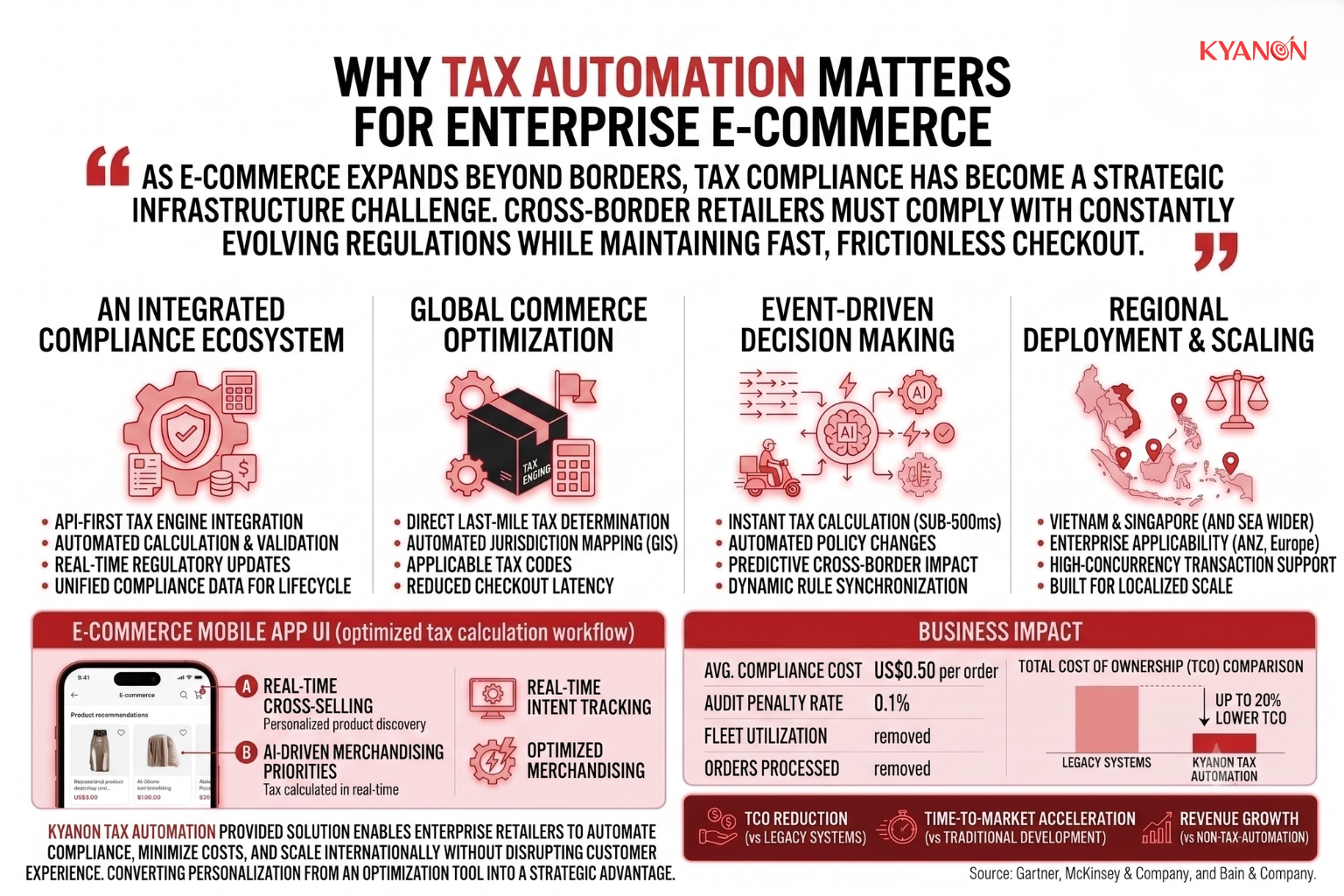
In high-growth regions such as Southeast Asia, competitive advantage is no longer driven solely by customer-facing applications. It increasingly depends on the strength of the underlying commerce infrastructure, including payment processing, tax compliance, and regulatory automation, that enables businesses to expand into new markets without introducing operational friction.
Tax automation addresses these challenges by integrating compliance directly into the transaction workflow. Rather than relying on manual tax tables or periodic rule updates, automated tax engines continuously apply the latest regulations during checkout, reducing compliance risks, minimizing operational overhead, and allowing organizations to scale internationally without slowing the customer experience.
The need for automation is further reinforced by an increasingly volatile regulatory environment. Governments regularly introduce new digital tax regimes, modify VAT or GST requirements, and debate changes to cross-border taxation policies for digital goods and electronic services. Programmatic tax automation enables enterprises to respond to these regulatory changes almost immediately through centralized rule updates, eliminating the need for manual intervention while helping maintain accurate tax collection and uninterrupted checkout performance.
Common Misconceptions
Tax automation platforms cannot fix corrupted or improperly mapped product taxability codes without human oversight.
Tax automation is a “set it and forget it” system that guarantees perfect compliance.
Software can only process the rules configured inside it. If your inventory team assigns incorrect taxability codes to products, the tax engine will calculate taxes inaccurately. Systems require ongoing monitoring of physical and economic nexus thresholds.
Tax automation software completely replaces internal accounting professionals
Automated engines excel at repetitive mathematical calculations, address geolocating, and populating standard tax forms. However, strategic tax planning, interpreting ambiguous tax regulations, and deciding on corporate tax structures still require certified human CPAs.
How Kyanon Digital Applies Tax Automation
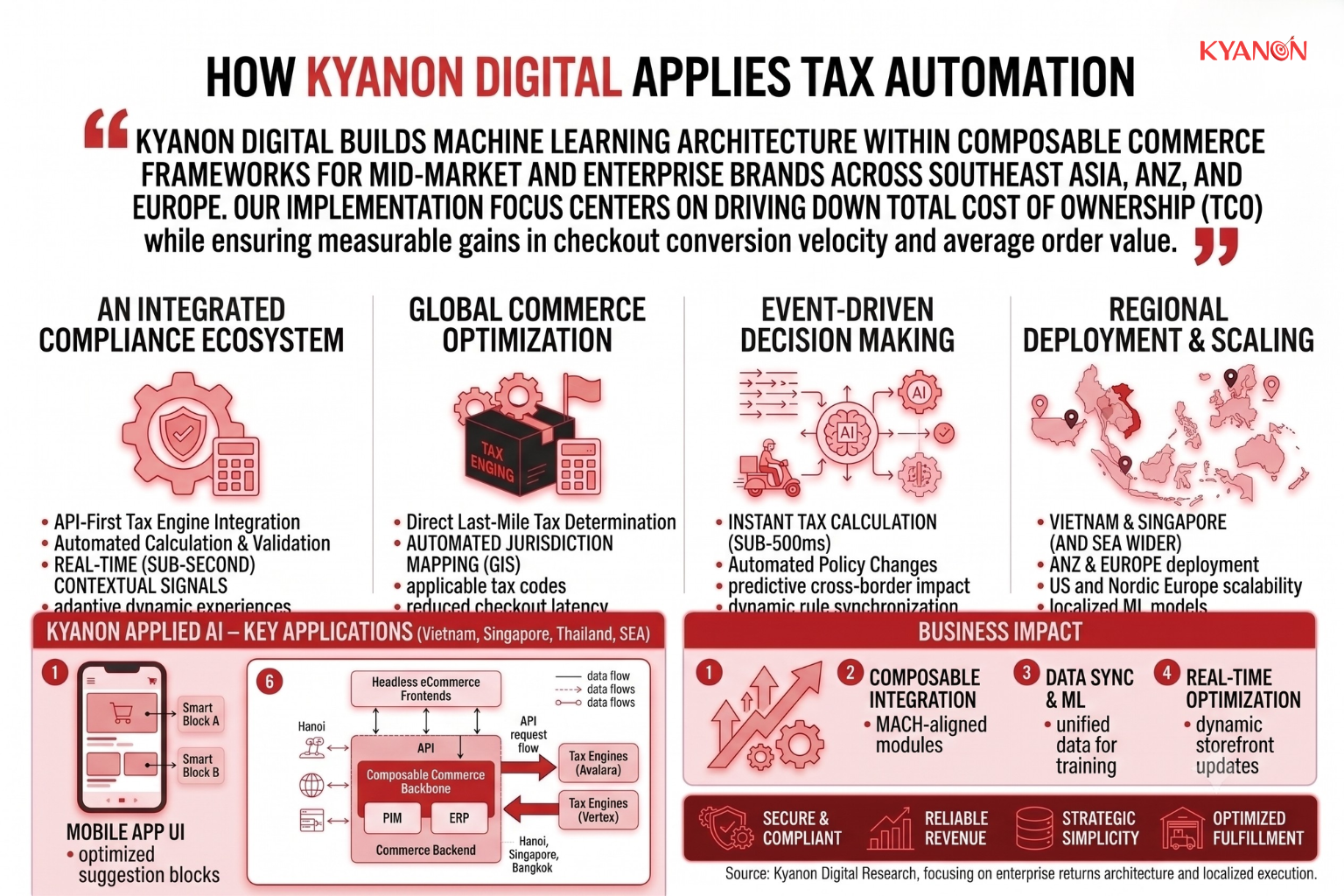
Kyanon Digital implements third-party tax engines like Avalara and Vertex within headless and composable e-commerce systems to automate cross-border compliance. Our implementation expertise ensures that these engines are integrated into your API-first commerce stack without introducing checkout latency.
We map taxability categories to your product information management (PIM) system and integrate tax engines with your enterprise resource planning (ERP) systems to provide clear, end-to-end data pipelines for enterprise clients across Vietnam, Singapore, Thailand, ANZ, the US, and Nordic Europe.
Explore our services:

 Create project brief with AI