
What Is a Transformer?
A Transformer is a deep learning architecture that uses self-attention mechanisms to process and understand entire data sequences simultaneously rather than in a strict chronological order. Unlike traditional neural networks such as Recurrent Neural Networks (RNNs) and Long Short-Term Memory (LSTM) models, which analyze information step by step, Transformers evaluate relationships across all elements in a sequence at the same time while preserving positional information.
This parallel processing capability significantly improves computational efficiency and scalability, enabling the training of models on massive volumes of structured and unstructured data. As a result, the Transformer has become the foundational architecture of modern generative AI, providing the core framework behind today’s foundation models and large language models, including GPT, Claude, Gemini, and Llama.

How a Transformer Works
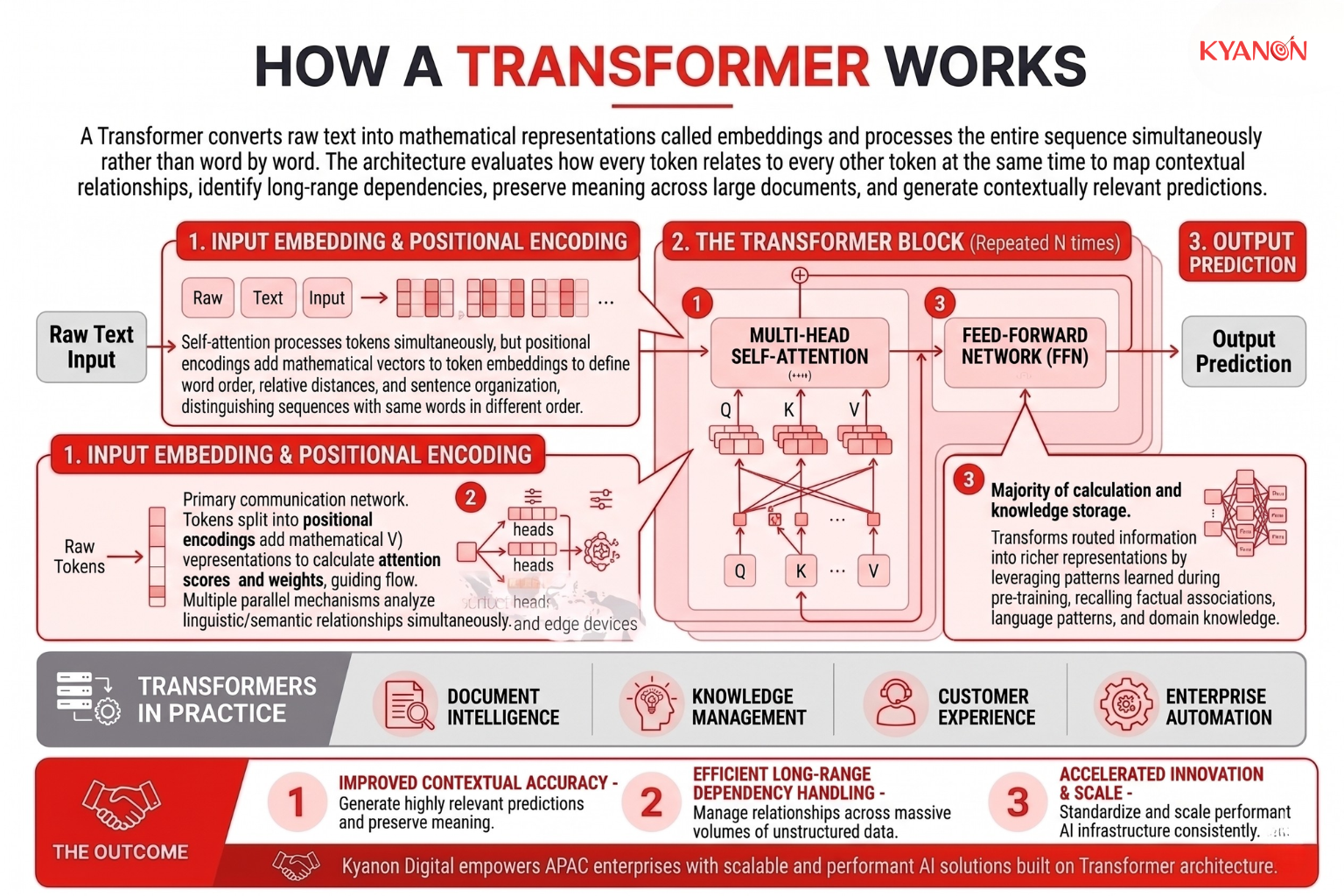
A Transformer converts raw text into mathematical representations called embeddings and processes the entire sequence simultaneously rather than word by word. Instead of analyzing information in a fixed chronological order, the architecture evaluates how every token relates to every other token at the same time. By mapping these contextual relationships across the entire sequence, the model can identify long-range dependencies, preserve meaning across large documents, and generate contextually relevant predictions.
Self-Attention Mechanism
The self-attention layer serves as the Transformer’s primary communication network. It enables every token in a sequence to evaluate and interact with every other token simultaneously, determining which pieces of information are most relevant in a given context.
To accomplish this, each token is transformed into three mathematical representations known as Queries (Q), Keys (K), and Values (V). The model compares these representations to calculate attention scores, which determine how strongly one token should focus on another. These scores are converted into attention weights that guide the flow of contextual information throughout the sequence.
Modern Transformers use multi-head attention, where multiple attention mechanisms operate in parallel. This allows the model to analyze different linguistic and semantic relationships simultaneously, such as grammatical structure, entity references, and contextual meaning.
Feed-Forward Networks (FFNs)
After information has been routed through the attention layers, it passes into Feed-Forward Networks (FFNs), which perform the majority of the model’s internal computation. FFNs make up roughly two-thirds of a Transformer’s total parameters and act as a large-scale knowledge storage and processing system.
While attention layers determine where information should flow, FFNs transform that information into richer representations by leveraging patterns learned during pre-training. Through this process, the model recalls factual associations, language patterns, and domain knowledge embedded within its parameters.
Positional Encodings
Because self-attention processes all tokens simultaneously, it does not inherently understand the order of words within a sequence. Positional encodings solve this problem by adding mathematical position vectors directly to token embeddings before processing begins.
These encodings provide the model with information about sequence structure, relative distances between words, and overall sentence organization. As a result, the Transformer can distinguish between sequences that contain the same words but convey different meanings due to word order, enabling accurate interpretation of grammar, syntax, and context.

Transformer vs Recurrent Neural Network (RNN)
Both architectures process sequential data, but they differ fundamentally in execution speed, memory retention, and how they scale across computing hardware.
Dimension | Transformer | Recurrent Neural Network (RNN) |
| Processing method | Parallel (Simultaneous) | Sequential (Chronological) |
Context retention | High (Maintains long-range dependencies) | Low (Suffers from rapid context loss) |
| Hardware scaling | High (Optimizes GPU matrix multiplication) | Low (Bottlenecked by sequential updates) |
Core mechanism | Self-attention and FFNs | Hidden state vectors |
| Best for | Enterprise GenAI & Large Language Models | Simple time-series forecasting |
When to Consider Transformers
Consider deploying Transformer architectures if:
- Your organization needs to process, summarize, or extract structured data from thousands of pages of unstructured technical documentation simultaneously.
- You are planning to deploy generative AI applications that require retaining accurate conversational context across very long user sessions.
- Your engineering team is shifting from localized predictive analytics to building proprietary, multimodal foundation models that combine text, image, and tabular data.
It may not be the right priority if:
- Your primary operational requirement is predicting daily inventory yields using highly structured, tabular historical data where standard regression or tree-based algorithms achieve optimal accuracy with negligible compute costs.
Why Transformers Matter for Enterprise AI
Transformer architectures have become the technological foundation of modern generative AI and foundation models, enabling organizations to process, understand, and generate content across massive volumes of unstructured data. Their ability to scale efficiently across large datasets has transformed AI from a niche research discipline into a practical enterprise capability.
The business significance of Transformers extends beyond technical performance. According to Gartner, more than 80% of enterprises will have deployed generative AI APIs, models, or built-in applications in production environments, up from less than 5% in early 2023. This rapid proliferation signifies that Transformer-driven technologies have officially graduated from the “Peak of Inflated Expectations” on the Hype Cycle into a phase of pragmatic enterprise democratization, where the primary focus shifts from algorithmic novelty to systematic utility.
For business leaders, this shift translates into new opportunities to automate knowledge-intensive work, improve customer experiences, accelerate content creation, enhance decision-making, and unlock value from previously inaccessible unstructured data sources. As organizations expand AI adoption, Transformer-based models are increasingly becoming core infrastructure for digital transformation initiatives rather than standalone experimental tools.
The rapid enterprise adoption of generative AI demonstrates how Transformer architectures have evolved from an academic breakthrough into a foundational technology layer supporting productivity, innovation, and operational efficiency at scale.

Common Misconceptions
Once deployed, the Transformer continuously learns from our enterprise data in real-time
A trained Transformer is completely static; its neural weights are entirely frozen. When a Large Language Model appears to remember an instruction from five prompts ago, it is not learning; it is taking your entire chat history, feeding it back through the frozen network as a single sequence, and recalculating the self-attention scores from scratch.
Parallel processing happens continuously, even when generating text
Parallel processing only occurs during the training phase, where the model can analyze entire documents simultaneously. During inference (text generation), the model operates sequentially, generating text one token at a time autoregressively, which creates a strict memory bandwidth bottleneck requiring optimization techniques like KV caching.
Hallucinations are just a software bug that our engineers can patch out
Hallucination is not a system glitch; it is the fundamental mechanism by which Transformers operate. The models function as lossy data compressors that minimize divergence between probability distributions, meaning they will confidently generate a factually incorrect word if it structurally and mathematically fits the pattern of the training data.
How Kyanon Digital Applies Transformers
Kyanon Digital helps enterprises turn Transformer-based AI from a technical innovation into a scalable business capability. Across Southeast Asia and global markets, Kyanon Digital designs and implements AI solutions that leverage Transformer architectures for document intelligence, knowledge management, customer experience, predictive analytics, and enterprise automation.
A key differentiator is Kyanon Digital’s focus on data quality and feature engineering. While many organizations focus primarily on selecting the right model, enterprise AI performance often depends on how effectively data is structured, enriched, and contextualized before it reaches the model. Kyanon Digital’s data scientists optimize inputs and retrieval strategies to improve accuracy, reduce inference costs, and increase the reliability of AI-generated outputs.
For generative AI initiatives, Kyanon Digital applies approaches such as Retrieval-Augmented Generation (RAG), domain-specific knowledge integration, and workflow orchestration to ground Transformer models in trusted enterprise data. This helps reduce hallucination risks while delivering more relevant, explainable, and business-ready results.
Beyond strategy and experimentation, Kyanon Digital provides deep implementation expertise across AI engineering, data platforms, cloud infrastructure, and enterprise systems integration. This enables organizations to move from proof of concept to production faster while maintaining governance, scalability, and measurable business outcomes.
By combining technical expertise with a strong focus on business value, Kyanon Digital helps enterprises deploy Transformer-powered solutions that improve operational efficiency, accelerate decision-making, and unlock greater value from enterprise data.

→ Explore our Machine Learning Development services.

 Create project brief with AI