
What is an Upsell & Cross-Sell Engine?
An Upsell & Cross-Sell Engine is an AI-driven e-commerce system that automatically presents higher-value alternatives or relevant complementary products to consumers based on real-time behavior, catalog attributes, and historical purchase data. Integrated into digital storefronts, checkout flows, and loyalty platforms, it optimizes merchant Average Order Value (AOV) and Customer Lifetime Value (CLV).
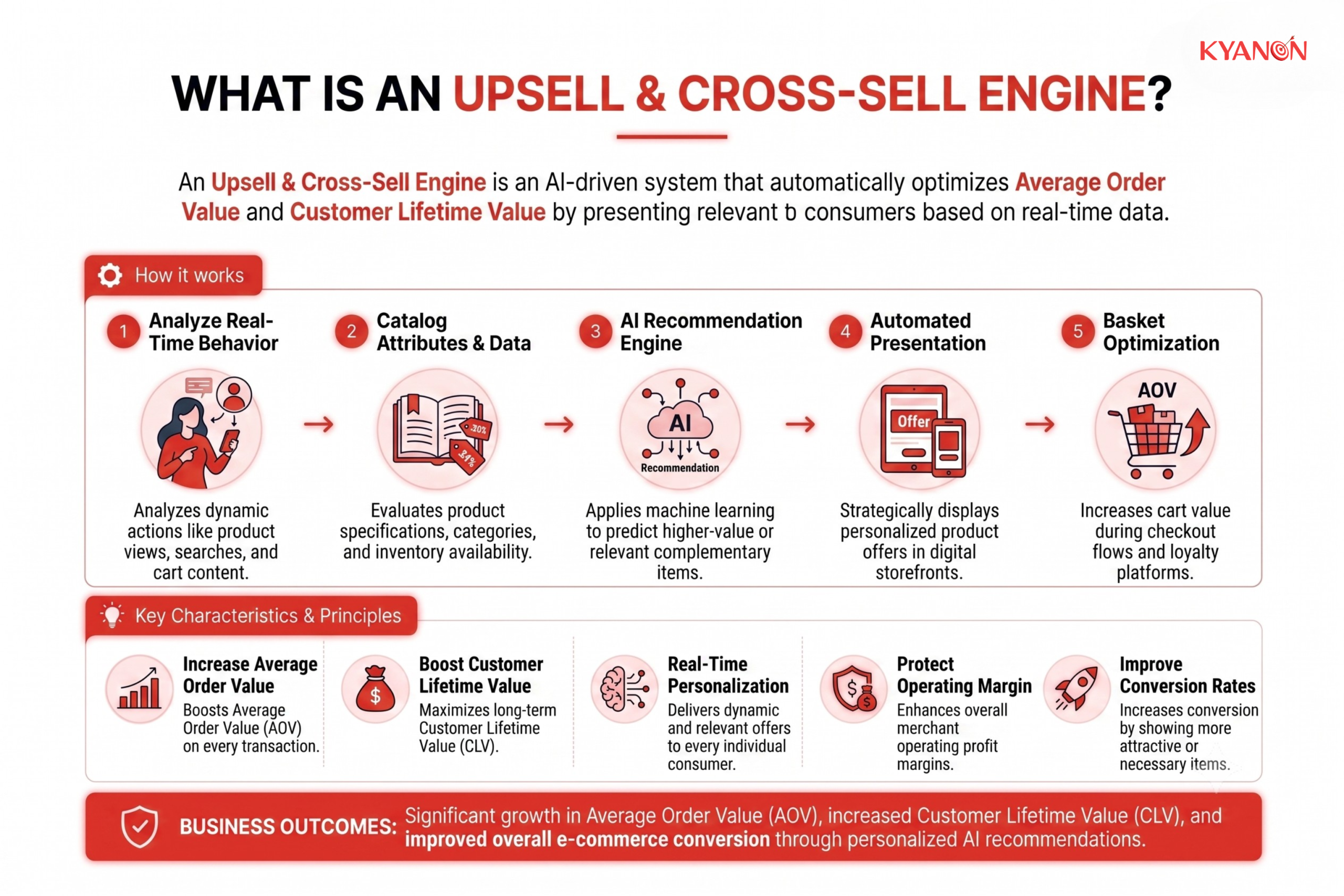
How an Upsell & Cross-Sell Engine Works
Modern upsell and cross-sell engines continuously analyze customer behavior, product relationships, and business rules to deliver personalized recommendations throughout the shopping journey. Rather than relying on static product pairings, these systems use real-time data processing and machine learning models to identify products that are most relevant to each customer while aligning with inventory availability and merchandising objectives.
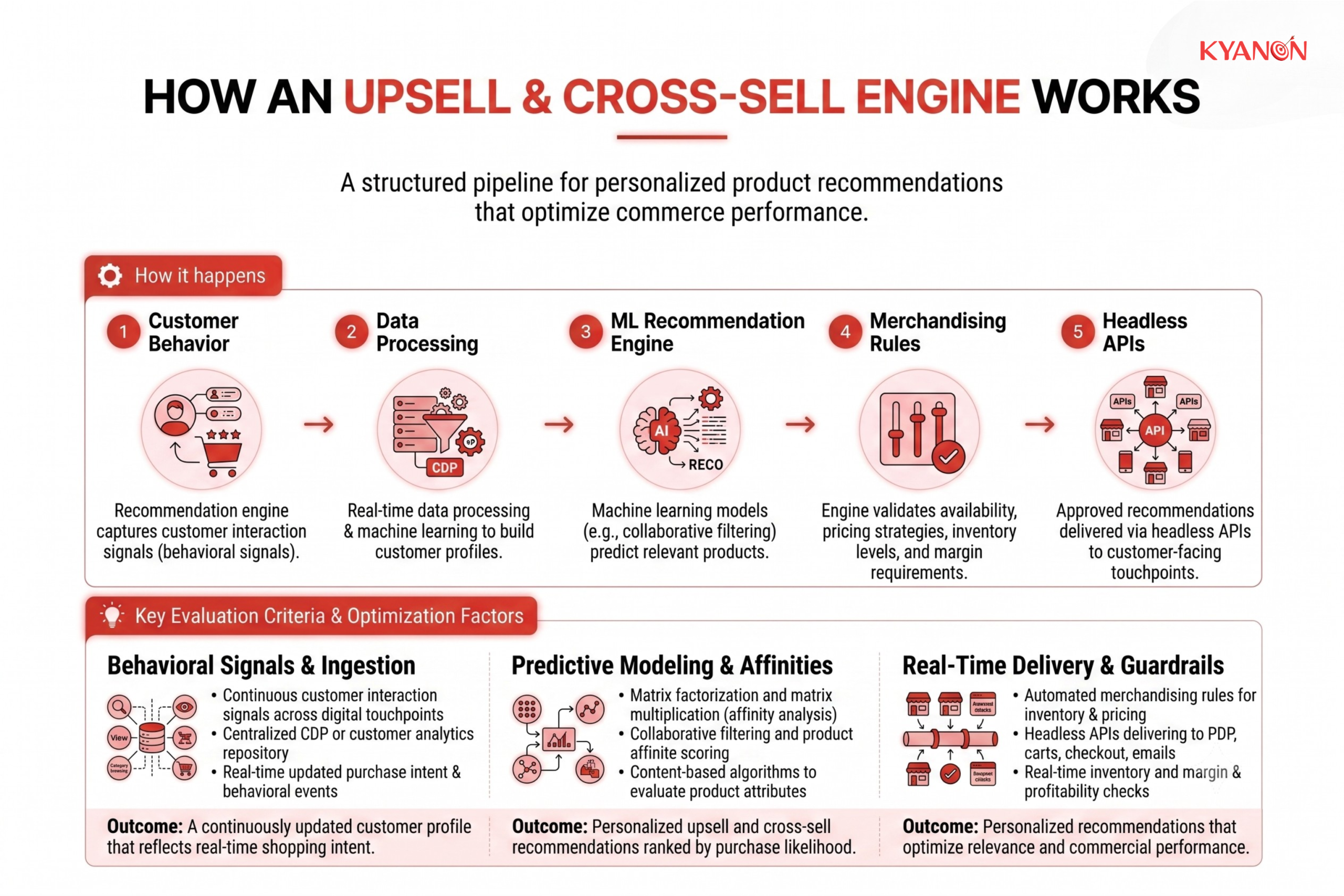
Data Ingestion & Behavioral Tracking
The recommendation engine continuously captures customer interaction signals across digital touchpoints to build a comprehensive understanding of purchase intent. These behavioral events are aggregated into centralized customer profiles, typically managed through a Customer Data Platform (CDP) or customer analytics repository.
Behavioral signals include:
- Search queries and product discovery
- Product page views and dwell time
- Category browsing history
- Cart additions and removals
- Historical purchases and transaction history
Outcome: A continuously updated customer profile that reflects real-time shopping intent.
Predictive Modeling & Matrix Factorization
Machine learning models analyze customer behavior alongside product relationship data to determine the most relevant recommendations. Collaborative filtering identifies products commonly purchased by customers with similar purchasing patterns, while content-based algorithms evaluate product attributes, including category, specifications, pricing, and compatibility, to recommend complementary or premium alternatives.
Recommendation techniques
- Collaborative filtering
- Content-based filtering
- Product affinity scoring
- Product co-occurrence analysis
Outcome: Personalized upsell and cross-sell recommendations ranked by purchase likelihood.
Real-Time API Delivery & Merchandising Rules
Before recommendations are displayed, they pass through automated merchandising rules that align AI-generated suggestions with business objectives. The engine validates product availability, pricing strategies, inventory levels, promotional exclusions, and margin requirements to ensure recommendations remain commercially relevant.
Approved recommendations are then delivered through headless APIs to customer-facing touchpoints, enabling dynamic merchandising across the entire buying journey.
Delivery channels
- Product Detail Pages (PDPs)
- Product recommendation carousels
- Shopping cart and cart drawer
- Checkout experience
- Post-purchase confirmation and follow-up emails
Business safeguards
- Real-time inventory validation
- Margin and profitability thresholds
- Promotional and campaign rules
- Product availability checks
Outcome: Personalized product recommendations that optimize both customer relevance and commercial performance without compromising operational constraints.

Comparative Analysis: Dynamic Recommendation Engine vs. Manual Merchandising Rules
Manual product rules rely on static curation, whereas automated recommendation engines continuously adapt to individual user intent and catalog changes.
Dimension | Manual Merchandising Rules | Dynamic Recommendation Engine |
| Operational Effort | High manual workload for catalog mapping | Fully automated real-time optimization |
Personalization Level | Generic rules applied to all site traffic | Individualized recommendations based on real-time behavior |
| Catalog Scalability | Low; impractical for large SKU catalogs | High; scales effortlessly across millions of SKUs |
Adaptability | Static; fails to account for shifting trends | Adaptive; updates dynamically via continuous machine learning |
| Conversion Performance | Baseline conversion lift | Maximized conversion rate optimization and AOV expansion |
When to Consider an Upsell & Cross-Sell Engine
Consider an Upsell & Cross-Sell Engine if:
- Your e-commerce store maintains a large SKU catalog where high-margin accessories or upgraded models remain undiscovered by browsing customers.
- Customer acquisition costs (CAC) are rising, requiring higher Average Order Value (AOV) to maintain operating profitability.
- Manual cross-selling configurations require excessive labor hours from merchandising and IT teams during product catalog updates.
It may not be the right priority if:
- Your business offers a single-product catalog or highly specialized custom B2B inventory without natural accessory pairings or premium tier upgrades.
Why an Upsell & Cross-Sell Engine Matters for E-Commerce
An upsell and cross-sell engine helps retailers overcome one of the most common sources of revenue leakage in eCommerce: limited product discovery. Without intelligent recommendations, customers often purchase only the items they initially searched for, leaving complementary products and premium alternatives undiscovered. AI-powered recommendation engines address this challenge by analyzing customer intent, behavioral signals, and product relationships in real time, enabling retailers to surface the most relevant products at every stage of the shopping journey.
Rather than functioning solely as a merchandising tool, modern recommendation engines have become a core capability of AI-driven personalization. By delivering contextually relevant product suggestions across Product Detail Pages (PDPs), shopping carts, checkout flows, and post-purchase experiences, retailers can increase basket size, improve product discovery, and maximize the value of each customer interaction.
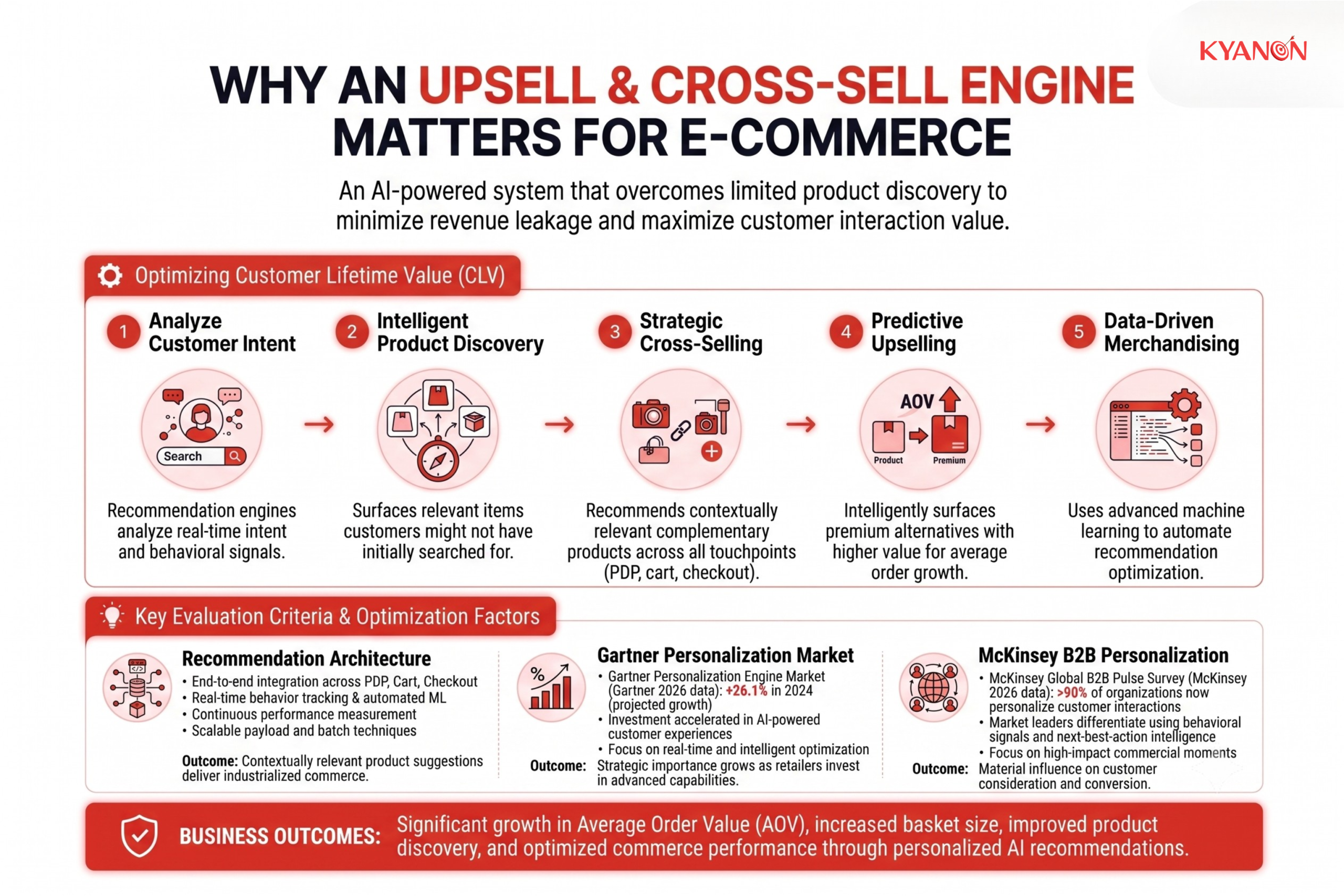
The strategic importance of recommendation technology continues to grow as retailers invest in more advanced personalization capabilities. According to Gartner, the personalization engine market grew 26.1% in 2024 as organizations accelerated investments in AI-powered customer experiences. Gartner also identifies real-time behavior tracking, automated machine learning, recommendation optimization, and continuous performance measurement as core capabilities for modern personalization platforms, reflecting the industry’s shift toward intelligent, data-driven commerce.
This trend is reinforced by McKinsey’s 2026 Global B2B Pulse Survey, which found that more than 90% of organizations now personalize customer interactions across digital channels. McKinsey further notes that market leaders differentiate themselves by using behavioral signals, purchase history, and next-best-action intelligence to deliver individualized recommendations during high-impact commercial moments, where personalization can materially influence customer consideration and conversion.
Common Misconceptions
Recommendations Always Annoy the Customer
Contextual, well-timed product recommendations improve the shopping experience by helping buyers quickly discover compatible accessories, necessary components, or relevant product upgrades.
Recommendation Engines Force People to Overspend
Intelligent engines surface items shoppers actively require—such as compatible batteries, protective cases, or maintenance plans—reducing post-purchase regret and missing item returns.
Recommendations Must Happen at Checkout
Triggering upsells and cross-sells on product detail pages, side-cart drawers, post-purchase order status screens, and automated email follow-ups frequently yields significantly higher conversion rates than cluttered checkout pages.
Recommendation Systems Require Massive Data to Start
Basic recommendation engines operate effectively from day one using rule-based algorithms, taxonomy metadata, and simple “frequently bought together” association logic before accumulating deep behavioral datasets.
How Kyanon Digital Applies Upsell & Cross-Sell Engine
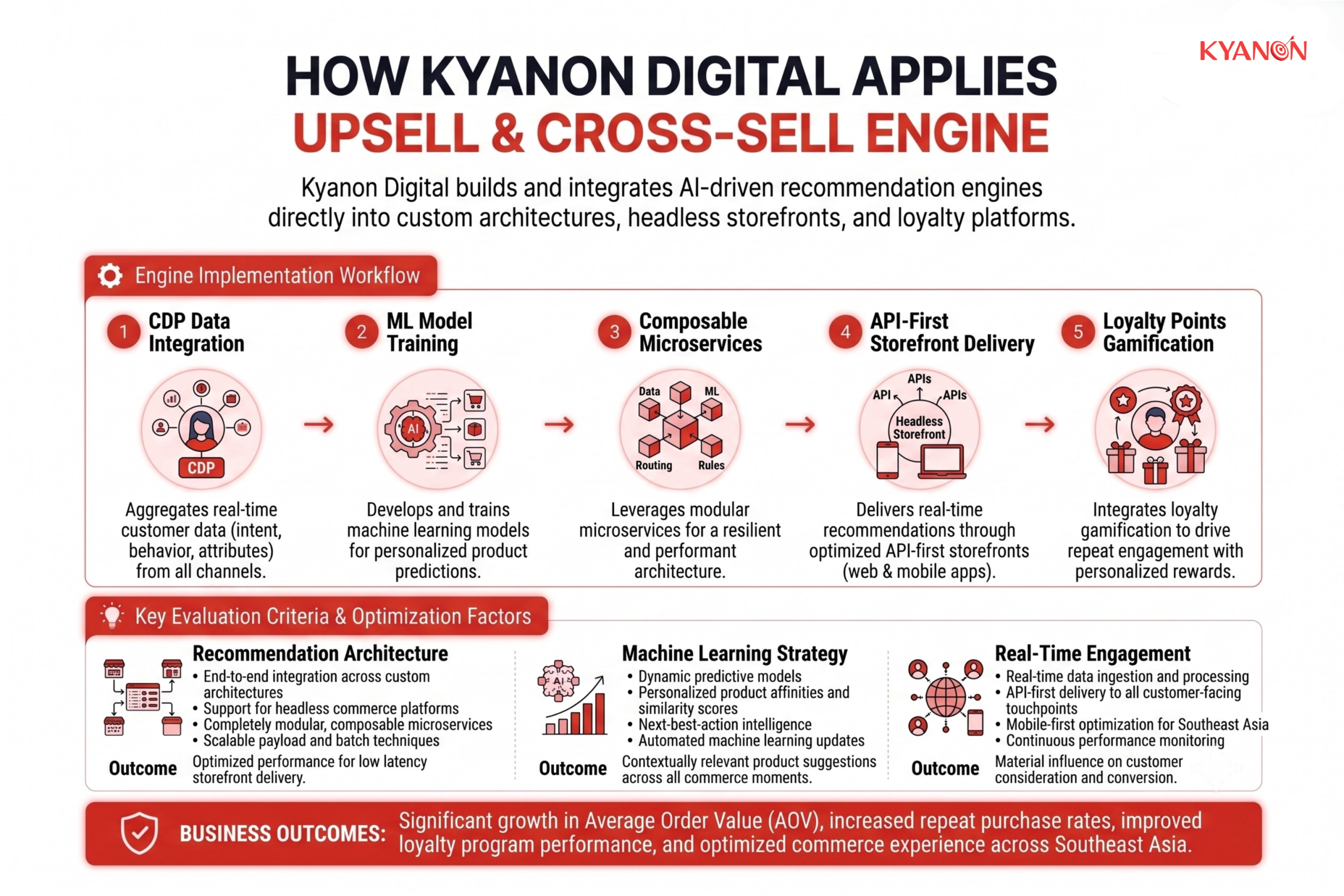
Kyanon Digital builds and integrates AI-driven recommendation engines directly into custom e-commerce architectures, headless storefronts, and customer loyalty platforms across Southeast Asia. Our engineering teams leverage composable microservices, real-time data pipelines, and machine learning models to surface personalized upsells and cross-sells across mobile apps and web storefronts without impacting page performance.
Explore our services:

 Create project brief with AI