
What is checkout optimization?
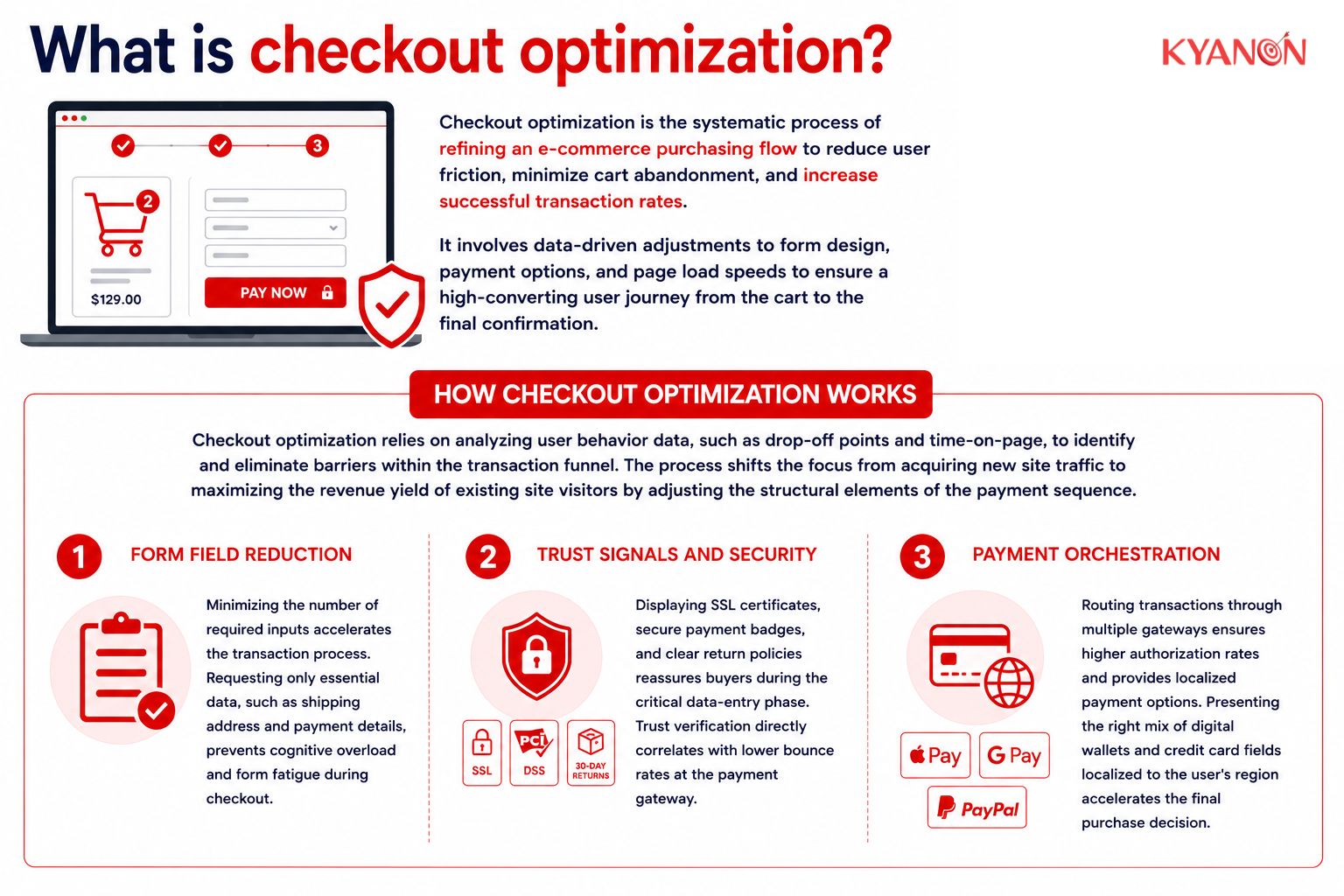
Checkout optimization is the systematic process of refining an e-commerce purchasing flow to reduce user friction, minimize cart abandonment, and increase successful transaction rates. It involves data-driven adjustments to form design, payment options, and page load speeds to ensure a high-converting user journey from the cart to the final confirmation.
How checkout optimization works
Checkout optimization relies on analyzing user behavior data, such as drop-off points and time-on-page, to identify and eliminate barriers within the transaction funnel. The process shifts the focus from acquiring new site traffic to maximizing the revenue yield of existing site visitors by adjusting the structural elements of the payment sequence.
Form field reduction
Minimizing the number of required inputs accelerates the transaction process. Requesting only essential data, such as shipping address and payment details, prevents cognitive overload and form fatigue during checkout.
Trust signals and security
Displaying SSL certificates, secure payment badges, and clear return policies reassures buyers during the critical data-entry phase. Trust verification directly correlates with lower bounce rates at the payment gateway.
Payment orchestration
Routing transactions through multiple gateways ensures higher authorization rates and provides localized payment options. Presenting the right mix of digital wallets and credit card fields localized to the user’s region accelerates the final purchase decision.

Checkout optimization vs Conversion rate optimization (CRO)
Both approaches improve overall site metrics, but differ in scope and position within the user journey.
Dimension | Checkout optimization | Conversion Rate Optimization (CRO) |
| Scope | Confined strictly to the cart and payment sequence | Spans the entire website or digital application |
Funnel Stage | Bottom of the funnel (Transaction) | Top to bottom of the funnel (Discovery to Transaction) |
| Primary Metric | Cart abandonment rate, payment success rate | Overall site conversion rate, click-through rate |
Focus Area | Payment gateways, form fields, shipping options | Landing pages, product descriptions, call-to-action buttons |
| Technical Complexity | High (involves API integrations, PCI compliance) | Low to Medium (involves A/B testing UI elements) |
When to consider checkout optimization
Evaluating the payment flow is necessary when specific analytics indicate a bottleneck at the final transaction stage. Consider Checkout Optimization if:
- Your analytics show high add-to-cart rates but a disproportionately high drop-off at the payment or shipping information stage.
- You are expanding into new international markets and your current payment gateway mix is causing localized payment authorization failures.
- Your mobile traffic exceeds 60%, but mobile revenue trails desktop revenue due to cluttered mobile payment screens.
It may not be the right priority if:
- Your e-commerce platform is currently undergoing a complete backend replatforming that will overwrite existing frontend code within the next quarter.
Why checkout optimization matters for retail and E-commerce
Optimizing the transaction phase directly impacts the bottom line without requiring additional marketing spend for customer acquisition. According to Baymard Institute’s 2025 checkout benchmark, the average online cart abandonment rate is 70.19%, and 18% of shoppers abandon purchases because the checkout process is too long or complicated. Baymard’s large-scale usability research also shows that simplifying checkout can materially improve conversion performance.
Common misconceptions
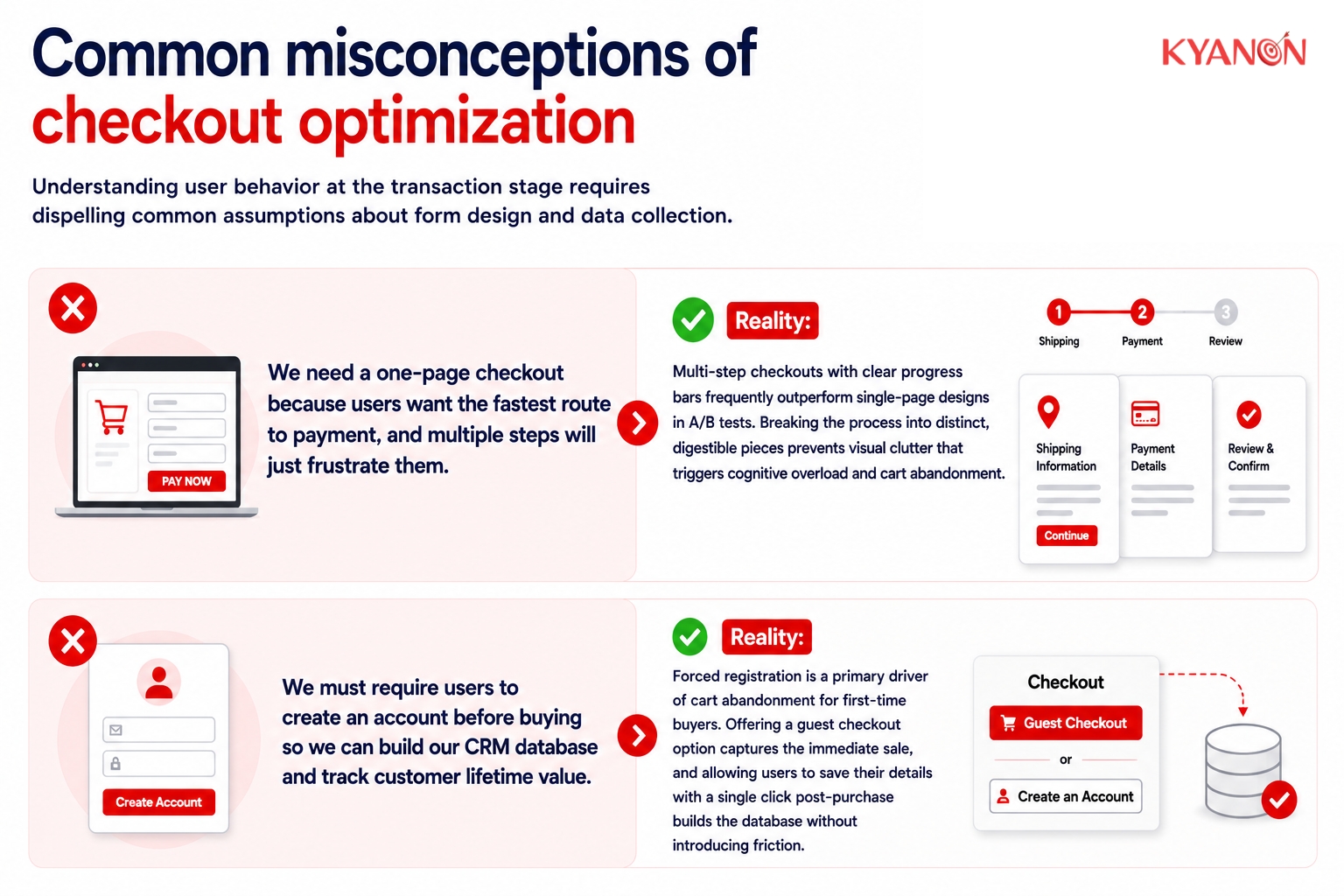
Understanding user behavior at the transaction stage requires dispelling common assumptions about form design and data collection.
We need a one-page checkout because users want the fastest route to payment, and multiple steps will just frustrate them
Reality: Multi-step checkouts with clear progress bars frequently outperform single-page designs in A/B tests. Breaking the process into distinct, digestible pieces prevents visual clutter that triggers cognitive overload and cart abandonment.
We must require users to create an account before buying so we can build our CRM database and track customer lifetime value
Reality: Forced registration is a primary driver of cart abandonment for first-time buyers. Offering a guest checkout option captures the immediate sale, and allowing users to save their details with a single click post-purchase builds the database without introducing friction.
How Kyanon Digital applies checkout optimization
Kyanon Digital implements Checkout Optimization using data analytics, payment gateway APIs, and A/B testing frameworks for enterprise clients across Vietnam, Singapore, Malaysia, Thailand, ANZ, the US, and Nordic Europe. Our approach relies on deep implementation expertise rather than pure consulting, focusing on measurable outcomes—specifically reducing time-to-market, increasing conversion, and lowering the Total Cost of Ownership (TCO)—by delivering targeted checkout UX improvements as part of comprehensive eCommerce performance projects.
Explore our services:

 Create project brief with AI