
What is a Vendor Management Portal?
A Vendor Management Portal (VMP) is a secure, web-based platform that centralizes and automates interactions between an enterprise and its third-party suppliers, covering supplier onboarding, compliance, performance tracking, and transaction workflows. By serving as a digital bridge between internal enterprise systems and external vendors, this technology replaces fragmented communications with standardized, self-service data exchanges.
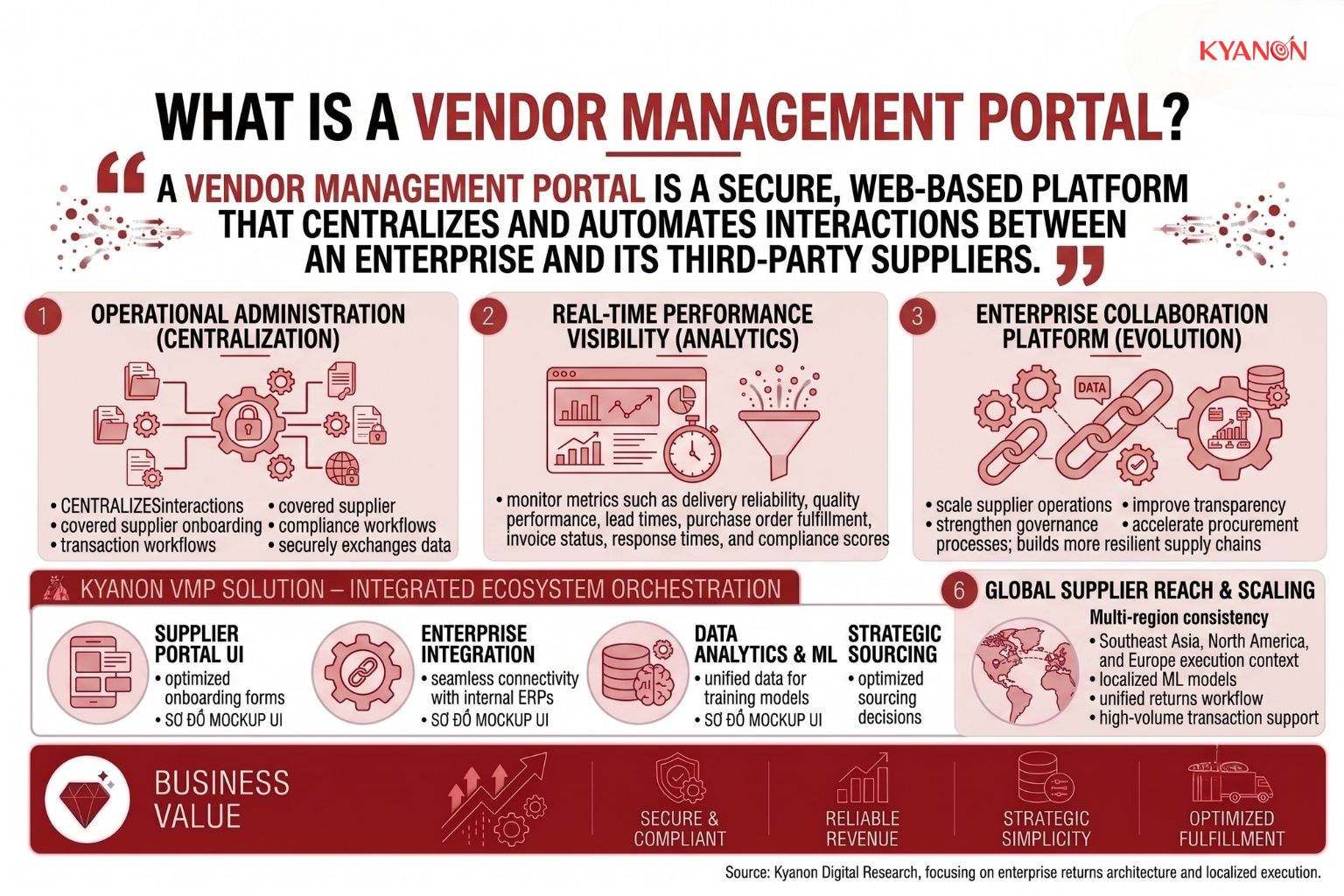
Beyond operational administration, the portal provides procurement and supply chain leaders with real-time visibility into supplier performance through dashboards and analytics. Organizations can monitor metrics such as delivery reliability, quality performance, lead times, purchase order fulfillment, invoice status, response times, and compliance scores to support data-driven supplier evaluations and strategic sourcing decisions.
As supply chains become increasingly global and supplier ecosystems grow more complex, Vendor Management Portals have evolved from administrative procurement tools into enterprise collaboration platforms. They enable organizations to scale supplier operations, improve transparency, strengthen governance, accelerate procurement processes, and build more resilient supply chains while reducing administrative overhead.
How a Vendor Management Portal Works
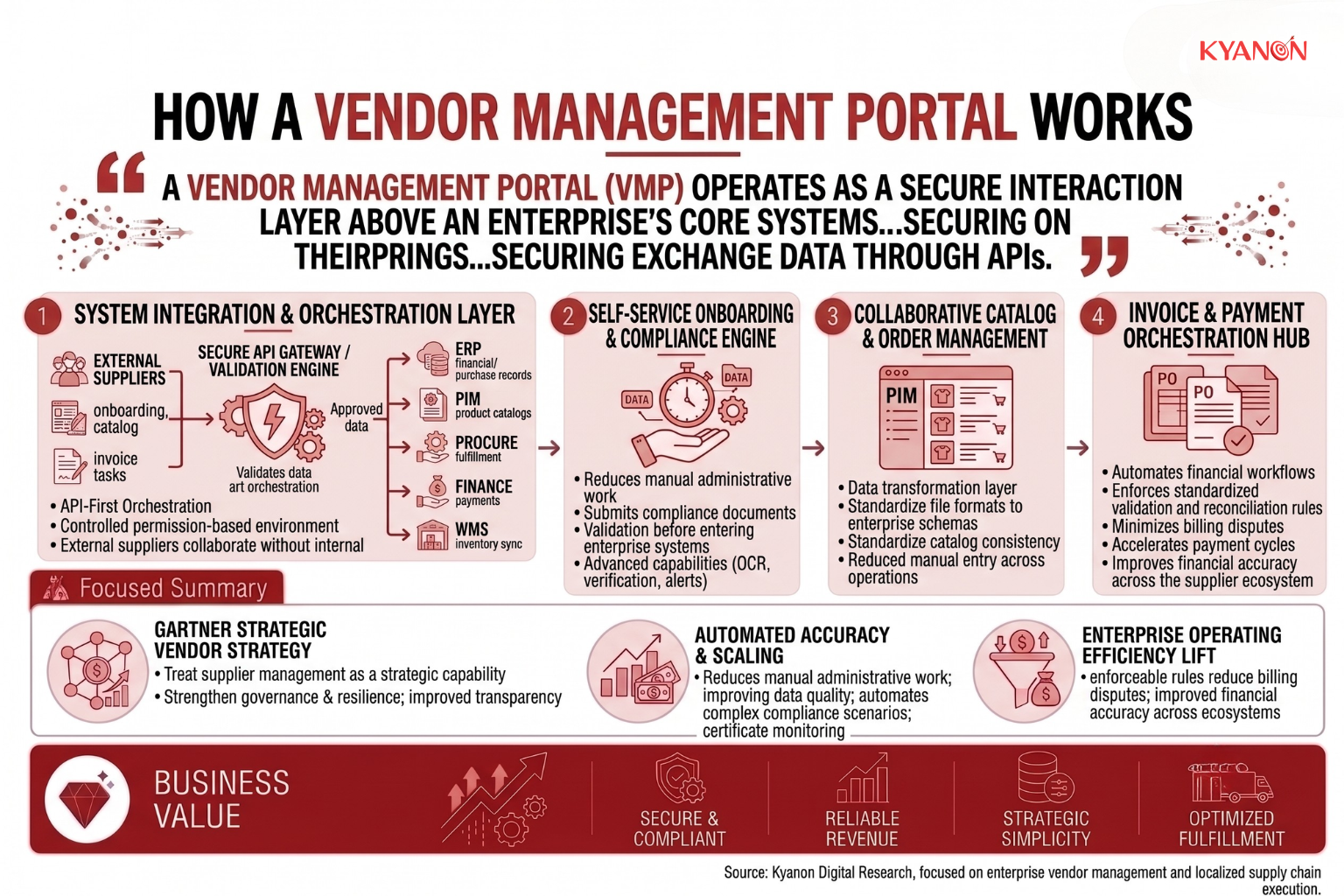
A Vendor Management Portal (VMP) operates as a secure interaction layer above an enterprise’s core systems, enabling external suppliers to collaborate with the organization without exposing internal databases or applications. Rather than granting vendors direct access to ERP or procurement systems, the portal provides a controlled, permission-based environment that securely exchanges data through APIs.
This architecture enables suppliers to independently maintain company information, submit compliance documents, update product catalogs, and manage invoices while ensuring all incoming data is validated before entering enterprise systems. The result is a secure, automated collaboration model that significantly reduces manual administrative work and improves data quality.
Self-Service Onboarding & Compliance Engine
This module streamlines supplier onboarding by allowing vendors to securely upload business registrations, tax documents, insurance certificates, licenses, and other compliance records through automated workflows.
Modern onboarding engines often include advanced validation capabilities such as:
- OCR-based document extraction to automatically capture key information from uploaded forms.
- Automated registry verification that checks supplier status against external government or regulatory databases.
- Certificate expiration monitoring that tracks renewal dates and generates automated compliance alerts before documents expire.
These capabilities reduce manual verification while helping procurement and compliance teams maintain accurate supplier records.
Collaborative Catalog & Order Management
This component enables suppliers to maintain product catalogs, inventory availability, pricing information, and purchase order communications through a standardized interface.
Because suppliers often use different systems and data formats, the portal functions as a data transformation layer by:
- Mapping supplier CSV, XML, or other file formats into standardized enterprise schemas.
- Matching supplier product identifiers with internal SKUs and master data.
- Synchronizing approved catalog updates directly with Product Information Management (PIM), procurement, or e-commerce systems.
This standardization improves catalog consistency while reducing manual data entry across procurement operations.
Invoice & Payment Orchestration Hub
The invoice orchestration hub automates financial workflows between suppliers and the enterprise, reducing reconciliation effort and payment delays.
Key capabilities include:
- Three-way matching that automatically compares purchase orders, goods receipt records, and supplier invoices before payment approval.
- Automated ERP posting for invoices that successfully pass validation.
- Exception management workflows that route discrepancies, missing information, or unmatched line items to designated procurement or finance teams for review.
- Real-time payment status visibility so suppliers can track invoice approval and payment progress without contacting procurement staff.
By enforcing standardized validation and reconciliation rules, the portal minimizes billing disputes, accelerates payment cycles, and improves financial accuracy across the supplier ecosystem.

Vendor Management Portal vs ERP Vendor Directory
While a legacy ERP vendor directory acts as a static internal system of record for supplier details, a Vendor Management Portal serves as an active, two-way communication and transactional platform.
Dimension | ERP Vendor Directory | Vendor Management Portal |
| User Access | Internal administrative and finance teams only | External suppliers and internal stakeholders |
Data Maintenance | Manual data entry by internal operators | Self-service data entry and updates by vendors |
| Communication Mode | Offline (emails, phone calls, paper trails) | Structured portal notifications and audit logs |
Integration Pattern | Core database storage | API-driven integrations with ERP and PIM |
| Compliance Management | Manual tracking with spreadsheet reminders | Automated credential verification and alerts |
When to Consider a Vendor Management Portal
Enterprises must consider a structured portal strategy when manual vendor communication begins to slow operational velocity.
Consider a Vendor Management Portal if:
- Your purchasing team spends considerable operational hours manually collecting, verifying, and updating supplier tax forms, banking details, or regulatory certifications.
- Inventory delays, inaccurate catalog uploads, or out-of-stock events frequently occur because suppliers cannot communicate real-time inventory levels directly.
- Your enterprise is expanding into a multi-vendor retail platform or digital marketplace, requiring hundreds of external suppliers to list, update, and manage products on your store.
It may not be the right priority if:
- Your brand operates with a small, static group of 5 to 10 local suppliers, and procurement updates can be handled through standard manual channels.
Why a Vendor Management Portal Matters for B2B Retail
As supplier networks grow larger and more geographically distributed, managing vendor relationships through emails, spreadsheets, and disconnected systems becomes increasingly inefficient and difficult to govern. A Vendor Management Portal replaces these fragmented processes with standardized, digital workflows that improve collaboration, strengthen supplier governance, and provide greater visibility across the procurement lifecycle.
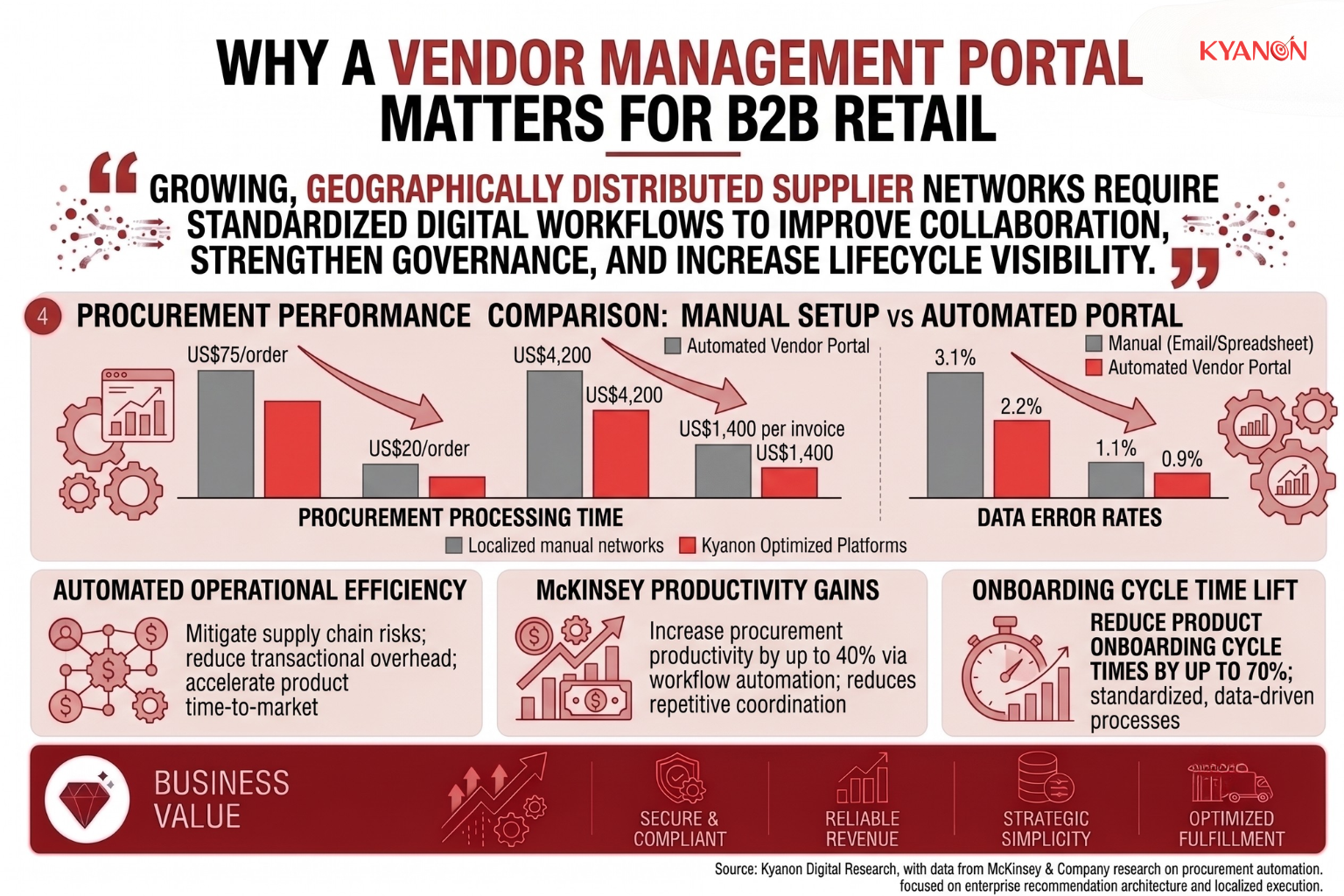
For B2B retailers, this translates into measurable operational benefits. Deploying a structured digital vendor platform helps mitigate supply chain risks, reduce transactional overhead, and accelerate product time-to-market by automating supplier onboarding, compliance management, catalog maintenance, purchase order processing, and invoice reconciliation.
According to McKinsey, organizations implementing vendor management platforms can increase procurement productivity by up to 30% through workflow automation while reducing product onboarding cycle times by up to 70%. By converting manual, error-prone administrative tasks into standardized, data-driven processes, procurement teams spend less time on repetitive coordination and more time on supplier performance, strategic sourcing, and supply chain optimization.
Beyond operational efficiency, a Vendor Management Portal creates a reliable digital foundation for enterprise procurement. With centralized supplier data, automated compliance monitoring, real-time transaction visibility, and standardized collaboration across internal teams and external vendors, organizations can make faster procurement decisions, improve supplier accountability, strengthen supply chain resilience, and respond more quickly to changing market demand.
Common Misconceptions
B2B leaders should avoid treating a vendor platform as a magical, hands-off automation tool that completely removes the need for human management.
Self-service features mean we lose operational control and security
A Vendor Management Portal does not give suppliers free rein over your systems. It provides highly structured self-service workflows where supplier updates (especially to critical financial or tax fields) must pass automated validation checks and go through internal approval loops before being committed to database records.
A Vendor Management Portal replaces our existing ERP system
The portal is designed to extend, not replace, your core ERP. Your ERP remains the ultimate database of record for financials and transactions, while the portal provides a secure, user-friendly interaction layer that allows suppliers to update data in real-time.
How Kyanon Digital Applies Vendor Management Portals
Kyanon Digital designs and builds modern Vendor Management Portals tailored for B2B and multi-vendor retail brands across Southeast Asia, North America, and Europe. Leveraging our deep implementation expertise, we architect portals that seamlessly integrate with your existing legacy ERPs, Product Information Management (PIM) systems, and Order Management Systems (OMS).
By building custom, API-first portal solutions or integrating leading marketplace frameworks, we help our clients optimize their supplier workflows, eliminate manual bottlenecks, and achieve measurable outcomes in system efficiency and operational agility.

Explore our Ecommerce services:

 Create project brief with AI