
What is Voice of the Customer (VoC)?
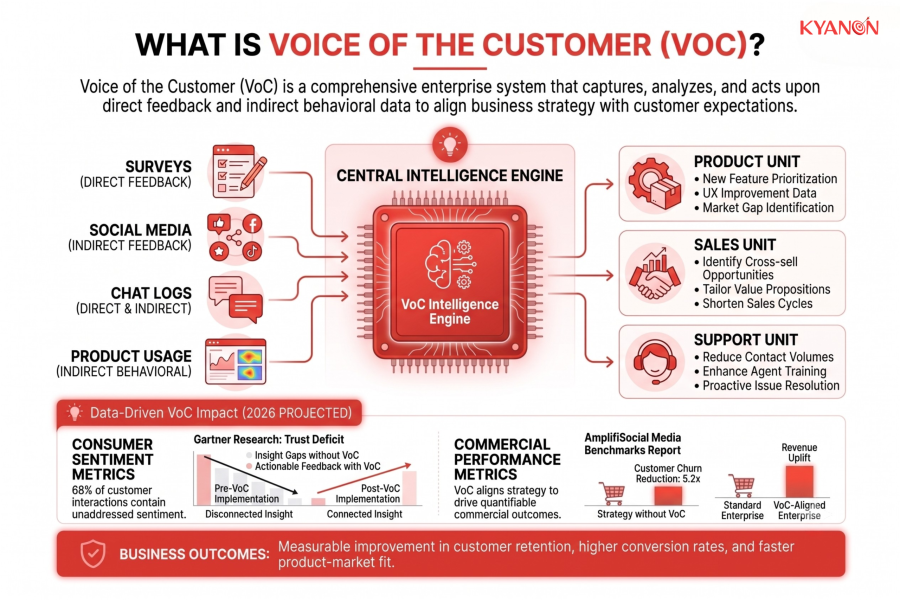
Voice of the Customer (VoC) is a comprehensive enterprise system that captures, analyzes, and acts upon direct feedback and indirect behavioral data to align business strategy with customer expectations.
How Voice of the Customer (VoC) Works
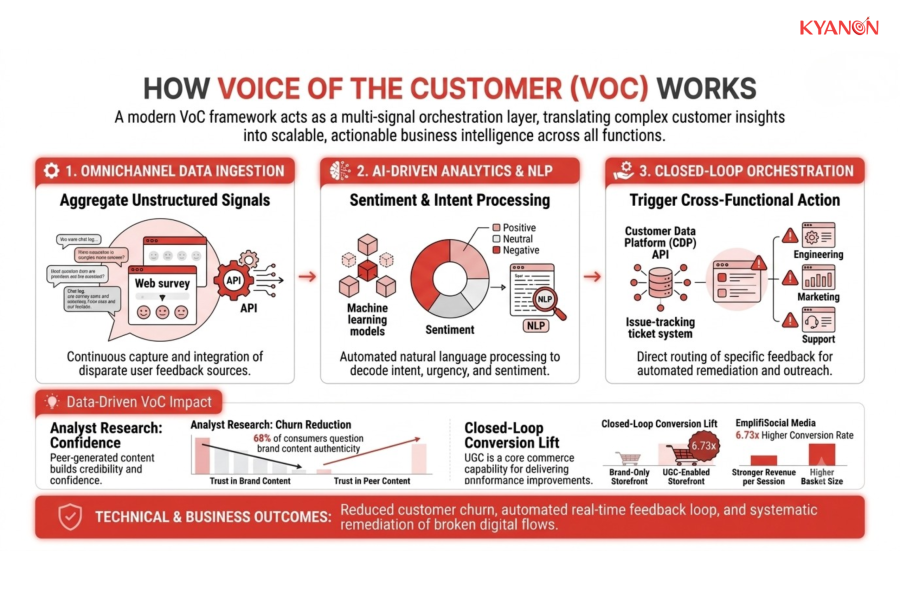
Modern Voice of the Customer (VoC) frameworks have evolved from passive, isolated survey tools into multi-signal orchestration layers embedded directly within the enterprise tech stack. A well-architected VoC system continuously aggregates qualitative and quantitative data, applies advanced natural language processing (NLP) to decode sentiment, and triggers automated technical or operational responses before dissatisfaction leads to customer churn.
Omnichannel Data Ingestion
The foundation of a modern VoC program relies on capturing unstructured, indirect telemetry, such as chat logs, reviews, and real-time support interactions, alongside traditional direct surveys. This ensures that the system registers the complete spectrum of customer sentiment, mitigating the data skew caused by survey fatigue.
AI-Driven Analytics and NLP
Raw feedback is processed through machine learning models and generative AI to categorize intent, identify root causes, and measure emotional sentiment. This component transforms millions of unstructured data points into quantifiable trends, allowing product and engineering teams to prioritize bug fixes or feature requests based on actual business impact rather than anecdotal complaints.
Closed-Loop Orchestration
Insights are systematically routed to the appropriate operational teams via API integrations with customer data platforms (CDPs) and issue-tracking software. This automated feedback loop guarantees that identified pain points trigger concrete technical actions, enabling organizations to systematically remediate broken digital flows in real time.

Comparative Analysis: Modern VoC vs. Traditional Survey Systems
Both approaches attempt to understand the customer, but they differ drastically in technical depth, data variety, and operational speed.
Dimension | Modern VoC Systems | Traditional Survey Systems |
| Data Sources | Direct and indirect (chat, usage, reviews) | Direct only (NPS/CSAT forms) |
Analysis Speed | Real-time AI processing | Retrospective manual analysis |
| Integration Level | High (APIs, CDPs, ticketing systems) | Low (isolated marketing dashboards) |
Actionability | Automated closed-loop workflows | Manual reporting and ad-hoc meetings |
| Best For | Proactive churn mitigation and product iteration | Point-in-time satisfaction benchmarking |
When to Consider Voice of the Customer (VoC)
Consider Voice of the Customer (VoC) if:
- Your organization is experiencing elevated customer churn but lacks visibility into the specific digital friction points causing abandonment.
- Your engineering and product teams are deploying self-service AI or new portal features and need real-time sentiment analysis to ensure these tools are not frustrating users.
- Your current feedback mechanisms exist in disjointed departmental silos, preventing leadership from making cohesive, data-driven decisions on product roadmaps.
It may not be the right priority if:
- Your business operates an early-stage MVP with a limited, highly communicative beta testing group where direct, one-on-one developer interviews provide sufficient context.
Why Voice of the Customer (VoC) Matters
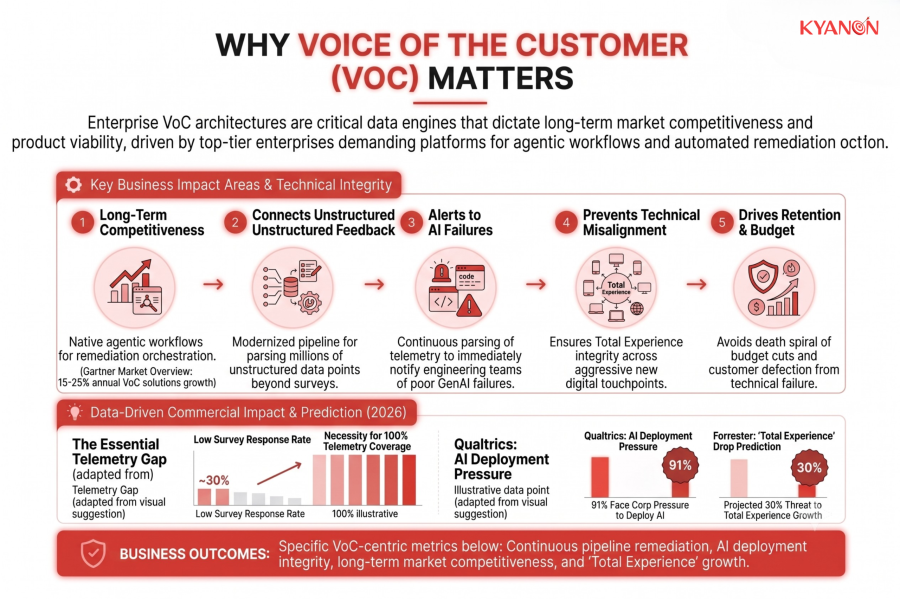
Enterprise VoC architectures are no longer optional customer service add-ons; they are critical data engines that dictate long-term market competitiveness and product viability.As enterprises aggressively deploy new digital touchpoints, the risk of technical misalignment increases. Concurrently, McKinsey & Company’s global research shows that while 44% of organizations are scaling AI enterprise-wide (with Chatbots leading deployment at 47%), only 6% of companies qualify as “AI high performers” that capture real financial value (at least 5% EBIT contribution). Furthermore, McKinsey reports that 39% of organizations expect AI deployments to decrease overall headcount over the coming year.
Taken together, these metrics underscore that without a modernized VoC pipeline capable of continuously parsing unstructured feedback and alerting engineering teams to AI failures, organizations risk entering a severe death spiral of budget cuts, workforce friction, and customer defection.
Common Misconceptions
Equating VoC with Only CSAT and NPS
Scores are lagging indicators. They tell you what happened, not why. A true VoC program blends quantitative scores with qualitative feedback (text analysis, interview notes) and operational data (churn rates, purchase frequency) to drive actual improvements.
Assuming Surveys Are the Only Way to Listen
Survey fatigue is exceptionally high, which skews data toward extremely angry or highly enthusiastic outliers. Effective VoC captures unsolicited feedback from indirect channels, including social media mentions, customer support chat transcripts, review sites, and call logs.
Treating VoC as a Marketing or Support Initiative
Customer feedback impacts the entire enterprise. If product engineering, product design, and finance do not use VoC insights to guide roadmaps or pricing models, the program turns into a hollow reporting mechanism rather than a catalyst for growth.
Over-indexing on the “Loudest” Customers
This creates an unbalanced strategy. The customers who complain the loudest do not always represent the quiet majority. VoC requires disciplined segmentation to distinguish between anomalies and systemic trends affecting your core customer base.
Assuming Feedback Equals Actionable Solutions
Customers are experts in their problems, but they are rarely experts in technical or business solutions. VoC is meant to uncover the root pain points and desires of the customer; it is up to your internal teams to design the best way to solve them.
How Kyanon Digital Applies Voice of the Customer (VoC)
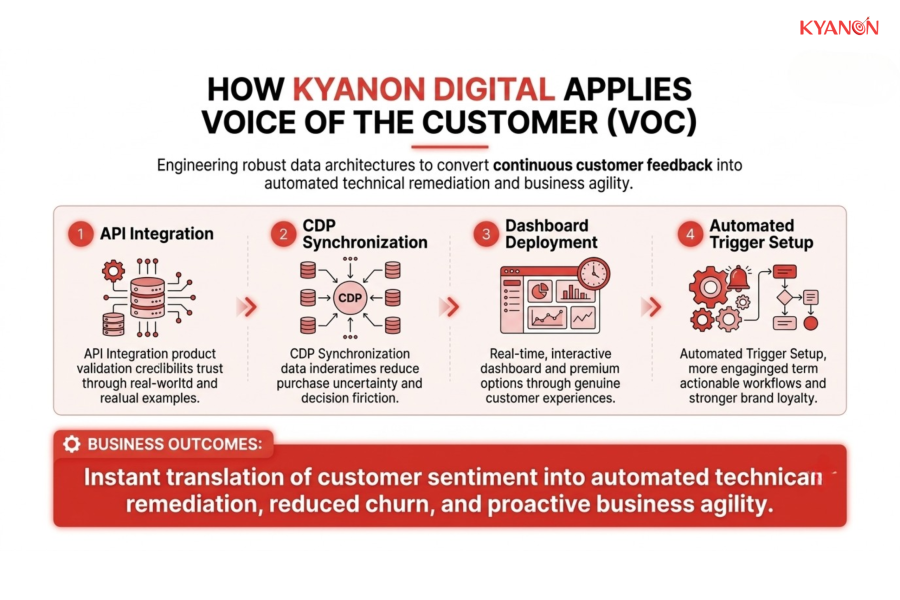
Kyanon Digital implements VoC programs for enterprise clients by engineering robust data architectures that seamlessly connect continuous feedback collection to advanced analytics dashboards and closed-loop action processes. We leverage advanced machine learning models to parse both structured surveys and unstructured telemetry, routing critical insights directly to technical teams. Through our Enterprise Digital Transformation strategies, we ensure that CTOs and e-commerce leaders can instantly translate shifting customer sentiment into automated technical remediation, turning passive listening into proactive business agility.
Explore our services:

 Create project brief with AI