
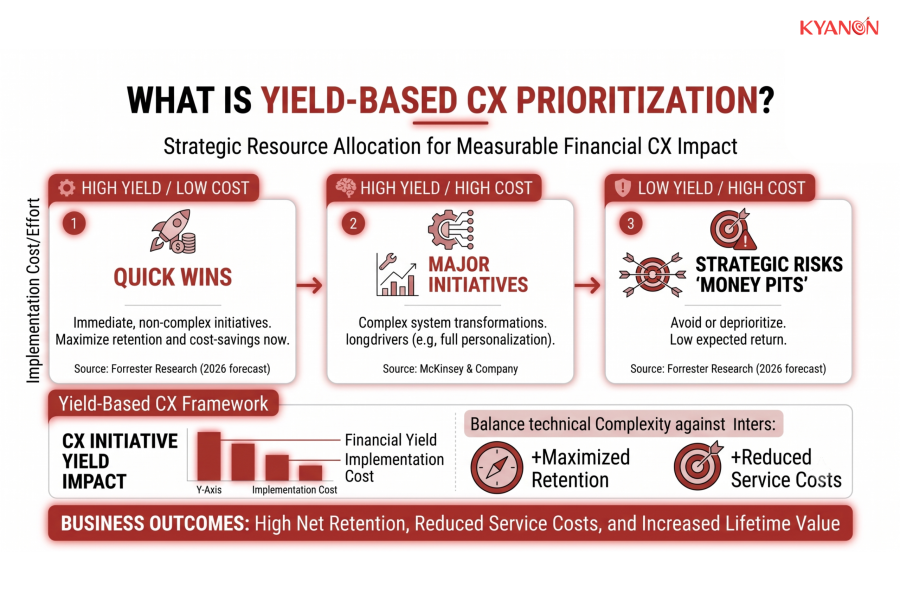
What is Yield-Based CX Prioritization?
Yield-Based CX Prioritization is a strategic evaluation framework that allocates technology and operational resources to customer experience initiatives based on their expected financial return per unit of cost. This methodology allows technology leaders to balance technical complexity against measurable improvements in customer retention, service cost reduction, and lifetime value.
How Yield-Based CX Prioritization Works
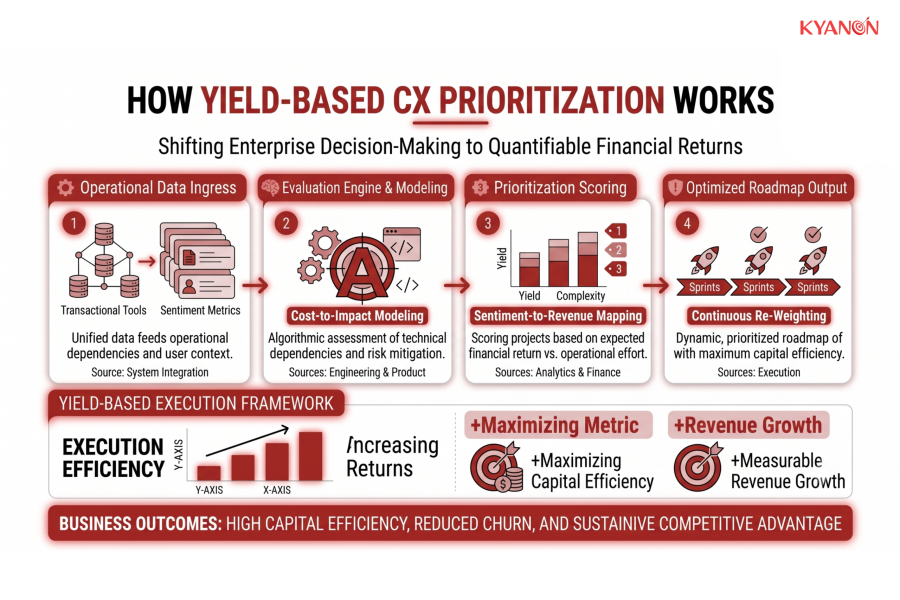
Yield-Based CX Prioritization shifts enterprise decision-making from subjective feature requests to quantifiable financial returns. Rather than optimizing every customer touchpoint uniformly, engineering and e-commerce leaders evaluate technical dependencies, operational effort, and expected risk mitigation to maximize capital efficiency across digital investments.
Cost-to-Impact Modeling
Engineering and product teams evaluate the required capital, development bandwidth, and back-office integration complexity against projected financial returns. By evaluating potential friction reductions against execution costs, teams isolate high-margin digital fixes from high-cost, low-impact enhancements.
Value-Centered Risk Mitigation
This component evaluates technical debt and operational vulnerabilities that threaten existing revenue streams. Rather than focusing exclusively on net-new features, value-centered modeling quantifies the cost of customer defection caused by broken service channels, prioritizing fixes that prevent churn and reduce support ticket volume.
Sentiment-to-Revenue Mapping
Qualitative telemetry, such as effort scores, support logs, and real-time frustration signals, is integrated directly into financial projections. By translating negative user sentiment into quantifiable defection risk, the framework establishes a clear baseline for calculating the return on fixing specific process bottlenecks.
Continuous Re-Weighting Evaluation
Yield calculations operate as a dynamic evaluation loop rather than a static annual matrix. As macroeconomic conditions change, technical capabilities mature, or competitive pressures emerge, project scoring weights are dynamically updated to align engineering resources with evolving enterprise objectives.

Comparative Analysis: Yield-Based CX Prioritization vs. Traditional Prioritization
Dimension | Traditional CX Prioritization | Yield-Based CX Prioritization |
| Primary Metric | Subjective satisfaction scores (NPS, CSAT) | Expected yield per unit of capital/development cost |
Scope of Value | Immediate conversions and front-end design | Total financial health (cost avoidance, lifetime value, churn prevention) |
| Risk Perspective | Reactive focus on loud customer complaints | Proactive mitigation of revenue-leaking process failures |
Data Integration | Isolated survey feedback and point-in-time audits | Continuous telemetry combining qualitative sentiment with back-office data |
| Resource Allocation | Static annual roadmap checklists | Dynamic re-weighting based on evolving enterprise capacity and goals |
Why Yield-Based CX Prioritization Matters
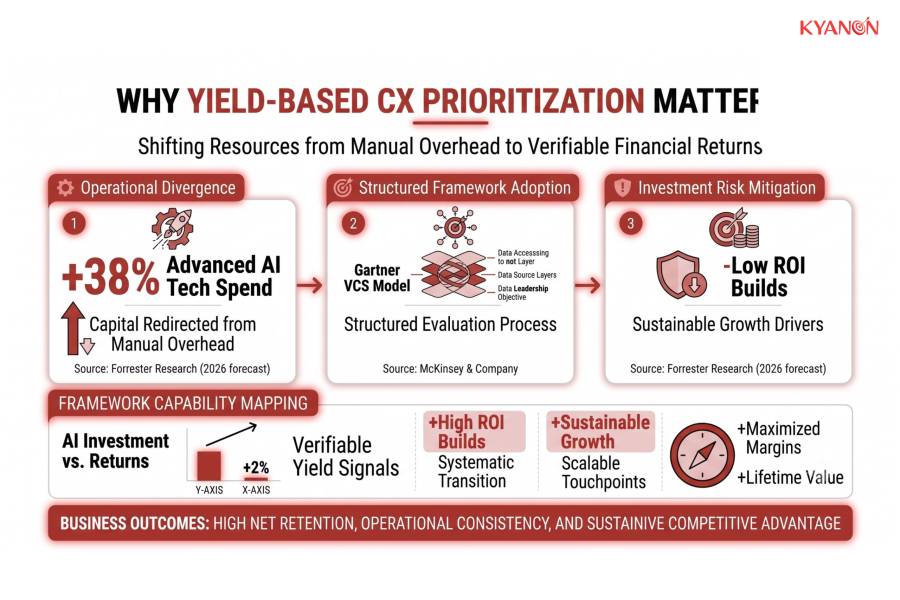
Enterprise technology leaders face growing pressure to demonstrate immediate, verifiable financial returns on customer experience software investments amid constrained departmental resources.
According to research from Gartner, enterprise spending on customer service technology has surged by 38%, despite total departmental budgets growing by a mere 2%. This capital allocation shift demonstrates how executive leadership is actively redirecting resources away from manual overhead toward advanced digital automation tools. However, deploying expensive AI or automation layers without a structured yield model risks inflating operational complexity without delivering proportional cost reductions.
To prevent technology investments from eroding margins, enterprise leaders are adopting structured frameworks that cross-reference experience enhancements with implementation overhead. Applying principles like Gartner’s Value-Centered Service (VCS) model helps organizations systematically transition customer support architectures from traditional cost centers into sustainable growth drivers. Establishing a yield-based evaluation process ensures engineering teams eliminate low-ROI software builds and direct technical capital toward scalable, high-impact touchpoints.
Common Misconceptions
Yield Means Looking Only at Immediate Revenue
Focusing strictly on immediate conversions turns customer experience into short-term marketing optimization. Yield-based prioritization accounts for total financial health, which includes cost avoidance through reduced support ticket volumes, churn prevention, and lower customer acquisition costs. True yield calculates the long-term value generated by shifting consumer behavior rather than end-of-month sales targets.
Highest Satisfaction Scores Yield the Highest Returns
Chasing peak satisfaction across every customer touchpoint results in over-investing with diminishing financial returns. A yield-focused approach recognizes that many experience optimizations are expensive enhancements that do not alter retention behavior. Instead, it prioritizes eliminating revenue-leaking operational breakdowns where poor performance causes direct customer defection.
Qualitative Customer Sentiment Data Is Ignored
Because the model calculates financial yields, organizations often mistakenly assume they should only track quantitative transactional data. In practice, qualitative sentiment, such as Customer Effort Score (CES) and frustration signals, serves as a primary leading indicator of customer loyalty and churn. Yield models incorporate this sentiment data to calculate the economic risk of service failures and the profitability of resolving them.
Automation and AI Yield the Highest CX Efficiency
Teams frequently deploy rapid digital automation under the assumption that it inherently yields maximum cost reduction. However, automation without cross-functional operational alignment accelerates service inconsistencies. When self-service portals or automated tools fail to resolve complex issues, customer frustration increases and secondary support costs rise. True yield prioritization evaluates the holistic human-and-digital lifecycle rather than treating standalone software as a cure-all.
Yield-Based Prioritization Is a One-Time Exercise
Organizations often create a static matrix during annual planning and treat it as a finished checklist. However, market conditions, competitive dynamics, and customer expectations shift continuously. Yield calculations must operate as an ongoing evaluation loop, adjusting project scoring weights as operational capacity and strategic corporate goals evolve.
How Kyanon Digital Applies Yield-Based CX Prioritization
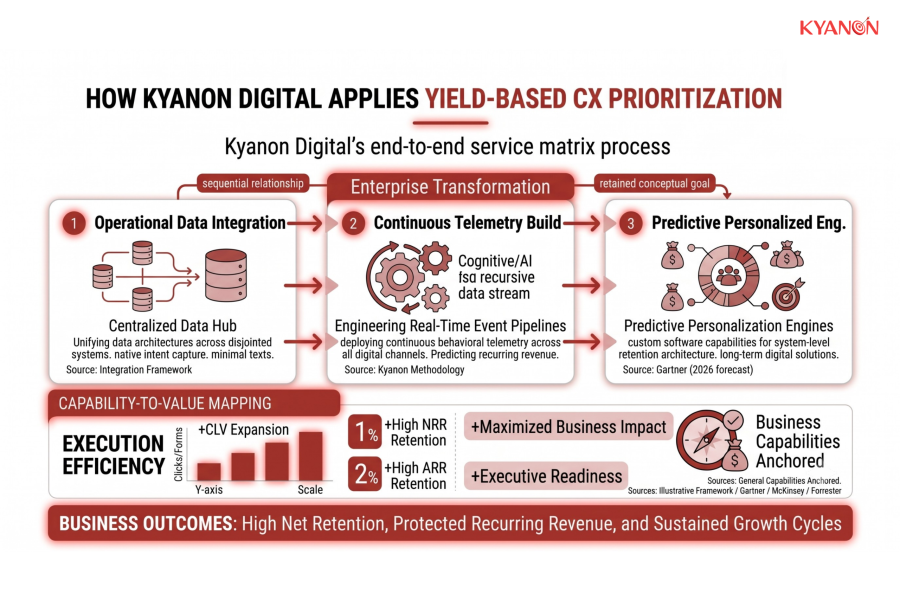
Kyanon Digital applies yield-based CX prioritization in enterprise roadmap planning to ensure clients invest in the highest-impact digital improvements first. By connecting front-end user experience designs with robust back-office integration, Kyanon Digital enables organizations to eliminate technical debt and maximize the return on their digital transformations.
Explore our services:

 Create project brief with AI