
What is a Zero Inventory Model?
The zero inventory model is an operational strategy where procurement, production, and order dispatch are executed strictly upon order confirmation, eliminating the requirement to hold static safety stock in enterprise warehouses. By shifting from a push-based stocking model to a pull-based fulfillment architecture, organizations minimize working capital encumbrance and protect cash flow from inventory depreciation.
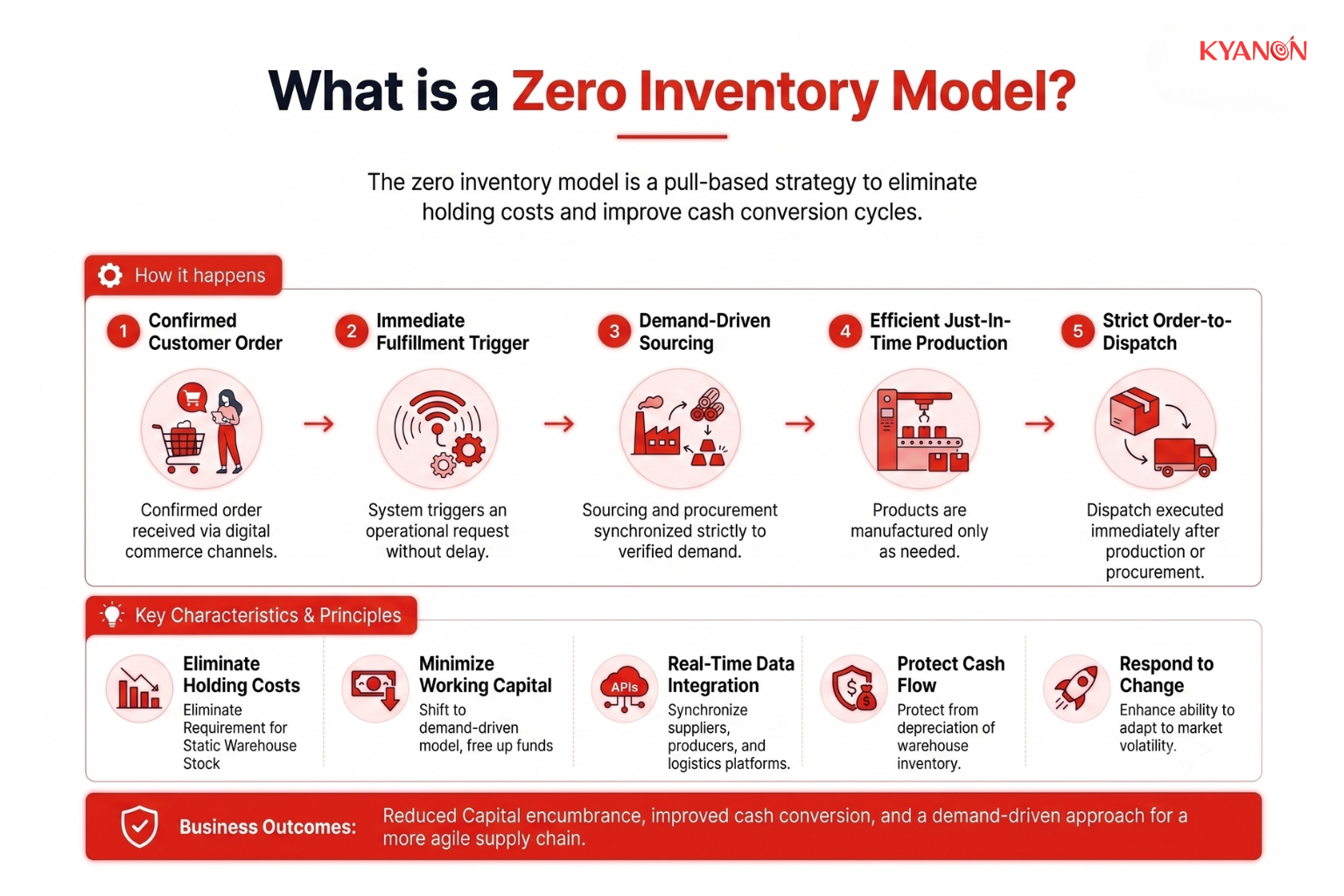
A zero inventory model replaces traditional inventory-driven operations with a demand-driven fulfillment architecture, where procurement, manufacturing, or product sourcing is triggered only after a confirmed customer order is received. Instead of forecasting demand and maintaining large warehouse stock levels, organizations synchronize suppliers, production facilities, logistics providers, and commerce platforms through real-time data integration. This approach significantly reduces inventory carrying costs while improving cash conversion cycles and enabling businesses to respond more flexibly to changing market demand.
How the Zero Inventory Model Works
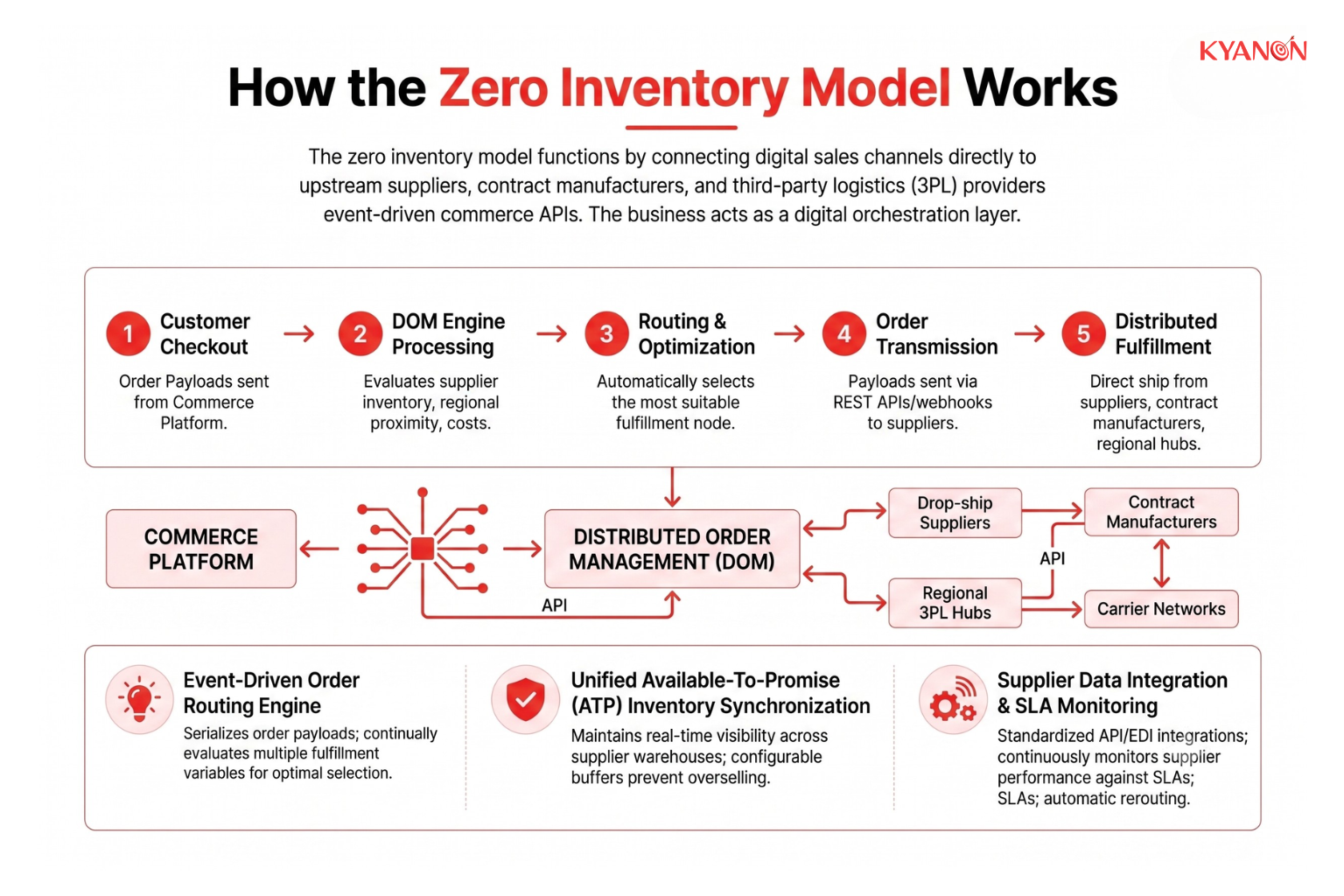
The zero inventory model functions by connecting digital sales channels directly to upstream suppliers, contract manufacturers, and third-party logistics (3PL) providers through event-driven commerce APIs. Rather than holding inventory inside company-owned warehouses, the business acts as a digital orchestration layer that coordinates procurement, production, inventory visibility, and fulfillment only after a customer order is confirmed.
When a customer completes checkout, the commerce platform transmits an order payload to a Distributed Order Management (DOM) system. The DOM evaluates supplier inventory, regional proximity, fulfillment capacity, shipping costs, processing times, and service level agreements (SLAs) before automatically routing the order to the most suitable fulfillment node. This pull-based workflow replaces physical inventory ownership with real-time data orchestration, allowing organizations to minimize working capital while maintaining scalable fulfillment operations.
Event-Driven Order Routing Engine
The event-driven routing engine serves as the operational intelligence layer that determines where every customer order should be fulfilled. Immediately after checkout, the commerce platform serializes order information into standardized XML or JSON payloads and transmits them through REST APIs or webhooks to supplier ERP systems and fulfillment partners.
Rather than relying on manual intervention, the Distributed Order Management (DOM) platform continuously evaluates multiple fulfillment variables, including supplier inventory availability, geographic proximity, shipping costs, processing latency, delivery commitments, and contractual SLAs. Based on these factors, the system automatically selects the optimal fulfillment node, helping reduce delivery times, lower transportation costs, and improve customer experience while balancing operational efficiency across the supplier network.
Unified Available-To-Promise (ATP) Inventory Synchronization
A zero inventory strategy depends on accurate visibility into inventory that the business does not physically own. To achieve this, the platform maintains a unified Available-to-Promise (ATP) view by continuously aggregating stock availability across supplier warehouses, manufacturing facilities, and distribution centers.
Inventory information is synchronized through API integrations or Electronic Data Interchange (EDI) transactions, allowing the commerce platform to expose near real-time supplier availability to customers. Many organizations also apply configurable inventory buffers to account for synchronization delays, preventing overselling and reducing the likelihood of cancelled orders caused by inventory discrepancies. This virtual inventory layer enables businesses to offer broad product assortments without maintaining physical warehouse stock.
Supplier Data Integration & SLA Monitoring
Reliable execution depends on continuous two-way communication between the commerce platform and every fulfillment partner. Standardized API and EDI integrations allow suppliers to automatically acknowledge orders, provide inventory updates, transmit shipping confirmations, and return tracking information throughout the fulfillment lifecycle.
The platform continuously monitors supplier performance against predefined Service Level Agreements (SLAs), tracking metrics such as order acceptance, processing time, dispatch latency, shipment confirmation, and delivery performance. If a supplier fails to meet established performance thresholds, the routing engine can automatically reroute future orders to alternative fulfillment partners, reducing operational risk while maintaining consistent service levels across the supply chain.
Distributed Fulfillment & Network Scalability
Unlike traditional inventory models that scale by expanding warehouse capacity, the zero inventory model scales by expanding connected supplier and logistics networks. New suppliers, manufacturers, fulfillment centers, or product catalogs can be integrated through standardized APIs without requiring additional warehouse space or inventory investment.
This distributed architecture enables organizations to rapidly expand product assortments, enter new geographic markets, and respond to changing customer demand while minimizing capital expenditure. Although businesses sacrifice some direct control over fulfillment operations, they gain significantly greater flexibility, lower inventory risk, and the ability to scale operations through digital connectivity rather than physical infrastructure.

Zero Inventory Model vs Traditional Safety Stock Model
Both operational strategies ensure order delivery, but they manage cash flow and supply chain risk through opposing inventory ownership paradigms.
Dimension | Zero Inventory Model | Traditional Safety Stock Model |
| Working Capital Allocation | Unencumbered (Capital invested in product development and channels) | High (Capital locked in warehouse safety stock) |
Risk of Stock Obsolescence | Minimal to zero | High (Vulnerable to shifts in market demand) |
| Order Lead Time | Dependent on supplier production and fast-freight processing | Immediate (Dispatched from owned warehouse stock) |
Operational Cost Focus | Higher variable freight and per-item handling expenses | Higher fixed facility storage and warehousing overhead |
| System Dependency | Requires low-latency API links and real-time supplier integrations | Requires local Warehouse Management System (WMS) control |
When to Consider a Zero Inventory Model
Consider adopting a zero inventory architecture if:
- Your platform operates as a multi-vendor marketplace or D2C model where holding physical inventory introduces high capital risk and warehousing overhead.
- Your catalog features high-value, highly customized, or perishable items where advance stocking leads to severe margin erosion or write-offs.
- You need to lower Total Cost of Ownership (TCO) by eliminating fixed logistics overhead while rapidly expanding available catalog SKUs.
It may not be the right priority if:
- Your supply chain relies on volatile raw material suppliers or unreliable transport networks where lead time delays would lead to severe stockouts.
Why the Zero Inventory Model Matters for Enterprise Commerce
The zero inventory model enables enterprise organizations to reduce working capital tied up in warehousing and excess stock, allowing resources to be redirected toward digital capabilities that improve agility, scalability, and customer experience. Rather than investing heavily in inventory that may depreciate, businesses can focus on technologies that strengthen supplier connectivity, automate fulfillment, and support faster responses to changing market demand.
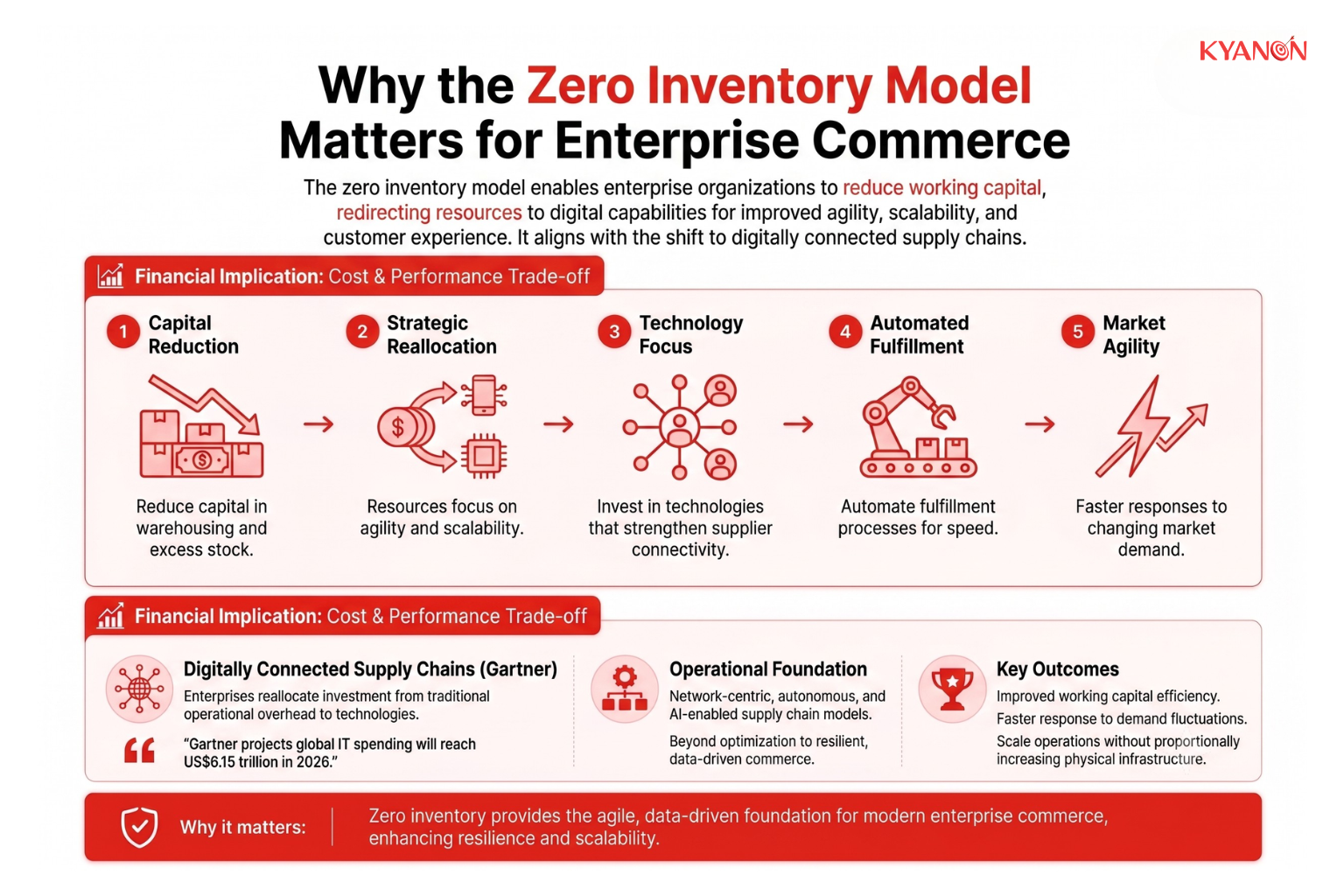
This approach aligns with the broader shift toward digitally connected supply chains. Gartner projects global IT spending will reach US$6.15 trillion in 2026, reflecting how enterprises are increasingly reallocating investment from traditional operational overhead to technologies that enable real-time decision-making and greater business agility.
As organizations adopt network-centric, autonomous, and AI-enabled supply chain models, the zero inventory model becomes more than an inventory optimization strategy, it provides the operational foundation for more resilient, data-driven commerce. By replacing static inventory with real-time supplier orchestration, enterprises can improve working capital efficiency, respond faster to demand fluctuations, and scale operations without proportionally increasing physical infrastructure.
Common Misconceptions
The Zero Inventory Model does not mean inventory no longer exists
Instead, it minimizes merchant-owned inventory by relying on safety stock, buffer stock, or supplier-held inventory maintained upstream within the supply chain.
Operating a zero inventory model completely eliminates operational expenses
While warehousing costs drop, organizations often face higher variable costs in expedited shipping, small-batch procurement, and complex supplier integration management.
A zero inventory strategy relies solely on having reliable suppliers
Flawless partner relations are insufficient without technical resilience; the model requires real-time data integrations, demand forecasting systems, and automated fallback routing to prevent service disruptions.
How Kyanon Digital Applies the Zero Inventory Model
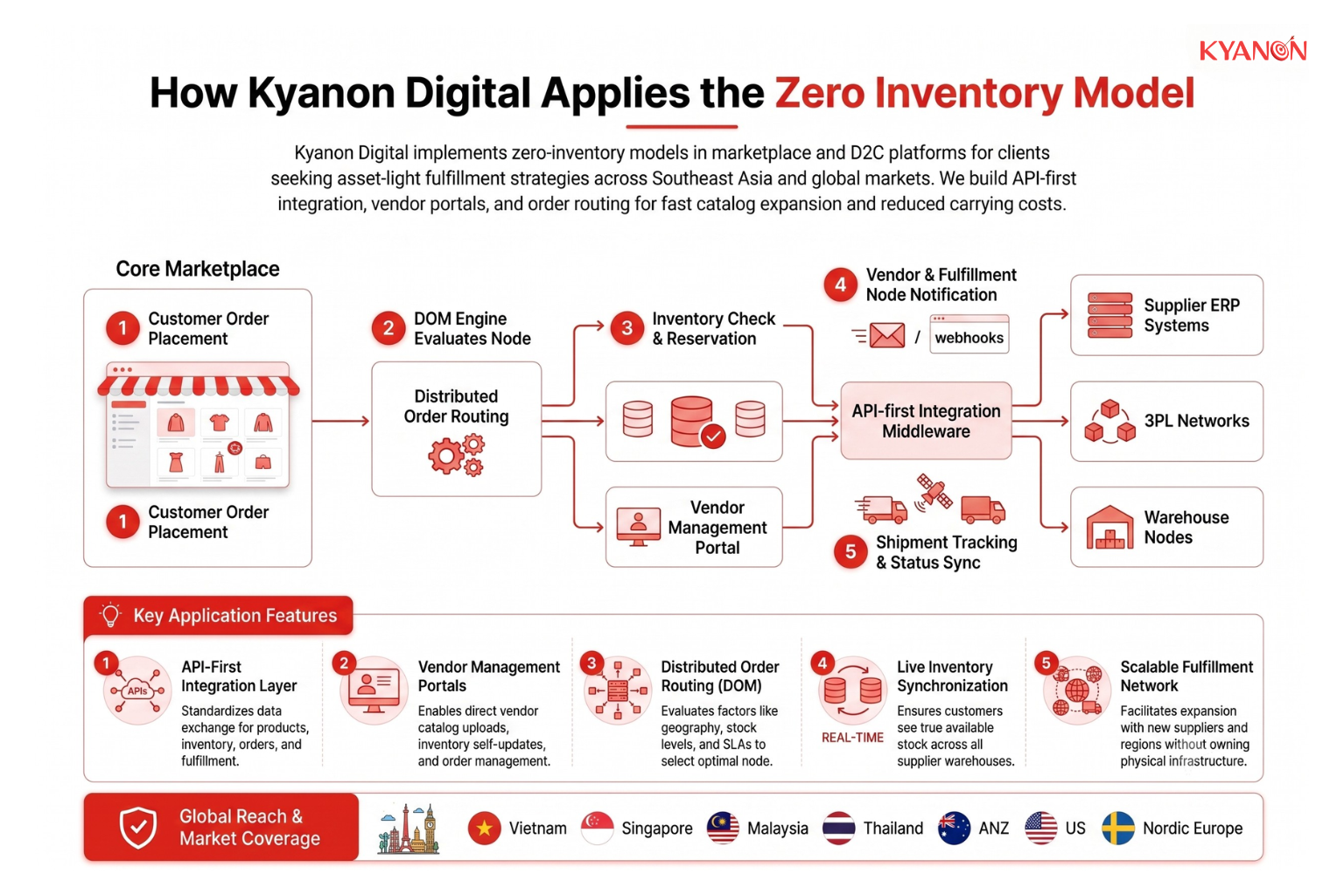
Kyanon Digital implements zero-inventory models in marketplace and D2C platforms for clients seeking asset-light fulfillment strategies across Vietnam, Singapore, Malaysia, Thailand, ANZ, the US, and Nordic Europe. Our engineering teams build API-first integration layers, vendor management portals, and distributed order routing systems that synchronize live inventory across supplier nodes, ensuring fast catalog expansion and reduced carrying costs.
Explore our services:

 Create project brief with AI