
What is Bayesian Inference?
Bayesian inference is a statistical framework that continuously updates the probability of a hypothesis or outcome by combining prior knowledge with new, observed data. It utilizes Bayes’ theorem to output a full probability distribution rather than a single point estimate, explicitly quantifying the uncertainty of its predictions.
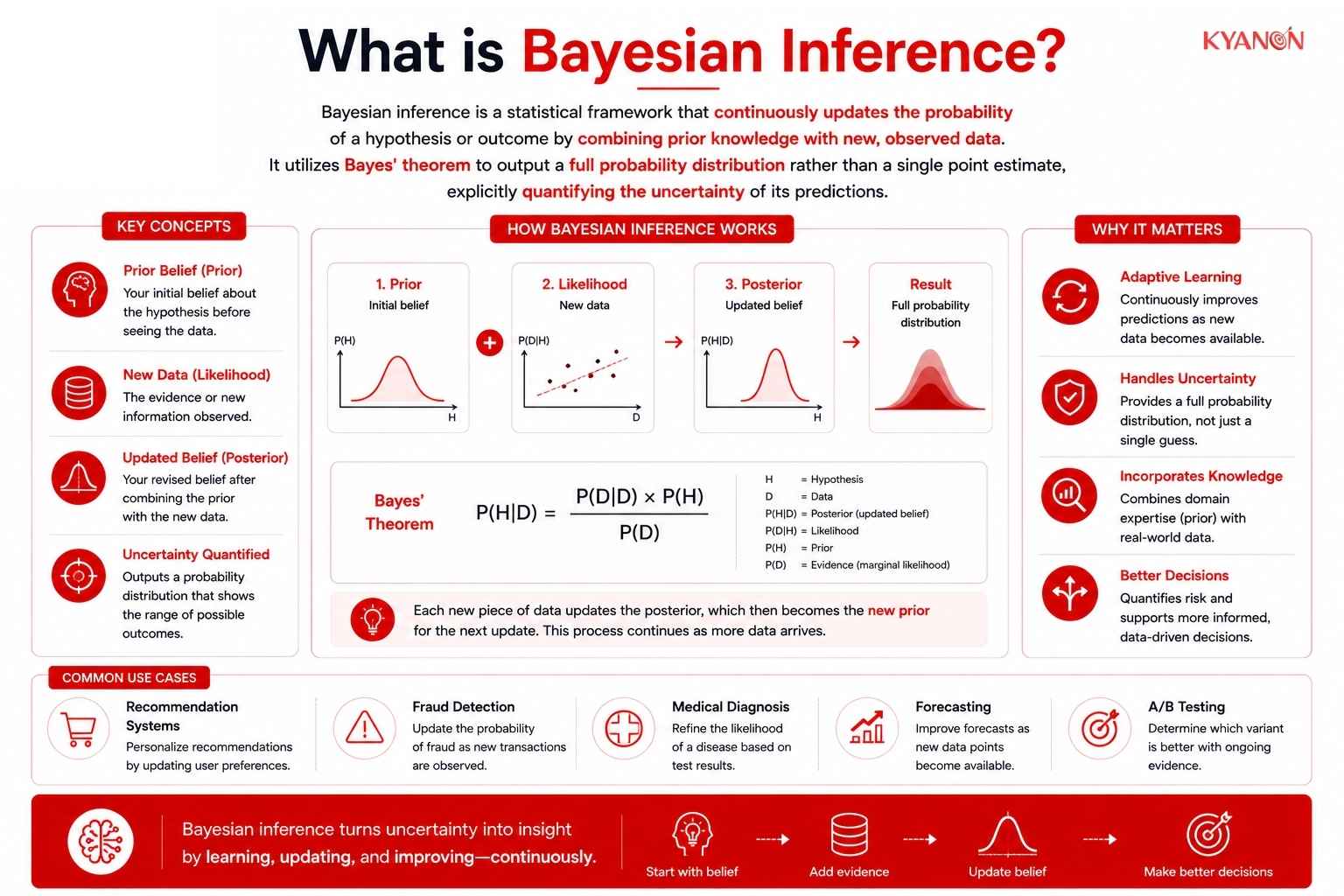
How Bayesian Inference works
The core mechanism of bayesian inference relies on iterative updating, where an initial belief is mathematically adjusted every time new evidence is introduced. This process transforms a static assumption into a dynamic, data-driven forecast that explicitly measures the margin of error at every stage of computation.
The prior distribution
The prior distribution represents the initial probability of an event or parameter before any new data is observed. It establishes the baseline statistical assumptions based on historical empirical data or uninformative mathematical defaults.
The likelihood function
The likelihood function calculates the probability of the newly observed data occurring, assuming that the initial hypothesis or parameter is true. This component acts as the mathematical bridge connecting existing beliefs to real-time observations.
The posterior distribution
The posterior distribution is the final output, representing the updated probability of the hypothesis after integrating both the prior distribution and the new likelihood data. This distribution explicitly quantifies the uncertainty of the prediction rather than returning a deterministic single value.
Bayesian Inference vs Frequentist Inference
Both approaches analyze data to make statistical predictions, but they differ fundamentally in how they handle uncertainty and initial assumptions.
|
Dimension |
Bayesian Inference | Frequentist Inference |
| View of probability | Degree of belief based on data |
Long-run frequency of repeatable events |
|
Final output |
Full probability distribution | Single point estimate (with confidence intervals) |
| Incorporation of prior data | Explicitly uses prior distributions |
Relies strictly on current sample data |
|
Upfront computational cost |
High (requires complex integration) | Low (uses standard formulaic tests) |
| Handling of uncertainty | Quantifies exact uncertainty |
Assumes fixed parameters |
When to consider Bayesian Inference
Consider bayesian inference if:
- Your supply chain forecasting requires explicit uncertainty quantification to manage inventory risk across highly volatile international markets.
- You are running continuous A/B testing on an e-commerce platform and need to update conversion probability dynamically as new visitor data arrives, without waiting for fixed sample sizes.
- Your data science team operates with small or sparse datasets where incorporating external domain knowledge mathematically prevents the model from overfitting.
It may not be the right priority if:
- Your application processes strictly deterministic, high-frequency transactions, such as automated stock trading, where the computational latency of calculating full probability distributions is unacceptable.
Why Bayesian Inference matters for enterprise data
Implementing bayesian inference transitions enterprise forecasting from rigid, point-based predictions to dynamic risk assessment frameworks.
According to Gartner (2024), organizations utilizing probabilistic forecasting models reduce inventory stockouts by up to 20% compared to those using deterministic point estimates. A Nordic retail enterprise applied bayesian inference to their demand planning systems to account for sudden supply chain disruptions. This application allowed their procurement algorithms to calculate the exact probability of material shortages, reducing emergency freight costs and improving operational continuity.
Common misconceptions
The ‘Prior’ is just a subjective guess that pollutes the data
Reality: While the prior distribution can incorporate expert knowledge, data science teams base it on previous empirical data or strict uninformative mathematical defaults. This ensures the prior grounds the model mathematically without overriding the incoming observed data.
This method is mathematically complex and only scales for small datasets
Reality: While Bayesian integration is computationally intensive, modern infrastructure utilizing Markov Chain Monte Carlo (MCMC) sampling and libraries like PyMC or Stan enables bayesian inference to scale across massive enterprise datasets efficiently.
It ultimately gives you a single prediction to act on, just like any other algorithm
Reality: Unlike standard models that output a rigid point estimate, bayesian inference provides a complete probability distribution. It explicitly quantifies exactly how uncertain the system is regarding every possible outcome, enabling precise enterprise risk management.
How Kyanon Digital applies Bayesian Inference
Kyanon Digital applies bayesian inference frameworks in data science engagements for enterprise clients across Vietnam, Singapore, and Nordic Europe. Our engineering teams utilize tools like PyMC and Stan to build analytical models that deliver explicit probabilistic forecasts rather than rigid point predictions, directly lowering the total cost of ownership (TCO) for risk-heavy supply chain and financial operations.
Explore our AI and ML services:











 Create project brief with AI