


A custom software development company in Singapore is no longer evaluated solely by coding speed, as IMDA reported in 2026 that more than 8 in 10 organizations experienced at least one cybersecurity incident annually. For many Singapore businesses, the real problem is not finding a developer. The harder problem is choosing a partner who can build software that scales, withstands compliance reviews, handles integration complexity, and supports post-launch operations.
Singapore aligns with global software trends: cloud-native platforms, AI-enabled workflows, API-first architecture, and enterprise integration. But the local market has sharper requirements around PDPA, grant eligibility, regional expansion, and hybrid delivery models.
The right choice depends on one question: is the project a simple MVP, a business-critical web app, or the start of a larger enterprise transformation?
This article explains how to evaluate custom software development services in Singapore, compare engagement models, and choose a fit-for-purpose partner without overbuying or underestimating delivery risk.
Key takeaways
- Do not compare vendors only by price. Compare scope clarity, architecture quality, delivery governance, PDPA fluency, and post-launch support.
- Singapore projects need local context. Any system handling customer, employee, financial, or operational data must account for PDPA, cybersecurity, and data retention from the start.
- Hybrid delivery often fits best. A local-facing project lead with offshore engineering can balance cost, communication, and execution quality.
- A boutique studio may fit a fast MVP. A larger transformation partner fits better when the system must integrate with ERP, CRM, data platforms, or regional operations.
- Ask for proof before signing. Strong vendors can show relevant portfolios, architecture examples, client references, sprint governance, and written SLA terms.
- The best proposal is usually not the cheapest. It is the one that explains trade-offs, risks, assumptions, and how the system will be maintained after launch.
Further reading:
- Custom Software Development Services
- Top 10 White-Label Software Development Partners in Singapore
- Custom Software Development for FMCG Operations in Singapore
- Custom Software Development for Startups – Designed for Success
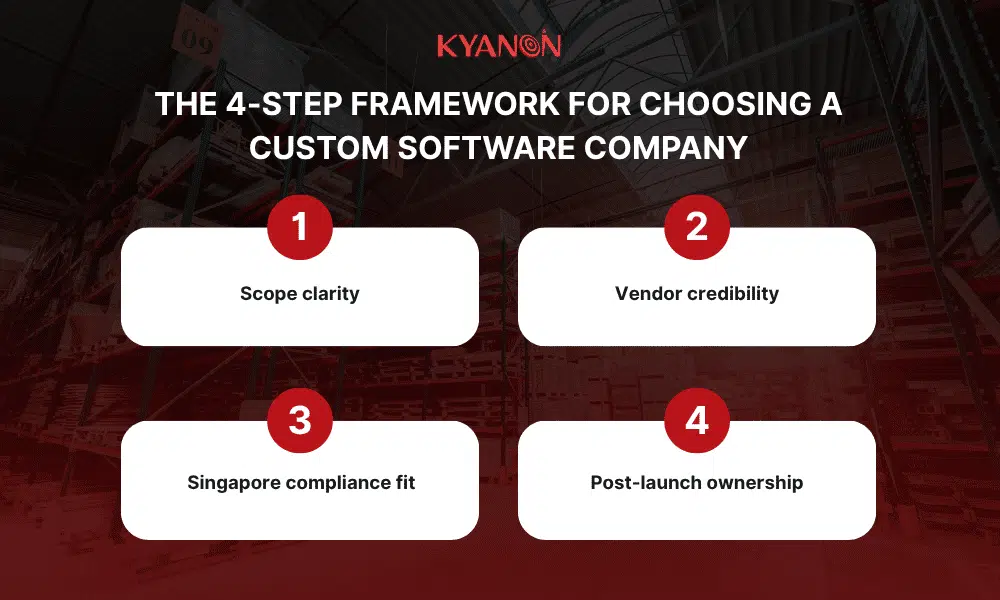
The 4-step framework for choosing a custom software company
Before shortlisting any provider of custom software development services in Singapore, businesses should evaluate both the business and technical sides of the decision. A strong vendor should be able to connect business goals with architecture, delivery governance, security, and long-term maintainability.
|
Step |
Business focus |
Technical focus |
|
1. Define needs and scope |
MVP vs full platform vs ERP-scale system; budget ceiling; launch timeline | Preferred tech stack; integration requirements; scalability needs |
| 2. Verify credibility | Client portfolio relevance; testimonials; reference calls |
Code quality signals; architecture case studies; review platforms |
|
3. Evaluate local context and cultural fit |
PDPA awareness; EDG or PSG grant experience; Singapore operating rhythm | Data residency, security architecture, access control, audit readiness |
| 4. Assess process and post-launch support | Agile cadence; communication style; SLA terms |
Maintenance model, uptime expectations, technical debt handling |
Decision rule: The more the project touches customer data, revenue operations, compliance, or existing enterprise systems, the more weight should be placed on architecture, security, integration, and support, not only delivery speed.
The strongest vendors do not simply say “yes” to every request. They clarify the business outcome, challenge risky assumptions, explain trade-offs, and show how each technical decision affects cost, timeline, scalability, and post-launch risk.
Custom software development engagement models in Singapore: Cost, fit, and trade-offs
Singapore businesses usually choose between four engagement models. Each model can work, but each fits a different risk profile.
|
Team model |
Best for | Cost level |
Key trade-off |
| Local Singapore-based team | Compliance-heavy, complex, close-collaboration projects | High |
Higher cost, strongest local alignment |
|
Offshore team |
Budget-conscious projects with clear scope | Low–medium |
Communication and time-zone risk if unmanaged |
| Hybrid team: local PM + offshore engineering | Most SME and mid-market builds | Medium |
Needs mature coordination and documentation |
|
Enterprise transformation partner |
Large-scale systems and integration with existing infrastructure | Medium–high |
Strong long-term value for multi-phase work, less ideal for a quick standalone MVP |
Enterprise SG’s 2026 budget update shows that Singapore is streamlining EDG, PSG, and MRA into EDGE in 2H2026, while expanding PSG to support more digital and AI-enabled solutions.
This matters because grant experience can reduce friction for eligible projects, but it should not be the main selection factor. A grant-aware vendor is useful. A delivery-weak vendor with grant knowledge is still risky.
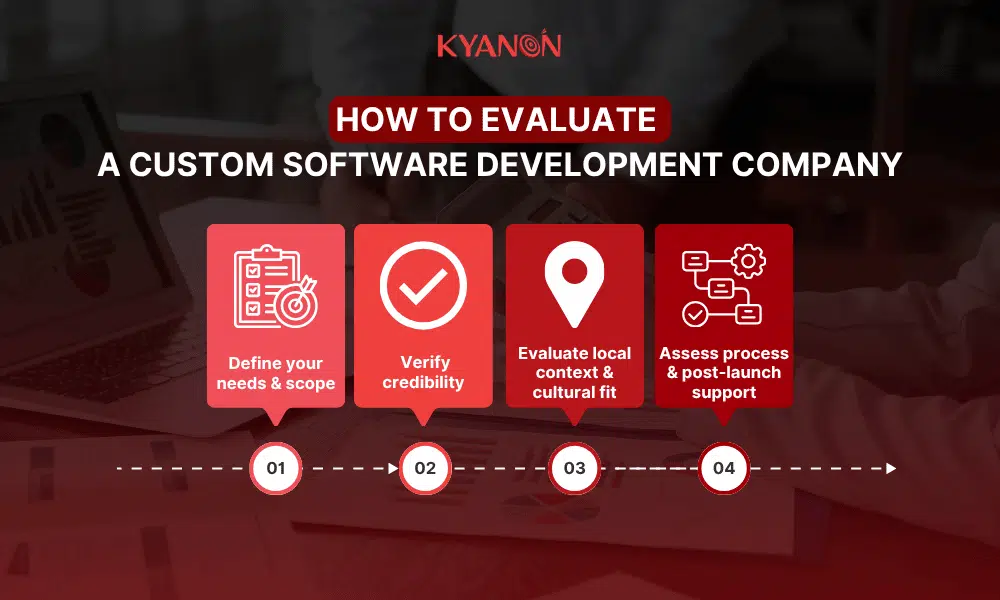
How to evaluate a custom software development company?
A strong software partner should not only build what is requested. It should help the business clarify what should be built first, what should wait, what may create technical risk, and what will affect long-term cost of ownership.
Step 1 — Define your needs and scope
Start with the business problem, not the feature list.
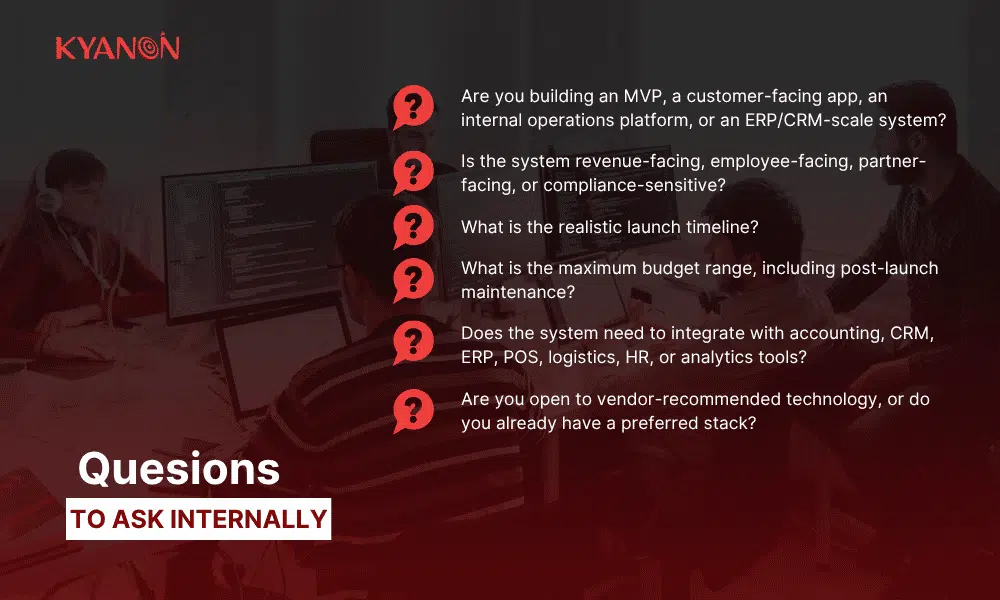
From Kyanon Digital’s delivery experience, unclear scope creates three common risks early in the project: architecture decisions are delayed, vendor proposals become harder to compare, and rework increases after the first sprint.
Practical tip: Write a one-page scope brief before contacting vendors. Include business goals, user groups, core workflows, integrations, timeline, budget band, and expected post-launch support.
A good vendor will ask clarifying questions. A weak vendor will quote too quickly from incomplete information.
Step 2 — Verify credibility
The strongest proof of vendor credibility is not a beautiful portfolio, but evidence that the company has handled similar workflows, integrations, security needs, and production constraints.
A software company’s portfolio should show more than nice interfaces. Look for evidence of delivery under real business conditions.
Check for:
- Projects in a similar industry or complexity level.
- Similar system type: customer portal, workflow platform, data dashboard, mobile app, or custom web app.
- Evidence of integration work, not just standalone websites.
- Architecture thinking: cloud setup, security model, APIs, CI/CD, monitoring.
- Independent reviews on platforms such as Clutch or DesignRush.
- Direct client references, especially for larger projects.
For a custom web application development company, the strongest proof is not only visual design. It is how the company handles authentication, access rights, performance, database design, third-party integrations, and production support.
Kyanon Digital perspective: In serious custom software builds, the best reference questions are not “Did the vendor deliver?” but “How did they handle change requests, defects, unclear requirements, and post-launch support?”
Red flag: A vendor that cannot provide one reference call for a serious project is not ready for a high-risk build.
Step 3 — Evaluate local context and cultural fit
Singapore software projects need local delivery awareness, especially around PDPA, cybersecurity, grants, data residency, and regulated industry requirements. Singapore has a high-trust business environment, but software delivery can still fail when vendors misunderstand local constraints.
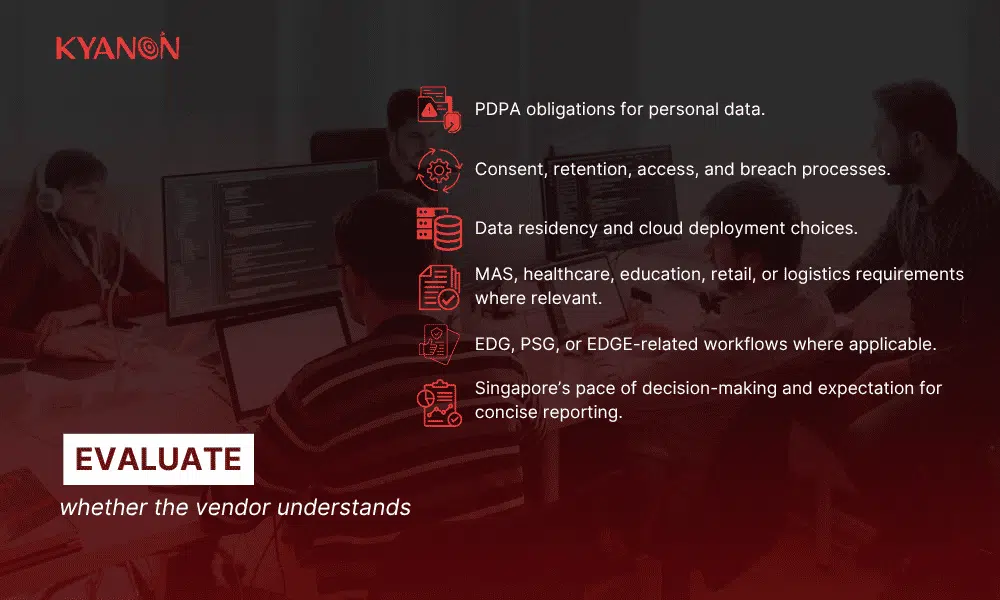
- PDPC’s 2026 DPO resource states that organizations need to understand PDPA responsibilities and protect customer and employee data, making data protection a delivery requirement rather than a legal afterthought.
- For AI-enabled systems, the compliance bar is rising. PDPC’s 2026 proposed advisory guidelines say general notifications are insufficient for using user data to develop generative AI models; organizations must provide AI-specific notifications for that purpose.
- EnterpriseSG’s 2026 Budget update also shows that EDG, PSG, and MRA will be streamlined into EDGE, while PSG is expanded to support more digital and AI-enabled solutions. This makes grant awareness useful, especially for eligible Singapore businesses evaluating digital or AI-enabled software projects.
Local context is not only about having a Singapore address. It is about knowing how compliance, grant readiness, decision cadence, reporting expectations, and regional scalability affect the delivery plan.
This affects software architecture. If the platform collects user data, uses AI features, or connects with sensitive systems, the vendor should design consent flows, access controls, audit logs, and data handling rules early.
Step 4 — Assess process and post-launch support
A reliable software partner should make delivery visible before the contract is signed, with clear sprint cadence, QA process, security review, release workflow, and SLA terms.
Ask for:
- Sprint cadence and demo checkpoints.
- Product backlog format.
- Change request process.
- QA and user acceptance testing process.
- Security review process.
- Release management workflow.
- Post-launch support plan.
- SLA terms in writing.
Do not accept “we do Agile” as a complete answer. Ask what the business will see every week: sprint plan, completed work, blockers, risks, demo output, and next priorities.
IMDA reported in 2026 that more than eight in 10 organizations experienced at least one cybersecurity incident annually, which makes security review, access control, monitoring, and post-launch resilience part of software delivery quality.
A serious vendor should be able to explain:
- Who owns sprint planning.
- Who approves scope changes.
- How defects are classified.
- How production issues are handled.
- How technical debt is tracked.
- What happens in month 2 after go-live.
A software project should not be judged only by go-live. The stronger test is whether the vendor can keep the system stable, secure, and maintainable after real users start using it.
For an enterprise web application development company, post-launch support is not optional. It is part of the total cost of ownership.
How to evaluate a custom software development company in Singapore
Kyanon Digital recommends this scorecard as a practical way to compare shortlisted software vendors across scope clarity, architecture, security, compliance, delivery process, support, and cost realism. The model is adapted from recognized criteria for software quality, secure development, data protection, and IT service management.
|
Evaluation area |
What to check |
Score 1–5 |
|
Scope clarity |
Did the vendor understand the business problem and define assumptions clearly? | |
| Portfolio relevance |
Have they delivered similar systems or industry use cases? |
|
|
Architecture thinking |
Can they explain scalability, integration, security, and maintainability? | |
| PDPA and compliance fluency |
Can they discuss consent, retention, breach handling, and data access controls? |
|
|
Agile transparency |
Are sprint cadence, demos, reporting, and change control clear? | |
| Post-launch SLA |
Are response time, support scope, uptime, and maintenance terms written clearly? |
|
|
Team structure |
Is the team model suitable for your scope and risk level? | |
| Cost realism |
Does the quote explain what is included, excluded, and likely to change? |
How to interpret the final score
| Total score |
What it usually means |
|
32–40 |
Strong fit. Shortlist for commercial negotiation and reference checks. |
| 24–31 |
Possible fit. Clarify weak areas before signing. |
|
16–23 |
High risk. The proposal may look acceptable but lacks enough proof. |
| Below 16 |
Avoid for business-critical work. |
Disclaimer: This scorecard is a practical vendor evaluation filter recommended by Kyanon Digital, not a fixed certification framework, and should be adjusted based on project complexity, compliance risk, integration scope, budget, and long-term operating needs.
The highest score should usually beat the lowest quote.
For businesses deciding between a boutique studio and a larger partner, use this rule:
- Choose a boutique studio when the scope is small, the workflow is simple, and speed matters more than long-term architecture.
- Choose a hybrid team when the project needs strong delivery but cost control still matters.
- Choose a transformation partner when the software is part of a larger modernization roadmap.
If the project may grow into ERP integration, CRM integration, multi-market rollout, analytics, automation, or AI-enabled workflows within 12–24 months, do not select a team that can only handle the first release.
Vendor fit by project type
The right software partner depends on project risk: simple MVPs need speed, while enterprise platforms need architecture, integration, governance, and post-launch ownership.
|
Project type |
Best-fit vendor model |
Why it fits |
|
Simple MVP |
Boutique studio or lean offshore team | Faster delivery, lower cost, and enough flexibility for early validation |
| Customer-facing web app | Hybrid team |
Balances delivery speed, UX, backend development, cost, and support |
|
Compliance-sensitive platform |
Local or hybrid team with compliance experience | Stronger fit for PDPA, security, audit, access control, and stakeholder review |
| Enterprise system integration | Transformation partner |
Better suited for ERP, CRM, data, automation, multi-system integration, and long-term scale |
|
AI-enabled workflow or automation platform |
Hybrid or transformation partner |
Requires data readiness, governance, human review, security controls, and future model/process updates |
What strong software decisions look like at scale?
DBS: Building middleware and platform teams for scalable digital banking
DBS is widely studied as a digital transformation case. IMD notes that DBS built a middleware layer on top of its core banking platform to launch products faster, support straight-through processing, and move data and applications to the cloud. It also reorganized into 33 platforms, each co-led by business and technology leads.
What businesses can learn
- Architecture matters before features. Middleware helped DBS connect new digital services with core banking systems.
- Software ownership needs both business and technology leadership. Platform teams reduced the gap between strategy and execution.
- Speed comes from system design, not only developer capacity. Faster launches depend on reusable foundations, not one-off builds.
Vendor selection lesson: When choosing a custom software development company in Singapore, ask whether the vendor can design around existing systems, APIs, data flows, and long-term ownership. A team that can only build screens may not be enough for enterprise-grade platforms.
FairPrice Group: Using AI and digital infrastructure to connect retail experiences
FairPrice Group shows how software selection becomes more complex when digital products must connect customer experience, store operations, staff workflows, data, and AI-enabled services.
FairPrice Group serves more than one million customers daily across Singapore and operates over 570 touchpoints, including grocery, dining, convenience, wellness, eCommerce, and rewards experiences. Google Cloud’s case study says the FairPrice Group app connects the wider ecosystem, and its Store of Tomorrow program uses Google AI, Gemini, Agent Development Kit, and open standards such as Model Context Protocol.
In April 2026, FairPrice Group announced that it would roll out innovations developed with Google Cloud AI across supermarkets by end-2026, including smart shopping carts, digital price cards, the ShopBeyond hybrid retail format, and Grocer Genie, an AI-powered staff app.
What businesses can learn
- Custom software must support both customers and operations. Retail software is no longer only a website or app.
- AI features need strong data and integration foundations. Assistants, recommendations, and staff apps depend on connected systems.
- Scalability needs physical-digital alignment. Store operations, eCommerce, loyalty, and staff workflows must work together.
Vendor selection lesson: For custom web app development Singapore projects, evaluate whether the vendor understands omnichannel workflows, not only front-end delivery. The right partner should be able to connect customer-facing applications with operational systems, data platforms, and future AI use cases.
Kyanon Digital case study: Singapore digital insurance app launch readiness
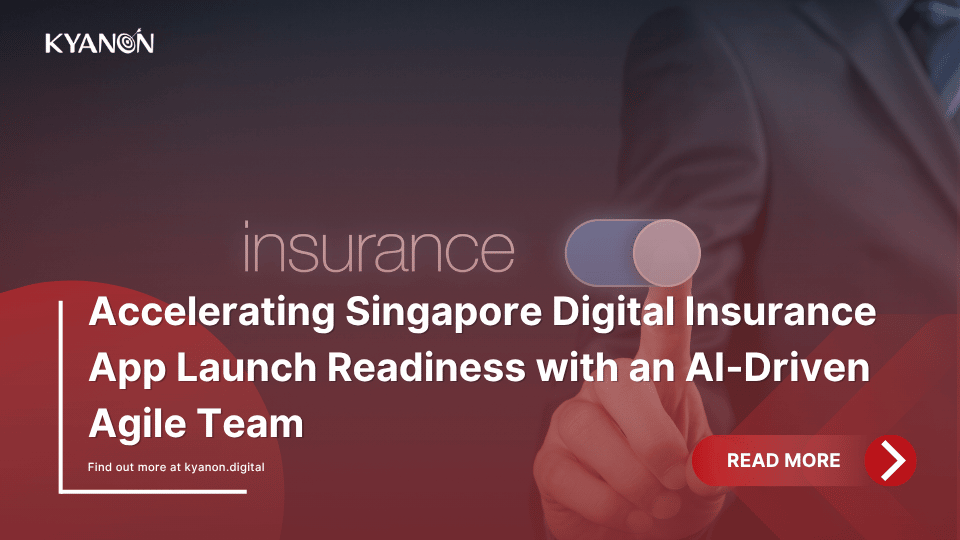
Kyanon Digital helped a Singapore digital insurance provider improve app launch readiness from 62% to 91% by combining mobile engineering, agile governance, AI-assisted delivery, quality control, security hygiene, and launch tracking.
Challenges
- The backend insurance workflows were mostly ready, but the mobile frontend still carried launch risks.
- User experience was inconsistent across claims, policy details, document upload, and notification screens.
- Business stakeholders had limited visibility into completed features, blockers, and launch readiness.
- The internal tech lead was overloaded with technical decisions, backlog clarification, coordination, and reporting.
- Security hygiene gaps existed around repository access, credentials, branch permissions, and contributor offboarding.
- Testing coverage was not mature enough for critical insurance flows such as claims submission, login, policy viewing, and document upload.
Solution
- Kyanon Digital applied an AI-driven agile team model combining mobile engineering, delivery governance, AI-assisted development, quality controls, security hygiene, and launch readiness reporting.
- The team introduced sprint planning, agreed acceptance criteria, weekly stakeholder updates, blocker tracking, sprint reviews, demo sessions, and monthly delivery reporting.
- Mobile stabilization focused on claims submission, policy viewing, document upload, login, authentication, push notification, status updates, agent-assisted workflows, reusable components, and UI consistency.
- Quality and security controls included code review, definition of done, static code checks, smoke testing, repository access review, MFA enforcement, credential rotation recommendations, secrets checks, branch permission controls, and offboarding review.
Results & impacts
- Pilot readiness score improved from 62% to 91% across priority insurance journeys.
- Open launch blockers were reduced by 72%, from 18 active blockers to 5 low-to-medium risk items.
- Sprint completion predictability improved to 86%.
- Internal tech lead coordination time was reduced by around 35%.
- High-priority frontend defects were reduced by 46%.
- Smoke testing covered 100% of priority launch journeys.
- Repository access was fully reviewed before launch, with unused contributor access removed, MFA enforced, and exposed credential risks remediated.
- AI-assisted coding, refactoring, and test generation shortened repetitive frontend fix turnaround by around 25%, while human engineers retained final review and release control.
Read more: Accelerating Singapore Digital Insurance App Launch Readiness with an AI-Driven Agile Team
Decision lesson
For businesses comparing software development partners, this case shows why the evaluation should go beyond team size or hourly rate. A stronger vendor should improve launch confidence, reduce coordination burden, expose risks early, and make delivery measurable before go-live.
When to choose a custom web app development partner in Singapore?
Businesses should choose a custom web app development partner in Singapore when standard SaaS tools cannot support complex workflows, integration needs, compliance requirements, or long-term product ownership.
Custom software is not always the first answer. In a mature digital market like Singapore, the better question is, Does the business need another tool, or does it need a system that fits how the business actually operates?
According to IMDA, Singapore’s digital economy grew by S$12 billion in 2024 to reach S$128.1 billion, contributing 18.6% of national GDP, up from 18.0% in 2023. This continued expansion shows that digital systems have become core business infrastructure rather than isolated technology initiatives.
Build vs buy: A simple decision filter
|
Situation |
Better fit |
| The process is standard and already supported by mature SaaS |
Buy or configure SaaS |
|
The process is unique but low-risk |
Start with SaaS, then customize later |
| The process affects revenue, compliance, or operations |
Consider custom software |
|
The system must connect many tools and data sources |
Custom software is often stronger |
|
The business needs roadmap and data ownership |
Custom software is usually better |
Choose custom software when standard tools create operational gaps
A business should consider custom web app development Singapore partners when off-the-shelf platforms cannot handle:
- Workflows that are too specific for standard SaaS tools.
- Customer, partner, or employee portals with custom access rules.
- Integration across ERP, CRM, POS, finance, logistics, HR, or analytics systems.
- Manual approvals that slow revenue, service delivery, or internal operations.
- Data models that do not fit generic software.
- Compliance, security, audit, or reporting requirements that need stronger control.
- Long-term ownership over roadmap, data, and product experience.
Custom development becomes more practical when teams rely on spreadsheets, systems do not sync cleanly, reporting is delayed, customer experience depends on workarounds, or AI and automation require cleaner data flows.
Do not build custom when SaaS is enough
Do not build custom software when:
- A mature SaaS platform can cover most core workflows with light configuration.
- The workflow is not strategic to the business.
- The business does not have ownership for post-launch decisions.
- The expected cost of support is not included in the budget.
- Requirements are still too unclear to justify a full build.
Decision rule: Start with SaaS when the workflow is common. Build custom when the workflow is strategic, compliance-sensitive, integration-heavy, or central to how the business creates value.
Common mistakes when hiring a custom software development company in Singapore
The most common mistakes when hiring a custom software development company in Singapore are choosing based on the lowest quote, underestimating backend complexity, ignoring post-launch ownership, and using AI-assisted delivery without proper governance.
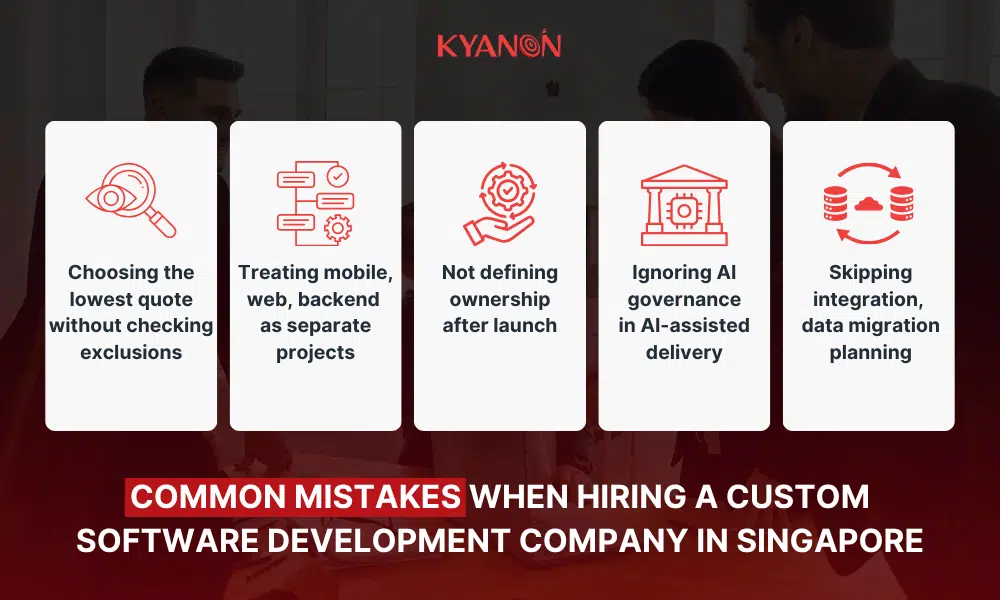
Mistake 1: Choosing the lowest quote without checking exclusions
A low quote may look attractive, but it often excludes the work that makes software reliable after launch.
Common exclusions include:
- Discovery workshops
- UX research
- API documentation
- Security testing
- DevOps setup
- Cloud cost planning
- Data migration
- Post-launch support
- Change requests
- Future enhancement planning
A fair comparison should separate:
|
Cost area |
What it covers |
| Build cost |
Design, development, testing, and release |
|
Integration cost |
APIs, third-party systems, ERP, CRM, POS, or payment connections |
| Infrastructure cost |
Cloud hosting, environments, monitoring, and deployment setup |
|
Support cost |
Bug fixes, SLA, maintenance, and version updates |
| Future change cost |
New features, workflow changes, and scalability improvements |
How to avoid it: Ask every vendor to state what is included, excluded, optional, and likely to change after discovery. The best proposal is not always the cheapest one; it is the one with the fewest hidden assumptions.
Mistake 2: Treating mobile, web, and backend as separate projects
For modern custom software, the mobile app or web app is usually only the visible layer. The real complexity sits behind the interface.
Important backend areas include:
- Authentication
- Role-based access control
- Data synchronization
- Payment processing
- Reporting
- Admin tools
- API orchestration
- System monitoring
- Security controls
- Audit logs
This is why businesses evaluating custom web app development Singapore partners should ask about backend architecture, not only frontend frameworks.
How to avoid it: Ask vendors to explain how the frontend, backend, database, APIs, cloud infrastructure, and security model will work together. A strong partner should be able to describe the whole system, not only the user interface.
Mistake 3: Not defining ownership after launch
A software product needs clear ownership after launch. Without it, businesses often face slow fixes, unclear accountability, rising technical debt, and unstable user experience.
Before signing, clarify:
|
Post-launch question |
Why it matters |
| Who monitors uptime? |
Prevents downtime from going unnoticed |
|
Who fixes bugs? |
Avoids unclear accountability |
| Who handles cloud updates? |
Reduces infrastructure and security risk |
|
Who owns security patches? |
Protects customer and business data |
| Who manages version upgrades? |
Keeps the system compatible and maintainable |
|
Who reviews performance issues? |
Supports better user experience at scale |
| Who handles future feature changes? |
Keeps the product aligned with business needs |
How to avoid it: Get the support model and SLA in writing before the project starts. A serious vendor should explain what happens in month 2, month 6, and month 12 after go-live.
Mistake 4: Ignoring AI governance in AI-assisted delivery
AI can improve development speed, testing, documentation, and code review. But AI does not remove the need for human judgment, security review, or architecture control.
Businesses should ask:
- Which parts of the software development lifecycle use AI?
- How is AI-generated code reviewed?
- Are there security checks for generated code?
- How are architecture decisions validated?
- How is intellectual property handled?
- Are prompts, code, and documentation managed securely?
- Who has final responsibility for production release?
AI-native delivery is useful only when combined with strong governance. Without review standards, AI can increase hidden technical debt, security gaps, and rework.
How to avoid it: Choose a vendor that treats AI as a productivity layer, not a replacement for senior engineering review. The strongest model combines AI-assisted speed with human-reviewed quality, secure delivery standards, and clear accountability.
Mistake 5: Skipping integration and data migration planning
Many custom software projects look simple at the start because the first discussion focuses on screens, workflows, and features. The real complexity often appears when the new system must connect with existing tools.
Common integration risks include:
- Legacy system limitations
- Poor API documentation
- Duplicate customer or product data
- Manual data cleanup
- Inconsistent user roles
- Unclear data ownership
- Reporting gaps between systems
How to avoid it: Ask the vendor to map integrations, data sources, migration steps, and system dependencies before finalizing the project plan. For enterprise software, integration planning should happen before development, not after the first release.
What businesses often underestimate
In enterprise software selection, the most underestimated risks are not coding effort but integration complexity, decision ownership, post-launch support, and hidden rework from unclear scope.
From Kyanon Digital’s implementation experience across Singapore and regional enterprise projects, the strongest custom software outcomes usually come from four delivery conditions:
- Clear scope before quotation: A one-page brief helps, but the vendor must still validate workflows, integrations, user roles, and operational risks.
- Architecture review before build: Businesses often underestimate API, data model, authentication, reporting, and third-party integration complexity.
- Governance built into delivery: Weekly progress reports, sprint demos, blocker tracking, and acceptance criteria reduce late-stage surprises.
- Support planned before go-live: Month-2 support is where many software projects expose weak handover, unclear ownership, and unresolved technical debt.
Decision rule: If the system is tied to revenue, compliance, customer data, internal operations, or regional scale, businesses should evaluate the vendor as a long-term delivery partner, not only a coding supplier.
Conclusion
Choosing the right custom software development company in Singapore is not about finding the biggest team or the lowest quote. It is about choosing a partner that fits the project’s real scale, risk, compliance needs, and long-term roadmap.
A simple MVP may need a lean delivery team. A business-critical platform may need stronger architecture, integration capability, delivery governance, and post-launch support. The key is to match the vendor model with where the project is today and where it may grow in the next 12–24 months.
For businesses planning custom software, enterprise web applications, modernization, or system integration across Singapore and the region, Kyanon Digital can support structured evaluation, scalable delivery, and technical risk reduction from strategy to launch.
Contact Kyanon Digital to discuss the right software delivery model for your next build.













 Create project brief with AI