




Are you an SME founder trying to figure out how to build an ecommerce website in Singapore from scratch? According to Global Data, Singapore’s e-commerce market is experiencing an intense acceleration, projected to expand by 17.7% to reach SGD 40.5 billion ($31 billion). Driven by a highly digitally proficient shopper base and massive mobile-first adoption, launching a digital retail brand requires aligning with distinct shifts in consumer expectations and platform technologies, there has never been a better time to launch, but building a successful store requires more than just picking a theme.
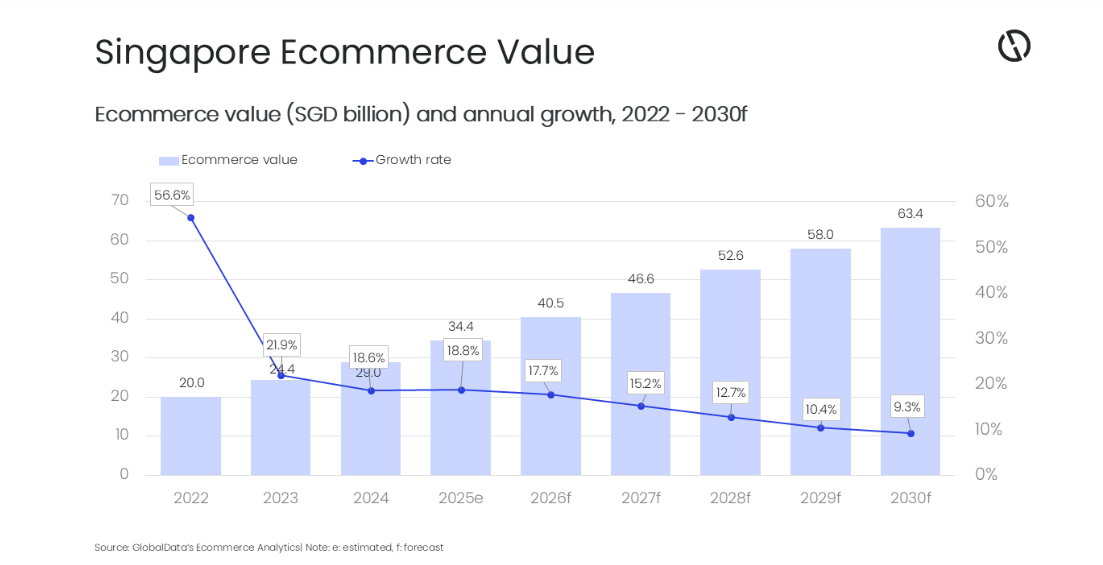
This guide previews the exact 5-step path tailored for true first-timers: moving from ACRA business registration and domain setup to platform choice, payment gateway integration, logistics, and strict legal compliance. Unlike generic tutorials that assume your business entity already exists, we cover both the technical build and the Singapore-specific regulatory steps.
Read on to master your digital launch and make a lasting business impact.
Key takeaways
- New founders often build a storefront without handling local compliance or securing the right registered entity first. Before selecting an ecommerce developer, you must establish your foundation.
- Follow a sequential 5-step roadmap starting with ACRA registration, ensuring no steps are missed. This prevents operational bottlenecks when applying for merchant bank accounts.
- Treat technical setup and PDPA compliance as parallel processes, not after thoughts. Integrating privacy policies natively saves costly redesigns later.
- A fully compliant, scalable platform equipped with localized payments like PayNow and ready for rapid local delivery. Customers enjoy a frictionless checkout experience.
- Navigating web ecommerce development smoothly allows SMEs to capture a share of Singapore’s booming digital economy faster. You launch with confidence and built-in trust.
Further Reading:
- Omnichannel eCommerce Solutions for Business Growth Singapore
- Singapore 10 Best Ecommerce Website Development Companies
- eCommerce Fulfillment: What Is It & Its Scope
- Scaling Singapore Retail Operations with Intelligent Supply Chain Automation
- Top 10 Omnichannel E-commerce Developers in Singapore
What to consider before you start building
Before you evaluate software features or hire an Ecommerce developer, you need a holistic launch strategy. True digital impact happens when your business goals seamlessly align with technical realities and regulatory requirements.
To avoid costly re-architecture later, we recommend evaluating your project through a dual-lens framework. The table below outlines the critical alignment needed between the business owner’s perspective and the technical/compliance realities when planning how to build an Ecommerce website in Singapore.
|
Criteria |
Business Owner Lens | Technical/Compliance Lens |
| Legal readiness | Do I have a registered business entity? |
ACRA registration status, business structure (sole prop vs Pte Ltd) |
|
Platform fit |
Budget, technical comfort, timeline to launch | Hosted SaaS vs self-hosted, scalability needs |
| Payment coverage | Which local payment methods do my customers expect? |
Gateway integration complexity (PayNow, GrabPay, cards) |
|
Logistics readiness |
Which couriers fit my product type and delivery promise? | API/plugin integration with chosen platform |
| Compliance | Do I need a privacy policy, ToS, GST registration? |
PDPA compliance implementation, GST threshold monitoring |
A crucial note for founders: Skipping the compliance column is the most common and costly mistake made by first-time retailers. Your digital storefront can be fully “built” and aesthetically perfect, yet remain entirely non-compliant. Launching without built-in PDPA safeguards or proper ACRA alignment risks immediate regulatory penalties and can irreversibly damage early customer trust.
Industry Insight
“eCommerce websites are increasingly becoming part of a broader digital ecosystem. Businesses need platforms that integrate with ERP, CRM, POS, inventory management, and marketing automation rather than treating the website as an isolated sales channel.” – Singapore Digital Economy Report
The 5 steps to build your Ecommerce website in Singapore
Understanding how to build an Ecommerce website in Singapore requires a strategic approach that goes beyond basic aesthetics. To achieve true business impact and operational efficiency, founders must follow a structured, sequential path that ensures both technical robustness and regulatory compliance.
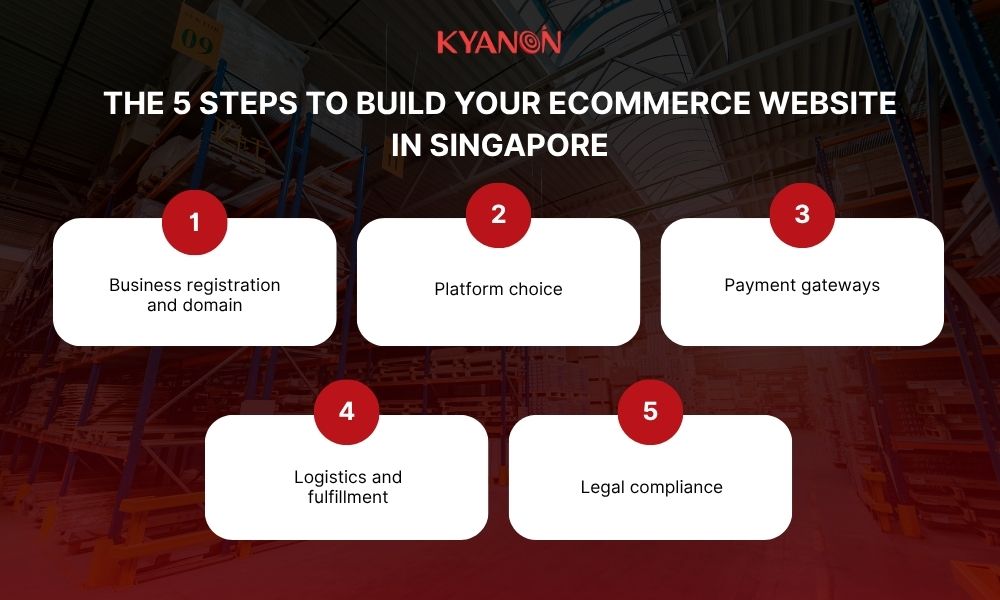
Step 1: Business registration and domain
Before writing a single line of code or evaluating software features, your foundation must be legally established. Registering your business with the Accounting and Corporate Regulatory Authority (ACRA) to obtain a Unique Entity Number (UEN) is the mandatory first step. Without this, corporate banking and local payment gateway approvals are impossible.
Once your ACRA registration is finalized, securing a localized domain name (such as a .com.sg or .sg) establishes immediate trust with local consumers. If you plan to hire an ecommerce developer to build custom logic or integrations later, having this corporate and brand infrastructure in place prevents administrative bottlenecks that could otherwise stall your project.
Step 2: Platform choice
With your entity registered, the next phase is selecting the right software architecture. SME founders must objectively assess their budget, timeline, and internal technical capabilities to decide between a hosted SaaS platform and a self-hosted or composable solution.
Hosted SaaS solutions offer speed to market, making them ideal for standard retail operations. However, if your long-term roadmap involves complex supply chain integrations or multi-vendor capabilities, choosing to develop e commerce website infrastructure using a custom architecture will provide the necessary scalability and data ownership for sustained growth.
Step 3: Payment gateways
Cart abandonment in Southeast Asia is heavily driven by checkout friction. Your store must natively support the payment methods Singaporean consumers use and trust daily. While standard credit and debit card processing is expected, integrating localized options is critical for high conversion.
As a core component of your web Ecommerce development, prioritizing seamless integrations like PayNow (especially anticipating Gen 2 deep-linking capabilities) and primary e-wallets like GrabPay will drastically improve your customer experience. Note that the application process for these merchant facilities requires your ACRA documentation, reinforcing why sequential planning is vital.
Step 4: Logistics and fulfillment
Delivering a successful digital product means ensuring your physical fulfillment operations are just as seamless as your storefront. Instead of relying on manual data entry or siloed tracking, your platform should be designed to communicate directly with local logistics providers such as Ninja Van, J&T Express, or Pickupp.
Modern merchants achieve this by integrating multi-carrier shipping applications to automate label generation and dynamically compare delivery rates. Configuring these APIs correctly ensures that your delivery promises on the front end perfectly match your operational capacity on the back end.
Step 5: Legal compliance
A fully functioning store is a liability if it fails to meet Singapore’s regulatory standards. Compliance must be woven into the digital fabric of your site, not tacked on as a pre-launch afterthought. This includes diligently monitoring your revenue to ensure timely GST registration once your annual taxable turnover approaches the mandatory SGD 1 million threshold.
Furthermore, adherence to the Personal Data Protection Act (PDPA) is strictly enforced from day one. Throughout the Ecommerce web development lifecycle, you must ensure that data collection touchpoints, from account creation to checkout are paired with clear privacy policies and secure data handling protocols to protect both your customers and your brand’s reputation.
How to sequence your Ecommerce build
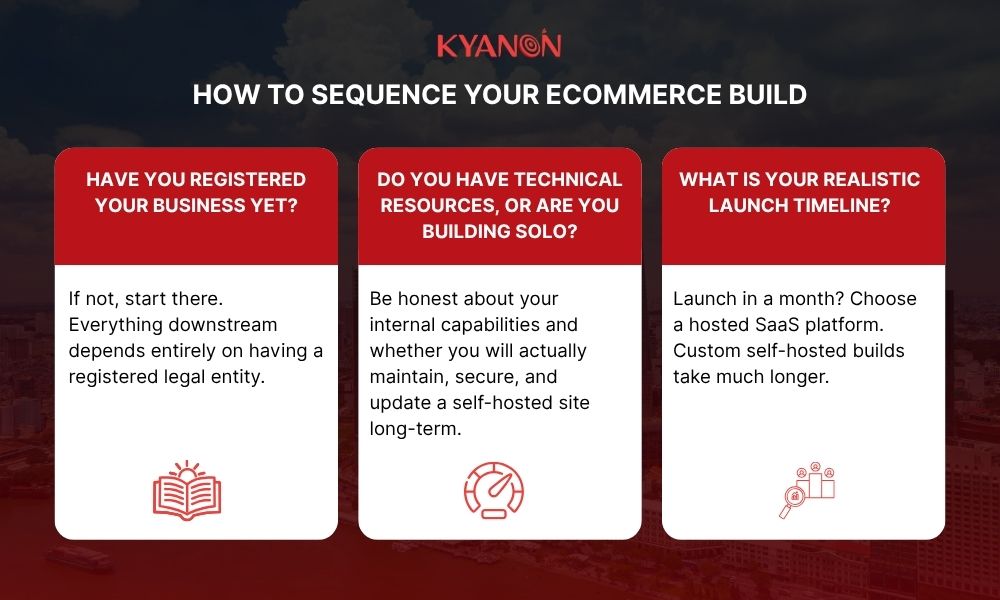
Building an online store isn’t just a technical project; it’s a strategic business initiative. To avoid costly delays and re-work, you need a decision framework that guides you through the right order of operations. Ask yourself these critical questions:
- Have you registered your business yet? If not, start there. Everything downstream—from opening a corporate bank account and securing payment gateway approvals to managing your GST registration—depends entirely on having a registered legal entity.
- Do you have technical resources, or are you building solo? Your answer here dictates your platform choice between hosted SaaS versus self-hosted architecture. Be honest about your internal capabilities and whether you will actually maintain, secure, and update a self-hosted site long-term.
- What is your realistic launch timeline? If your go-to-market strategy requires launching within a month, a hosted SaaS platform paired with app-based payment and logistics integrations is the only realistic path. Conversely, self-hosted builds requiring custom design and bespoke workflows typically need a significantly longer runway.
As you move through this sequence, it is vital that your legal and compliance steps (Step 5) run in parallel with your technical build steps (Steps 2–4). Do not treat legal readiness as a final checkbox right before launch. Retrofitting a privacy policy or enforcing PDPA compliance after a site is live is incredibly disruptive and risks damaging early customer trust. Build compliance into your foundation from the start to ensure a seamless, secure, and truly impactful digital launch.
Navigating the complexities of platform selection, seamless localized integrations, and strict legal compliance simultaneously can be overwhelming. That is where Kyanon Digital steps in. Our Ecommerce Website Development services are tailored to absorb this technical and operational friction for Singaporean SMEs. Contact Kyanon Digital today to map out your high-performing ecommerce architecture!
What a first-time Ecommerce launch looks like in Singapore
Entering the digital marketplace in Singapore today is drastically different than it was even a few years ago. SME founders are no longer just putting a product catalog online; they are plugging into a highly sophisticated and rapidly expanding digital economy.
What does this mean for your launch day? It means your baseline for digital quality must be exceptionally high. You are launching into an ecosystem driven by near-universal internet connectivity and high consumer confidence in digital transactions. Your store must immediately exude trust, security, and technical fluidity.
To understand the environment you are entering, consider the data shaping the modern Singaporean consumer’s expectations:
- Incredible Market Penetration: With 5.04 million online shoppers representing 85.3 per cent of the population, Singapore has one of the highest ecommerce penetration rates in the Asia-Pacific region. (Marketing Agency)
- High Purchasing Power: Singapore’s high GDP per capita—around US$65,000—gives consumers substantial purchasing power, enabling higher spending on premium and discretionary e-commerce products. (Grow with Singlife)
- Mobile Wallet Dominance: Digital payments have become the default payment method in Singapore, with 92% adoption in 2025, creating an environment where consumers expect fast, seamless checkout experiences. (PwC)
- Social and Live Commerce Integration: Modern consumer journeys frequently begin on social media. The surge of platforms like TikTok Shop and Instagram Shopping is heavily influencing how products—especially in the apparel and electronics sectors—are discovered and purchased.
Because local shoppers are accustomed to the frictionless experiences provided by regional marketplace giants, a “first-time” launch cannot afford to feel like a trial run. If your site suffers from slow load times, lacks preferred localized e-wallets, or fails to optimize for mobile devices, users will bounce to a competitor within seconds.
This reality underscores why partnering with a proven Ecommerce developer is a strategic business necessity, not merely an IT expense. A robust develop Ecommerce website strategy ensures that from day one, your SME operates with the performance, compliance, and scalability of an established brand, allowing you to capture your share of this lucrative market immediately.
2026 trends shaping Ecommerce launches in Singapore
In 2026, the digital landscape in Southeast Asia is moving faster than ever. For SME founders planning how to build an Ecommerce website in Singapore, staying ahead of these structural shifts is the difference between a thriving, scalable launch and immediate operational gridlock.
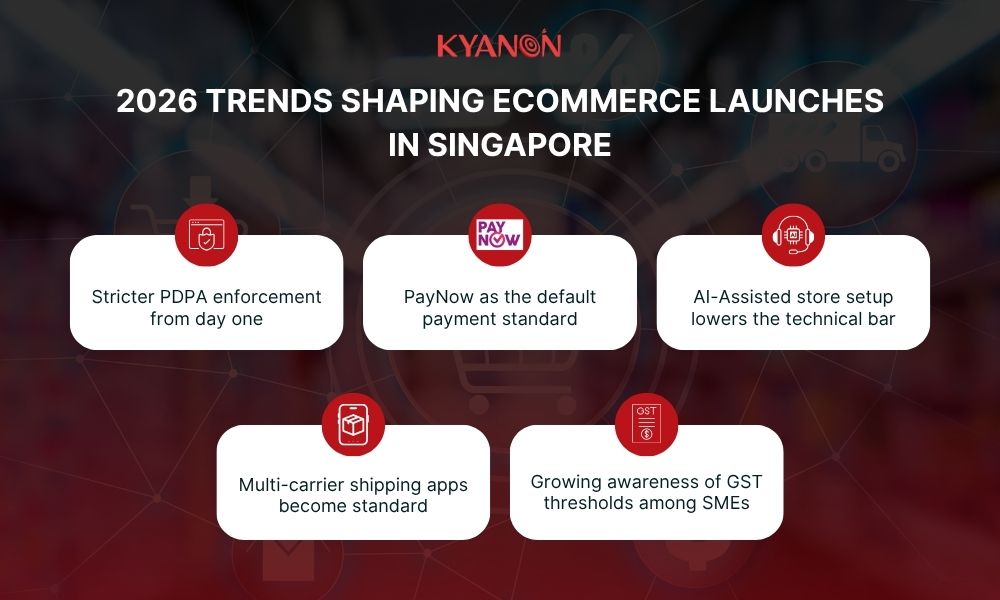
Stricter PDPA enforcement from day one
As Singapore’s data protection landscape matures, regulatory bodies are tightening enforcement. First-time retailers should expect greater scrutiny regarding how customer data is collected, processed, and stored immediately upon launch—not just when they reach enterprise scale.
PayNow as the default payment standard
Adoption of peer-to-peer and QR payments continues to climb relentlessly. More local shoppers now default to PayNow QR over traditional credit cards for their online purchases. Integrating this capability is a near-must rather than a nice-to-have, and should be a core priority in your web Ecommerce development roadmap to capture high-intent local buyers without friction.
AI-Assisted store setup lowers the technical bar
The barrier to entry continues to drop as generative AI tools like Shopify Magic and Hostinger AI become mainstream. These tools are radically compressing the time needed to generate bulk product listings, write SEO-optimized descriptions, and structure basic storefront designs, reducing the advantage that highly customized self-hosted platforms once held on initial deployment speed.
Multi-carrier shipping apps become standard
Rather than integrating a single, rigid courier plugin, modern stores are launching with shipping aggregators. Applications like EasyParcel and ShipBob are being implemented from day one to compare rates and delivery times dynamically. If you collaborate with an Ecommerce developer, ensure they map out these dynamic routing APIs to optimize your fulfillment costs and offer flexible delivery promises.
Growing awareness of GST thresholds among SMEs
As new online retailers scale rapidly through integrated social commerce and regional marketplaces, crossing the mandatory SGD 1 million annual taxable turnover mark happens much faster. Consequently, GST registration timing is becoming a commonly discussed, critical compliance milestone even for very young, fast-growing businesses.
Anticipating these 2026 trends ensures your foundation is built for longevity. When you decide to develop Ecommerce website architecture that respects both technical agility and strict legal boundaries, you position your SME for sustainable, impactful growth in a highly competitive market.
Case Study: Kyanon Digital Developed An E-Commerce System For Coway
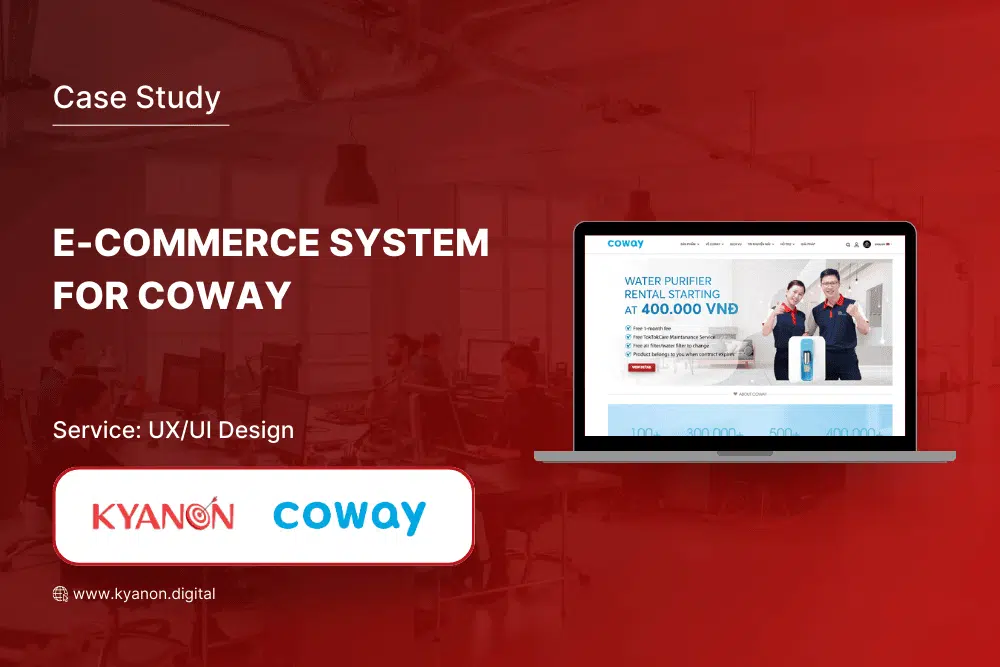
Even industry leaders like Coway can face digital bottlenecks. Despite a stellar product reputation, a fragmented online customer journey and a disconnected sales agent management system hindered their scalability.
Coway partnered with Kyanon Digital to engineer a Completed Technology Solution. By integrating a frictionless B2C checkout with an advanced backend commission-tracking portal, we optimized their internal operations and delivered profound digital impact.
Challenges
- Subpar digital experience: Coway struggled with managing its online presence and lacked a robust platform to create a seamless eCommerce experience for its customers to browse and purchase products.
- Operational bottlenecks: The brand lacked an efficient system to manage its sales agents, track their performance, and monitor overall sales comprehensively.
- Scalability issues: Coway needed an integrated solution that could improve internal efficiencies and confidently scale to meet the growing digital consumer demand.
Solutions
- Comprehensive E-Commerce platform: Kyanon Digital developed a centralized digital hub showcasing Coway’s purifiers. The platform was designed with a user-friendly interface, seamless navigation, and secure payment integrations to drive engagement and sales.
- Flexible E-Commerce admin portal: An advanced back-end portal was built to give administrators full control over product listings, website content, order processing, and SEO. This empowered the Coway team to quickly adapt to market trends, launch promotions, and streamline inventory management.
Impact
- Frictionless customer experience: The new eCommerce system provided customers with a smooth, intuitive purchasing journey, elevating Coway’s digital brand presence.
- Optimized agent management: Kyanon Digital successfully integrated Coway’s agent management system, allowing the company to efficiently track sales records and automatically calculate commissions for their sales agents, drastically improving operational efficiency.
Conclusion
Understanding how to build an Ecommerce website in Singapore means recognizing that a successful launch is an intersection of legal readiness, strategic web architecture, and localized operational plugins. From securing your ACRA registration to mastering PayNow integrations and ensuring PDPA compliance, sequencing these five steps correctly guarantees a resilient digital foundation.
Kyanon Digital empowers businesses to achieve rapid growth and impact through completed, end-to-end technology solutions. Ready to transform your digital presence? Contact Kyanon Digital today to partner with leading experts who know exactly how to scale your business securely.




















 Create project brief with AI