

Most CRM and ERP systems still require prompting. They show dashboards, answer questions, and leave a human to do the work. Agentic AI CRM and ERP systems don’t wait: they draft quotations, auto-adjust inventory, summarize sales calls, and route leads without being prompted. For Singapore’s CEOs, CTOs, and heads of digital, that distinction, not “Does it have AI?”, is now the real budget question.
This enterprise shift is accelerating rapidly. According to a Gartner report, 40% of enterprise applications will feature task-specific AI agents by the end of 2026, making AI autonomy a core operational standard rather than an experiment.
This guide compares the four paths Singapore enterprises are choosing between in 2026: AI-native platforms such as Odoo, agentic layers wrapping existing SAP or Oracle investments, global productivity suites like Microsoft 365 Copilot or Google Workspace with Gemini, and fully custom AI-native builds. We also map where Enterprise Development Grant (EDG) funding fits, since budget is usually the first filter Singapore decision-makers apply. Read on for a side-by-side breakdown you can bring straight into your next planning meeting.
Key takeaways
- Agentic AI: Acts first and waits for approval; a chatbot layered on your ERP just answers questions about data you already have.
- Four paths: Singapore enterprises are navigating choices between AI-native platforms (Odoo), agentic layers on existing SAP/Oracle systems, global productivity suites (Microsoft 365 Copilot, Google Workspace with Gemini), and fully custom AI-native builds.
- Cost spread: Odoo’s official pricing, an AI-native platform requires roughly US$8.95-13.6 per user per month for an AI-native platform. Inconstrat, as outlined in the AlphaCorp AI 2026 Pricing Guide, a production AI agent typically costs 40,000 to $300,000+ to develop, depending on integration complexity and enterprise-grade security requirements.
- Grant support: Singapore’s Enterprise Development Grant can offset up to 50% of qualifying project costs, which changes the math on custom builds.
- The one question that matters: Does the AI act and wait for your approval, or does it only answer when prompted? That’s the line between real agentic AI and a rebranded chatbot.
Further reading
- What Are The Five Steps Of The CRM Process? Find Out Now!
- List of 5 Best CRM & Enterprise Loyalty Platforms
- Top ERP Software Companies in Singapore for Enterprises 2026
- How AI Is Redefining Customer Loyalty in SEA
- From Transaction to Relationship: Loyalty 4.0
Quick comparison – Four strategic AI CRM & ERP approaches
| Solution type | Core architectural approach | Best for |
AI maturity / Autonomy |
|
AI-native core platform |
Core systems built from the ground up with embedded automation modules. | SMEs and mid-market enterprises looking for unified data pipelines without bolt-on friction. | High: No-code agentic lead routing and pre-localized compliance out of the box. |
| Agentic layer on legacy ERP | Orchestration layers wrapping existing systems via robust API connections. | Large enterprises with heavy legacy core configurations are avoiding an expensive rip-and-replace phase. |
High: Autonomous agents deployed on top of established record-keeping foundations. |
|
Global ecosystem AI |
Front-office productivity tool extensions embedded into desktop apps. | Teams heavily standardized on Microsoft or Google suites, seeking immediate productivity optimization. | Medium: Strong text and data synthesis; lighter on complex operational business logic. |
| Custom AI-native build | Purpose-built, fully proprietary multi-agent ecosystems. | Large enterprises with highly non-standard operations or niche industry compliance rules. |
Highest: Custom agents mapped exactly to proprietary enterprise workflows. |
Evaluation framework for enterprise system readiness
To protect infrastructure stability, enterprise technology leads cannot rely solely on basic cost comparisons. True readiness requires analyzing deep architectural dependencies across both business and technical dimensions.
|
Evaluation metric |
Business pov (COO/operations director) |
Technical pov (CTO/IT lead) |
|
AI maturity & Autonomy |
Does the system directly reduce manual transaction times or simply generate static reports? | True agentic architecture (execute + wait for validation) vs. conversational chatbot layer. |
| Data readiness | Can business teams leverage clean, unified historical profiles for immediate targeting? |
Pipeline maturity: Real-time data normalization, vector database grounding, and ETL pipeline latency. |
|
Security & governance |
Does the deployment align with strict internal risk management rules and liability models? | Multi-tenant isolation, data lineage tracking, role-based access control (RBAC), and LLM data posture. |
| Human approval & Exceptions | How easily can operations staff override an agentic decision when anomalies occur? |
Human-in-the-loop (HITL) orchestration loops, error logging, fallback logic, and alert triggers. |
|
Post-launch ownership |
What are the total costs of ownership regarding platform support and business modifications? | Codebase maintainability, custom integration flexibility, vendor lock-in risks, and IP control. |
| Integration observability | How visible are process blockages or system anomalies to the management team? |
API runtime metrics, transaction tracing across multi-agent setups, and middleware log health. |
|
Singapore localization |
Full compliance with local corporate tax changes and immediate technical vendor support. |
Direct native integration with local banking networks, IRAS InvoiceNow (Peppol), and SingPass API modules. |
Maximizing ROI with Singapore’s Enterprise Development Grant (EDG)
To offset capital allocation challenges, eligible local organizations can leverage Singapore’s Enterprise Development Grant (EDG), which subsidizes up to 50% of qualifying costs for digital transformation projects. This grant mechanism is specifically applicable to process automation, deep core system integrations, and custom software development projects that drive measurable productivity improvements, shifting the financial feasibility of bespoke deployments significantly.
Market landscape: Top product profiles & solutions in 2026
Evaluating specific software platforms reveals how these distinct architectural paths translate into commercial products for modern operations:
|
Platform / Solution |
Core architectural path | Strategic value |
Key capabilities |
|
Odoo (AI-Native Core) |
AI-native core platform | The benchmark for modular execution. |
Seamless data integration, native assistants for invoice drafting & lead routing, proactive agent execution (Odoo 20). |
|
SAP business AI / Joule |
Agentic Layer on Legacy ERP | The standard for large-scale enterprise record-keeping. | Plain text querying of complex ledgers and autonomous multi-system transaction execution while protecting core data. |
| Oracle AI capabilities | Agentic Layer on Legacy ERP | Unmatched for multi-entity finance operations. |
Embedded GenAI workflows in core data structures minimized transaction latencies for global logistics. |
|
Microsoft Dynamics 365 Copilot |
Global ecosystem AI/bridge | Bridges databases and cloud productivity modules. | Surfaces real-time, active CRM updates directly inside daily team communication loops. |
| Microsoft 365 Copilot & Google Workspace with Gemini | Global ecosystem AI | The definitive leaders in personal knowledge worker optimization. |
Text generation, meeting summaries, and immediate draft creation natively inside communication apps. |
|
Custom AI integrations |
Custom AI-native build | Guaranteed full ownership over intellectual property (IP) and data pipelines. |
Open architectures, bespoke modular visual workflow orchestrators built by dedicated partners (e.g., Kyanon Digital). |
Industry data: How fast is agentic AI actually moving?
McKinsey’s June 2026 survey found that almost 90% of organizations are experimenting with AI, but only 7% have scaled it across the enterprise. Agentic AI remains at an earlier stage, with no more than one-quarter of organizations experimenting with AI agents in any business function.
Gartner also predicts that by 2027, 40% of enterprises will demote or decommission autonomous agents because of governance gaps identified after production incidents. Together, these findings show that the enterprise challenge is shifting from AI access to secure integration, governance, and operational scaling.
How to choose the right AI CRM/ERP approach for your enterprise
To determine the most effective path for your organization, use this operational decision matrix:
| Decision criteria | Your current state |
Recommended strategy |
| System investment | Running legacy platforms (SAP, Oracle, Dynamics) | Wrap with an agentic layer: Faster and more cost-effective than a full replacement. |
| Migrating from manual spreadsheets or starting fresh |
Adopt an AI-native core: Platforms like Odoo provide a robust, built-in foundation. |
|
|
Primary bottleneck |
Front-office productivity (drafting emails, meeting notes) |
Deploy ecosystem AI: Microsoft 365 Copilot or Google Workspace with Gemini are excellent solutions. |
| Backend operations (procurement, inventory, quoting) |
Integrate operational AI: Require a genuinely agentic CRM/ERP layer or a custom build. |
|
|
Workflow complexity |
Standard, predictable operations |
Leverage off-the-shelf platforms: Highly efficient for standard processes. |
| Highly specific, multi-layered approval chains |
Commission bespoke AI-native builds: Ensure you verify with vendors that the AI autonomously executes tasks rather than merely retrieving data. |
Kyanon Digital perspective: For enterprises still unsure which path fits, extending an existing SAP or Oracle investment with an AI layer, adopting an AI-native platform like Odoo, or commissioning a custom build, the right starting point is usually an operational mapping exercise before any platform decision is made.
Kyanon Digital’s AI, GenAI, and automation practice works with Singapore enterprises on exactly this kind of mapping as part of a broader end-to-end digital transformation engagement, helping identify where agentic AI genuinely reduces manual work before recommending a platform.
Connect with Kyanon Digital for more information about our end-to-end digital transformation services.
2026 trends shaping AI CRM and ERP adoption in Singapore
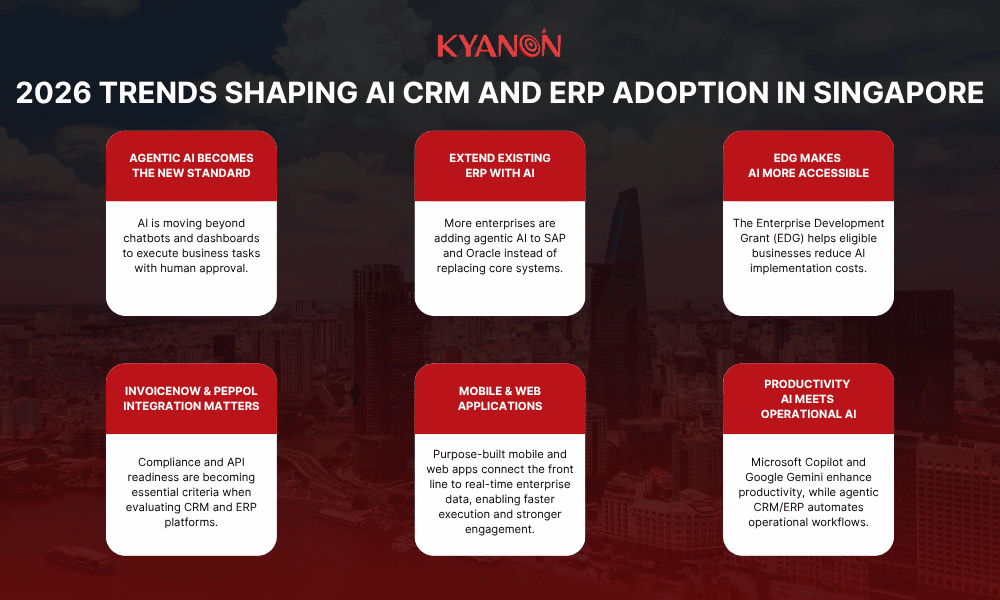
- From passive to agentic AI: the defining question is shifting from “Does it have AI?” to “Does the AI act or just answer questions?” – a distinction Gartner‘s own research frames around agent maturity and real business value rather than feature marketing.
- Grant-supported adoption: Singapore’s Enterprise Development Grant continues to lower the barrier to AI adoption for eligible enterprises, covering up to 50% of qualifying project costs for both platform-based and custom AI CRM/ERP projects.
- E-invoicing as an integration forcing function: IRAS’s GST Invoice Now requirement, built on the Peppol network, is progressively extending to all GST-registered businesses through April 2031, making InvoiceNow/Peppol connectivity an increasingly standard integration checkpoint for any CRM/ERP evaluated in Singapore.
Kyanon Digital case study: Global coffee chain’s digital ecosystem stabilization in Hong Kong
Kyanon Digital helped a global coffee chain in Hong Kong restore system reliability and operational efficiency by implementing agile governance, centralizing documentation, and delivering continuous system enhancements across their digital platforms.
Challenges
- Limited system documentation made it difficult for engineering teams to understand the existing architecture and workflows.
- Frequent bugs and ongoing system instability negatively affected platform performance and service reliability.
- A lack of standardized processes and a clear governance model reduced operational efficiency and slowed down issue resolution.
Solution
- Kyanon Digital implemented an agile governance framework to establish clear standard operating processes and streamline issue resolution workflows.
- The team centralized and structured technical documentation, making system understanding and knowledge transfer significantly easier.
- Continuous system enhancements were delivered, focusing on stabilizing the core platform, improving the loyalty program, and optimizing third-party integrations.
Results & impacts
- System stability was significantly improved, drastically reducing service disruptions across the digital ecosystem.
- Faster issue resolution times and increased operational efficiency were achieved through clearer workflows and governance.
- The stabilized digital ecosystem enabled better customer experiences and supported new features aligned with business growth in the Hong Kong market.
Read more: Maintenance and Enhancement of a Global Coffee Chain’s Digital Ecosystem in Hong Kong
Choosing an AI CRM and ERP strategy that fits your business
Choosing among AI CRM and ERP solutions for Singapore enterprises in 2026 comes down to one distinction that cuts through the marketing: does the system act on your behalf and wait for approval, or does it simply answer questions faster?
Odoo suits enterprises wanting AI built into a new core, while an agentic layer from partners like Axxis Consulting protects existing SAP or Oracle investments. Microsoft 365 Copilot and Google Workspace with Gemini suit productivity-first teams, and a custom build serves enterprises whose operations don’t fit any of the above.
Whichever path fits, mapping your workflows and checking EDG eligibility early will do more for your ROI than any single feature comparison. Talk to Kyanon Digital for deeper consultancy.









 Create project brief with AI