


A Shopify development agency in Singapore now operates in a market where online sales represented 15.1% of total retail sales in May 2026, according to the Singapore Department of Statistics.
Platform choice alone does not determine whether an e-commerce program succeeds. The implementation partner also affects:
- Store performance and checkout reliability.
- PayNow, GrabPay, and regional payment integration.
- Product, customer, and order migration.
- ERP, CRM, PIM, POS, OMS, and warehouse connections.
- Inventory and fulfillment accuracy.
- SEO protection during replatforming.
- Security, platform updates, and post-launch support.
Businesses searching for Shopify development services in Singapore are often at the same decision stage as those comparing Magento e-commerce development services in Singapore. They are deciding between faster SaaS delivery, deeper platform control, and the level of customization their operating model requires.
This article reviews Shopify-capable companies serving Singapore, explains their most relevant fit, and provides an evaluation framework for selecting a partner based on store complexity rather than brand visibility alone.
Key takeaways
- Platform fit comes first. Shopify supports faster, managed commerce, while Magento offers deeper control for complex pricing, catalogs, and workflows.
- Partner credentials are only the starting point. Shopify tier, verified skills, named specialists, and comparable case studies should all be checked.
- Singapore localization requires end-to-end testing. PayNow, GrabPay, refunds, settlement, multi-currency payments, and finance reconciliation depend on the final setup.
- Integration and migration create the highest delivery risk. ERP, POS, PIM, OMS, inventory, customer data, redirects, and analytics need clear ownership.
- Post-launch support is part of the implementation. API updates, app compatibility, security, monitoring, and incident response should be defined before signing.
- Compare total operating cost, not hourly rates alone. Applications, middleware, migration, testing, maintenance, and future upgrades can materially change the three-year cost.
- The right provider depends on store complexity. Standard DTC stores may need a focused Shopify agency, while B2B, omnichannel, or replatforming programs require broader commerce engineering capability.
Top picks: Shopify development companies in Singapore for 2026
The following list covers Shopify agencies, e-commerce design companies, and broader software engineering providers serving the Singapore market.
Each company is assessed across four areas:
Evaluation area | What was considered |
Platform capability | Public evidence of Shopify, Shopify Plus, Magento, e-commerce, or custom commerce services |
| Project fit | Whether the company appears better suited to design-led stores, custom software, migration, mobile commerce, or enterprise integration |
Delivery model | Singapore-based, regional, offshore, or distributed delivery structure |
| Validation needs | The most important claims, skills, references, and operating capabilities to verify before engagement |
Pricing note: The hourly figures below are third-party directory indications checked in July 2026. They are not confirmed project quotations. Actual pricing depends on scope, team seniority, delivery location, integrations, support coverage, and commercial model.
Quick comparison table
| Company | Pricing indication | Most relevant fit |
Kyanon Digital | $25–$49/hour | Custom Shopify, Shopify Plus, Magento, migration, and enterprise integration |
| TechGropse | $25–$49/hour | E-commerce combined with mobile applications and custom software |
Kuchoriya TechSoft | Below $30/hour | Multi-platform e-commerce and broader product engineering |
| Junkies Coder | Not clearly disclosed | E-commerce connected to mobile applications and custom digital products |
Elites | Not disclosed | Brand-led e-commerce design and creative digital experiences |
| Orfeostory | $70–$150/hour | Singapore-based website design, e-commerce, and maintenance |
Visible One | $30–$70/hour | Design-led Shopify, Magento, and regional e-commerce websites |
| OnGraph Technologies | $25–$49/hour | Custom e-commerce, web, mobile, cloud, and AI engineering |
axiusSoftware | Below $30/hour | Shopify stores requiring custom software or system integration |
| Win-Pro | $70–$150/hour | Local managed IT, infrastructure, cybersecurity, and web support |
Mobirevo | Not clearly disclosed | E-commerce combined with web, mobile, SaaS, or ERP development |
| Catching Clicks | Not disclosed | Smaller e-commerce projects supported by SEO and digital marketing |
Octal IT Solution | $30–$70/hour | Larger software, mobile, and e-commerce development programs |
Kyanon Digital

Founded in 2012, Kyanon Digital operates through a regional delivery model across Singapore and other Asia-Pacific markets. Kyanon Digital combines Shopify, Shopify Plus, Magento, custom commerce, migration, enterprise integration, and ongoing support under a regional delivery model.
This makes Kyanon Digital more suitable for replatforming, omnichannel commerce, regional expansion, and integration-heavy programs than for businesses seeking only a basic theme build or visual storefront refresh.
Unlike providers focused mainly on storefront design, Kyanon Digital positions e-commerce as part of a wider operating system. Its services cover connections with ERP, CRM, PIM, POS, OMS, warehouse, loyalty, and customer-data platforms.
- Website: kyanon.digital
- Founded: 2012
- Team size: 500+ across Vietnam, Singapore, Thailand, Australia, and Malaysia
- Pricing tier: $25–$49/hour for Vietnam-based engineering
- Key clients: Enterprises, Fortune 500 companies, and regional organizations
Best suited to:
- Shopify Plus implementation or migration.
- Magento or legacy-platform replatforming.
- Omnichannel and regional commerce.
- Custom applications and middleware.
- Integration-heavy e-commerce programs.
- Long-term platform engineering.
What to verify:
- Shopify and Magento credentials.
- Comparable migration and integration references.
- Middleware, code, and documentation ownership.
- Responsibilities across Singapore and regional teams.
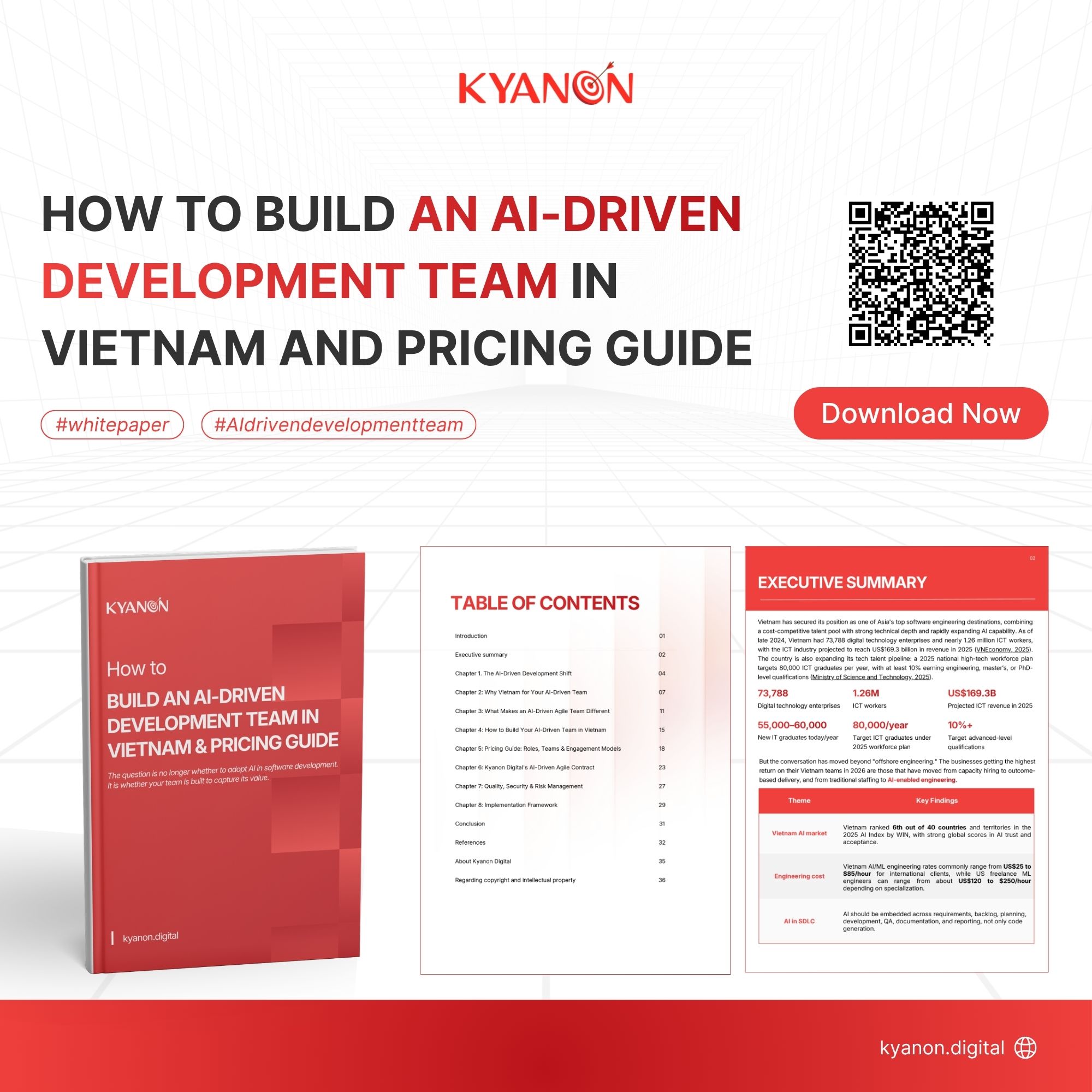
Explore more omnichannel e-commerce solutions for business growth.
TechGropse

TechGropse combines e-commerce implementation with mobile applications, AI, CRM, ERP, and custom software development.
- Website: techgropse.com
- Founded: 2015
- Team size: 150+
- Pricing tier: $25–$49/hour
Best suited to:
- Shopify stores connected to mobile apps.
- Customer portals and custom back ends.
- Projects combining commerce, cloud, and AI.
- Offshore product-development teams.
What to verify:
- Shopify Plus references.
- Singapore payment and logistics experience.
- Team location and seniority.
- Post-launch architecture and support ownership.
Kuchoriya TechSoft

Kuchoriya TechSoft delivers Shopify, Magento, mobile, web, AI, and custom software services through an offshore delivery model.
- Website: kuchoriyatechsoft.com
- Founded: 2009
- Team size: 50–249 in public directories
- Pricing tier: Below $30/hour
Best suited to:
- Multi-store and multi-market e-commerce.
- Shopify or Magento with mobile development.
- Commerce connected to custom business systems.
- Businesses seeking offshore capacity.
What to verify:
- Current Shopify and Magento specialists.
- Shopify Plus experience.
- Singapore references.
- Team continuity and local governance.
Junkies Coder

Junkies Coder combines e-commerce, mobile applications, cloud, AI, UX, QA, and custom software development.
- Website: junkiescoder.com
- Founded: Not clearly disclosed
- Team size: 50+
- Pricing tier: Not clearly disclosed
Best suited to:
- Ecommerce connected to mobile applications.
- Custom customer or account experiences.
- Products requiring UX, development, QA, and DevOps.
- Smaller distributed engineering teams.
What to verify:
- Direct Shopify references.
- Shopify Plus and checkout-extension experience.
- Singapore localization capability.
- Production support arrangements.
Elites

Elites focuses on branding, digital strategy, UX, web development, and design-led e-commerce experiences.
- Website: weareelites.com
- Founded: 2022
- Team size: 10–49
- Pricing tier: Not disclosed
Best suited to:
- Brand-led storefronts.
- Visual redesign and user-experience projects.
- Product-launch or campaign stores.
- Ecommerce programs with moderate technical complexity.
What to verify:
- Direct Shopify project evidence.
- Shopify Partner status.
- Back-end integration capability.
- Singapore delivery and maintenance coverage.
Orfeostory

Orfeostory is a Singapore-based agency offering e-commerce development, website design, mobile applications, maintenance, and managed IT support.
- Website: orfeostory.com
- Founded: 2011
- Team size: 11–50 on LinkedIn
- Pricing tier: $70–$150/hour
Best suited to:
- Singapore-focused e-commerce websites.
- Store redesign and ongoing maintenance.
- Small and mid-sized e-commerce programs.
- Businesses requiring direct local communication.
What to verify:
- Shopify Plus and Magento experience.
- ERP, POS, PIM, and OMS integration capability.
- High-volume store references.
- Application support outside standard business hours.
Visible One
Visible One combines Shopify, Magento, web design, development, SEO, and digital marketing across Singapore and Hong Kong.
- Website: visibleone.com
- Founded: 2008
- Team size: 50–249
- Pricing tier: $30–$70/hour
Best suited to:
- Design-led Shopify or Magento stores.
- Ecommerce redesign and SEO programs.
- Regional websites requiring localization.
- Businesses combining development and marketing.
What to verify:
- Shopify Plus and Magento references.
- Middleware and custom application capability.
- Migration and redirect controls.
- Post-launch maintenance ownership.
OnGraph

OnGraph combines e-commerce development with custom software, mobile, SaaS, cloud, AI, and product engineering.
- Website: ongraph.com
- Founded: 2007
- Team size: 250+
- Pricing tier: $25–$49/hour
Best suited to:
- Ecommerce connected to SaaS or mobile products.
- Custom marketplaces and customer portals.
- Cloud-based commerce platforms.
- Larger offshore engineering teams.
What to verify:
- Shopify and Magento credentials.
- Direct Shopify Plus references.
- Singapore payment and fulfillment experience.
- API maintenance and post-launch support.
axiusSoftware

axiusSoftware provides Shopify development alongside custom software, mobile applications, AI, portals, and enterprise solutions.
Website: axiussoftware.com
Founded: 2013
Team size: 50–249
Pricing tier: Below $30/hour
Best suited to:
- Shopify stores requiring custom functionality.
- Commerce connected to enterprise software.
- Customer and partner portals.
- Offshore development programs.
What to verify:
- Shopify Plus skills.
- Singapore e-commerce references.
- Integration monitoring and error recovery.
- Code, documentation, and support ownership.
Win-Pro

Win-Pro is a Singapore-managed IT provider covering cloud, cybersecurity, infrastructure, systems integration, web services, and operational support.
Website: winpro.com.sg
Founded: 1993
Team size: 10–49
Pricing tier: $70–$150/hour
Best suited to:
- Ecommerce within a broader managed IT relationship.
- Businesses requiring local infrastructure support.
- Smaller websites and commerce programs.
- Organizations prioritizing cybersecurity and help-desk access.
What to verify:
- Size of the Shopify practice.
- Direct Shopify implementation references.
- Whether development is delivered internally.
- E-commerce UX and application-support capability.
Mobirevo

Mobirevo offers e-commerce, custom web, mobile, SaaS, ERP, and enterprise software development through an offshore model.
Website: mobirevo.com
Founded: 2018
Team size: 11–50
Pricing tier: Not clearly disclosed
Best suited to:
- Ecommerce connected to custom applications.
- Stores requiring mobile or SaaS products.
- ERP-connected commerce.
- Smaller offshore engineering engagements.
What to verify:
- Direct Shopify references.
- Shopify Partner status.
- Magento capability.
- Singapore localization and support coverage.
Catching Clicks

Catching Clicks combines e-commerce development with web design, SEO, branding, social media, and digital marketing.
Website: catchingclicks.com
Founded: 2010
Team size: 10–49
Pricing tier: Not disclosed
Best suited to:
- Smaller Shopify or WooCommerce stores.
- Ecommerce combined with SEO.
- Brand and content refresh projects.
- Websites with limited custom integration.
What to verify:
- Depth of Shopify engineering.
- Shopify Plus and custom application experience.
- Migration and SEO controls.
- Technical support after launch.
Octal IT Solution

Octal IT Solution provides e-commerce, mobile, web, AI, data, IoT, and enterprise software engineering.
Website: octalsoftware.com.sg
Founded: 2007
Team size: 300+
Pricing tier: $30–$70/hour
Best suited to:
- Larger e-commerce development programs.
- Stores connected to mobile or enterprise applications.
- Custom portals and digital platforms.
- Programs requiring several engineering disciplines.
What to verify:
- Shopify Plus and Magento references.
- Singapore localization experience.
- Architecture and integration ownership.
- Team continuity and post-launch maintenance.
How to interpret the company list
The 13 companies represent different operating models rather than interchangeable Shopify providers.
Provider type | Companies to assess | Best suited to |
Custom commerce and integration | Kyanon Digital, OnGraph, axiusSoftware, Octal IT Solution, Kuchoriya TechSoft | Replatforming, system integration, custom applications, and wider digital programs |
| Mobile and digital product engineering | TechGropse, Junkies Coder, Mobirevo, OnGraph, Octal IT Solution | Commerce connected to mobile apps, portals, SaaS, or custom products |
Design-led e-commerce | Elites, Orfeostory, Visible One, Catching Clicks | Storefront redesign, branding, content, UX, and moderate e-commerce requirements |
| Managed IT and operations | Win-Pro | Businesses combining website requirements with infrastructure, cybersecurity, and IT support |
Hybrid regional delivery | Kyanon Digital and other Singapore-facing offshore providers | Local stakeholder engagement supported by lower-cost regional engineering |
The relevant shortlist depends on the business problem:
- A standard DTC store may need a focused Shopify design and development agency.
- A Shopify Plus migration may need stronger data, architecture, and release-management capability.
- A B2B store may require custom catalogs, pricing, accounts, payment terms, and ERP integration.
- An omnichannel retailer may require POS, inventory, loyalty, OMS, and warehouse integration.
- A Magento migration may require both source-platform and target-platform expertise.
- A custom commerce program may require a product engineering provider rather than a web agency.

Key factors to consider when hiring
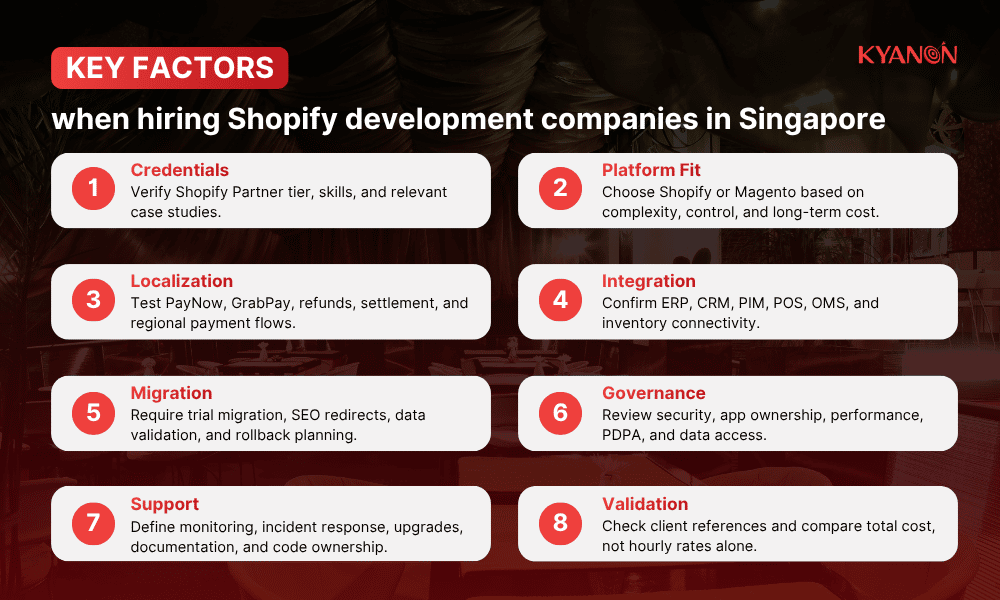
A provider of Shopify development services in Singapore should be evaluated across the full commerce operating model, including platform fit, payments, integrations, migration, security, and post-launch ownership.
Verify Shopify credentials and relevant experience
Check whether the provider appears in the Shopify Partner Directory and confirm:
- Current Shopify Partner tier.
- Verified Shopify skills.
- Named specialists assigned to the project.
- Shopify Plus or B2B experience.
- Recent projects with similar complexity.
Shopify Partner status supports initial validation, but comparable delivery experience is a stronger indicator of project fit.
Match the platform to the operating model
Businesses evaluating Magento e-commerce development services in Singapore are often comparing Shopify’s managed SaaS model with Magento’s deeper customization and infrastructure control.
Decision area | Shopify or Shopify Plus | Magento Open Source or Adobe Commerce |
Platform model | Managed SaaS | Open-source or Adobe-managed options |
| Implementation | Generally faster for standard requirements | Requires more architecture and engineering |
Infrastructure | Managed by Shopify | Depends on edition and hosting model |
| Customization | Strong within platform boundaries | Greater code and infrastructure control |
Standard DTC | Strong fit | May add unnecessary complexity |
| Complex B2B | Supported, especially with Shopify Plus | Strong for custom pricing, catalogs, and workflows |
Main risk | App sprawl and platform constraints | Patching, upgrades, infrastructure cost, and technical debt |
| Best suited to | Speed, standardization, and managed operations | Complex workflows and deeper platform control |
The right platform is the one that supports the required customer journeys and operating workflows with the lowest sustainable cost and risk.
Test Singapore payment localization
Setting the store currency to SGD is not enough. Payment availability and behavior depend on the selected gateway, store entity, customer location, currency, and checkout configuration.
The provider should verify:
- PayNow and GrabPay support.
- Cards, wallets, and installment methods.
- Direct or redirected checkout.
- Multi-currency settlement.
- Full and partial refunds.
- Failed-payment recovery.
- Subscription-payment limitations.
- Chargebacks and disputes.
- Finance and ERP reconciliation.
A payment logo in a proposal does not prove that checkout, refund, settlement, and reconciliation flows work end to end.
Assess integration, migration, and SEO capabilities
The provider should define:
- Systems of record for products, inventory, customers, and orders.
- Real-time and batch integrations.
- Middleware, monitoring, retry logic, and reconciliation.
- Trial migrations and launch cutover.
- Redirects, metadata, structured data, and analytics validation.
Warning signs include:
- “Native integration” without naming the connector.
- No field-level data mapping.
- No retry or error-handling process.
- No migration rehearsal.
- SEO validation left until launch.
For replatforming projects, migration quality can affect customer access, search visibility, analytics accuracy, and order operations after launch.
Review security, performance, and app governance
Commerce platforms handle customer, payment, order, and behavioral data. Security and performance therefore need clear ownership across Shopify, third-party applications, custom code, and internal teams.
Review:
- Administrator access and multi-factor authentication.
- Least-privilege permissions.
- Application data access.
- API key and secret management.
- PDPA responsibilities and data retention.
- Cross-border data transfers.
- Vulnerability and dependency management.
- Performance under real catalog and traffic conditions.
Every Shopify application should have a documented
- Business purpose.
- Owner.
- Current and projected cost.
- Data-access scope.
- Performance impact.
- Support responsibility.
- Replacement or exit plan.
Platform security does not remove the need to secure applications, integrations, accounts, and business processes.
Define post-launch ownership
A short defect warranty is not a complete support model.
The contract should cover:
- Store and integration monitoring.
- Incident priorities and response targets.
- API and application upgrades.
- Security remediation.
- Performance regression.
- Peak-event support.
- Documentation and knowledge transfer.
- Code, account, and deployment ownership.
The provider should explain who responds when payments fail, inventory stops syncing, an application breaks checkout, or a custom integration reaches an unsupported API version.
Validate clients and compare total costs
Use Clutch and public directories for initial screening, then request references from:
- A recently completed implementation.
- A store already operating under the provider’s support model.
Compare proposals using the same cost structure:
| Cost area | What to confirm |
Discovery | Architecture and process assessment |
| Build | Included and excluded functionality |
Applications | Current and future subscription costs |
| Integration | Connectors, middleware, monitoring, and error handling |
Migration | Data scope, trial runs, and reconciliation |
| Testing | Performance, security, integration, and regression testing |
Launch | Cutover, rollback, and hypercare |
| Support | Service hours, response targets, and maintenance |
Exit | Ownership of code, data, documentation, and accounts |
The lowest hourly rate may not produce the lowest total cost if the proposal excludes integration, migration, testing, maintenance, or future platform upgrades.
Decision takeaway: The strongest Shopify partner is the provider that can demonstrate platform fit, Singapore localization, integration depth, migration controls, and clear post-launch ownership, not simply the most attractive storefront portfolio.
Recommended vendor scorecard
Kyanon Digital developed this vendor scorecard by adapting criteria from Shopify partner requirements, ISO software and data-quality models, OWASP application-security guidance, Singapore PDPA obligations, and recognized service-management and outsourcing-governance standards. The weightings reflect common e-commerce implementation risks and should be adjusted to each project’s priorities.
Score each provider from one to five, then apply the weighting.
| Evaluation category | Weight |
Platform and solution architecture | 20% |
| Integration and data engineering | 20% |
Singapore payment, localization, and fulfillment | 15% |
| Delivery governance and team quality | 15% |
Security, support, and maintenance | 15% |
| Comparable references and outcomes | 10% |
Commercial transparency and exit protection | 5% |
| Total | 100% |
Methodology note: This is a Kyanon Digital evaluation framework, not an official Shopify scoring model. Its criteria are informed by Shopify Partner requirements, ISO/IEC 25010, OWASP ASVS, and Singapore PDPA guidance.
A provider should not proceed if it cannot demonstrate:
- Payment reconciliation
- Data-migration controls
- Security ownership
- Integration monitoring
- Launch rollback
- Post-launch support
2026 trends shaping Shopify development in Singapore
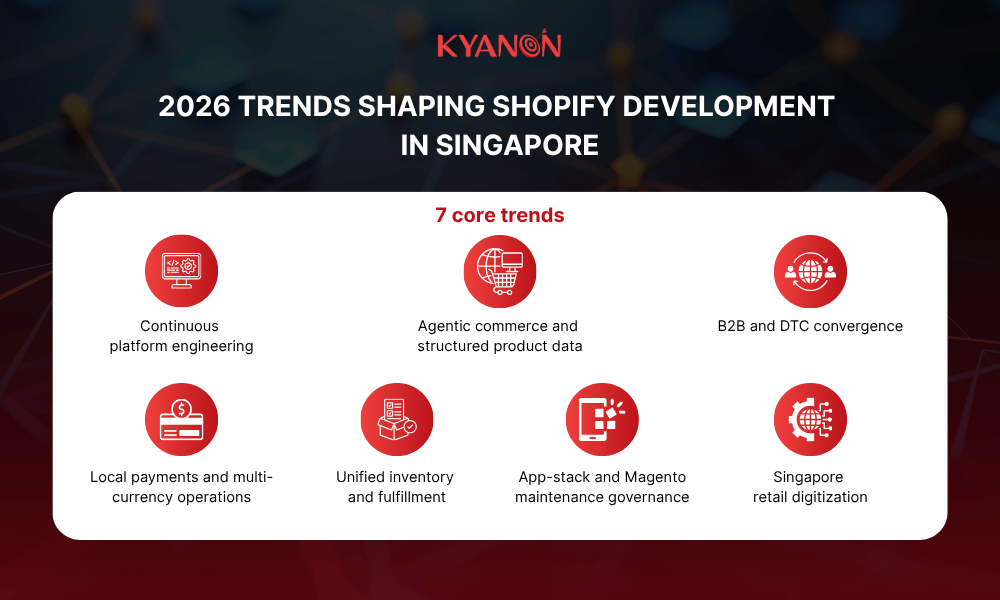
Continuous platform engineering
Shopify introduced more than 150 updates in its Spring 2026 Editions release and continues to publish new API versions every three months.
Stores using custom applications and integrations, therefore, require ongoing
- API version management.
- Regression testing.
- Application compatibility reviews.
- Technical debt control.
- Post-launch engineering support.
The business implication is clear: a Shopify implementation should be treated as a continuously managed commerce product, not a one-time website project.
Agentic commerce requires structured product data
Shopify’s 2026 direction includes agent-enabled shopping, structured catalog data, catalog APIs, and the Universal Commerce Protocol.
These capabilities depend on accurate and machine-readable commerce data, including:
- Product attributes and identifiers.
- Pricing and promotion rules.
- Real-time inventory.
- Delivery information.
- Return policies.
- Reliable product feeds.
AI-assisted commerce cannot compensate for incomplete product records or inaccurate stock data.
From Kyanon Digital’s implementation perspective, the main readiness gap is often not access to AI features but fragmented product, inventory, and promotion data across e-commerce, ERP, PIM, and warehouse systems.
B2B and DTC commerce are converging
Shopify expanded selected B2B capabilities in 2026, including company profiles, volume pricing, and B2B catalogs.
This allows more businesses to manage B2B and DTC commerce on one platform. However, complex requirements still need careful architecture planning, particularly around:
- Customer-specific pricing.
- Approval workflows.
- Payment terms.
- Product access rules.
- ERP synchronization.
- Separate B2B and DTC customer journeys.
Businesses should assess whether Shopify can support both models natively or whether Shopify Plus, Adobe Commerce, or custom development is required.
Local payments and multi-currency operations remain critical
Shopify announced additional multi-currency payout capabilities for Singapore in Spring 2026.
These improvements can reduce settlement friction for regional commerce, but local payment operations still depend on the selected provider and store configuration.
Businesses should validate:
- PayNow and GrabPay availability.
- Checkout behavior.
- Refund and partial-refund flows.
- Multi-currency settlement.
- Subscription-payment limitations.
- Finance and ERP reconciliation.
The stronger implementation partner is not the one that simply enables a payment method, but the one that can connect checkout, settlement, refunds, and financial reporting into one reliable process.
Unified inventory and fulfillment are becoming standard
Shopify’s 2026 updates include faster inventory synchronization, shared SKUs, multi-source pickup fulfillment, and stronger inventory controls.
These capabilities support more connected operations, but Shopify still needs to work with:
- POS systems.
- Order management systems.
- Warehouses and 3PL providers.
- Delivery carriers.
- Store inventory.
- Returns platforms.
The main risk is not only delayed inventory updates. Poor integration can also create overselling, incorrect fulfillment routing, canceled orders, and inconsistent returns.
From Kyanon Digital’s retail delivery experience, inventory accuracy depends on clearly defining the system of record, update frequency, exception handling, and ownership across every connected channel.
App-stack governance is becoming a total-cost issue
Shopify applications can speed up implementation, but an unmanaged app stack can increase:
- Subscription costs.
- Storefront scripts.
- Data exposure.
- Performance issues.
- Vendor dependencies.
- Upgrade and support effort.
Each application should have a documented purpose, owner, cost, data-access scope, and replacement plan.
The lowest initial implementation cost may not result in the lowest three-year operating cost if the solution depends on overlapping applications and unsupported customizations.
Magento and Adobe Commerce create a different cost profile. They provide deeper control but require funded security patching, extension testing, infrastructure management, and platform upgrades. The platform decision should therefore compare total ownership cost, not only launch cost.
Singapore retail digitization is becoming more connected
IMDA and Enterprise Singapore refreshed the Retail Industry Digital Plan in May 2026 to support digital adoption among more than 2,000 SME retailers.
This reflects a broader move from standalone e-commerce websites toward connected commerce operations covering:
- Payments.
- Customer data.
- Loyalty.
- Inventory.
- Stores.
- Fulfillment.
- Analytics.
- Automation.
For Singapore businesses, the implementation partner increasingly needs to understand the full retail operating model rather than only Shopify configuration.
What these trends mean for partner selection
The right Shopify partner in 2026 should demonstrate more than theme development.
Businesses should look for capability across:
- Platform architecture.
- Product and inventory data.
- Payment and finance integration.
- ERP, POS, OMS, PIM, and warehouse connections.
- API and application maintenance.
- Security and performance.
- Long-term operating cost.
Overall, Shopify development in Singapore is shifting from one-time storefront delivery to continuous commerce engineering, where data quality, integration ownership, and long-term operating cost determine platform value.
Global trends vs. Singapore priorities
Global trend | Singapore implementation priority |
Agentic product discovery | Accurate local prices, inventory, delivery, and return data |
| Expanded B2B commerce | Account pricing, payment terms, tax, and ERP integration |
Unified commerce | Shared data across e-commerce, POS, loyalty, and fulfillment |
| Faster releases | Continuous app and integration maintenance |
More payment capabilities | PayNow, GrabPay, settlement, and reconciliation testing |
| AI-assisted operations | Consent, data governance, and PDPA controls |
Headless commerce | Justify flexibility against higher operating complexity |
Which partner fits the store complexity?
Requirement | Suitable provider profile | Platform direction |
Standard DTC store | Shopify design and development specialist | Shopify |
| Multi-market DTC | Provider with market and localization experience | Shopify or Shopify Plus |
Custom apps and integrations | Shopify Plus provider or systems integrator | Shopify Plus |
| Combined B2B and DTC | Provider with ERP and B2B workflow experience | Shopify Plus or Adobe Commerce |
Complex pricing and approvals | Magento or Adobe Commerce specialist | Magento or Adobe Commerce |
| Omnichannel retail | Commerce integrator with POS, OMS, PIM, and WMS skills | Shopify Plus, Adobe Commerce, or composable |
Legacy migration | Data, integration, SEO, and migration specialist | Determined through discovery |
| Commerce within a custom product | Product engineering provider | Platform plus custom development |
From Kyanon Digital’s delivery experience, the right partner should align its platform, architecture, and engineering model with the store’s complexity, integration requirements, regional operations, and long-term ownership needs.
Recommended shortlisting process
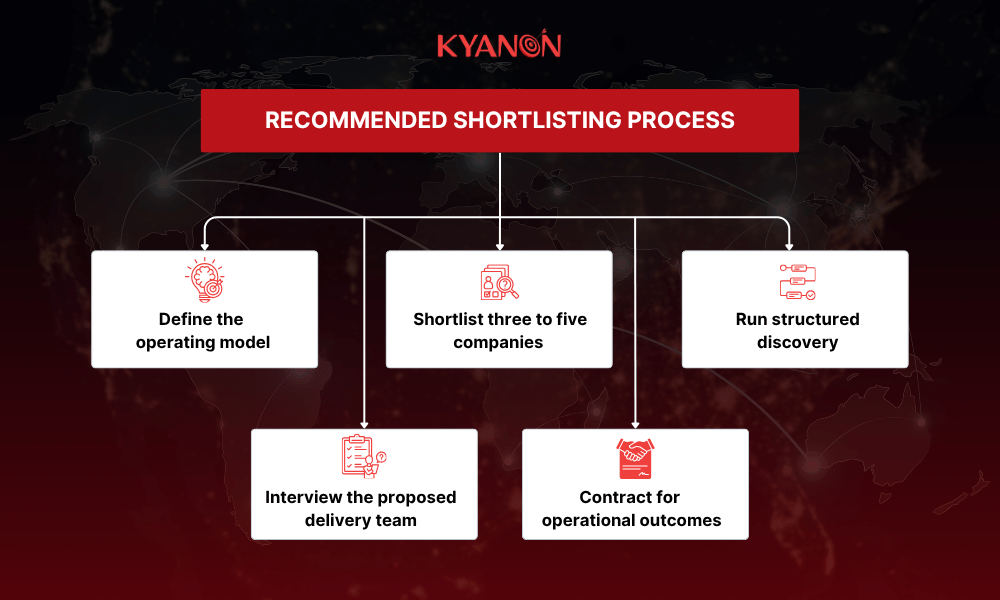
Step 1: Define the operating model
Document markets, channels, product volume, B2B and DTC journeys, payments, integrations, fulfillment, migration scope, traffic, and support requirements.
Step 2: Shortlist three to five companies
Include providers with evidence relevant to the actual complexity—not only attractive storefront portfolios.
Step 3: Run structured discovery
Request the same architecture, integration, migration, team, risk, support, and pricing information from each provider.
Step 4: Interview the proposed delivery team
Meet the people responsible for architecture, development, integration, migration, QA, and post-launch support.
Step 5: Contract for operational outcomes
Define acceptance criteria, performance, security, migration reconciliation, rollback, service levels, intellectual property, documentation, and exit support.
Conclusion
The right Shopify development agency in Singapore is not necessarily the provider with the lowest hourly rate or strongest design portfolio.
The better choice is the company that can:
- Recommend Shopify or Magento based on actual requirements.
- Support Singapore payments and regional operations.
- Connect commerce with business systems.
- Protect data and SEO during migration.
- Maintain applications, integrations, and platform changes.
- Provide clear post-launch ownership.
- Demonstrate comparable delivery experience.
A standard DTC store may only require a focused Shopify agency. A Shopify Plus migration, Magento replatforming, B2B program, omnichannel operation, or integration-heavy store may require a broader commerce engineering partner.
Kyanon Digital supports Shopify, Shopify Plus, Magento, custom e-commerce, migration, system integration, and ongoing platform engineering. Contact us to assess platform fit, migration risk, integration scope, and long-term ownership before committing to an implementation model.






 Create project brief with AI