

In 2026, Singapore enterprises should compare digital transformation partners by delivery fit rather than brand ranking. Global consultancies are generally suited to enterprise-wide, multi-year programs; regional integrators are better suited to focused architecture and execution; and regional engineering partners fit defined scopes where transformation leadership already exists internally.
The challenge is no longer finding a provider that offers cloud, artificial intelligence, data engineering, application development, or automation. Most established providers now offer these capabilities.
The harder questions are:
- Can the provider modernize legacy systems without interrupting operations?
- Can it connect AI to reliable data and production workflows?
- Can it manage security, PDPA obligations, and cross-border delivery?
- Does it lead with strategy, engineering execution, or additional delivery capacity?
- Is its delivery model appropriate for the program’s size, risk, and budget?
AI integration, cloud-native modernization, API-first integration, and modular architecture are increasingly baseline capabilities. The differentiators are production evidence, industry depth, delivery governance, security, regional execution, and post-launch ownership.
This is why a flat ranking of the “top IT companies in Singapore” can mislead businesses. A global consultancy, regional software builder, and nearshore engineering provider solve different problems.
This comparison therefore groups the market into three categories:
- Global enterprise and strategy consulting firms for large, multi-year transformation programs.
- Agile regional integrators and software builders for focused modernization, integration, and digital product delivery.
- Nearshore delivery partners for scalable engineering capacity when transformation leadership already exists internally.
This guide compares digital transformation companies in Singapore by category, delivery model, technical capability, industry fit, and the level of ownership they can take across the transformation lifecycle.
The companies are not ranked from best to worst. Their suitability depends on the business problem, architecture, delivery model, and level of transformation ownership required.
Key takeaways
- The right partner category matters more than the ranking. Strategy-led programmes, execution-led modernization, and staff augmentation require different operating models.
- AI capability must be evaluated at the production level. Gartner expects task-specific AI agents to appear in up to 40% of enterprise applications by the end of 2026, increasing the need for data readiness, integration, security, and governance.
- Local presence does not always mean local delivery. Many providers use Singapore-based consulting or account management with engineering teams in Vietnam, India, or other regional hubs.
- Industry evidence matters. A provider experienced in retail commerce may not be the right choice for a core banking, public-sector, or industrial control programme.
- Architecture claims require technical proof. Businesses should ask for diagrams, integration patterns, migration plans, security controls, and production references—not only capability presentations.
- Using multiple partners can reduce concentration risk. A global firm may define the roadmap while a regional integrator executes specific platforms, integrations, or digital products.
- The lowest day rate rarely means the lowest transformation cost. Rework, weak governance, delayed integration, and unclear post-launch ownership can outweigh initial savings.
Further reading:
- Enterprise Digital Commerce Transformation in Singapore
- Best End-to-End Product Development Companies in Singapore
- 7 Tips For Crafting Digital Transformation Roadmap
- Top 10 Digital Transformation Challenges In Retail
- Digital Transformation Roadmap: From Zero to Hero Business
How we evaluated these digital transformation partners
The assessment considers both commercial outcomes and engineering feasibility. A provider should be able to explain how its operating model, architecture, governance, and delivery structure support the intended business result.
Evaluation criterion | Business and operations view | Engineering and architecture view |
Engagement model fit | Does the enterprise need strategy-first consulting, execution-first delivery, managed services, or additional engineering capacity? | Does the delivery model support agile, hybrid, onshore-offshore, embedded team, or outcome-based delivery? |
| Program scale | Is the work enterprise-wide, multi-market, and multi-year, or limited to a specific platform or workflow? | Can the provider manage legacy integration, distributed systems, data migration, and production cutover at the required scale? |
Industry specialization | Does the provider understand the operating model, regulations, customer journeys, and commercial priorities of the sector? | Can it show relevant experience with sector-specific data, integrations, performance requirements, and security controls? |
| Architecture capability | Will the proposed architecture support new markets, channels, products, and operating models? | Can the provider design API-first, cloud-native, event-driven, composable, headless, or MACH-based systems where appropriate? |
AI and data readiness | Is AI connected to measurable workflows rather than treated as an isolated experiment? | Can the provider build governed data pipelines, model integrations, evaluation controls, observability, and human review? |
| Cost and speed trade-off | Does the commercial model balance delivery speed, risk, ownership, and three-year operating cost? | How quickly can the team mobilise, and what level of architecture, quality assurance, DevOps, and support is included? |
Regional footprint | Is local stakeholder access available, and can the provider support expansion across APAC? | Where are architecture, development, testing, support, and data-processing activities performed? |
| Security and compliance | Can the provider support PDPA, sector requirements, vendor risk reviews, and audit obligations? | Are security testing, role-based access, encryption, logs, vulnerability management, and incident response built into delivery? |
Governance and transparency | Are scope, milestones, risks, dependencies, and business outcomes visible throughout the program? | Are architecture decisions, code quality, test coverage, environments, release controls, and technical debt measurable? |
| Post-launch ownership | Who is accountable for service continuity, changes, support, and performance after release? | Are service-level agreements, monitoring, patching, incident management, knowledge transfer, and exit provisions defined? |
Evaluation principle:
A transformation partner should be assessed against the actual program, not against a general capability list.
For example:
- A provider with strong strategy credentials may still depend on multiple subcontractors for implementation.
- A strong product engineering company may not have the governance structure required for a multi-country ERP program.
- A cost-efficient nearshore team may perform well when architecture and product ownership remain internal but struggle when asked to define the full transformation roadmap.
- A large consultancy may reduce program-level coordination risk but introduce higher cost, slower mobilization, or more complex governance.

Quick comparison: Digital transformation companies in Singapore by category
| Category | Companies | Best suited for | Typical engagement |
Global enterprise and strategy consulting | Accenture Singapore, NCS, Deloitte Digital, Thoughtworks Singapore, Cognizant Singapore | Enterprise-wide programs, regulated environments, complex stakeholder structures, multi-year roadmaps | Strategy, architecture, implementation, change management, platforms, and managed services |
| Agile regional integrators and software builders | Kyanon Digital, Vinova, TechTIQ Solutions, Codigo, Eastgate Software | Focused modernization, digital products, system integration, composable platforms, and faster execution | Discovery, architecture, custom software, embedded teams, integration, and support |
Nearshore delivery partners | Kaopiz | Defined software scopes, dedicated engineering capacity, application development, and cost-efficient scaling | Staff augmentation, dedicated teams, managed development, or fixed-scope delivery |
Important market distinction
The list includes several types of provider:
- Companies headquartered in Singapore.
- Global firms with established Singapore operations.
- Regional companies with a Singapore office.
- Offshore software providers that serve Singapore-based enterprises without a material local delivery center.
Businesses should verify the contracting entity, local leadership, delivery location, data access, escalation process, and support coverage before treating any provider as locally based.
Explore more: The Essential IT Roadmap for Digital Business Transformation (Gartner).
Singapore’s enterprise digital transformation companies by category in 2026
Category 1: Global enterprise and strategy consulting firms
These providers are generally suited to transformation programs involving multiple business units, technology domains, markets, and executive stakeholders.
Their main advantage is breadth: strategy, operating model design, architecture, technology implementation, change, security, and managed operations can be coordinated under a large program structure.
Their main risk is complexity. Businesses should clarify which work will be completed by the named senior team, which work will move to regional delivery centers, and which components may be subcontracted.
Accenture Singapore

Accenture combines consulting, technology implementation, cloud, data, AI, industry platforms, and managed services. Its Singapore practice also supports public sector, healthcare, financial services, and enterprise cloud transformation.
- Website: https://www.accenture.com/sg-en
- Founded: 1989 globally; operating in Singapore since 1975
- Team size: ~3,590 employees in Singapore
- Pricing tier: Premium enterprise pricing
- Key clients: Large enterprises and public-sector organizations
Best suited for
- Enterprise-wide transformation involving several functions or markets.
- Large cloud, platform, data, or AI programs.
- Programs requiring extensive industry, technology, and change-management resources.
- Businesses that prefer one prime contractor across strategy and implementation.
Potential strengths
- Broad technology and industry coverage.
- Access to large delivery teams and major technology alliances.
- Ability to manage parallel workstreams across architecture, applications, cloud, data, security, and operations.
- Suitable governance structures for complex multi-vendor programs.
What to validate
- Named team composition after the sales and discovery stages.
- Onshore, regional, offshore, and subcontracted delivery ratios.
- Whether the proposed design uses standard platform capabilities or creates unnecessary customization.
- Commercial exposure to change requests and program extensions.
- Knowledge-transfer and exit arrangements.
Enterprise assessment
Accenture is most relevant when program breadth and coordination capacity are more important than lean team size or low initial cost. It may be excessive for a narrow application, integration, or digital product scope that can be delivered by a focused software builder.
NCS
NCS provides services across application development, AI, cloud, cybersecurity, data, digital experience, infrastructure modernization, and managed technology operations. It has a substantial Singapore base and an established APAC delivery footprint.
A 2026 NCS case study describes an AI-enabled IT service transformation supporting more than 25,000 users and reducing service-request volume by 20%, illustrating its focus on large operational environments.
- Website: https://www.ncs.co/en-sg/
- Founded: 1981
- Team size: ~15,000 employees
- Pricing tier: Premium enterprise pricing; rates are customized based on program scope, delivery model, technology stack, security requirements, and managed-service coverage.
- Key clients: Governments and large enterprises
Best suited for
- Public-sector and regulated-sector programs.
- Large Singapore-based technology estates.
- Infrastructure, cybersecurity, cloud, workplace, and application modernization.
- Programs requiring long-term managed services and local operational coverage.
Potential strengths
- Strong local presence and knowledge of Singapore’s technology environment.
- Broad infrastructure, application, cloud, security, and operations capabilities.
- Experience with hybrid onshore and offshore delivery.
- Ability to support both implementation and ongoing operations.
What to validate
- Whether the program is using NCS-owned capabilities, technology partners, or delivery subcontractors.
- Product engineering depth for highly specialized customer-facing platforms.
- Flexibility for smaller, iterative scopes.
- Responsibility boundaries across infrastructure, applications, data, and support.
Enterprise assessment
NCS is a strong candidate when local accountability, operational resilience, and long-term service delivery are central. Businesses seeking a small, product-led team should compare their delivery structure with more focused regional builders.
Deloitte Digital

Deloitte Digital combines digital strategy, transformation consulting, creative services, analytics, commerce, service experience, and digital product engineering.
- Website: https://www.deloittedigital.com/sea/en.html
- Founded: 2012
- Team size: Global enterprise delivery network
- Pricing tier: Premium, custom enterprise pricing
- Key clients: Large enterprises
Best suited for
- Transformation programs led by customer experience, service design, commerce, or operating-model change.
- Businesses seeking strategy, creative, technology, and organizational change within one program.
- Large enterprises already working with major consulting ecosystems.
Potential strengths
- Ability to connect customer, operational, and technological transformations.
- Experience across digital commerce, service platforms, and digital products.
- Access to broader consulting, risk, workforce, and industry capabilities.
What to validate
- Whether the engagement is strategy-heavy or includes sufficient hands-on engineering.
- Which implementation components will be delivered directly.
- The continuity of the team from discovery through production.
- Any independence or procurement constraints arising from other professional-service relationships.
- Long-term application ownership after launch.
Enterprise assessment
Deloitte Digital is most relevant when transformation involves significant business model, experience, and organizational change. For engineering-led modernization, businesses should examine the exact development, architecture, DevOps, and support team proposed.
Thoughtworks Singapore

Thoughtworks focuses on digital product development, modern software engineering, platform modernization, data, AI, and Agile operating models. It has also worked with GovTech Singapore on the evolution of the Singpass national digital identity platform.
- Website: https://www.thoughtworks.com/en-sg
- Founded: 1993
- Team size: 10,500+ globally
- Pricing tier: Premium, custom enterprise pricing
- Key clients: Enterprises and government organizations
Best suited for
- Software-led transformation.
- Legacy application and platform modernization.
- Digital product operating models.
- Programs requiring strong engineering practices and iterative delivery.
- Businesses seeking to strengthen internal software delivery capability.
Potential strengths
- Strong connection between product strategy and engineering execution.
- Experience with modern architecture and continuous delivery.
- Emphasis on internal capability building rather than only system handover.
- Relevant experience in complex public digital platforms.
What to validate
- Fit for ERP-led or infrastructure-led transformation.
- Capacity for very large multi-country program management.
- Industry-specific platform and package implementation capabilities.
- Managed support and long-term operations coverage.
Enterprise assessment
Thoughtworks is a strong option when custom software, platform engineering, and the internal product operating model are central. It may be less suitable as the sole prime contractor for transformations dominated by packaged ERP, infrastructure outsourcing, or broad business-process outsourcing.
Cognizant Singapore
Cognizant’s Singapore service portfolio includes application services, artificial intelligence, business-process services, cloud, core modernization, digital strategy, and enterprise platforms.
- Website: https://www.cognizant.com/sg/en
- Founded: 1994
- Team size: ~357,600
- Pricing tier: Premium, custom enterprise pricing
- Key clients: Large enterprises
Best suited for
- Large application modernization programs.
- Cloud migration and core-system transformation.
- Managed application services.
- Enterprise platform and business-process transformation.
- Global businesses requiring delivery across several regions.
Potential strengths
- Broad application, platform, cloud, data, and operations capability.
- Large global engineering and service-delivery network.
- Ability to combine transformation projects with ongoing managed services.
- Industry-specific service structures.
What to validate
- Delivery-centre allocation and senior technical ownership.
- Governance across consulting, engineering, and operations.
- Flexibility for product-led or experimental work.
- Commercial transparency across blended teams.
- Technical debt and knowledge-transfer responsibilities.
Enterprise assessment
Cognizant is relevant for businesses that need transformation and long-term application operations at scale. Smaller or architecture-specific programs should compare their delivery overhead with more focused integrators.
Category 2: Regional transformation integrators and product engineering firms
Regional integrators usually operate with smaller program structures, closer access to engineering leadership, and lower-cost regional development teams.
They can be effective for:
- Custom platforms.
- Legacy modernization.
- Commerce and customer experience.
- Middleware and system integration.
- Data and AI applications.
- Mobile and web products.
- Defined transformation workstreams.
The key risk is uneven scale. Some firms can manage enterprise architecture and multi-market programs, while others are better suited to a single application or product.
Kyanon Digital
Kyanon Digital provides digital transformation strategy, architecture, software development, integration, automation, data, AI, digital experience, and commerce services through teams across Singapore and regional delivery locations. Its published service structure covers strategy and planning, software engineering, integration, analytics, and ongoing operations.
- Website: https://kyanon.digital/
- Founded: 2012
- Team size: 500+ across Vietnam and Singapore
- Pricing tier: $25 – $49/hr (Vietnam-based engineering)
- Key clients: Regional enterprises and global organizations
Best suited for
- Retail and F&B transformation.
- Composable commerce and loyalty platforms.
- Customer, partner, and employee portals.
- Enterprise application integration.
- Custom operational systems.
- Programs requiring Singapore-facing engagement with Vietnam-based engineering capacity.
Potential strengths
- Strategy-to-operation coverage: Supports architecture planning, software delivery, integration, analytics, AI enablement, and ongoing support under one regional team.
- Commerce and operational depth: Strong focus on retail, F&B, loyalty, omnichannel commerce, and connections across CRM, ERP, POS, inventory, order, and payment systems.
- Hybrid regional delivery: Combines Singapore-facing engagement with scalable Vietnam-based engineering.
- Flexible ownership: Can deliver a defined platform, embed a dedicated team, or remain responsible for post-launch optimization and support.
What to validate
- The named architecture and program leadership for the engagement.
- Which roles are based in Singapore and which are delivered regionally.
- References matching the required industry, scale, and architecture.
- Ownership of middleware, integrations, and post-launch operations.
- Product-specific certifications where packaged platforms are involved.
Enterprise assessment
Kyanon Digital is most relevant when a business requires architecture and hands-on software execution under one regional delivery model. It should be evaluated against the same production evidence, governance, security, and support criteria as larger firms rather than selected solely on regional cost.
Explore more end-to-end digital transformation services.
Case study: How Kyanon Digital delivered enterprise digital transformation for Chan Brothers Travel in Singapore
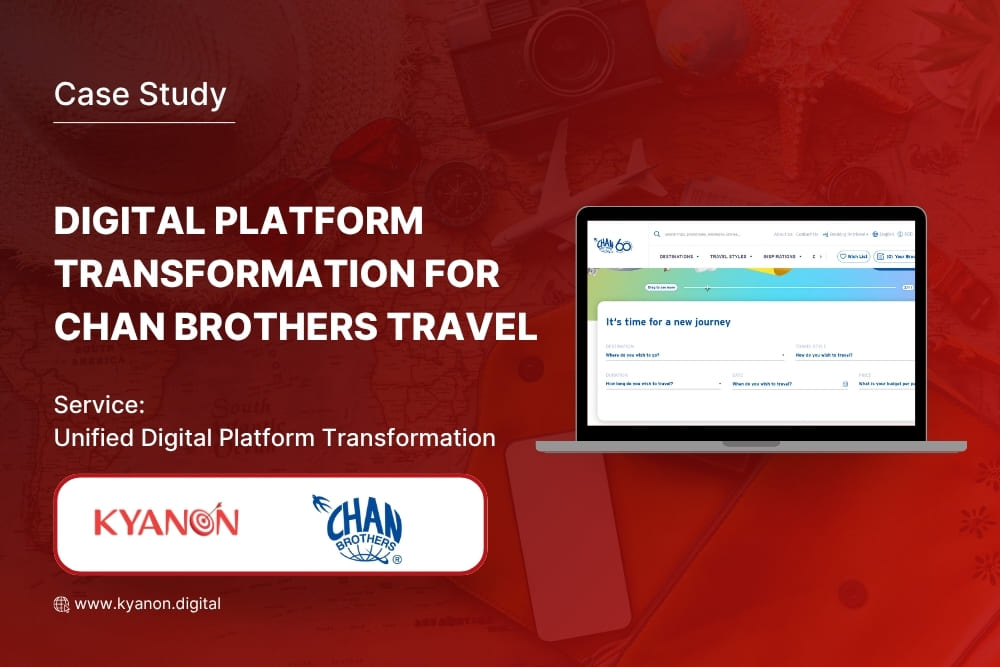
Challenges
- Outdated website and fragmented booking experience.
- Disconnected customer, payment, and advisor workflows.
- Limited flexibility to launch new offers and services.
Solutions
- Redesigned the customer discovery and booking journey.
- Built booking flows for members and non-members.
- Developed a travel advisor management platform.
- Connected inquiries, bookings, payments, and internal workflows.
- Used phased delivery to reduce operational disruption.
Results and impacts
- More connected B2C and B2B operations.
- Lower friction across booking and inquiry journeys.
- Faster rollout of new offers and platform features.
- Improved advisor productivity and customer experience.
- Scalable foundation for future business expansion.
Explore full case study here: Digital Platform Transformation for a Leading Travel Corporation
Vinova

Vinova is headquartered in Singapore and offers custom software, mobile and web development, data engineering, robotic process automation, AI, blockchain, and cybersecurity services. Its published industry coverage includes government, healthcare, manufacturing, commerce, finance, education, and real estate.
- Website: https://vinova.sg/
- Founded: 2010
- Team size: 400+
- Pricing tier: $26 – $37/hr
- Key clients: Startups, enterprises, and multinational companies
Best suited for
- Custom applications and portals.
- Mobile and web platforms.
- Defined automation and data projects.
- Enterprises seeking Singapore-based engagement with regional engineering.
- Government-related or sector-specific digital solutions.
Potential strengths
- Long-standing Singapore operating presence.
- Broad custom software and emerging-technology coverage.
- Regional cost structure.
- Experience across several industry sectors.
What to validate
- Enterprise architecture depth for multi-system programs.
- Scale and complexity of production references.
- Senior engineering allocation.
- DevOps, security, observability, and managed-support scope.
- Use of permanent employees versus external resources.
Enterprise assessment
Vinova is a practical option for custom software and focused digital transformation scopes. Businesses planning enterprise-wide modernization should verify program governance and cross-system architecture experience in addition to application-development capability.
TechTIQ Solutions

TechTIQ Solutions is a Singapore-based software provider focused on custom web and mobile solutions, AI, and digital transformation. Its current positioning primarily targets startups and SMEs, supported by a Singapore-Vietnam delivery model.
- Website: https://techtiqsolutions.com/
- Founded: 2017
- Team size: 250–999
- Pricing tier: $25 – $49/hour
- Key clients: Startups, SMEs, and enterprises seeking custom software, AI, mobile apps, and digital transformation services in Singapore.
Best suited for
- Defined web and mobile applications.
- Cost-sensitive custom software projects.
- Early-stage platforms and business process tools.
- Smaller transformation workstreams.
Potential strengths
- Lean delivery structure.
- Access to regional engineering capacity.
- Custom software, AI, web, and mobile coverage.
- Potentially faster commercial and mobilization cycles.
What to validate
- References for enterprise-scale security, availability, and integration.
- Ability to manage multiple systems and business units.
- Architecture governance and senior technical oversight.
- Support for formal procurement, vendor-risk, and compliance processes.
- Long-term maintenance capacity.
Enterprise assessment
TechTIQ may be suitable for contained software initiatives, but large enterprises should not infer program-scale maturity from the term “digital transformation.” Evidence of production scale, governance, security, and support should determine fit.
Codigo

Codigo is a Singapore-headquartered design and technology company focused on mobile applications, websites, backend systems, user experience, and digital products. It operates with teams across Singapore and regional locations.
- Website: https://www.codigo.co/
- Founded: 2010
- Team size: 51–200
- Pricing tier: $100 – $149/hour
- Key clients: Businesses seeking mobile apps, digital products, UI/UX, websites, loyalty platforms, and backend systems.
Best suited for
- Mobile-first transformation.
- Customer-facing digital products.
- User experience redesign.
- Booking, loyalty, hospitality, retail, service, and consumer platforms.
- Backend systems supporting mobile and web experiences.
Potential strengths
- Strong combination of UI/UX and application engineering.
- Experience building customer-facing digital products.
- Local Singapore product and design perspective.
- Relevant capabilities for businesses where adoption and usability are central.
What to validate
- Breadth beyond the customer-facing application.
- Complex integration, data platform, and legacy modernization experience.
- Enterprise security and operational support.
- Program governance for multi-country or multi-workstream delivery.
- Capability to act as prime integrator across several technology vendors.
Enterprise assessment
Codigo is most relevant when the transformation outcome centers on digital product experience. It should not automatically be treated as a full enterprise transformation provider for ERP, infrastructure, data platform, or operating model programs.
Eastgate Software
Eastgate Software provides custom engineering, enterprise platforms, legacy modernization, AI automation, industrial technology, and mission-critical software. Its headquarters are in Hanoi, with offices in Germany and Japan; its current public contact information does not show a Singapore office.
- Website: https://eastgate-software.com/
- Founded: 2014
- Team size: 200+
- Pricing tier: $25 – $49/hour
- Key clients: Enterprises in transportation, fintech, retail, manufacturing, and mission-critical software, including Siemens Mobility and Yunex Traffic.
Best suited for
- Defined engineering workstreams.
- Industrial, manufacturing, transport, and technical systems.
- Legacy-to-modern architecture migration.
- Embedded engineering teams.
- Businesses comfortable with offshore delivery and remote governance.
Potential strengths
- Engineering-led positioning.
- Experience with mission-critical and industrial systems.
- ISO-certified delivery processes.
- Offshore team scalability.
What to validate
- Contracting and escalation arrangements for Singapore-based businesses.
- Availability of local program leadership.
- PDPA and cross-border data handling.
- Time zone and stakeholder-management expectations.
- Sector references directly comparable to the proposed program.
Enterprise assessment
Eastgate should be assessed as a regional engineering provider serving Singapore rather than automatically described as a Singapore-based company. It may fit technical modernization programs where internal transformation leadership is already strong.
Category 3: Nearshore delivery partners
Nearshore and offshore partners are most effective when the business already has:
- Clear transformation ownership.
- Defined product priorities.
- An approved architecture.
- Internal program leadership.
- Mature engineering governance.
- Established security and release processes.
Without these controls, lower engineering rates can be offset by unclear decisions, rework, integration defects, and management overhead.
Kaopiz
Kaopiz provides custom software, AI, cloud, web, mobile, and staff augmentation services. The company operates from Vietnam, Japan, and Singapore and lists a Singapore office at One Raffles Place.
- Website: https://kaopiz.com/
- Founded: 2014
- Team size: 1,000+ professionals across Vietnam, Japan, and Singapore
- Pricing tier: <$25/hour
- Key clients: Mid-market and enterprise organizations seeking custom software, AI, cloud, staff augmentation, and dedicated engineering teams.
Best suited for
- Dedicated software teams.
- Staff augmentation.
- Defined custom application scopes.
- Cloud and AI implementation.
- Businesses seeking cost-efficient regional engineering capacity.
Potential strengths
- Large Vietnam-based delivery capacity.
- Singapore business presence.
- Multiple engagement models.
- Experience across application development, cloud, and AI.
- Ability to scale engineering teams for defined scopes.
What to validate
- Whether the engagement is staff augmentation, managed delivery, or outcome-based.
- Internal responsibility for product, architecture, and technical decisions.
- Senior technical leadership included in the commercial model.
- Knowledge-transfer and team-replacement provisions.
- Security, data access, and production support responsibilities.
Enterprise assessment
Kaopiz is most suitable where the business needs engineering capacity or managed delivery against a clear scope. A nearshore model should not be used as a substitute for internal transformation ownership unless strategic and architectural leadership is explicitly included.
How to choose the right digital transformation partner for your enterprise
The selection decision can be narrowed through three questions.
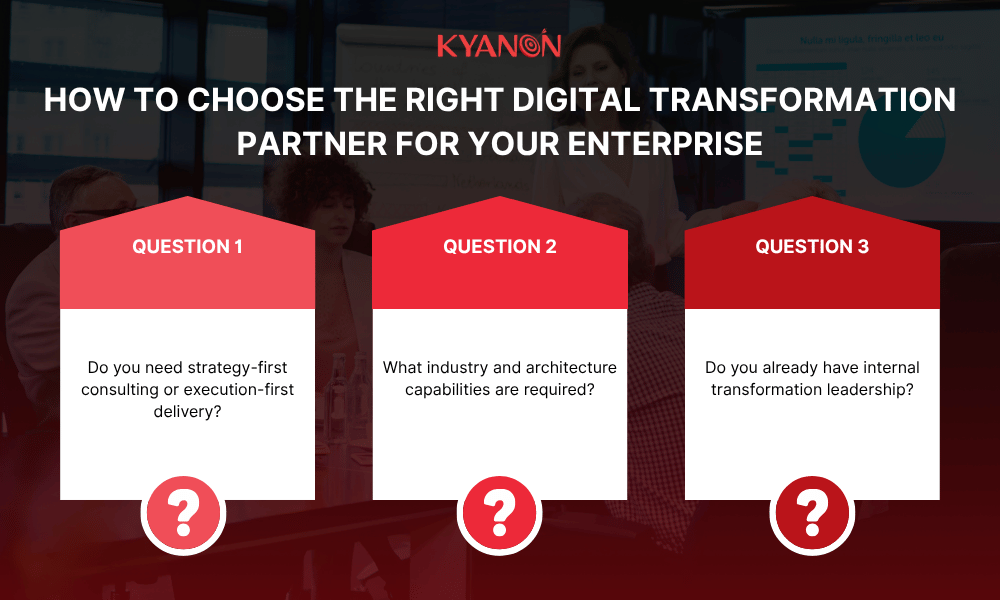
Question 1: Do you need strategy-first consulting or execution-first delivery?
Choose a global enterprise or strategy consulting firm when the program involves:
- Several business units or countries.
- Major operating-model change.
- Executive and board-level transformation governance.
- Multiple platforms and technology vendors.
- Regulatory or public-sector complexity.
- Significant change-management requirements.
- A multi-year roadmap requiring a prime contractor.
Relevant providers include:
- Accenture
- NCS
- Deloitte Digital
- Thoughtworks for software-led transformation
- Cognizant
Choose an execution-first regional integrator when the enterprise already understands the intended business direction but needs:
- Architecture refinement
- Custom software
- Commerce modernization
- System integration
- Data and AI enablement
- Product engineering
- Faster mobilization with a smaller governance structure
Relevant providers include:
- Kyanon Digital
- Vinova
- TechTIQ Solutions for narrower scopes
- Codigo for experience-led digital products
- Eastgate Software for engineering-led modernization
Question 2: What industry and architecture capabilities are required?
A transformation provider should understand both the sector and the target architecture.
| Business requirement | Capability to prioritise |
Retail and F&B modernization | Commerce, loyalty, POS, ERP, CRM, OMS, inventory, payment, and marketplace integration |
| Financial services | Security, auditability, data governance, core integration, resilience, and regulatory controls |
Manufacturing | ERP, MES, IoT, industrial data, automation, edge systems, and operational continuity |
| Public services | Accessibility, identity, security, scalability, procurement governance, and citizen experience |
Logistics | Order management, warehouse integration, fleet systems, tracking, APIs, and operational analytics |
| Regional digital products | Multi-market architecture, localisation, payments, cloud operations, and cross-border support |
For retail and F&B enterprises, composable commerce and MACH architecture may be relevant where monolithic platforms limit integrations, channel expansion, or release speed.
MACH stands for:
- Microservices-based
- API-first
- Cloud-native
- Headless
However, MACH should not be treated as an automatic target state. A modular architecture increases flexibility but can also increase integration, observability, vendor management, and operational complexity.
Kyanon Digital is one regional provider relevant to retail, F&B, commerce, loyalty, integration, and custom platform programs. Its suitability should still be tested through comparable production references, proposed architecture, team composition, migration planning, and support responsibilities.
→ Talk to Kyanon Digital’s team about your transformation roadmap.
Question 3: Do you already have internal transformation leadership?
A nearshore or staff augmentation model can be cost-efficient when the business already controls:
- Business priorities.
- Product ownership.
- Solution architecture.
- Security standards.
- Engineering practices.
- Vendor dependencies.
- Release decisions.
- Production operations.
In that situation, Kaopiz or a similar offshore engineering provider may supply delivery capacity without the overhead of a full consulting engagement.
A strategy and architecture layer should be added when:
- The target operating model is unclear.
- Several systems must be replaced or integrated.
- Data ownership is fragmented.
- Business functions disagree on priorities.
- Security and compliance requirements are still being defined.
- There is no internal owner for cross-vendor decisions.
Transformation partner decision matrix
| Current situation | Most suitable partner model |
Business direction and architecture are both unclear | Strategy-first global consultancy |
| Business direction is clear, but architecture requires design | Regional integrator with architecture capability |
Architecture is approved, but delivery capacity is limited | Nearshore dedicated team or staff augmentation |
| The program spans several countries and business units | Global firm or multi-partner governance model |
Scope is one customer-facing application | Product-focused regional software builder |
| Scope is commerce, loyalty, and enterprise integration | Regional integrator with commerce and middleware depth |
Scope is core infrastructure and managed operations | Large technology services provider |
| Internal software capability must improve | Engineering consultancy with capability-transfer experience |
Questions to ask during vendor evaluation
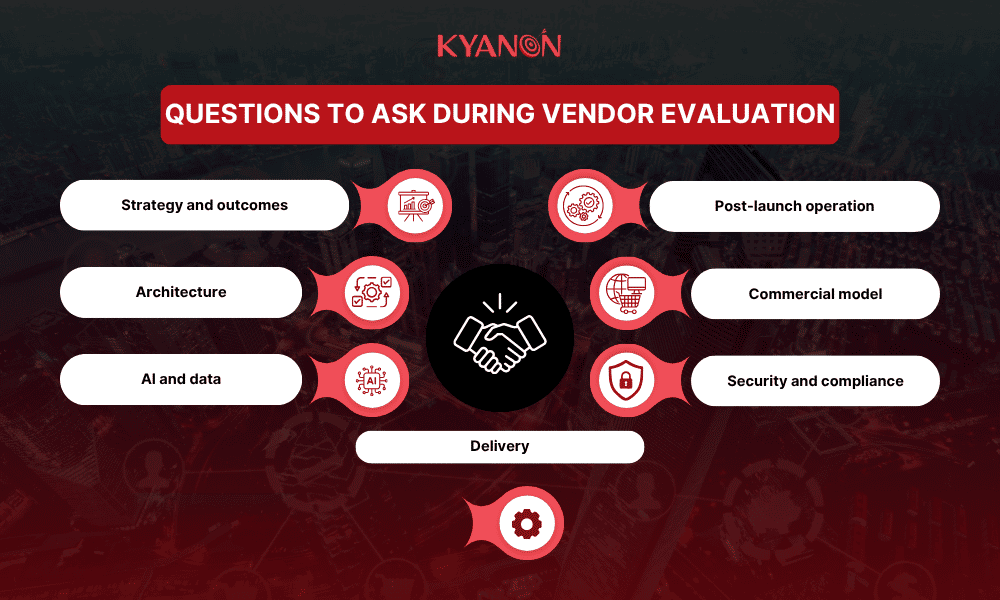
Strategy and outcomes
- What measurable operational or commercial result will each workstream produce?
- Which assumptions must be validated before the roadmap is approved?
- What will the business be able to do after the transformation that it cannot do today?
- Which benefits depend on process or organizational change rather than technology?
Architecture
- Which systems remain systems of record?
- Which components will be replaced, integrated, or retired?
- Where will APIs, events, identity, and orchestration be managed?
- How will the design reduce vendor lock-in?
- Which architecture decisions would be expensive to reverse?
AI and data
- Which AI use cases are ready for production?
- What data quality and access problems must be resolved first?
- How will model accuracy, cost, privacy, and risk be monitored?
- Where is human review required?
- How will third-party models and AI agents interact with enterprise systems?
Delivery
- Who are the named program, product, and architecture leads?
- What percentage of delivery is onshore, nearshore, offshore, or subcontracted?
- How quickly can the team mobilize?
- What evidence will be delivered in the first 30, 60, and 90 days?
- How are risks and dependencies reported?
Security and compliance
- How is PDPA compliance translated into technical controls?
- Where will data be stored, processed, logged, and backed up?
- What security testing is included?
- How are vulnerabilities prioritized and remediated?
- What is the incident-response and breach-escalation process?
Commercial model
- Which activities are included and excluded?
- What triggers a change request?
- How are third-party license, cloud, and support costs handled?
- Is pricing based on capacity, milestones, deliverables, or outcomes?
- What is the estimated three-year total cost of ownership?
Post-launch operation
- Who owns monitoring, incident response, upgrades, and performance?
- What service levels apply?
- How is technical knowledge transferred?
- Can the enterprise transition the system to another provider?
- Who owns the source code, documentation, configuration, and deployment pipelines?
Kyanon Digital perspective: A credible vendor should connect strategy, architecture, delivery, security, and post-launch ownership rather than treating them as separate project phases.
7 enterprise digital transformation trends in Singapore for 2026
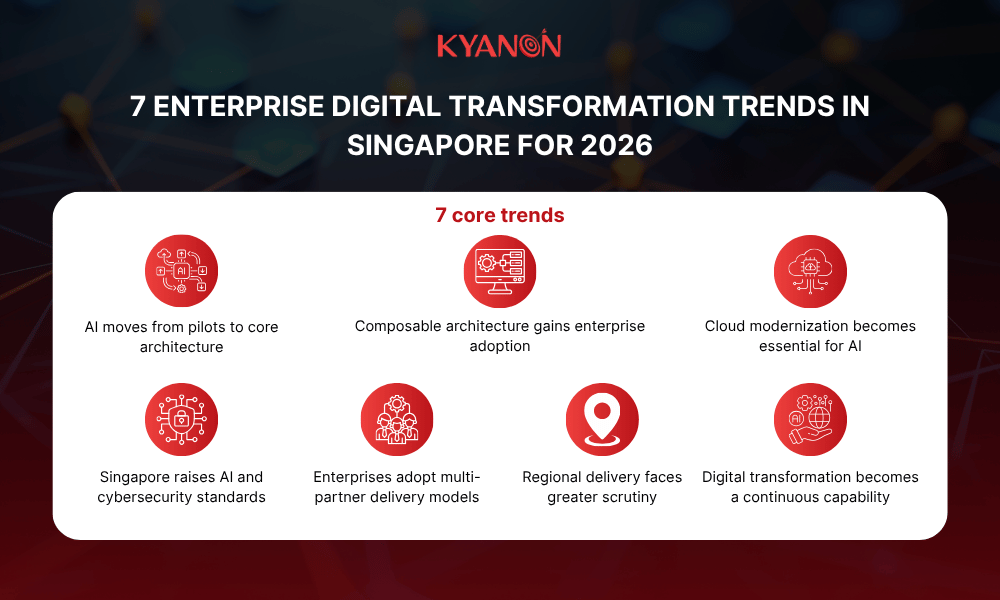
AI integration moves from pilot to core architecture
The main AI problem in 2026 is not access to models. It is connecting AI securely to enterprise data, applications, decisions, and workflows.
Gartner predicts that up to 40% of enterprise applications will include integrated task-specific AI agents by 2026, up from less than 5% in 2025.
This changes transformation requirements:
- APIs must support machine-to-machine actions.
- Identity and access controls must cover AI agents.
- Business rules must define which decisions can be automated.
- AI outputs require evaluation, monitoring, and audit records.
- Data platforms must provide current, governed context.
- Human approval must remain available for sensitive actions.
In May 2026, IMDA stated that the challenge for Singapore enterprises had shifted from AI experimentation to secure deployment at scale, with technical barriers, operational complexity, and cyber risk remaining material obstacles.
Selection implication: Providers should demonstrate production AI integration, not only workshops, prototypes, or chatbot demonstrations.
Composable architecture becomes more relevant, but not universally correct
Composable architecture separates capabilities into modular services that can be changed independently.
It is increasingly relevant to:
- Commerce.
- Loyalty.
- Customer identity.
- Content.
- Search.
- Pricing.
- Promotions.
- Order management.
- Customer service.
- AI-enabled interfaces.
Gartner has linked composable architecture with faster integration of agentic experiences through modular backend services and API mediation.
However, composability introduces additional responsibilities:
- API lifecycle management.
- Integration testing.
- Distributed monitoring.
- Vendor coordination.
- Data consistency.
- Cloud-cost management.
- Security across more components.
Selection implication: Businesses should reject both extremes: forcing every requirement into one monolith or breaking a stable system into unnecessary microservices.
Cloud modernization becomes inseparable from AI readiness
AI adoption increases demand for scalable compute, governed data, secure integration, and modern deployment pipelines.
Cloud transformation in 2026 therefore involves more than moving servers.
It may include:
- Application refactoring.
- Data-platform modernization.
- Containerization.
- Platform engineering.
- DevSecOps.
- Observability.
- Cost controls.
- Confidential computing.
- Regional or sovereign deployment choices.
Gartner’s 2026 technology trends identify confidential computing, AI security platforms, and geopatriation among the capabilities enterprises must consider as AI and regulatory complexity increase.
Selection implication: Ask providers how the cloud design improves resilience, release speed, security, and unit economics, not simply how much infrastructure will be migrated.
Singapore raises the baseline for AI, cyber resilience, and digital trust
Smart Nation 2.0 continues to shape Singapore’s digital environment around trust, growth, and social inclusion. The government’s 2026 frameworks include an update to the National AI Strategy alongside existing digital enterprise, connectivity, and cybersecurity programs.
The enterprise impact is practical:
- AI systems need stronger governance.
- Cybersecurity must be included in transformation budgets.
- Data handling must support local and cross-border requirements.
- Vendors must be able to participate in formal risk assessments.
- Resilience and incident readiness must be demonstrated before launch.
Selection implication: Security should be evaluated as part of architecture and delivery, not purchased as a final penetration test.
Enterprises increasingly blend partner categories
One provider does not need to own every component of a transformation.
A multi-partner model may use:
- A global consultancy for enterprise strategy and target operating model.
- A regional integrator for custom software and integration.
- A platform specialist for ERP, CRM, commerce, or data.
- A nearshore team for additional engineering capacity.
- A managed-service provider for production operations.
This can improve access to specialist capability and reduce dependence on one vendor. It can also create governance problems when architecture, scope, data, and production responsibilities are unclear.
Selection implication: A multi-partner model requires one accountable architecture authority, one integrated dependency plan, and explicit responsibility for end-to-end testing.
Regional delivery models become more mature and more closely scrutinized
Singapore-based programs increasingly combine local stakeholder management with engineering in regional hubs.
This model can provide:
- Faster team scaling.
- Access to broader technical skills.
- Lower blended delivery cost.
- Extended support coverage.
- More flexible team structures.
It also creates questions about:
- Data access.
- Cross-border transfers.
- Communication.
- Seniority.
- Staff continuity.
- Subcontracting.
- Local accountability.
- Knowledge retention.
Selection implication: Do not assess a regional model only through hourly rates. Evaluate governance overhead, retention, architecture leadership, quality controls, and production ownership.
Digital transformation shifts from project delivery to continuous operating capability
Transformation is increasingly treated as an ongoing capability rather than a one-time system launch.
Enterprises need operating models that support:
- Continuous improvement.
- Product-based funding.
- Reusable platforms and APIs.
- Regular security updates.
- AI model evaluation.
- Technical debt reduction.
- Customer and employee feedback.
- Measurable business outcomes.
Selection implication: The partner should explain how the enterprise will operate and improve the system after the initial implementation team leaves.
Red flags when comparing digital transformation companies
Avoid selecting a provider solely because it:
- Appears in several online “top company” lists.
- Uses AI, cloud, MACH, or digital transformation terminology.
- Presents a low blended hourly rate.
- Lists major technology partners.
- Shows client logos without explaining the work performed.
- Promises an enterprise roadmap before reviewing systems and data.
- Describes Agile delivery without measurable governance.
- Treats security as a separate final-stage activity.
- Cannot identify the named technical leadership.
- Avoids defining post-launch ownership.
Stronger evidence includes:
- Comparable production references.
- Architecture diagrams.
- Migration and cutover plans.
- Dependency registers.
- Security controls.
- Data-flow documentation.
- Team allocation.
- Delivery metrics.
- Support responsibilities.
- Client references that can be verified.
Conclusion
The market for digital transformation companies in Singapore includes global consultancies, established local technology providers, regional software integrators, product-focused studios, and nearshore engineering partners.
The final decision should be based on program ownership, industry evidence, architecture depth, delivery transparency, security, and long-term operating cost, not brand visibility alone.
For enterprises assessing commerce, loyalty, integration, custom platforms, data, AI, or regional software delivery, Kyanon Digital can be included in the evaluation alongside other relevant providers.
Contact Kyanon Digital to review the transformation scope, architecture dependencies, delivery model, and risks before deciding whether its regional approach fits the program.

 Create project brief with AI