
What is flash sale architecture?
Flash sale architecture is a specialized e-commerce infrastructure design pattern that utilizes queueing systems, edge caching, and decoupled data layers to process massive, instantaneous traffic spikes without degrading site availability. This design prevents system collapse during concentrated promotional events where visitor volume can multiply rapidly within minutes, ensuring that transactional pathways remain operational under stress.
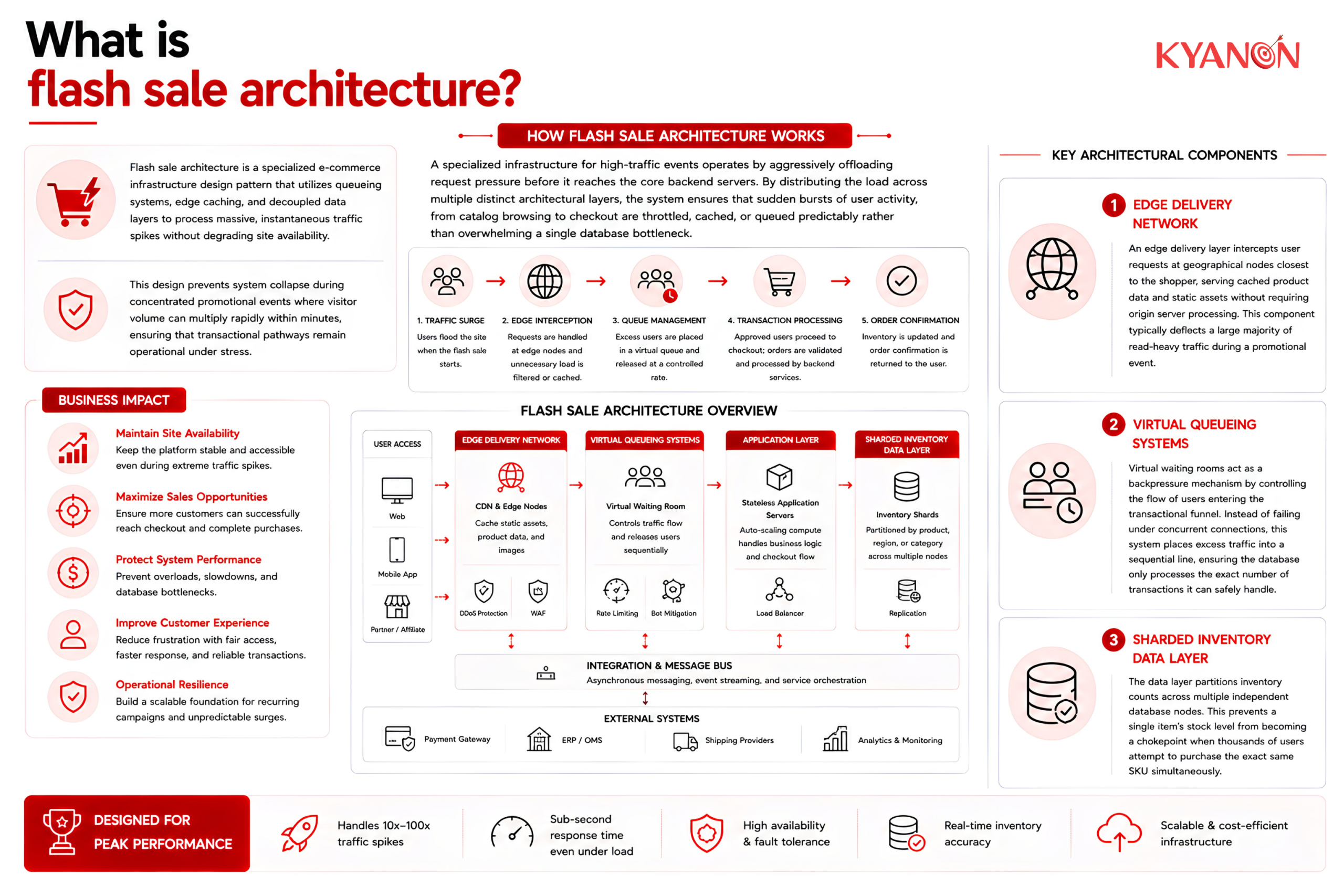
How flash sale architecture works
A specialized infrastructure for high-traffic events operates by aggressively offloading request pressure before it reaches the core backend servers. By distributing the load across multiple distinct architectural layers, the system ensures that sudden bursts of user activity, from catalog browsing to checkout are throttled, cached, or queued predictably rather than overwhelming a single database bottleneck.
Edge delivery network
An edge delivery layer intercepts user requests at geographical nodes closest to the shopper, serving cached product data and static assets without requiring origin server processing. This component typically deflects a large majority of read-heavy traffic during a promotional event.
Virtual queueing systems
Virtual waiting rooms act as a backpressure mechanism by controlling the flow of users entering the transactional funnel. Instead of failing under concurrent connections, this system places excess traffic into a sequential line, ensuring the database only processes the exact number of transactions it can safely handle.
Sharded inventory data layer
The data layer partitions inventory counts across multiple independent database nodes. This prevents a single item’s stock level from becoming a chokepoint when thousands of users attempt to purchase the exact same SKU simultaneously.
Flash sale architecture vs Traditional Monolithic Architecture
Both frameworks support online transactions, but differ fundamentally in how they distribute load and handle sudden concurrency surges.
Dimension | Flash sale architecture | Traditional E-commerce Setup |
| Deployment speed | Moderate | Fast |
Vendor lock-in | Low | High |
| Upfront complexity | High | Low |
Best for | Peak event-driven retail | Steady, predictable traffic |
| Cost model | OpEx (Usage-based scaling) | CapEx (Fixed capacity limits) |
When to consider flash sale architecture
Consider flash sale architecture if:
- Your platform relies heavily on limited-edition product drops where 80% of monthly sales occur within a concentrated two-hour window.
- Your current infrastructure experiences unrecoverable timeouts or connection exhaustion errors when traffic exceeds three times your normal baseline.
- You are expanding into new regional markets where mobile-first, influencer-driven promotions generate sudden, highly concentrated user surges.
It may not be the right priority if:
- Your product catalog consists of high-ticket B2B equipment with long sales cycles and flat, predictable traffic patterns year-round.
Why flash sale architecture matters for E-commerce
Infrastructure failures during high-visibility promotional windows directly destroy expected revenue and brand equity. When systems halt due to overload, marketing investments drive users to dead pages, resulting in permanently lost sales and increased customer acquisition costs. Flash sales can generate extreme traffic and transaction spikes within seconds, putting checkout, inventory, pricing, and commerce services under intense pressure. A resilient Flash Sale Architecture helps retailers maintain availability, performance, and transaction reliability during peak-demand campaigns, protecting revenue and customer experience.
Shopify’s own flash-sale guidance highlights the scale of the challenge: a typical store might receive 10,000 visitors and 100 orders per day, while a major promotion could attract 50,000 visitors and 1,000 orders in 24 hours and some high-demand events can involve tens of thousands of customers competing for inventory within minutes.
Common misconceptions
Scale up the database to handle the spike
Reality: Directing millions of concurrent checkout requests straight to a relational database collapses throughput due to row-level lock contention and connection exhaustion. Adding vertical compute power does not solve underlying architectural bottlenecks in transaction sequencing.
Redis is infinitely fast and bulletproof
Reality: A single Redis instance or a hot inventory shard can melt under massive concurrent key access if operations are unoptimized or lack sharding. In-memory datastores require strict partitioning to survive concentrated access patterns.
First-in, first-out (FIFO) ensures fairness
Reality: Strict IP- or timestamp-based ordering fails because automated bots manipulate network packets and requests to bypass line logic. Effective systems require active bot mitigation rather than relying solely on simplistic timestamp sorting.
How Kyanon Digital applies flash sale architecture
Kyanon Digital implements flash sale architecture using composable frameworks and headless commerce principles for enterprise clients across Vietnam, Singapore, Thailand, ANZ, and the US. Our approach focuses on measurable outcomes such as protecting conversion rates and lowering total cost of ownership (TCO) by integrating distributed caching, intelligent queueing, and scalable microservices that guarantee transaction stability during high-stakes regional sales events.
Explore our services:











 Create project brief with AI