

BFSI software development is becoming a larger investment and a harder operating-model decision as financial institutions modernize customer journeys, data, integrations, automation and resilience.
The global IT BFSI market is estimated at USD 213.64 billion in 2026 and is forecast to reach USD 359.2 billion by 2030, according to Research and Markets. This growth is increasing demand for software skills while financial institutions remain under pressure to control costs, protect sensitive data, and release changes safely.
Talent supply adds another constraint. In a 32-firm financial-services sample, the Financial Services Skills Commission’s 2026 report found that headcount fell 5% while new hires rose 3, developers and IT architects remained among the hard-to-fill roles.
The finding is UK-based, but it illustrates a wider sourcing problem: Businesses can reduce total headcount while still competing for scarce specialists.
The delivery model therefore affects more than payroll. It determines where technical knowledge sits, how quickly capacity can change, who controls architecture, and how security evidence is produced.
In-house development places people and day-to-day delivery inside the organization. Outsourced development uses an external provider for individuals, a team, a defined project or an operated service. Neither model wins universally. The right choice depends on business goals, budget, internal expertise, regulatory obligations, workload duration and scalability needs.
Key takeaways
- There is no universal winner. Select the model for each workload instead of applying one sourcing policy to every system.
- In-house development is strongest for control, institutional context, and long-term knowledge retention. It fits continuous, highly proprietary and strategically differentiating work.
- Outsourcing is strongest for rapid mobilization, specialist access, and variable capacity. Its cost advantage is clearest for bounded or fluctuating demand.
- Security does not depend on employment status alone. An internal team can have weak controls, while a mature provider can have strong controls; evidence matters more than labels.
- Regulatory accountability stays with the financial institution. Contracts, certifications, and service levels support governance but do not transfer the institution’s obligations.
- Compare three-year total cost, not salary, against vendor rates. Include recruitment, tools, governance, rework, transition, support, knowledge transfer and exit.
- A hybrid model often fits complex modernization. It works only when internal ownership, external deliverables and shared responsibilities are explicit.
Further reading:
- Digital Transformation in BFSI: A Framework for APAC Banks in 2026
- Dedicated Tech Team vs Project-Based Development in Singapore
- Singapore’s Guide to Software Outsourcing ROI
- How to Choose a Custom Software Development Company in Singapore
Understanding the two BFSI software development models
The practical difference is where employment, delivery management, risk control, and knowledge sit. Geography and accountability are separate decisions: An offshore team can be tightly governed, while an onshore provider can still create weak ownership.
What is in-house BFSI software development?
In-house BFSI software development uses employees who are recruited, managed, and retained by the financial institution. The organization owns the development lifecycle, engineering standards, delivery priorities, and operating knowledge directly.
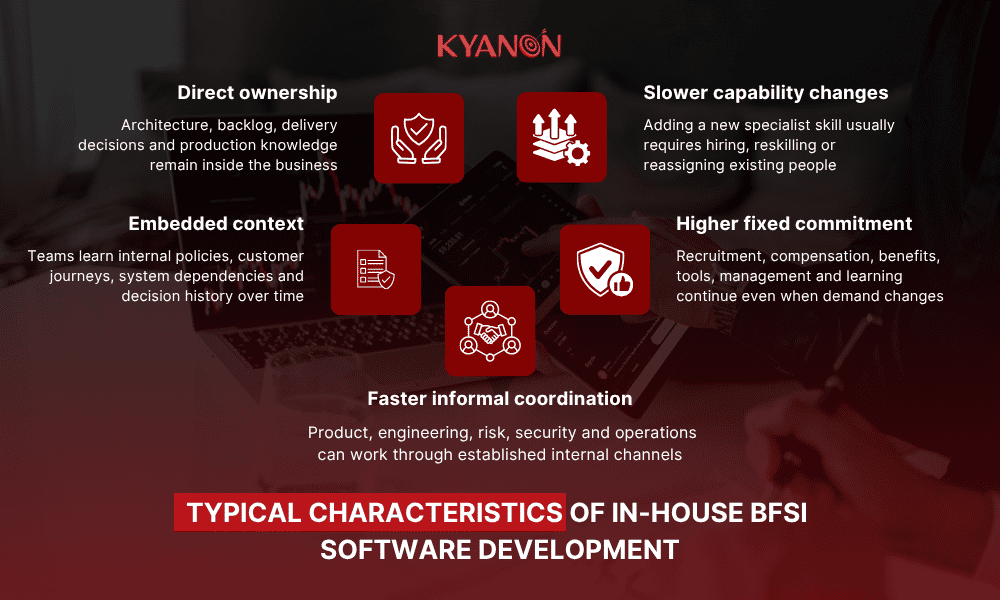
In-house development excels where deep institutional context, full control over delivery, and long-term knowledge retention are critical strategic assets.
Typical use cases include continuous evolution of proprietary platforms, highly restricted systems, stable multi-year roadmaps and capabilities that the organization considers strategically differentiating.
What is outsourced BFSI software development?
Outsourced BFSI software development uses an external provider to supply engineering capacity, deliver a defined outcome or operate an agreed service. It can support custom BFSI software development without moving business accountability outside the financial institution.
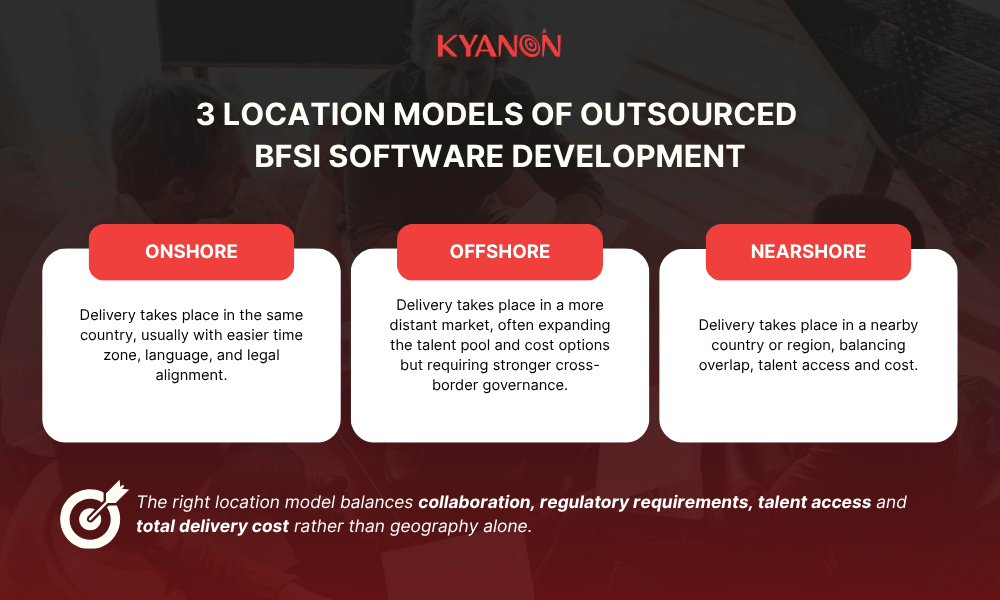
Engagement models describe who manages the work:
| Engagement model | Delivery control | Best fit |
Main risk to control |
|
Staff augmentation |
The financial institution directs individual external specialists | Temporary skill or capacity gaps within an established internal team | Role ambiguity, dependency on individuals and weak outcome ownership |
| Dedicated development team | A stable external team works against an agreed roadmap and operating cadence | Ongoing development where priorities may change |
Blurred accountability between product direction and delivery execution |
|
Project-based delivery |
The provider commits to a defined scope, milestones and acceptance criteria | Bounded initiatives with clear outcomes and dependencies | Change requests, incomplete requirements and handover gaps |
| Managed application service | The provider operates and improves an application against service levels | Stable run, support and enhancement needs |
Vendor lock-in, service concentration and weak internal operational knowledge |
The model name does not prove maturity. Businesses should examine delivery governance, BFSI domain knowledge, engineering evidence, security controls, subcontracting and exit readiness for every proposed arrangement.
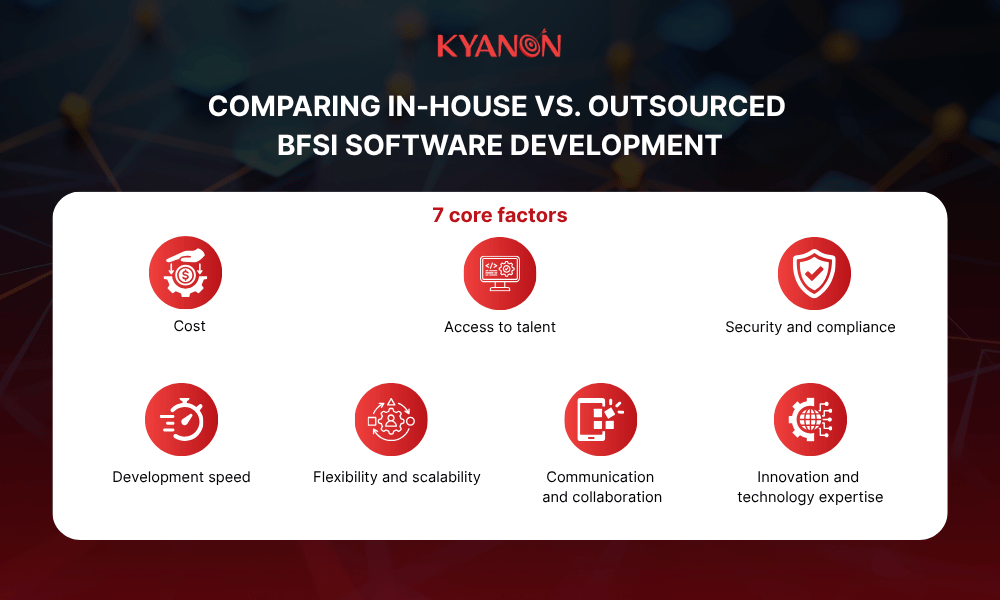
Comparing in-house vs outsourced BFSI software development
The seven factors below should be evaluated together. Optimizing only for cost or speed can increase rework, compliance effort and long-term dependency elsewhere.
For custom BFSI software development, the strongest model is the one that preserves control over critical decisions while supplying the skills and capacity the workload actually requires.
Cost
Outsourcing usually reduces the upfront commitment, but the lower hourly rate is not the same as lower total cost.
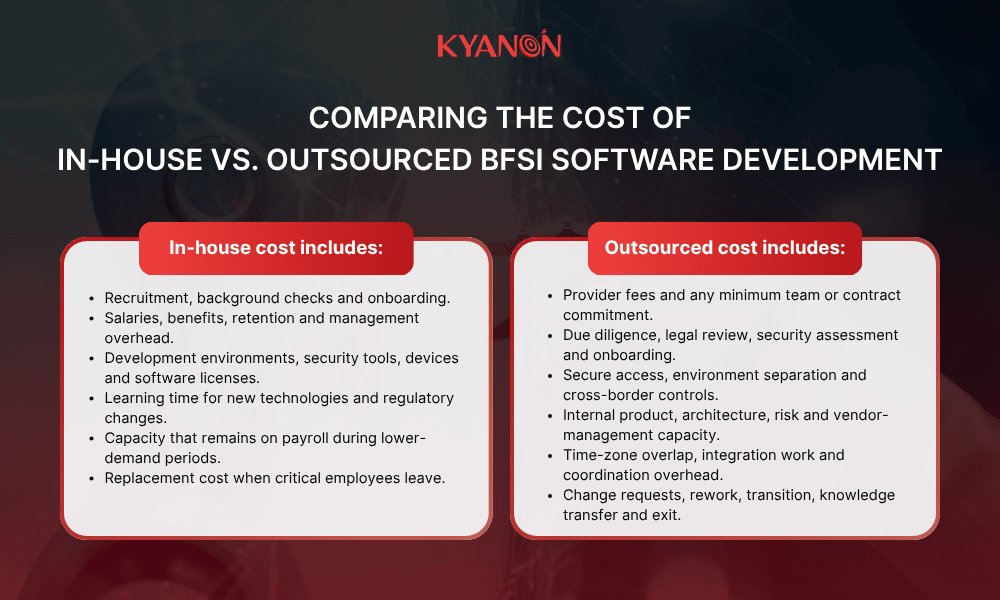
A useful comparison is:
Three-year TCO = mobilization + people + tools and infrastructure + governance + delivery + run support + transition and exit.
Real-world cost comparison
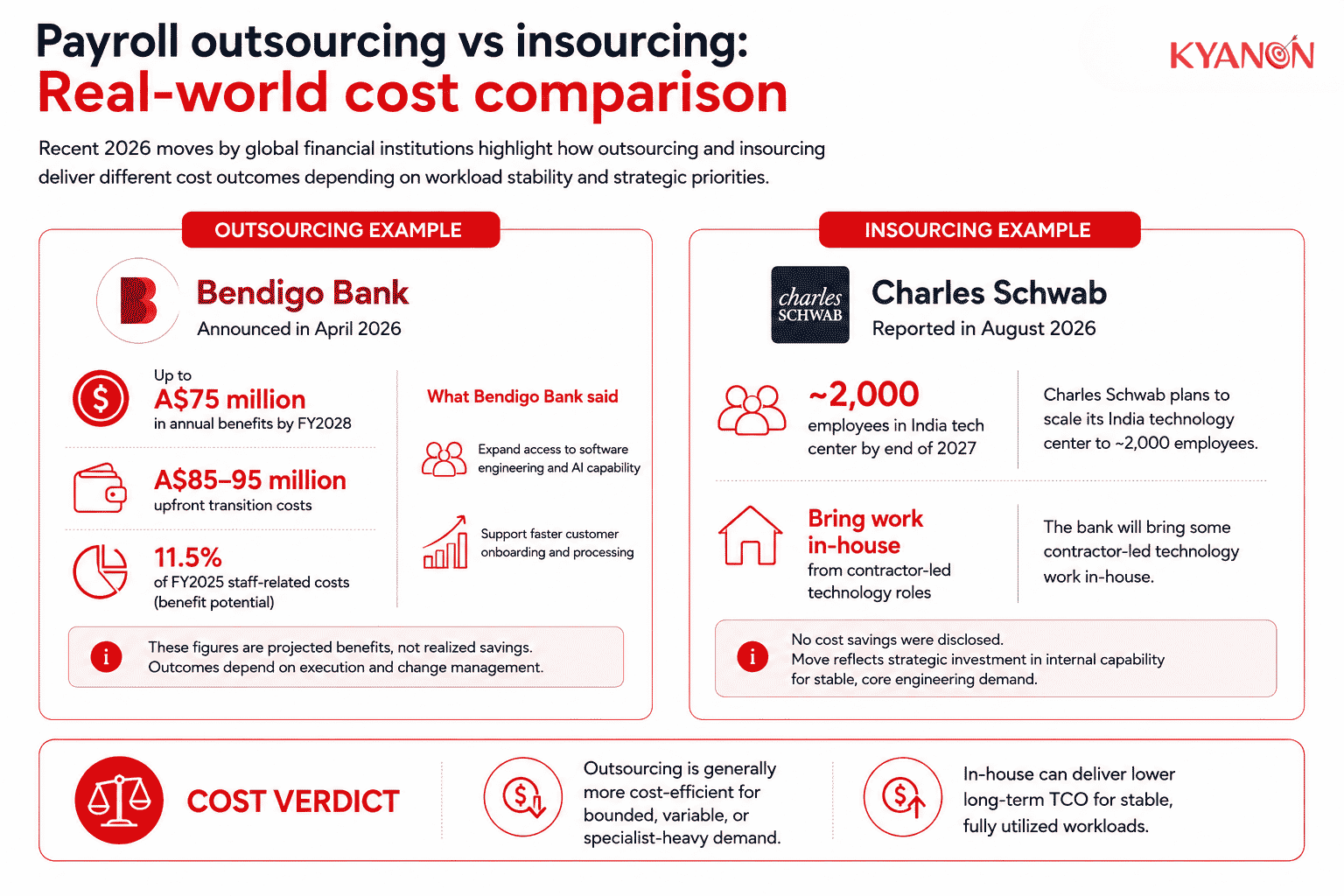
In April 2026, Bendigo Bank announced a seven-year technology partnership with Infosys and a six-year operations partnership with Genpact. Reuters reported that the arrangements are expected to generate up to A$75 million in annual benefits by FY2028, equivalent to approximately 11.5% of the bank’s FY2025 staff-related costs, against A$85–95 million in upfront transition costs. Bendigo Bank said the partnerships would expand access to software engineering and AI capability while supporting faster customer onboarding and processing. These figures are projected benefits, not realized savings.
The opposite movement is also visible. In August 2026, Reuters reported that Charles Schwab planned to expand its India technology center to approximately 2,000 employees by the end of 2027 and bring some contractor-led technology work in-house. No cost savings were disclosed, but the decision shows why stable, strategically important engineering demand can justify greater internal ownership.
Cost verdict: Outsourcing is generally more cost-efficient for bounded, variable or specialist-heavy demand, while in-house can deliver lower long-term TCO for stable, fully utilized workloads.
Access to talent
The main talent question is not how many developers are available. It is whether the team combines software engineering with the relevant financial workflows, controls and production environment.
The 2026 Financial Services Skills Commission report found that machine learning and AI had become the most in-demand skill area in its sample, while technical skills gaps had widened on average. This makes specialist access a continuing constraint rather than a one-time hiring problem.
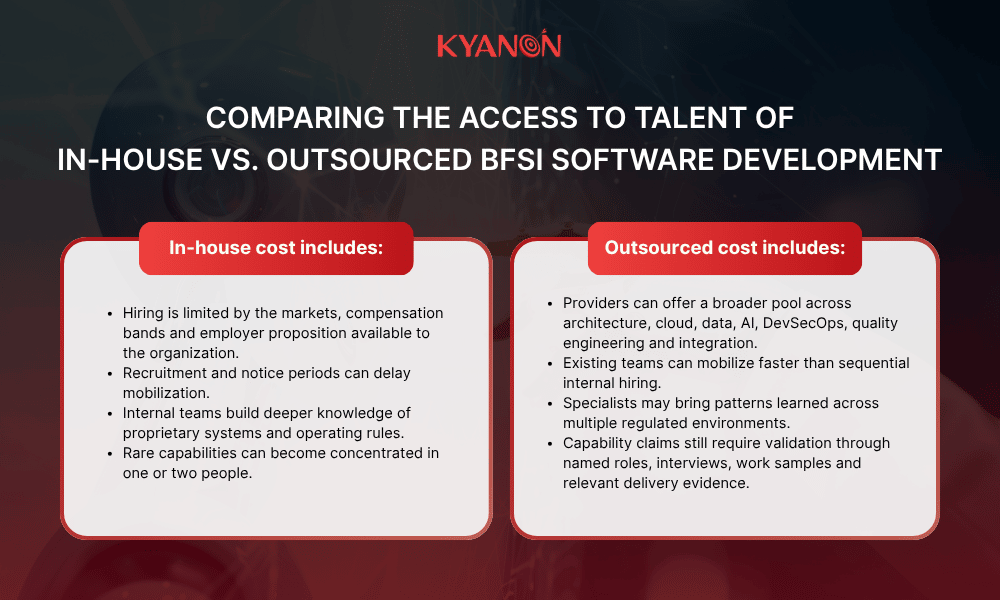
Real-world example: In May 2026, Reuters reported that JPMorgan Chase employed more than 55,000 people in India across software development, product development, data analytics and AI. The case shows that an in-house global capability centre can retain specialist knowledge at scale, but only when demand is continuous enough to justify the long-term investment. (Reuters)
Winner: Outsourced for urgent access to scarce or changing skills. In-house remains stronger for knowledge that must compound inside the organization.
Security and compliance
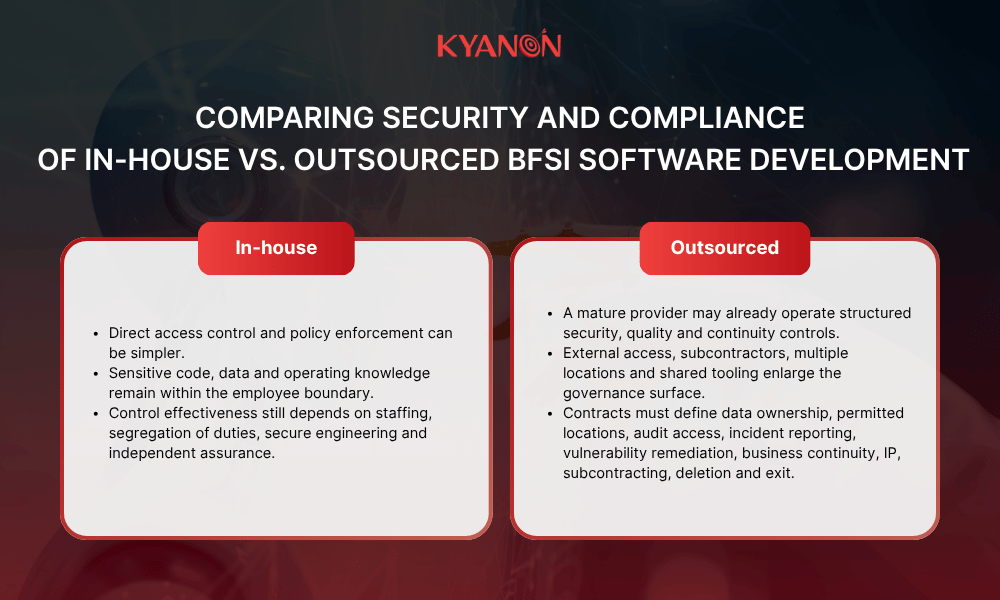
Security is not automatically stronger in-house or weaker when outsourced. The outcome depends on control design, operating discipline, evidence and accountability across the full delivery chain.
Applicable requirements may include GDPR, PCI DSS, ISO/IEC 27001, SOC 2 and local financial-sector rules. As each covers different risks, verify its scope, validity and exceptions.
The Basel Committee’s 2026 review also highlights due diligence, audit rights, incident notification, data portability, fourth-party visibility and data localization.
Before approval, verify evidence for the exact service scope, not only corporate certifications. Review secure development practices, access controls, vulnerability remediation, dependency management, recovery tests, incident exercises and unresolved audit findings.
FS-ISAC’s 2026 advisory recommends treating patch velocity and platform currency as operational-risk measures for both internal and external teams.
Real-world example: In August 2026, APRA reported that unresolved authentication weaknesses at Bendigo Bank’s Alliance Bank business contributed to unauthorized access to approximately 257 customer accounts and about A$490,000 in unauthorized transactions. The case shows that control testing, remediation ownership and accountability matter more than whether development is labelled in-house or outsourced. (APRA)
Winner: Depends on the provider, internal environment, workload, and jurisdiction. Control evidence, not the sourcing model, should decide.
Development speed
Speed has at least four components: time to mobilize, time to deliver a releasable increment, time to pass controls and time to recover from a failed change.
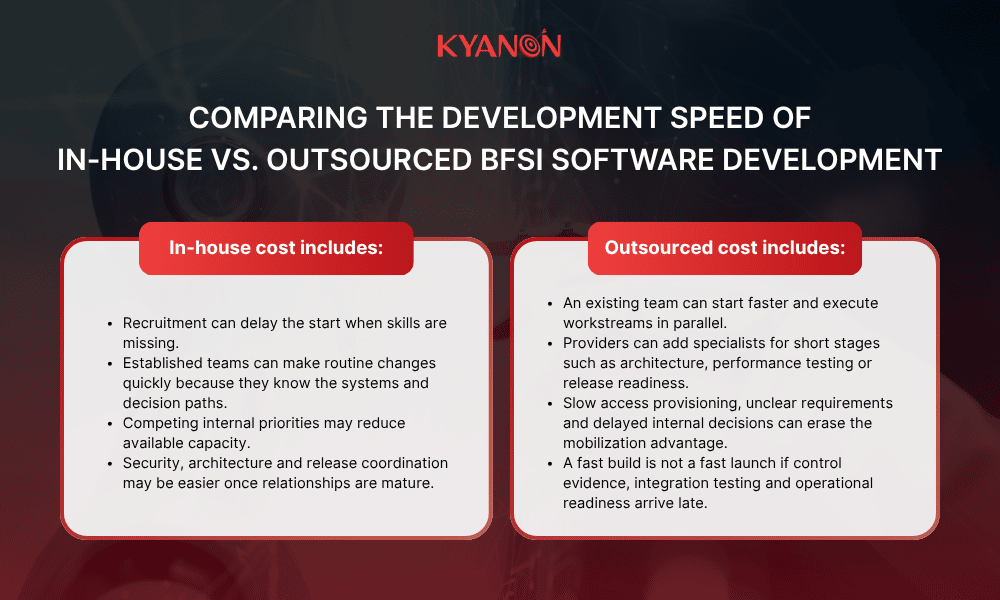
Measure both delivery and readiness: mobilization lead time, cycle time, release frequency, escaped defects, control exceptions, rework, dependency wait time and change-failure recovery.
Winner: Outsourced for rapid mobilization and parallel capacity. A mature in-house team can win for continuous changes in systems it already knows deeply.
Flexibility and scalability
Outsourcing makes capacity more variable, but real flexibility depends on contract terms, onboarding time and knowledge continuity.
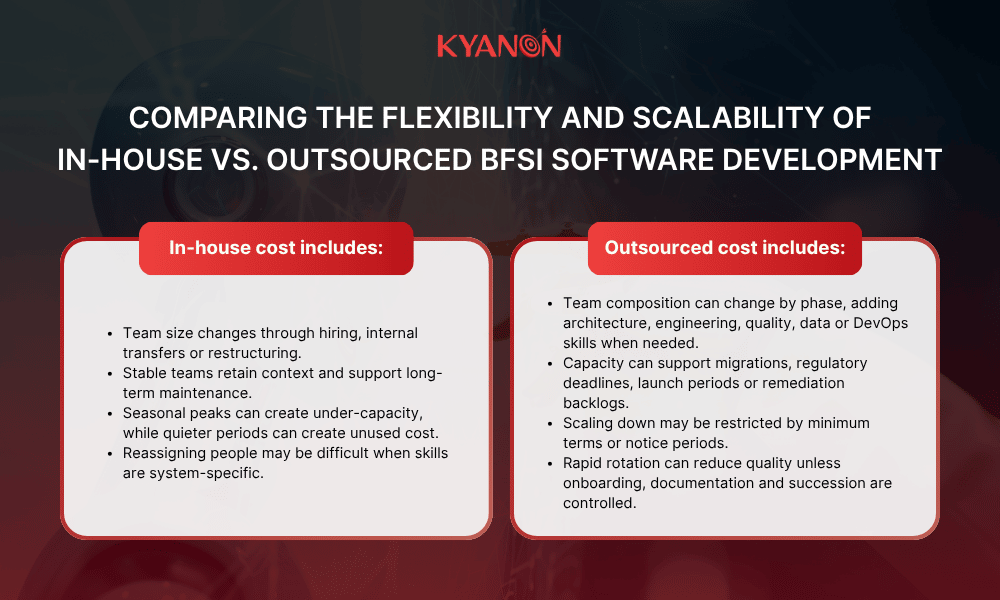
Winner: Outsourced for fluctuating demand and temporary specialist capacity. In-house fits predictable demand where continuity has higher value than elasticity.
Communication and collaboration
In-house teams usually have a context advantage. However, physical proximity does not guarantee clear decisions, and remote delivery does not inherently create poor collaboration.
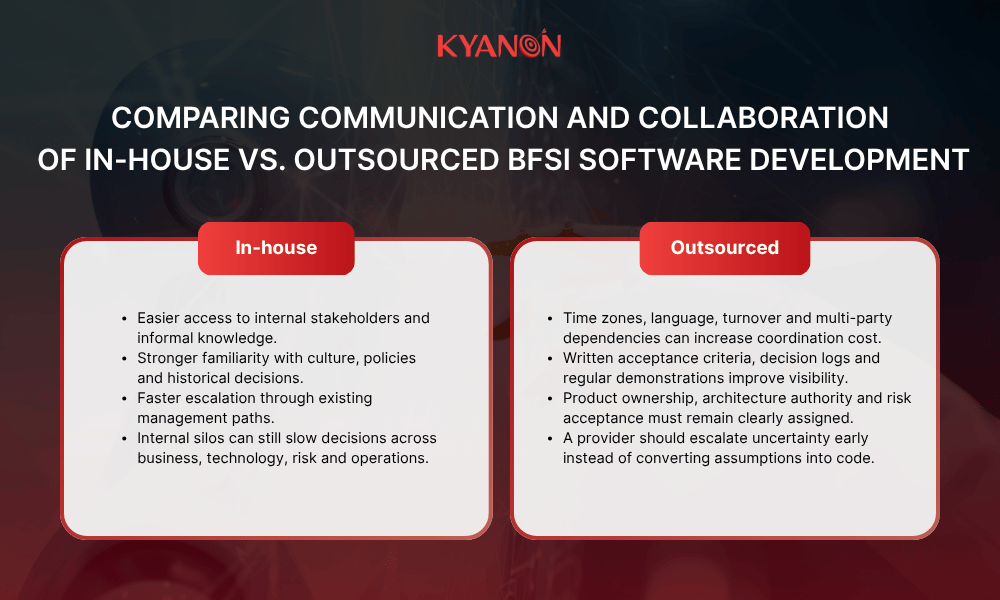
Real-world example: HSBC’s 2026 partnership with Google Cloud combines HSBC’s internal teams with Google Cloud and Google DeepMind engineers around three initial workstreams and more than 200 planned AI use cases over two years. The model demonstrates how external collaboration becomes more manageable when joint teams, priorities, expected value and internal accountability are defined upfront; the announced benefits remain projections until verified through delivery results. (HSBC)
Winner: In-house for day-to-day context and informal alignment. A well-governed external team can narrow the gap through disciplined communication and transparent delivery evidence.
Innovation and technology expertise
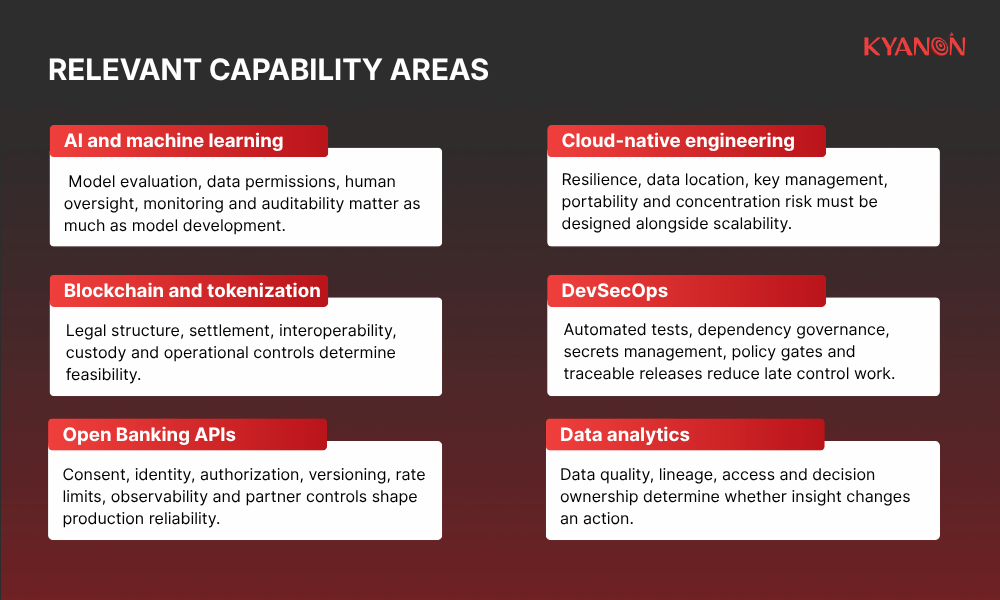
Access to technology is no longer the differentiator; applying it safely to a valuable financial workflow is.
Gartner forecasts worldwide AI spending at USD 2.52 trillion in 2026, up 44% year over year, but also states that adoption depends on human and process readiness, not investment alone. The January 2026 forecast supports a practical conclusion: specialist access must be paired with operating maturity and measurable outcomes.
Real-world example: In August 2026, Citi, HSBC, Deutsche Bank, Standard Chartered and Barclays were among the major banks partnering with Ant International on a specialized AI model for FX forecasting and liquidity management. Ant International stated that more accurate forecasting could reduce hedging and allocation costs by over 60%; because this is a provider claim, businesses should validate model performance, controls and realized savings independently. (Reuters)
Winner: Outsourced for rapid access to specialized expertise. In-house wins when innovation depends on proprietary knowledge that must remain and compound internally.
In-house vs outsourced BFSI software development: Pros and cons summary
|
Factor |
In-house | Outsourced |
Practical decision |
|
Cost |
Higher fixed investment; can be efficient at sustained utilization | Lower entry cost; variable TCO and added governance cost | Compare full lifecycle cost over the same time horizon |
| Control | Direct control over people, priorities and environments | Control is shared and enforced through governance and contract |
Keep non-delegable decisions and risk acceptance internal |
|
Security |
Direct access control, but effectiveness depends on maturity | Depends on provider, service scope and delivery chain | Assess evidence, not employment status or certifications alone |
| Talent | Deep internal context; constrained by hiring and retention | Broader specialist pool and faster access |
Separate general engineering skill from BFSI domain capability |
|
Scalability |
Slower to expand or reduce; stronger continuity | Faster to change capacity; contractual and rotation risks | Match capacity model to demand volatility |
| Development speed | Slower to build a new team; fast on familiar systems | Faster mobilization; internal dependencies can delay launch |
Measure end-to-end readiness, not coding speed alone |
|
Communication |
Strong context and informal access | Requires structured cadence and documentation | Make decisions, response times and escalation explicit |
| Innovation | Strong proprietary context; limited specialist breadth | Wider exposure to emerging capabilities |
Require use-case fit, production evidence and knowledge transfer |
|
Long-term knowledge retention |
Strong when retention and documentation are healthy | Moderate unless transfer is designed into delivery |
Treat documentation, pairing and exit as deliverables |
The summary shows why a single company-wide answer is usually weak. Different systems can justify different sourcing decisions within the same financial institution.
When in-house BFSI software development makes more sense
Choose in-house BFSI software development when long-term control, institutional knowledge and continuous ownership outweigh the cost of permanent capacity.
It is best suited when:
- A mature engineering function already exists.
- Proprietary logic or sensitive data requires restricted access.
- The product has a stable, long-term roadmap.
- Architecture and production governance are difficult to delegate.
- Engineering capability is a strategic business asset.
External specialists can still support testing, training or temporary capacity while ownership remains internal.
When outsourcing BFSI software development is better
Choose outsourcing when specialist capability or delivery capacity is needed faster than internal hiring can provide.
Common use cases include:
- Fintech MVPs and product validation.
- Mobile banking and digital customer journeys.
- Legacy modernization and system integration.
- Data, automation and platform initiatives with defined outcomes.
- Regulatory changes, migrations or launches with fixed deadlines.
Core systems, regulated decisions and risk ownership should remain clearly assigned internally. Outsourcing is unsuitable without an accountable internal owner, defined access controls and the ability to review delivery evidence.
How Kyanon Digital helped Cynopsis Solutions scale RegTech development
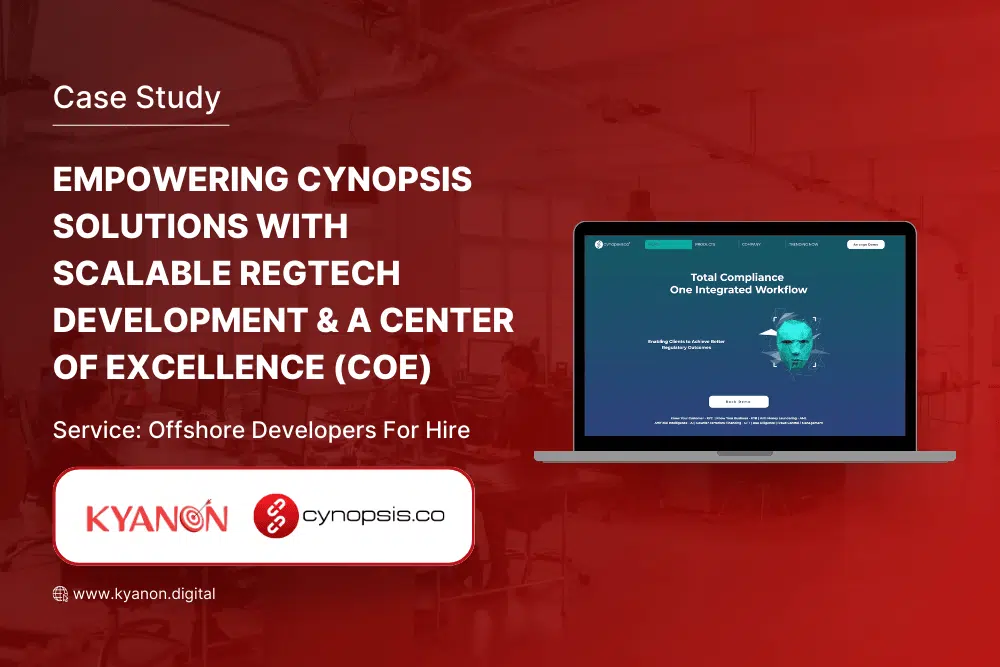
Challenges
- Growing demand for AML, KYC and digital onboarding products.
- High onboarding demands on the internal team.
- Need for faster releases without reducing quality.
Solutions
- Built a dedicated engineering, product and QA team.
- Established a Center of Excellence for training and knowledge transfer.
- Introduced bi-weekly sprints and automated CI/CD.
Business impact
- Launched three RegTech products within months.
- Reduced repeated training demands on the onshore team.
- Improved delivery scalability and consistency.
- Strengthened long-term knowledge continuity.
This case shows how outsourced BFSI software development can add governed delivery capacity while product and compliance ownership remain internal.
Read more: Empowering Cynopsis Solutions with Scalable RegTech Development & a Center of Excellence (CoE)
Hybrid BFSI software development: The best of both worlds?
A hybrid model combines internal ownership with external delivery capacity. It is often suitable for enterprise modernization because financial institutions need both strong control and access to changing specialist skills.
The model works only when the seams are designed:
|
Activity |
Internal ownership | External contribution |
Shared requirement |
|
Business outcomes and priorities |
Own the business case, roadmap and acceptance of value | Challenge feasibility and clarify delivery implications | Maintain one prioritized source of truth |
| Architecture and risk appetite | Set principles, non-negotiable controls and exception authority | Produce designs and evidence within those boundaries |
Review material decisions before implementation |
|
Software delivery |
Maintain product and technical ownership | Build agreed increments and resolve delivery risks | Use common engineering standards and acceptance criteria |
| Security and compliance | Interpret obligations and accept residual risk | Implement controls and provide traceable evidence |
Test controls throughout delivery, not only before launch |
|
DevOps and releases |
Control production authority and segregation rules | Automate pipelines, environments and release evidence as agreed | Define access, approval, rollback and incident procedures |
| Maintenance and incidents | Own service criticality and business escalation | Support diagnosis, remediation and service levels |
Run joint exercises and maintain current runbooks |
|
Knowledge and exit |
Name internal successors and preserve institutional records | Document, pair, train and return or delete assets |
Test handover and exit before dependency becomes critical |
The Basel Committee’s 2026 ICT report notes that exit strategies and ongoing provider-resilience evaluation are widely regarded as essential for critical third parties. In a hybrid model, exit readiness should be an operating capability, not a document created when the relationship is already failing.
A current market example also shows that sourcing boundaries can change. In August 2026, Reuters reported that Charles Schwab planned to expand its India capability center to about 2,000 employees by the end of 2027 while bringing some contractor-led technology work in-house. The broader lesson is not that internal delivery always wins; it is that institutions continually rebalance control, capability and cost as their operating model matures.
The hybrid model can provide:
- Better flexibility without removing internal ownership.
- More controlled fixed cost than building every specialty internally.
- Faster mobilization for defined modernization workstreams.
- Stronger governance when decision rights and evidence requirements are explicit.
- Better knowledge retention when transfer occurs continuously rather than at contract end.
Hybrid delivery fails when both sides assume the other owns architecture, quality, compliance or operational readiness. Every shared activity needs one accountable decision owner, even when execution is collaborative.
Key questions before choosing a BFSI software development model
Choose the BFSI software development model by workload, timeline and governance requirements, not through one organization-wide rule.
| Question |
Decision signal |
|
What is the three-year TCO? |
Bounded funding favors outsourcing; stable demand may support in-house. |
| How quickly must delivery start? |
Urgent or scarce expertise favors outsourcing. |
|
What regulations and data controls apply? |
Higher risk raises provider-governance requirements but does not automatically require in-house delivery. |
| What must remain internally controlled? |
Proprietary decisions, sensitive access and institutional knowledge favor in-house or hybrid. |
|
Is long-term maintenance required? |
Continuous demand favors in-house or a governed dedicated team. |
| Will capacity change significantly? |
Variable demand favors external capacity. |
|
Can the provider be replaced safely? |
Weak portability, documentation or exit rights signal unacceptable outsourcing risk. |
| Who owns outcomes and risk? |
If internal accountability is unclear, the model is not ready. |
Simple decision rule:
- In-house: Best for continuous, proprietary, and context-heavy workloads.
- Outsourced: Best for bounded, urgent, or specialist work with effective provider governance.
- Hybrid: Best when internal control and external capability are both required.
Make the final decision at workload level, as customer applications, data platforms, integrations, and critical systems may require different models.
Which BFSI software development model wins?
Neither in-house nor outsourced BFSI software development wins across every cost, risk and delivery condition. In-house is stronger where proprietary knowledge, continuous ownership and direct control dominate. Outsourcing is stronger where speed, specialist access and variable capacity create more value than permanent headcount.
For many financial institutions, hybrid delivery is the most practical answer, but only when the organization remains an informed owner. Strategy, architecture authority, regulatory interpretation, risk acceptance and vendor governance cannot become unassigned simply because development is external.
The best model is therefore the one that produces secure, supportable and measurable outcomes at an acceptable total cost while preserving the knowledge and control the business cannot afford to lose.
Every custom BFSI software development initiative should make that trade-off explicit before team structure or provider selection begins.
Building or modernizing a BFSI solution and need to test the delivery model, governance, integration scope or go-live risks? Contact Kyanon Digital to discuss the requirements.















 Create project brief with AI