
What is YPPO (Your Price, Our Platform)?
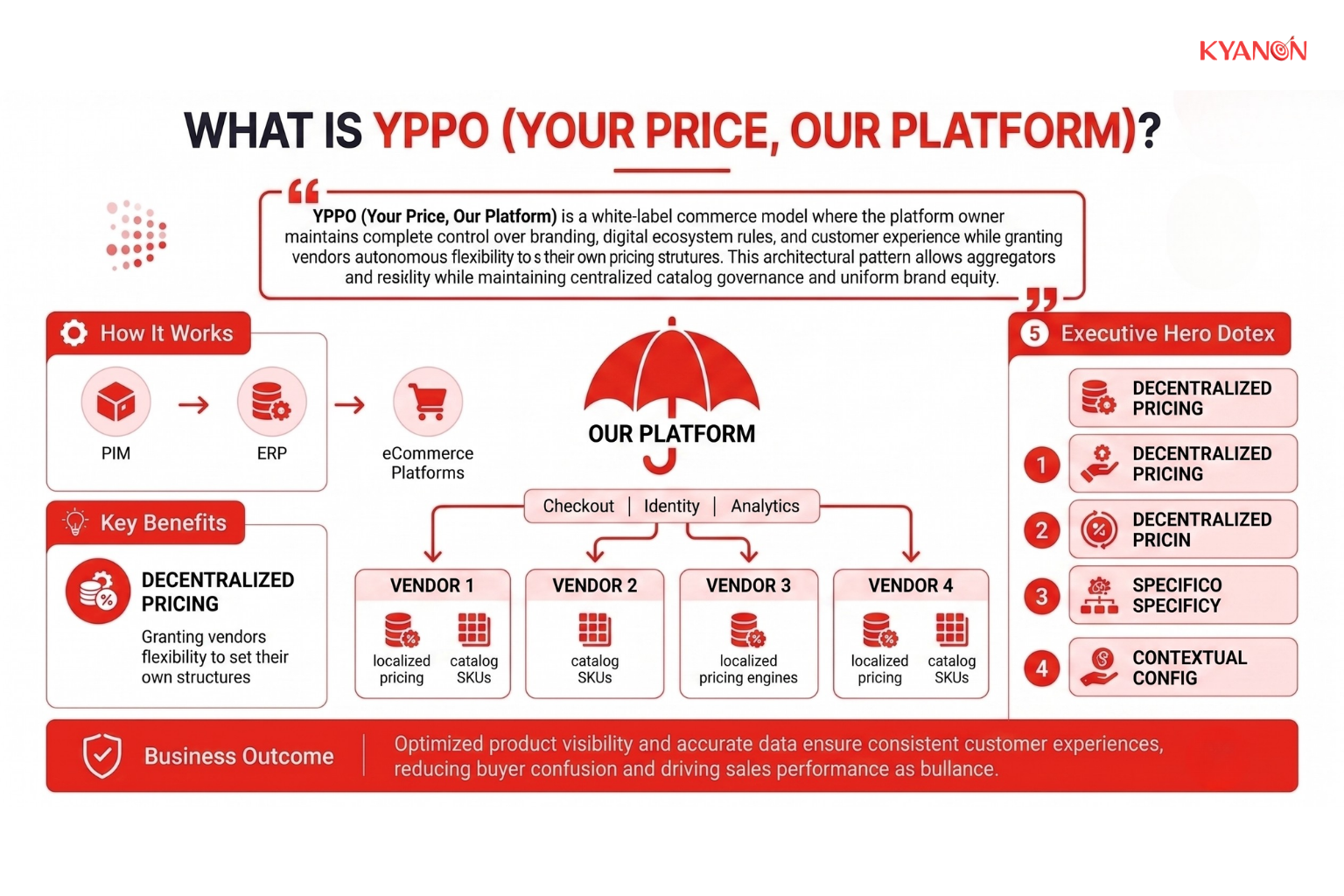
YPPO (Your Price, Our Platform) is a white-label commerce model where the platform owner maintains complete control over branding, digital ecosystem rules, and customer experience while granting vendors autonomous flexibility to set their own pricing structures. This architectural pattern allows aggregators and resellers to scale multi-vendor operations rapidly while maintaining centralized catalog governance and uniform brand equity.
How YPPO (Your Price, Our Platform) Works
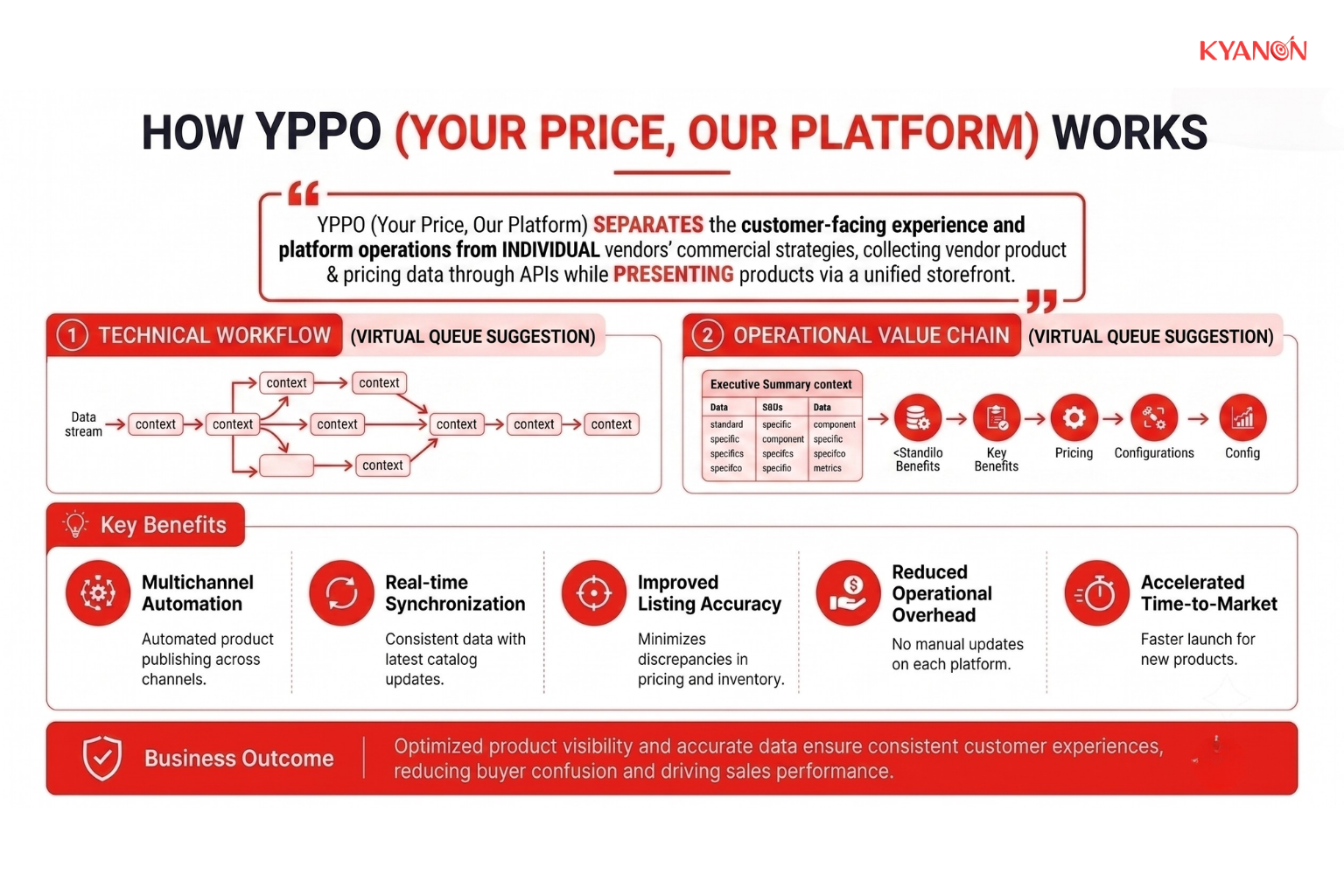
YPPO (Your Price, Our Platform) separates the customer-facing experience and platform operations from individual vendors’ commercial strategies. Using standardized APIs, the platform collects vendor inventory and pricing data, applies centralized governance rules, and presents products through a unified storefront.
Centralized Governance Engine
The governance engine establishes the rules that keep a multi-vendor marketplace consistent and controlled.
It manages:
- Global operational and security rules
- Product and storefront presentation standards
- Checkout and transaction workflows
- Transactional boundaries across vendors
This allows different sellers to operate independently while customers experience one consistent storefront and checkout journey.
Merchant Pricing Middleware
Vendors manage their commercial settings through dedicated portals or headless endpoints. The platform then processes these inputs before publishing prices to customers.
The middleware can:
- Capture base prices and operational margins
- Apply vendor-specific discount structures
- Incorporate platform transaction fees
- Synchronize updated pricing with the storefront in real time
This keeps vendor pricing flexible while maintaining centralized control over how products are presented and sold.
Automated Order Orchestration
When a customer places a multi-vendor order, the platform manages the transaction centrally before separating fulfillment responsibilities.
The process:
- Customer completes checkout through the unified storefront.
- The platform processes the payment and creates the order.
- The system splits the order by vendor.
- Fulfillment data is routed to each vendor’s warehouse or fulfillment system.
- The platform maintains centralized tracking and customer service.
This enables multi-vendor fulfillment without fragmenting the customer experience.
Comparative Analysis: YPPO vs. Traditional Marketplace
The choice between a YPPO architecture and a traditional multi-vendor marketplace directly influences operational overhead, vendor adoption, and brand risk.
Dimension | YPPO (Your Price, Our Platform) | Traditional Marketplace | Business Impact |
| Brand Control | High (Unified Platform Branding) | Low (Fragmented Merchant Branding) | Protects core brand equity and customer trust |
Pricing Autonomy | Merchant-controlled within rule bounds | Variable / Unstructured | Attracts premium suppliers who demand pricing control |
| Fulfillment Sourcing | Distributed Vendor Fulfillment | Merchant-managed or Platform 3PL | Minimizes central capital expenditure and inventory liability |
Customer Data Ownership | Platform retains primary account data | Shared or Merchant-owned | Accelerates direct customer relationship building |
| Catalog Integration | Standardized White-label API Feeds | Manual / Multi-format listings | Reduces platform onboarding friction and time-to-market |
Why YPPO (Your Price, Our Platform) Matters
Modern digital commerce demands architecture capable of scaling operations without incurring proportional operational friction. As enterprises adapt to algorithmic sales channels, modernizing system architecture becomes essential to operational scale. Modern enterprise deployment metrics highlight this pressure, as IBM research indicates that 48% of enterprise references cite a lack of AI-ready architecture as their primary barrier to scaling operations.
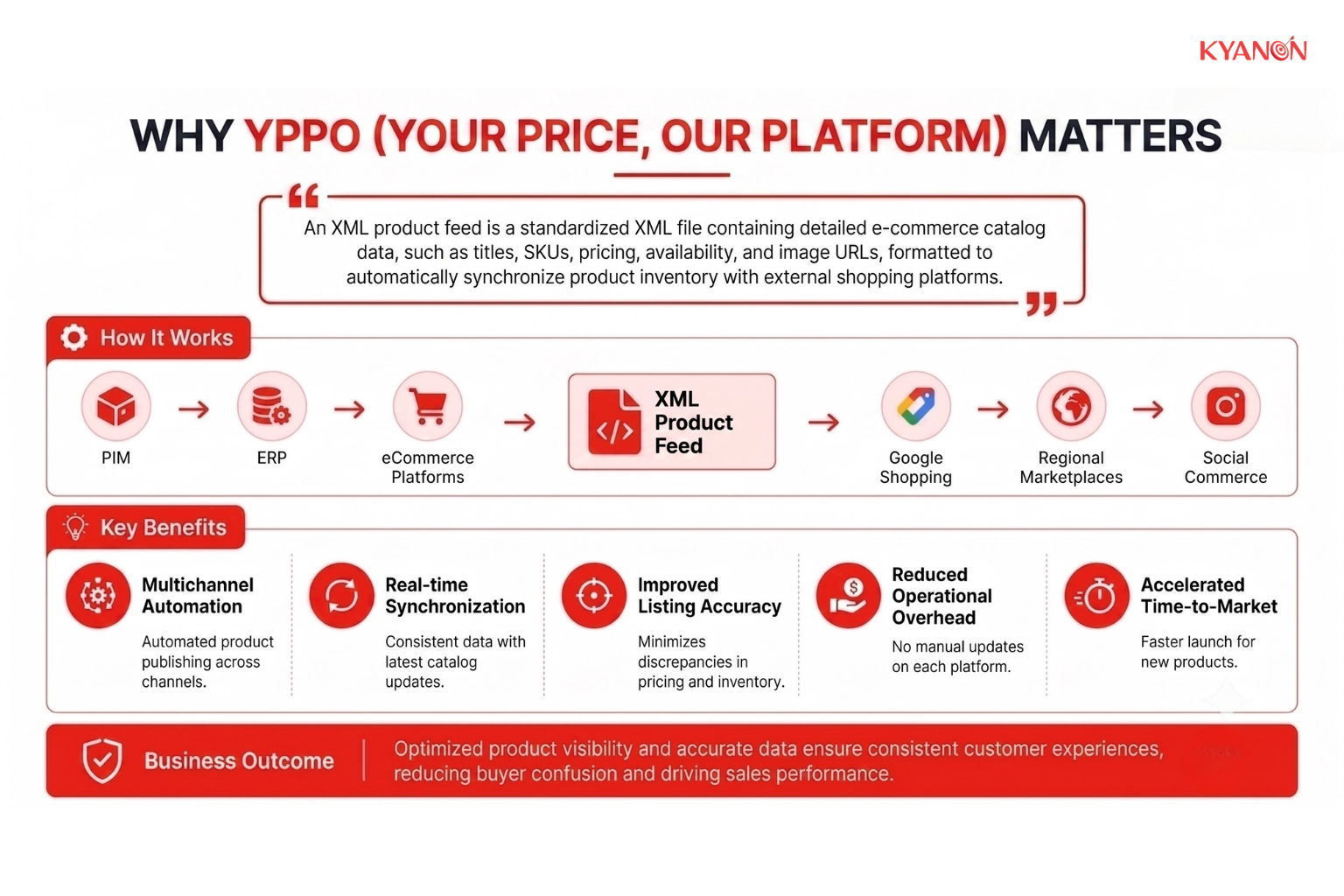
At the same time, shifting consumer behaviors toward autonomous buying agents necessitate platform ecosystems built for automated pricing adaptability. The market impact of this evolution is substantial; according to McKinsey & Company, research shows that $3 trillion to $5 trillion in global B2C retail revenue will flow through agentic commerce models by 2030. Furthermore, McKinsey & Company reports that 38% of European consumers already use GenAI tools to decide what to purchase. By employing a YPPO model, enterprise aggregators position themselves to ingest dynamic pricing from vendors instantly, serving dynamic commerce demands while mitigating catalog management costs.
Common Misconceptions
Merchants maintain absolute pricing autonomy
Setting raw list prices does not grant total operational pricing freedom. Merchants must operate within the platform’s programmatic boundaries, where algorithmic suppression rules, automated commission tiering, and structural platform fee deductions continuously adjust final seller margins and buy-box eligibility.
The host platform functions as a neutral passive utility
Hosting platforms actively govern market dynamics through search algorithms, category curation, and operational quality metrics. The underlying architecture prioritizes listings that meet strict performance standards, effectively shaping commercial outcomes rather than acting as a simple, passive hosting environment.
Retaining control of list prices guarantees zero hidden costs
A stable sticker price does not shield seller margins from baseline platform economics. Underlying transaction surcharges, marketplace referral percentages, mandatory platform marketing contributions, and payment gateway costs routinely compress net revenue despite constant retail pricing.
Listing on a hosted platform delivers instant, built-in buyer demand
Publishing a catalog to a ready-made platform host does not automatically secure high conversion or steady organic traffic. Merchants must continually invest in platform-native search optimization and performance marketing campaigns to gain meaningful audience reach.
Marketplaces distribute search visibility equally across all participating merchants
Platform discovery architecture routinely favors top-tier sellers, sponsored placements, and participants utilizing paid platform acceleration tools. Organic placement alone rarely yields equal impression share for newly onboarded merchants.
Brands retain exclusive ownership of buyers acquired through the host ecosystem
Customer accounts, purchase histories, and contact identities created within the platform belong primarily to the platform’s core database. Merchants generally receive restricted, transaction-specific operational data rather than open CRM access.
How Kyanon Digital Applies YPPO (Your Price, Our Platform)

Kyanon Digital designs and engineers YPPO marketplace frameworks for enterprise aggregators and resellers across Southeast Asia needing flexible merchant pricing coupled with strict unified brand governance. Utilizing API-first methodologies and headless microservices, we build high-concurrency vendor management portals, resilient catalog ingestion pipelines, and automated commission reconciliation systems that integrate seamlessly with legacy ERP ecosystems.
Explore our services:











 Create project brief with AI