

An agentic workflow is an AI-driven process where autonomous agents interpret goals, plan execution sequences, and adapt to real-time inputs, replacing rigid RPA scripts that break on exceptions. Built on the Workflows, Agents, and Tools (WAT) architecture, these systems automate complex operations such as invoice triage and customer ticket handling with minimal ongoing human supervision. Kyanon Digital implements this model for enterprises across Singapore, Malaysia, and ANZ, delivering measurable improvements in cycle time, scalability, and compliance readiness.
This article presents a clear agentic workflow definition, explains the supporting architecture, outlines implementation strategy steps, and reviews benefits, risks, and enterprise use cases delivered through enterprise-grade implementation approaches from Kyanon Digital.
Agentic Workflow Development for Enterprise Software
Key Takeaways
- Traditional RPA is limited by fixed scripts: Automation breaks in exception-heavy workflows because rule-based systems cannot handle unstructured inputs or dynamic decisions.
- Agentic workflows provide decision-aware execution infrastructure: Goal-driven AI agents coordinate across enterprise systems using the WAT framework because complex operations require adaptive orchestration.
- Successful rollout follows a three-step deployment model: Start with high-frequency pilots, establish governance guardrails early, and integrate observability from day one because structured rollout accelerates production readiness.
- Agentic workflows deliver measurable operational ROI: Organizations achieve significantly faster processing, reduced manual workload, and stronger scalability because agents handle variability across workflows.
Further Reading
- 2026 Tech Trends Shaping Enterprise Software Architecture
- Trends in Business Process Automation 2026
- AI-Driven Software Development for Enterprises
What is agentic workflow development?
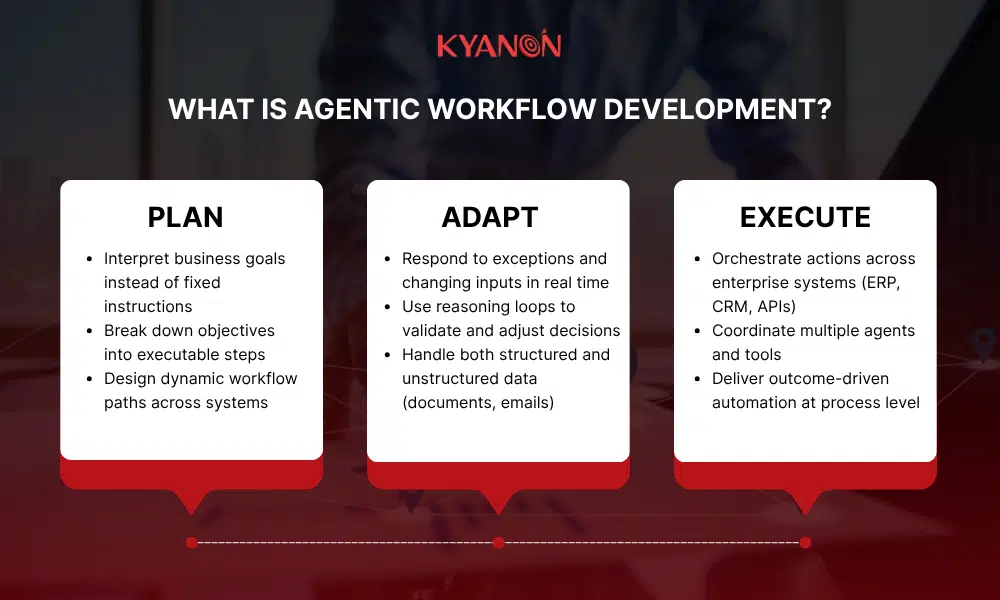
AI agents instead of fixed rule-based scripts. Rather than automating isolated steps, agentic workflows interpret objectives, plan execution sequences, interact with enterprise systems, and adapt dynamically when inputs or operating conditions change.
According to IBM and MyWave, this represents a shift from task-level automation toward outcome-oriented workflow orchestration across finance, operations, procurement, and service environments.
For enterprise technology and operations leaders, the implication is practical. Automation evolves from script execution support into decision-aware execution infrastructure that improves cycle time, resilience, and scalability across complex workflows.
Why enterprises are expanding beyond traditional RPA
Traditional RPA remains effective for structured tasks such as reconciliation, data entry, and form handling. However, RPA performance typically declines when workflows involve exceptions or unstructured inputs such as documents and emails.
Agentic workflows address this limitation by interpreting goals instead of executing predefined instructions. This expands automation coverage into higher-value pipelines such as invoice triage, ticket routing, and RFP evaluation.
Comparing enterprise automation: traditional RPA vs. agentic workflows
Capability area | Traditional RPA | Agentic workflow automation |
| Execution model | Fixed scripts | Goal-driven adaptive agents |
Error handling | Breaks on unexpected changes | Self-corrects through reasoning loops |
| Workflow flexibility | Limited to predefined logic | Dynamically plans execution paths |
Data compatibility | Structured inputs only | Structured and unstructured inputs |
| Typical enterprise use | Data entry and reconciliation | Invoice triage, ticket routing, RFP evaluation |
Core design patterns and the WAT architecture model
Most enterprise deployments rely on four foundational execution patterns:
- Planning to structure execution sequences
- Tool use to connect with enterprise systems and APIs
- Reflection to improve reliability through validation loops
- Multi-agent coordination to scale execution across functions
Production-scale deployments typically organize these capabilities through the Workflows, Agents, and Tools (WAT) architecture. For enterprise leaders, the key question is not which pattern to adopt but how to structure them into a system that can scale reliably across business functions while maintaining control and measurable outcomes. The WAT model provides a practical way to map these capabilities into deployable layers with clear roles and business impact.
WAT architecture layers for enterprise agentic workflow deployment
Architecture layer | Enterprise role | Business outcome |
Workflows | Define execution logic and approvals | Stronger governance alignment |
| Agents | Interpret goals and coordinate execution | Expanded automation coverage |
| Tools | Integrate ERP, CRM, and analytics using governance tools like human-in-the-loop approvals, observability dashboards, audit trails, and APIs. | Faster integration scalability and enhanced compliance readiness |
Enterprise success requires aligning orchestration, decision-making, and system integration. Isolated optimization creates gaps that often lead to failed pilots and diminished ROI.
Organizations should audit current workflows and map them to WAT layers to identify gaps in orchestration, intelligence, or connectivity. This structured approach enables a controlled, prioritized path to scaling automation and achieving clear outcomes.

Core Architecture: The WAT Framework
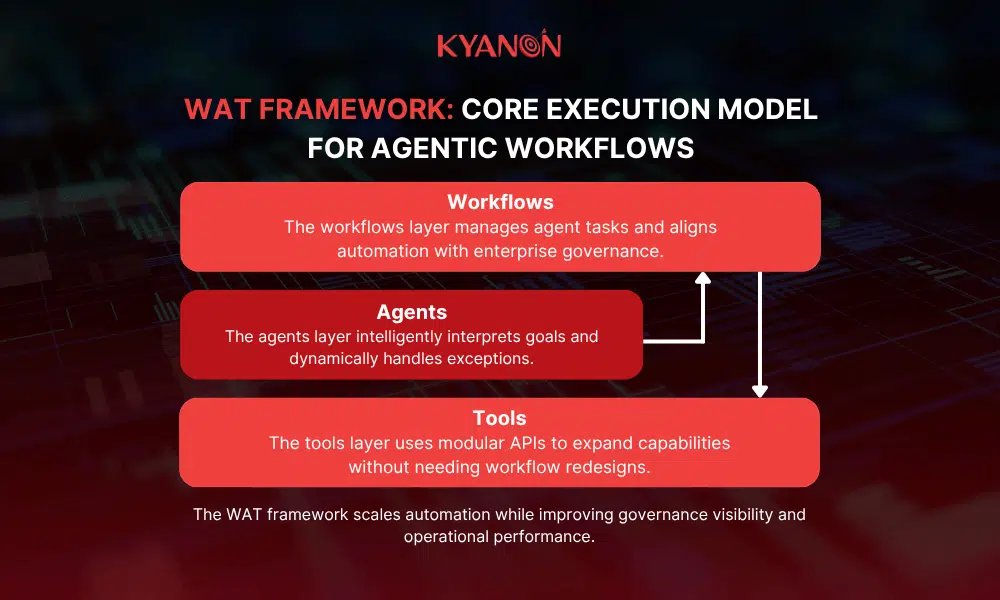
Most enterprise-scale agentic workflow deployments rely on the Workflows, Agents, Tools framework, a layered architecture that separates orchestration logic, decision intelligence, and execution connectivity. This structure allows organizations to scale automation safely across existing enterprise systems while maintaining governance visibility.
According to The Guardian Business Briefings, agentic architectures are shifting automation from task scripting toward decision infrastructure embedded across operational environments. For enterprise technology leaders, understanding how responsibilities are distributed across WAT layers helps identify where scalability, compliance readiness, and automation ROI improvements originate.
Workflows layer: Orchestration and governance across enterprise processes
The workflows layer defines execution sequences, trigger conditions, and approval checkpoints across automation pipelines. It coordinates how agents activate, collaborate, and resolve tasks across systems while ensuring governance, observability, and policy alignment.
Platforms such as Orkes Conductor, CrewAI, and emerging interoperability protocols support structured orchestration across distributed enterprise environments. According to Deloitte, effective agent orchestration enables multiagent systems to interpret requests, design workflows, delegate tasks, and continuously validate outcomes, unlocking end-to-end intelligent automation without requiring a full replacement of existing enterprise infrastructure.
For enterprise leaders, the workflows layer is where agentic AI moves from experimentation to operational scale. The priority is not adding more automation, but structuring how automation executes, how decisions are governed, and how outcomes are measured across systems. The following table highlights how specific orchestration capabilities translate into measurable business impact.
Business impact of the workflows layer
Capability | Enterprise value |
| Trigger-based orchestration | Real-time delegation reduces coordination latency and cuts event-driven process cycles by 30-60% through autonomous agent interpretation and execution. (Deloitte) |
Approval checkpoints | Improves reliability and decisions; multiagent systems thrive with human oversight, particularly in regulated sectors where full autonomy is impractical. |
| Sandbox execution | Minimizes rollout risk and deployment failures. Pre-production validation is critical as over 40% of agentic AI projects risk cancellation by 2027 due to cost, complexity, and governance gaps. (Gartner) |
Cross-system coordination | Achieves measurable gains, including ~34% MTTR reduction and ~94% task success in multi-agent IT operations benchmarks. (Deloitte) |
These capabilities position orchestration as a control layer for scaling automation safely, not just coordinating tasks. In practice, enterprises should start with high-volume, cross-system workflows where coordination overhead is highest, then introduce structured orchestration with clear approvals and testing before scaling.
Agents layer: decision intelligence that expands automation coverage
The agents layer enables automation systems to interpret goals, gather context, and dynamically adjust execution paths across workflows with variability, exceptions, and unstructured inputs. This represents a shift from predefined logic to adaptive, decision-driven execution.
AI agent adoption is surging, with Gartner forecasting that 80% of governments will automate routine decisions using them by 2028. This shift toward agent-based execution replaces rigid automation with adaptive models capable of reasoning and operating reliably within complex enterprise environments.
AI agent features like context interpretation and multi-agent coordination provide operational gains, such as faster cycle times and better accuracy. These benefits are most significant in decision-heavy enterprise tasks like service request routing and financial document analysis.
Tools layer: Secure execution across enterprise systems with compliance visibility
The tools layer connects agents to enterprise platforms such as ERP systems, CRM environments, analytics pipelines, and cloud APIs. Because tools remain modular, automation capabilities expand without redesigning workflow logic.
For enterprise decision-makers, the strategic takeaway is practical. The WAT framework enables agentic workflows to scale across existing technology environments while strengthening governance visibility and improving process execution performance across operations.
Enterprise Implementation Strategy
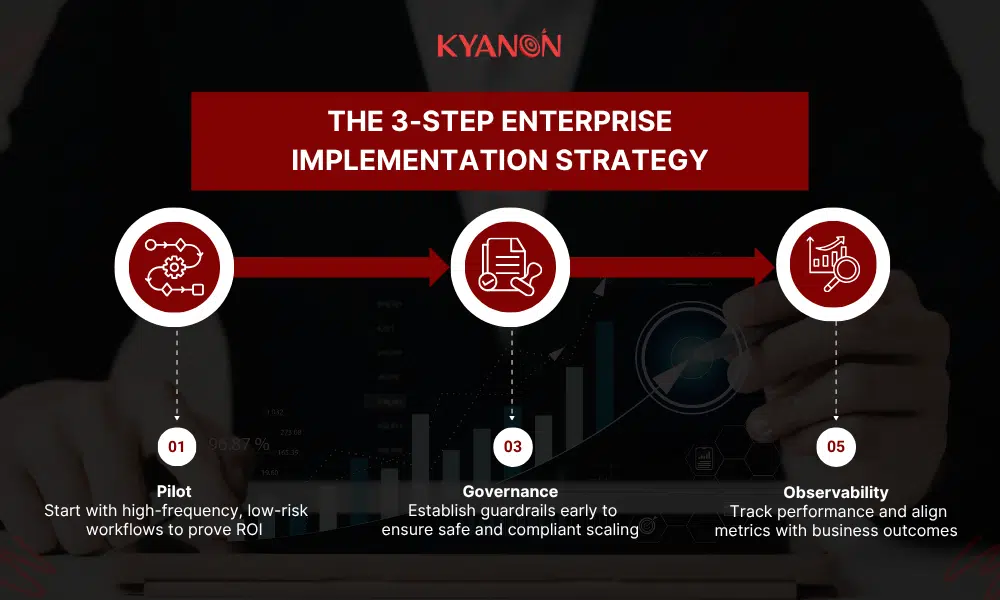
Scaling agentic workflows in enterprise environments requires a structured rollout approach aligned with governance, risk control, and measurable productivity outcomes. According to guidance from Gartner on operationalizing agentic AI adoption, organizations that begin with targeted pilots, enforce guardrails early, and connect automation to business performance metrics achieve stronger returns from intelligent workflow programs.
For enterprise technology leaders, the priority is not experimentation. The priority is building a repeatable deployment model that converts automation capability into measurable operational impact.
Step 1: Start with high-frequency, low-risk pilot workflows
Early implementations should focus on workflows that are frequent, exception-prone, and operationally visible to stakeholders. Pilot selection strongly influences whether agentic automation scales beyond proof-of-concept stages into production programs.
Typical starting points include invoice reconciliation, ticket triage, and RFP evaluation workflows. These processes contain structured logic but still require interpretation, making them strong candidates for agentic execution.
The table below highlights the characteristics that define strong pilot candidates and explains why these attributes accelerate enterprise adoption confidence.
Recommended pilot selection criteria
Pilot characteristic | Business impact rationale |
| High transaction volume | Faster demonstration of time savings |
Existing process bottlenecks | Immediate productivity improvement visibility |
| Limited regulatory exposure | Lower deployment risk |
Cross-team visibility | Stronger executive sponsorship |
Selecting a visible operational workflow enables leadership teams to establish baseline metrics such as processing time, backlog volume, and resolution speed. These indicators support early ROI validation and create momentum for expanding automation coverage across additional workflows.
Step 2: Establish governance guardrails before scaling automation
Enterprise agentic deployments need immediate, structured governance. Essential guardrails include staged environments, read-only defaults, and approval checkpoints for production write operations.
The table below summarizes the governance mechanisms most commonly used by enterprise teams to transition agentic workflows from pilot environments into production-ready infrastructure.
Embedding these controls early allows automation programs to expand confidently across business-critical workflows instead of remaining isolated experimentation initiatives.
Step 3: Integrate observability and performance metrics from day one
Agentic workflows require full transparency across decisions and execution. Observability allows leadership to confirm if automation effectively improves cycle times, reduces backlogs, or accelerates service delivery.
The table below outlines the observability layers that support measurable productivity validation across enterprise automation programs.
Enterprise observability priorities focus on embedding visibility across the execution lifecycle, including decision-level audit trails to support compliance readiness, tool-call monitoring to improve reliability visibility, and execution dashboards to enable continuous performance tracking. In parallel, aligning KPIs with business outcomes strengthens ROI justification and ensures that agentic workflow performance is directly tied to measurable enterprise value.
Strong observability signals allow agentic workflow programs to transition from experimentation into verifiable productivity infrastructure aligned with enterprise performance targets.
Building on this rollout foundation, Kyanon Digital supports enterprises through orchestration-layer design, governance integration, and production deployment of agentic workflows aligned with operational systems.
Explore more about the enterprise AI integration services.
Benefits, risks, mitigation, and ROI drivers of agentic workflows
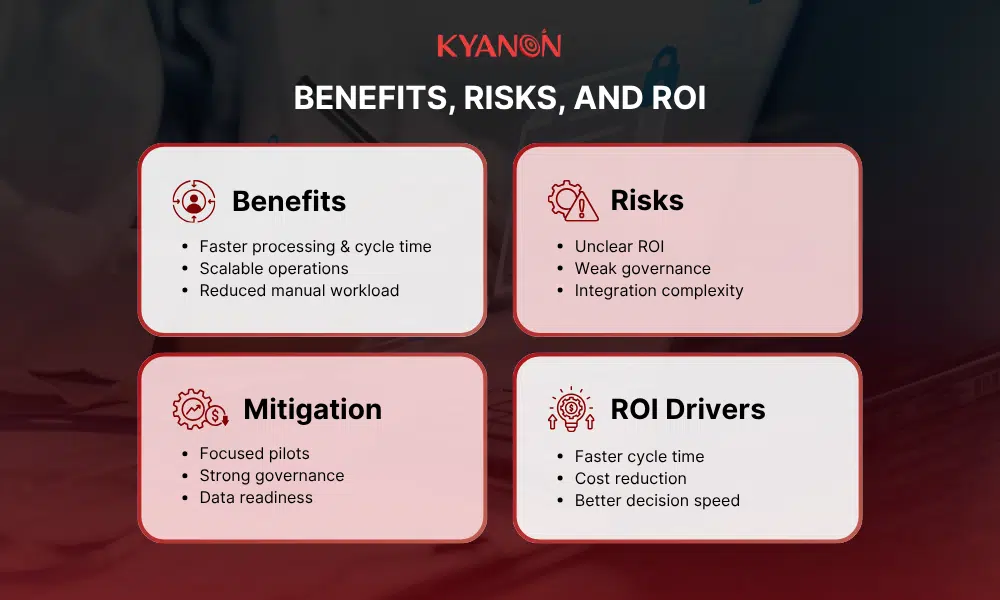
Agentic workflows can deliver measurable improvements in execution speed, scalability, and operational resilience. However, enterprise value depends on disciplined implementation strategy and clear alignment with productivity outcomes. According to Gartner, more than 40 percent of agentic AI projects are expected to be canceled by 2027 due to weak governance models, unclear ROI targets, or unrealistic deployment expectations.
Agentic workflow programs create strong operational leverage when implemented with measurable outcomes in mind. Without structured rollout discipline, they remain experimental investments.
Where agentic workflows create measurable business impact
Organizations adopting agentic workflow automation report improvements across cycle time, workforce utilization, and service responsiveness. According to implementation benchmarks summarized by FPA Trends and Neurons Lab, agentic execution models enable automation coverage to expand beyond structured workflows into decision-heavy operational pipelines.
The table below outlines where agentic workflows produce immediate enterprise productivity gains and how leadership teams can activate these opportunities through targeted deployment prioritization.
Enterprise productivity acceleration opportunities from agentic workflow adoption
Benefit | Enterprise impact | Recommended action |
| Significant processing speed increase | Shorter cycle time across operations | Prioritize high-delay workflows for early deployment |
Dynamic scalability | Handle peak workloads without increasing headcount | Shift investment toward flexible automation infrastructure |
| Self-correcting execution | Reduced downtime from input variability | Expand automation coverage into exception-heavy workflows |
Workforce capacity recovery | Routine workload reduction across teams | Reallocate staff toward strategic initiatives |
| New automation coverage | Enables document analysis and decision routing | Launch pilots in knowledge-intensive processes |
These improvements typically translate into faster service delivery timelines, stronger operational responsiveness, and improved utilization of existing enterprise platforms.
Why agentic AI projects fail and how enterprise teams reduce deployment risk
Agentic AI projects often fail due to vague success criteria, complex integration, and poor governance alignment. Addressing these predictable risks early in the implementation lifecycle ensures they remain manageable.
The table below summarizes predictable deployment risks and the mitigation strategies commonly used by successful enterprise rollout programs.
Common agentic workflow deployment risks and enterprise mitigation strategies
Risk driver | Business consequence | Mitigation strategy |
| Overly broad pilot scope | Delayed ROI realization | Start with high-frequency operational workflows |
Weak governance controls | Compliance exposure | Use a staged rollout with approval checkpoints to control execution and minimize risk. Core governance includes read-only defaults, sandboxed staging, mandatory human approval for write operations, and risk-validation checkpoints before production. |
| Legacy integration complexity | Extended deployment timelines | Use orchestration-layer architecture |
Low-quality data environments | Reduced automation reliability | Prioritize structured data readiness before scaling |
Organizations that position agentic workflow adoption as part of platform modernization initiatives consistently achieve faster production readiness and stronger cross-functional adoption. Kyanon Digital supports enterprise rollout programs across orchestration-layer design, governance integration, and production deployment environments, reducing implementation uncertainty and accelerating time to measurable automation value.
How enterprise teams build a realistic ROI case for agentic workflows
Enterprise ROI from agentic workflows depends on aligning automation metrics with productivity indicators such as processing speed, service quality, operating cost efficiency, and scalability readiness. According to Gartner, successful agentic AI programs measure both direct savings and decision-speed improvements across operational pipelines.
Initial deployments demonstrate that agentic workflows drive ROI by accelerating cycles, reducing manual labor, and providing real-time visibility. These scalable systems improve responsiveness and lower overhead, allowing enterprises to efficiently expand automation across departments while increasing operational agility.
Across finance, logistics, and service operations environments, organizations frequently observe that targeted agentic workflow pilots reach break-even within the first deployment cycle when aligned with clearly defined productivity metrics and governance-ready rollout strategies. For enterprise leaders, ROI relies on disciplined pilot selection, governance, and production visibility rather than just model capability.
Industry Use Cases
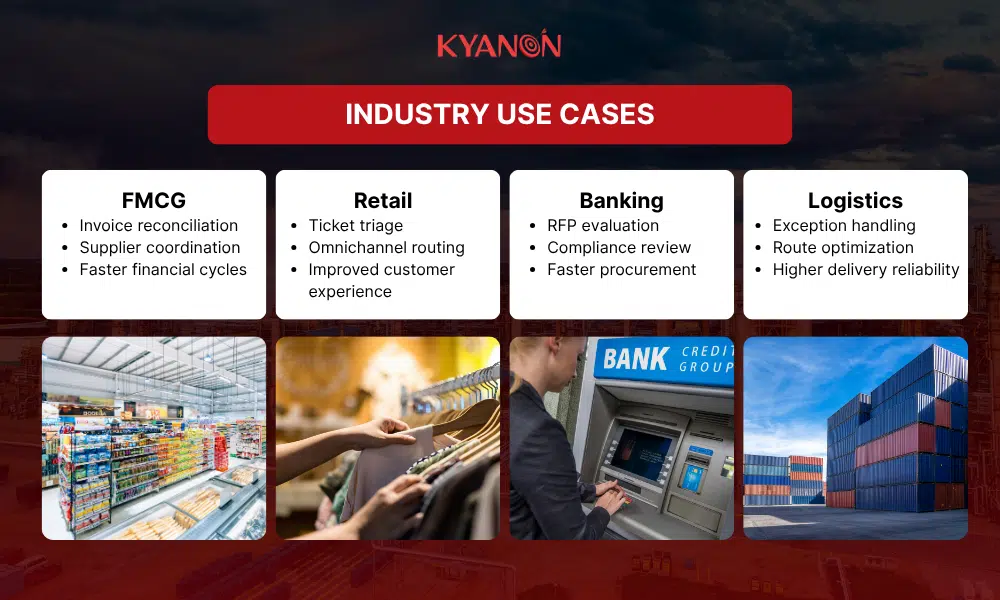
Agentic workflows are transitioning to operational use across Singapore, Malaysia, and ANZ in complex, high-volume sectors. Deloitte predicts rapid adoption in Singapore over the next two years as enterprises automate supply chain, compliance, and service operations at scale.
The table below summarizes common agentic workflow use cases across priority sectors in Singapore, Malaysia, and ANZ enterprise environments.
High-impact agentic workflow entry points across priority industries in Singapore, Malaysia, and ANZ
Industry | Example workflow | Business impact |
| FMCG | Invoice reconciliation and supplier coordination | Faster closing cycles and improved working capital visibility |
| Retail | Customer ticket triage and omnichannel routing | Shorter response times and stronger customer experience |
Banking | RFP evaluation and compliance documentation review | Accelerated procurement and improved audit readiness |
| Logistics | Shipment exception handling and routing optimization | Higher delivery reliability and reduced disruption risk |
Gartner predicts that by 2029, agentic systems will autonomously resolve 80% of common customer service issues, establishing them as essential automation infrastructure. For leaders in Singapore, Malaysia, and ANZ, high-volume tasks like invoice reconciliation, ticket triage, and RFP evaluation offer the fastest measurable impact for initial deployment.
Why do enterprise leaders work with Kyanon Digital?
Kyanon Digital designs and deploys agentic workflow systems for enterprise clients across Singapore, Malaysia, and ANZ combining WAT architecture design, AI agent development, and governance integration within a single delivery team. With a team of over 500 experts and a presence across Vietnam, Singapore, Thailand, Australia, and Malaysia, the company delivers consistent engineering quality across complex digital initiatives.
Kyanon Digital partners with fast-growing startups, regional enterprises, and Fortune 500 companies to design, build, and scale digital systems that enable sustainable performance and measurable business outcomes.
Our agentic workflow capabilities include:
- Agentic workflow readiness assessment across processes, data, and infrastructure.
- Workflow architecture design with seamless integration across existing enterprise systems.
- Decision-centric automation combining AI agents, human oversight, and governance controls.
- Scalable data and orchestration foundations supporting cross-functional automation at scale.
The following case study illustrates how this approach translates into real-world enterprise impact.
Case Study: How Kyanon Digital enabled AI-driven automation for a leading retail enterprise
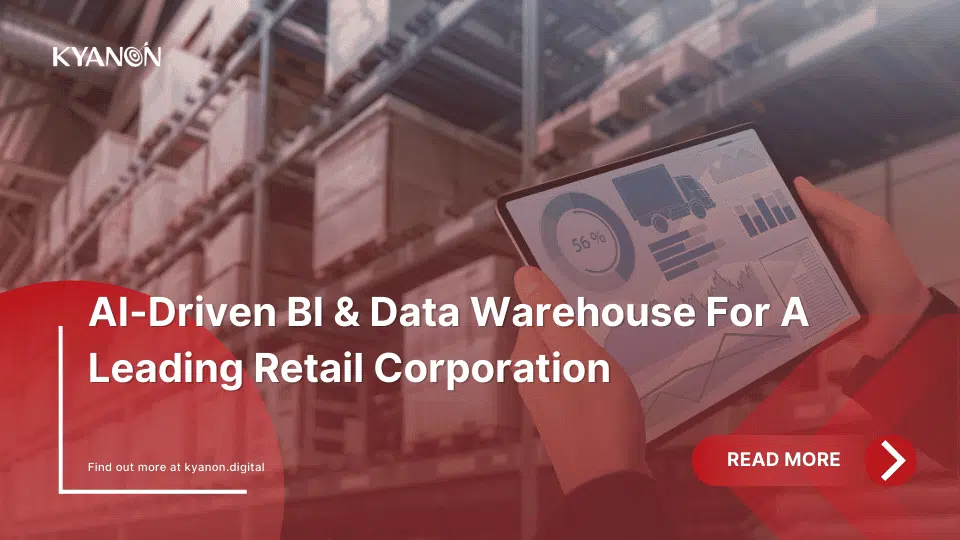
Kyanon Digital implemented an AI-driven data orchestration platform for a large retail enterprise to replace fragmented reporting pipelines across CRM, ERP, and spreadsheet environments. The initiative focused on establishing an execution-ready data foundation that supports real-time visibility, faster decision cycles, and scalable agentic workflow adoption across business units.
The enterprise required a transition from manual reporting dependencies toward centralized operational intelligence capable of supporting automation at scale.
Challenges:
- Fragmented enterprise data across CRM, ERP, and spreadsheet-based reporting layers
- Delayed decision cycles caused by manual consolidation workflows
- Limited cross-functional visibility for operations and planning teams
- No scalable infrastructure supporting agentic workflow expansion
Solution:
- Implemented a centralized enterprise data warehouse as a unified operational data layer
- Automated reporting pipelines replacing manual consolidation workflows
- Deployed real-time executive dashboards supporting continuous monitoring
- Established an AI-ready workflow architecture supporting forecasting and anomaly detection modules
Business impact:
- Real-time operational visibility across business units improving coordination speed
- Shorter planning and reporting cycles supporting faster execution decisions
- Reduced dependency on manual reporting resources across operations teams
- Scalable automation foundation supporting future agentic workflow rollout
Business value for enterprise technology and operations leaders:
This implementation demonstrates how centralized data orchestration creates the infrastructure layer required for agentic workflow development in enterprise software environments. Transitioning from fragmented reporting pipelines to governed analytics execution platforms improves decision velocity, strengthens operational alignment, and enables scalable automation across retail operations.
Read more: AI-Driven BI & Data Warehouse For A Leading Retail Corporation
Conclusion: Choosing the right partner for agentic workflow implementation
Agentic workflows surpass traditional RPA by managing complex decisions rather than just fixed tasks. This enables enterprises to handle variability with greater speed and adaptability.
Practical implementation requires outcome-focused goals and robust governance. Organizations should begin with specific use cases, evaluating impact before scaling based on proven value.
Kyanon Digital has implemented agentic workflow systems for retail, logistics, and financial services enterprises across Singapore and ANZ, from orchestration-layer design to governance integration and production deployment. If you are evaluating how agentic AI applies to your operations, begin with a workflow readiness assessment: we map your highest-leverage automation entry points and give you a phased deployment plan before any build commitment. Contact Kyanon Digital.







 Create project brief with AI