

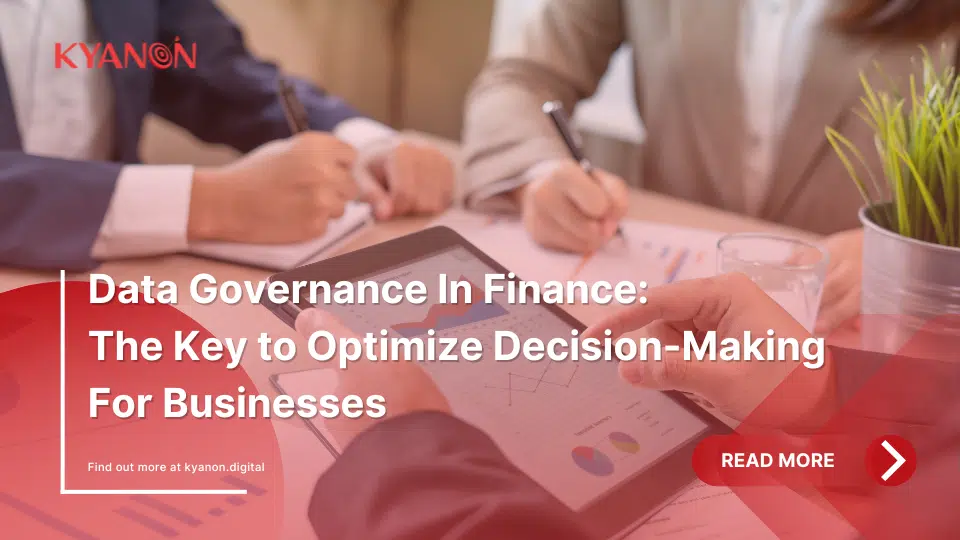
Data governance in finance is the formal system of policies, roles, controls, and technologies that manages how financial data is created, stored, accessed, and used across an organization. Far from a mere compliance checkbox, it acts as the bedrock for reliable business intelligence and strategic optimization.
Key takeaways
- Reveals that establishing single-source financial data accelerates executive decision-making, a standard field observation that only holds true if cross-departmental stakeholders finalize core metric definitions beforehand.
- Warns against deploying automated governance tools without established data protocols, an oversight the Kyanon Digital team notes will amplify errors unless legacy pipelines are thoroughly audited first.
- Clarifies that robust compliance frameworks directly secure customer trust, an outcome proven in practice only when organizations enforce strict access controls rather than default data sharing.
- Explains how systematic data categorization practically optimizes investment decisions, a strategic advantage that remains out of reach if entrenched departmental silos continue to isolate financial records.
Further reading:
- 5 Data Governance Examples for Smarter Business Moves
- 5 Key Data Governance Metrics for Business Success
- Master Data Governance: Turning Clicks into Cash
What does Data Governance mean in the financial sector?
Data Governance in finance (financial data management) is a framework and process established to ensure financial data’s quality, accuracy, and security throughout its lifecycle. Critical components of Data Governance include data ownership, quality management, regulatory compliance, and risk management. The main goal is to ensure that financial data is reliable, secure, and compliant with internal and external regulations.

Benefits of Data Governance in finance
Improving data quality
In financial institutions, data often comes from various sources, including customer transactions, internal management systems, and external sources like market information. Data Governance ensures that this vast amount of data remains accurate, consistent, and integral, creating a solid foundation for important decisions.
Compliance with legal regulations
The financial sector must comply with numerous stringent regulations regarding security and privacy, such as GDPR, Basel III, anti-money laundering regulations, or requirements from governmental regulatory agencies. Implementing Data Governance helps businesses manage data properly, protect personal information, and avoid legal violations.

Enhancing analytics and forecasting capabilities
With a solid data foundation, financial institutions can deploy more effective analytics and forecasting tools, helping to predict market trends and customer demands and optimize investment portfolios.
Optimizing operational efficiency
Data is managed systematically through the standardization of data collection and storage methods, making internal processes smoother thereby saving time and resources. Activities such as financial reporting, profit analysis, or risk management are carried out more quickly and accurately.
Making wiser decisions
When data is managed systematically, every collection, processing, and storage process is clear about the data’s origin, validity, and consistency. This means that when managers or financial analysts review the data to make decisions, they can fully rely on accurate, undistorted, or incorrect figures.
Process of implementing Data Governance in finance
Implementing financial data management is necessary to ensure data accuracy and security within financial organizations. To build a strong Data Governance framework, the following basic steps should be taken:
– Defining objectives: The organization needs to clearly define the objectives of data governance, including data quality, regulatory compliance, and risk management.
– Assigning responsibilities: Next, determine who is responsible for each data type, such as Data Managers, Data Owners, and the Data Governance Board. Clear assignments will help ensure data is managed consistently and responsibly.
– Establishing policies and procedures: Data management policies and procedures must be developed and widely disseminated within the organization so that all employees are aware.

– Utilizing data management technology: Businesses should use appropriate tools for financial data governance, including data management platforms, analytics, and reporting systems to ensure transparency and data traceability.
– Training personnel: Training programs can be organized for the finance department and related departments to ensure that employees fully understand data governance principles and create a data-conscious culture.
– Continuous monitoring and improvement: Establish monitoring mechanisms to track the effectiveness of data governance processes and improve them based on feedback and changes in the business environment.
How do enterprises operationalize financial analytics and ensure governance and data security?
Enterprises operationalize financial analytics while maintaining strict governance and security by shifting away from fragmented, spreadsheet-heavy practices and adopting a centralized, automated Modern Data Stack (MDS) architecture
Data Architecture & Analytics
- Centralization: Consolidating siloed ERP, CRM, and banking data into a unified cloud data warehouse (e.g., Snowflake, BigQuery).
- Versioned Transformations: Shifting calculations out of local Excel files and into code-driven modeling tools (e.g., dbt) managed via Git.
- Orchestration: Using automated pipelines (e.g., Airflow) to handle data ingestion, transformation, and dashboard updates continuously.
Data Governance
- Automated Lineage: Mapping data paths from source transactions to final executive dashboards using catalogs (e.g., Collibra).
- Quality Guardrails: Deploying automated testing frameworks (e.g., Monte Carlo) to flag duplicate ledger balances or anomalous inputs instantly.
- Semantic Standardization: Hardcoding business definitions (e.g., “Net Revenue”) into a centralized layer so all BI tools pull identical logic.
Data Security
- Granular Access Control: Implementing Role-Based Access Control (RBAC) to ensure employees only view data required for their specific function.
- Dynamic Masking: Automatically obscuring PII, bank routing details, and payroll data at the query level for general business analysts.
- Immutable Auditing: Logging all platform queries and data exports to instantly track and flag unauthorized data access or movement.
Case study: Building a Scalable Data Standardization & BI Framework for a Leading Forestry & Wood Products company
Building a Scalable Data Standardization & BI Framework for a Leading Forestry & Wood Products company
- Challenge: Fragmented data sources, inconsistent data standards, manual Excel workflows, and lack of data governance.
- Solution: Unified data model, standardized data definitions, ETL pipelines, centralized data repository, and Power BI dashboards.
- Impact: Improved data accuracy, consistency, reporting efficiency, and scalability.
Explore the full case study here: Building a Scalable Data Standardization & BI Framework for a Leading Forestry & Wood Products company
Conclusion
Data Governance plays a key role in ensuring the quality and accuracy of financial data, thus optimizing critical decisions. By implementing effective data management and protection processes, businesses enhance transparency and legal compliance, discover opportunities, and reduce risks. This is a solid foundation for the financial sector to grow sustainably in a highly competitive market.
Kyanon Digital offers suitable solutions to help businesses ensure accuracy, security, and regulatory compliance, making financial data governance easier. With our experience and expertise, Kyanon Digital supports businesses in optimizing data management processes effectively and sustainably.
Contact Kyanon Digital for consultation on financial data governance from leading experts in the field.







 Create project brief with AI