


Choosing enterprise data analytics solutions in Singapore requires evaluating business objectives, data integration, governance, scalability, and total cost of ownership. Enterprises should compare packaged BI tools, cloud data platforms, and custom analytics solutions based on existing infrastructure, PDPA obligations, and implementation readiness. The right choice depends on which business decisions the solution must improve.
For Singapore enterprises, choosing a data analytics solution goes beyond advanced dashboards or AI features. The real challenge is connecting fragmented ERP, CRM, financial, and operational data to support reliable, actionable business decisions.
As an enterprise digital transformation and AI partner, Kyanon Digital helps businesses address these challenges through data engineering, integration, business intelligence, and advanced analytics. This guide explains how to evaluate enterprise data analytics solutions in Singapore, from selecting the right architecture and ensuring regulatory compliance to comparing implementation costs and choosing a suitable technology partner.
Key takeaways
- Start with business outcomes: Define the KPIs and decisions analytics must improve before comparing platforms.
- Match solutions to data maturity: Improve data quality and integration before investing in advanced AI capabilities.
- Validate compliance: Evaluate PDPA obligations, industry-specific security requirements, and cross-border data risks.
- Compare three-year TCO: Include licensing, integration, cloud infrastructure, and ongoing support.
- Choose implementation expertise: Kyanon Digital is relevant when enterprises need integrated data engineering, BI, and AI capabilities.
Further reading:
- Exploratory Data Analytics: From Raw Data to Business Insights
- The Data Platform Should Follow the Flow of Decisions
- How Do You Bridge Data and AI Consulting with Execution?
- How Should Singapore Enterprises Assess AI Delivery Capacity?
How to choose an enterprise data analytics solution in Singapore?
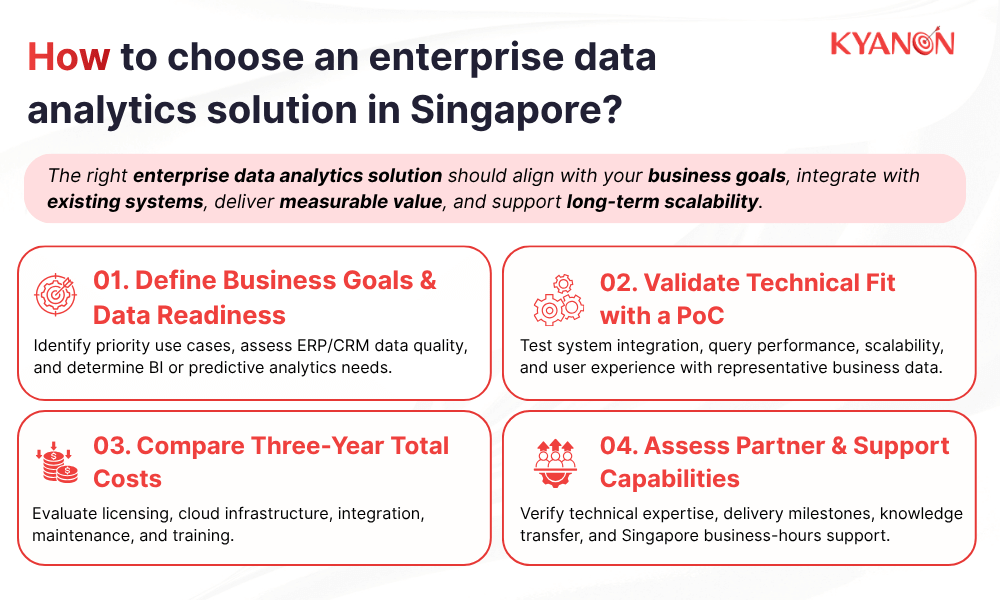
The right solution depends on your business requirements, existing systems, and ability to turn analytical insights into operational decisions.
Assess business objectives and data integration requirements
Start by identifying the business decisions your analytics solution must support and whether your current data infrastructure can provide reliable information.
- Define priority use cases: Identify whether the business needs financial reporting, customer behavior analytics, demand forecasting, or real-time operational monitoring.
- Audit existing data sources: Map information across ERP, CRM, POS, eCommerce, cloud applications, and legacy databases to identify integration gaps.
- Determine analytics capabilities: Decide whether standard BI dashboards are sufficient or whether predictive analytics, machine learning, and unstructured data processing are necessary.
- Evaluate user requirements: Distinguish between executive dashboards, self-service reporting for business teams, and advanced analytics environments for data specialists.
Decision consideration: If data quality and integration are the primary constraints, prioritize strengthening the data foundation before investing in advanced analytics capabilities.
Evaluate technical compatibility through a proof of concept (PoC)
Before committing to enterprise-wide deployment, test shortlisted solutions using a controlled dataset representative of your actual business environment.
A proof of concept (PoC) should verify:
- Integration: Connectivity with existing ERP, CRM, and cloud systems.
- Performance: Query response times, data processing reliability, and scalability.
- Usability: Ability of non-technical users to create and interpret reports.
- AI readiness: Access to governed data for predictive models when required.
Define measurable acceptance criteria before testing. A vendor demonstration alone cannot establish whether a solution will work within your enterprise architecture.
Compare three-year costs and implementation requirements
Evaluate software subscriptions, cloud consumption, integration, maintenance, and user adoption over three years. A solution with lower licensing costs may require greater investment in custom connectors, data engineering, or operational support.
Assess implementation and long-term support
Confirm that your implementation partner can provide relevant technical expertise, realistic delivery milestones, knowledge transfer, and post-launch support.
For Singapore enterprises, clarify delivery responsibilities, support coverage during Singapore business hours, and access arrangements for regional engineering teams.
For organizations facing complex data integration, reporting inconsistencies, or expanding AI requirements, Kyanon Digital supports enterprise data engineering, business intelligence, and analytics initiatives. Its capabilities can help businesses evaluate data readiness, connect existing enterprise systems, and establish the technical foundation needed for scalable analytics.

How can Singapore enterprises ensure data compliance and security?
Singapore enterprises can ensure data compliance and security by implementing PDPA-aligned data governance, enterprise security controls, and industry-specific risk management practices. For enterprise data analytics solutions, these requirements must extend across data collection, storage, processing, access, and third-party integrations.
The goal is to protect sensitive information while ensuring data remains accessible, reliable, and usable for business intelligence and advanced analytics.
Establish PDPA-aligned data governance
Singapore’s Personal Data Protection Act (PDPA) establishes obligations for organizations collecting, using, disclosing, and protecting personal data.
Enterprises should establish the following governance practices:
- Appoint a Data Protection Officer (DPO): Designate at least one DPO and make their business contact information publicly available, as required under the PDPA.
- Maintain a data inventory: Document personal data sources, processing purposes, access permissions, retention periods, and third-party data flows.
- Manage consent and retention: Establish appropriate grounds for processing personal data and cease retaining it when no longer required for legal or business purposes.
- Implement breach response procedures: Prepare processes to identify, assess, contain, and report notifiable data breaches.
Under Singapore’s PDPA, breaches involving 500 or more individuals, or those likely to result in significant harm, generally trigger notification to the Personal Data Protection Commission (PDPC). Once a breach is determined to be notifiable, organizations must notify the PDPC as soon as practicable and no later than three calendar days.
Implement enterprise data security controls
Data analytics platforms should protect sensitive information throughout the entire data lifecycle, including integration pipelines, cloud storage, analytics environments, and user access.
Key technical controls include:
- Identity and access management: Apply role-based access control (RBAC), multi-factor authentication (MFA), and least-privilege access.
- Encryption and data masking: Protect sensitive information in transit and at rest, and restrict personally identifiable information in analytical datasets.
- Auditability and monitoring: Maintain access logs, data lineage, and automated monitoring to detect unauthorized activity.
- Cloud security: Evaluate relevant certifications, such as ISO 27001 and Singapore’s Multi-Tier Cloud Security (MTCS) standard, against the actual services being deployed.
For enterprises handling customer and operational data across multiple systems, security controls should be evaluated at both the platform and integration levels.
Align with industry-specific security standards
In addition to PDPA obligations, enterprises should evaluate applicable regulatory frameworks and voluntary certifications based on their industry, operating model, and data sensitivity.
|
Standard / framework |
Enterprise relevance |
Key considerations |
|
SS 714:2025 – Data Protection Trustmark (DPTM) |
Singapore organizations seeking independent validation of data protection practices | Voluntary certification covering accountable governance, third-party management, and data protection practices |
| MAS Technology Risk Management (TRM) | Financial institutions regulated by MAS |
Technology risk governance, cybersecurity, system resilience, and applicable regulatory notices |
|
ISO 27001 |
Enterprises managing information security risks | Information security management, risk assessment, and security controls |
| ISO 42001 | Organizations implementing AI management systems |
AI governance, risk management, and responsible AI processes |
Singapore’s IMDA Data Protection Trustmark is now aligned with SS 714:2025, with annual surveillance audits incorporated into the certification framework.
For financial institutions, the Monetary Authority of Singapore publishes technology risk management guidelines and applicable notices that organizations must assess according to their regulated activities.
These frameworks serve different purposes. Certifications can demonstrate specific governance practices, but they do not automatically establish compliance with every applicable law or regulatory requirement.
For enterprises evaluating data analytics solutions, Kyanon Digital emphasizes data protection and governance as essential considerations in enterprise technology initiatives. Its Personal Data Protection Policy outlines principles for data processing, security safeguards, retention, and cross-border data transfers.
Enterprise takeaway: Before selecting a data analytics partner, map applicable industry regulations to specific security controls, verify the provider’s data governance practices, and establish clear responsibilities for compliance, access management, and ongoing monitoring.
Manage third-party and cross-border data risks
Enterprise analytics environments frequently integrate cloud platforms, external data processors, and regional business systems. These connections introduce additional responsibilities for managing data access and transfers.
Singapore enterprises should:
- Assess third-party providers: Review vendor security controls, certifications, subcontractors, and incident response capabilities.
- Establish contractual safeguards: Define data processing responsibilities, breach reporting obligations, audit rights, and data deletion requirements.
- Control cross-border transfers: Ensure overseas transfers of personal data meet the PDPA’s Transfer Limitation Obligation, including applicable requirements for comparable protection.
- Verify data residency requirements: Assess whether Singapore-based storage is required by internal policies, contracts, or applicable sector-specific obligations.
Importantly, Singapore’s PDPA does not universally require personal data to remain within Singapore. Cross-border transfers are permitted when the relevant legal requirements are satisfied.
For enterprise buyers, the practical priority is to select data and analytics solutions that support governance, traceability, secure integration, and regulatory accountability without unnecessarily restricting business access to trusted data.
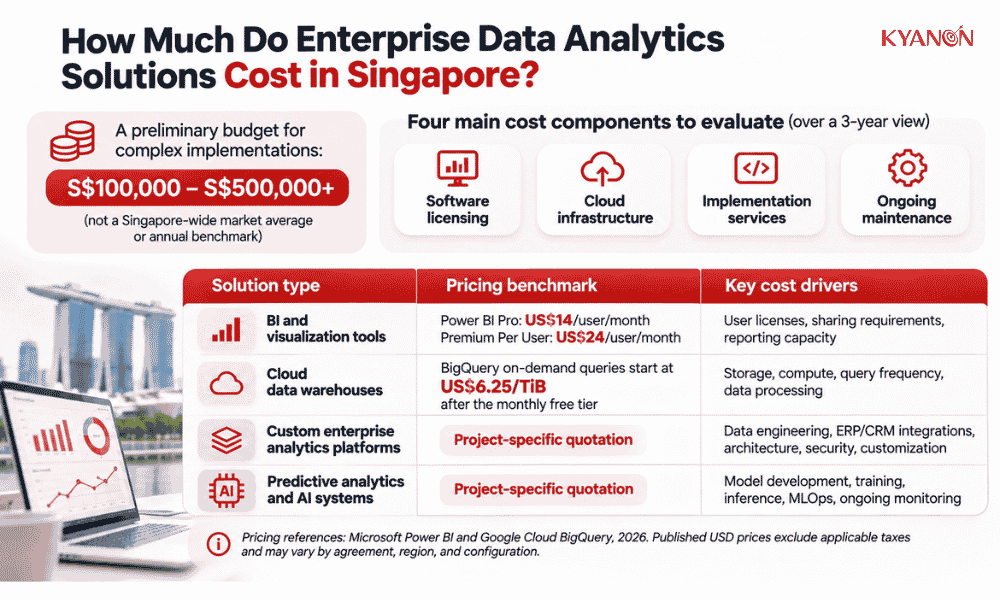
How much do enterprise data analytics solutions cost in Singapore?
What additional costs should enterprises budget for?
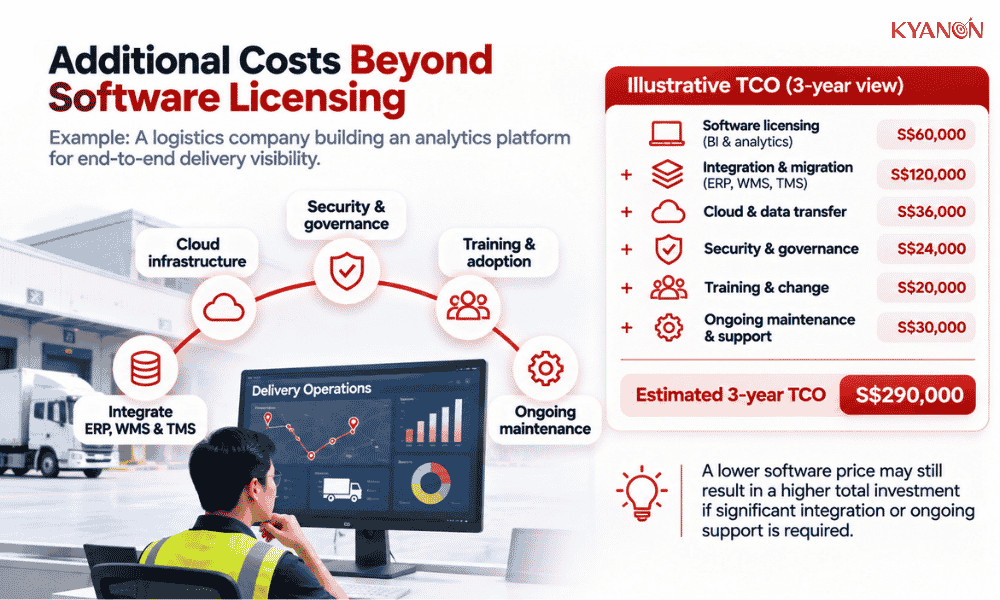
Beyond platform licensing, several expenses can substantially affect the total cost of ownership (TCO):
- Data integration and migration: Building connectors to legacy ERP, CRM, financial systems, and external databases.
- Cloud infrastructure and data transfer: Storage, processing, data egress, and cross-cloud integration charges.
- Security and governance: Access controls, monitoring, auditability, and data protection requirements.
- Training and change management: Enabling business teams to adopt dashboards, reporting tools, and analytical workflows.
- Ongoing maintenance: Pipeline monitoring, platform upgrades, technical support, and model retraining where applicable.
A lower software subscription price may not result in a lower total investment if the solution requires extensive customization or ongoing engineering support.
For enterprises dealing with fragmented data or complex legacy integrations, Kyanon Digital’s Data, Analytics & Business Intelligence services can support data architecture assessment, integration planning, and phased implementation to help define the required investment scope.
Can Singapore enterprises reduce costs through government grants?
Singapore businesses may qualify for government support through the EDGE Grant, introduced by Enterprise Singapore on 30 September 2026 to replace new applications under the former EDG, PSG, and MRA schemes.
According to Enterprise Singapore, eligible companies can access up to S$100,000 in total annual grant support across qualifying activities, subject to specific limits and eligibility requirements. The grant operates on a reimbursement basis.
Businesses should check whether their proposed analytics initiative falls within an eligible activity and review application requirements before committing expenditure.
Enterprise takeaway: Compare shortlisted solutions using a three-year TCO model covering licensing, infrastructure, implementation, maintenance, and internal resources. Request itemized vendor quotations and validate one priority analytics use case before approving a broader enterprise investment.
How do you choose the right data analytics solutions company in Singapore?
Choosing the right data analytics solutions company in Singapore requires evaluating enterprise implementation experience, technical compatibility, regulatory readiness, delivery capabilities, and long-term support. Beyond software expertise, the right partner should demonstrate how its approach will integrate existing systems, improve data reliability, and deliver measurable business outcomes.
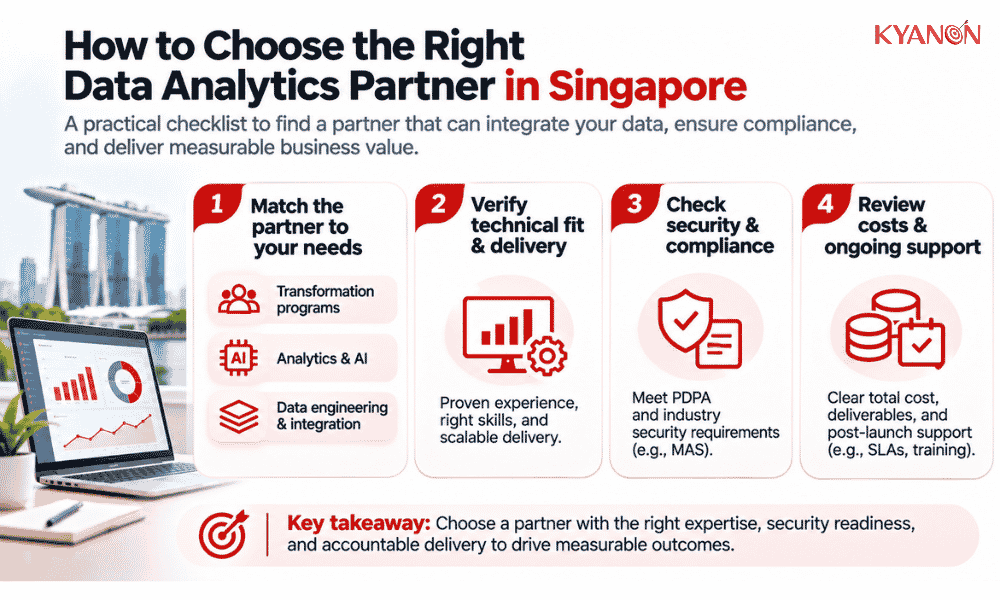
Match the partner’s expertise to your enterprise requirements
Not every data analytics company offers the same delivery capabilities. Enterprises should select a partner based on project complexity, industry requirements, and internal technical resources.
| Partner type | Best suited for |
Key consideration |
|
Enterprise transformation consultancies |
Large-scale, multi-country data transformation and governance programs | Broad advisory capabilities, but potentially complex engagement structures |
| Specialized analytics and AI firms | Predictive analytics, machine learning, and advanced data science initiatives |
Validate enterprise integration and operational support capabilities |
|
Regional data engineering and systems integration partners |
Data warehouse development, BI modernization, ERP/CRM integration, and scalable delivery |
Assess delivery capacity, architecture expertise, and long-term support |
For enterprises facing fragmented data across business functions, prioritize partners that can address data engineering, integration, governance, and analytics together, rather than focusing exclusively on dashboard development.
Verify technical expertise and delivery capabilities
Before selecting an implementation partner, evaluate whether the proposed team can work effectively within your enterprise technology environment.
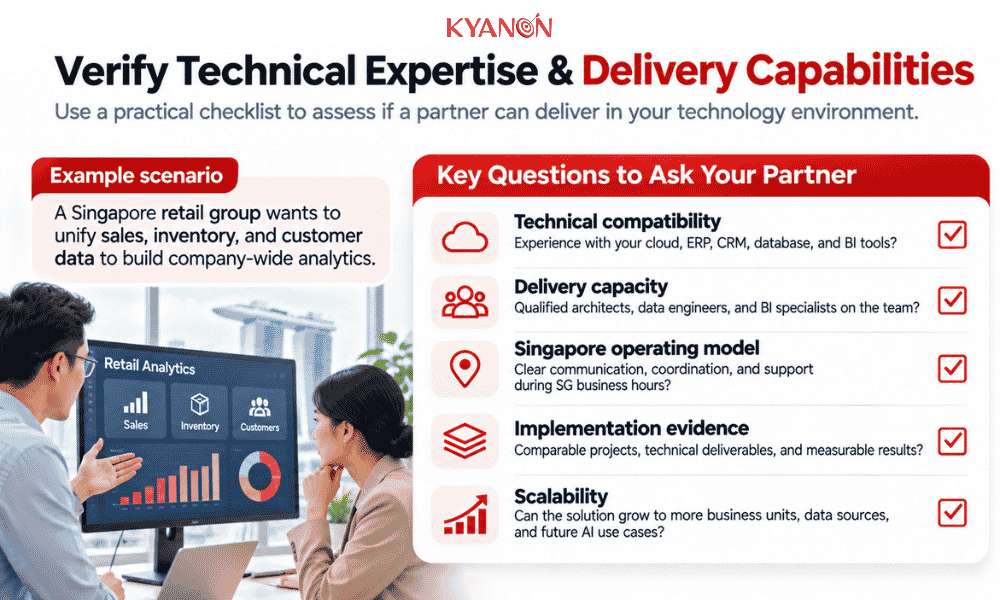
Key questions include:
- Technical compatibility: Does the team have demonstrated experience with your existing cloud, ERP, CRM, database, and BI technologies?
- Delivery capacity: Are qualified solution architects, data engineers, and BI specialists assigned to the engagement?
- Singapore operating model: Can the partner provide appropriate communication, delivery coordination, and support during Singapore business hours?
- Implementation evidence: Can the vendor demonstrate comparable integration projects, technical deliverables, and measurable outcomes?
- Scalability: Can the delivery model support additional business units, data sources, and future AI initiatives?
For Singapore organizations working with regional engineering teams, clarify delivery ownership, escalation procedures, and authorized data access locations before signing.
Assess data governance, security, and compliance readiness
Enterprise data analytics partners should demonstrate how their proposed architecture supports applicable Singapore data protection obligations and industry-specific security requirements.
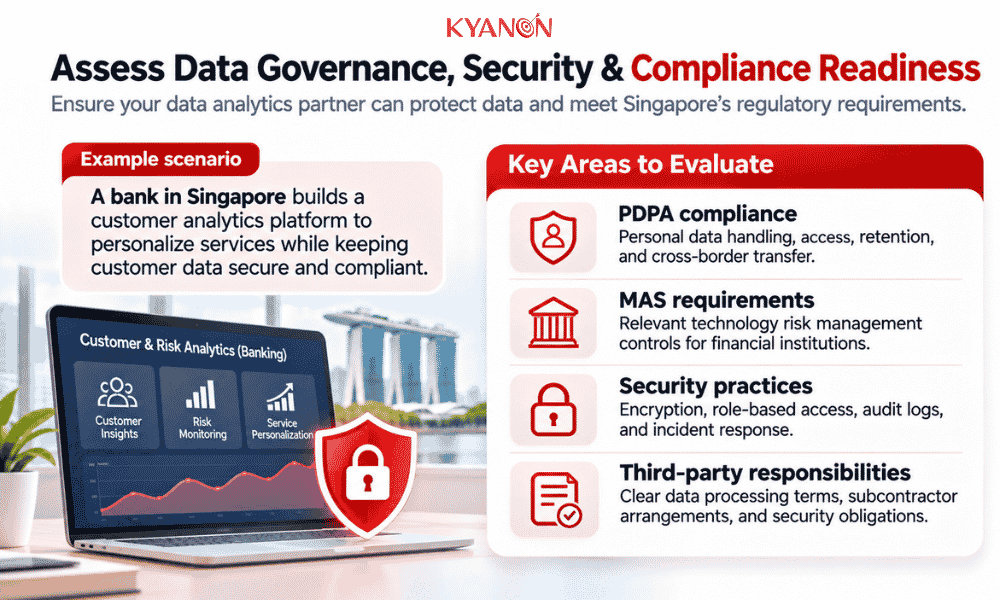
Evaluate their ability to address:
- PDPA requirements: Appropriate personal data handling, access management, retention, and cross-border transfer safeguards.
- Industry-specific controls: Relevant MAS technology risk management requirements for regulated financial institutions.
- Security practices: Encryption, role-based access control, audit logging, and incident response.
- Third-party responsibilities: Documented data processing terms, subcontractor arrangements, and security responsibilities.
Singapore’s PDPC guidance on data protection clauses provides a useful reference for defining contractual responsibilities when engaging external data processors.
Decision consideration: Require vendors to demonstrate relevant security controls and provide contractual evidence rather than relying solely on compliance statements or certifications.
Compare commercial transparency and long-term support
A suitable implementation partner should provide a clear delivery scope, transparent cost structure, and defined responsibilities after deployment.
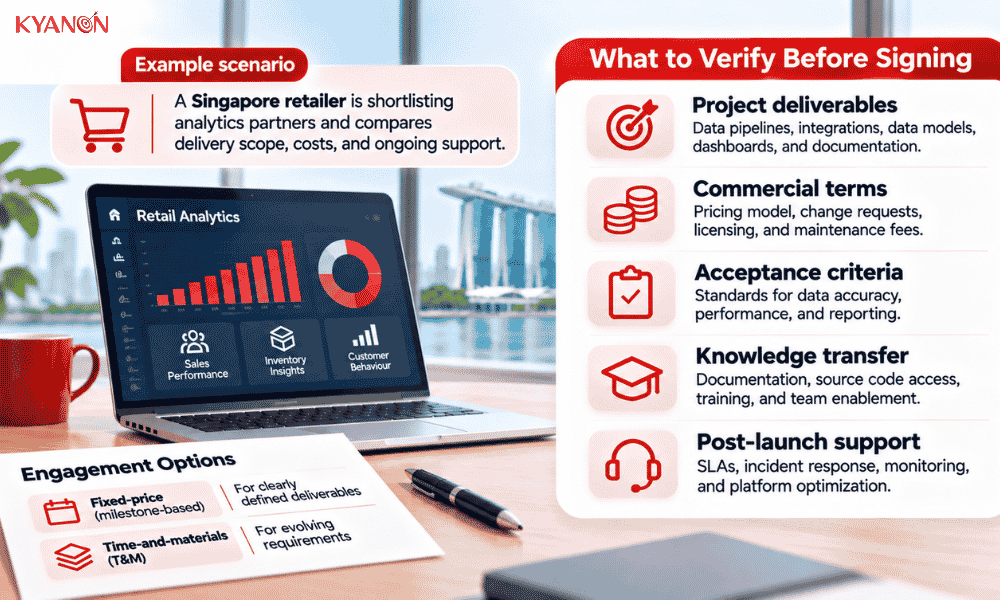
Before signing, verify:
- Project deliverables: Data pipelines, integrated systems, validated data models, dashboards, and technical documentation.
- Commercial terms: Fixed-price or time-and-materials arrangements, change requests, licensing, and maintenance fees.
- Acceptance criteria: Measurable standards for data accuracy, system performance, and reporting functionality.
- Knowledge transfer: Documentation, source code access, training, and internal team enablement.
- Post-launch support: Service-level agreements (SLAs), incident response, monitoring, and platform optimization.
For projects with evolving requirements, a time-and-materials engagement may provide flexibility. For clearly defined deliverables, milestone-based contracts can improve cost visibility and delivery accountability.
Why consider Kyanon Digital for enterprise data analytics?
Kyanon Digital is an enterprise digital transformation and AI partner supporting organizations across data engineering, integration, business intelligence, and advanced analytics. Its Data, Analytics & Business Intelligence services address enterprise challenges such as disconnected ERP and CRM systems, inconsistent reporting, fragmented customer information, and limited data readiness for AI.
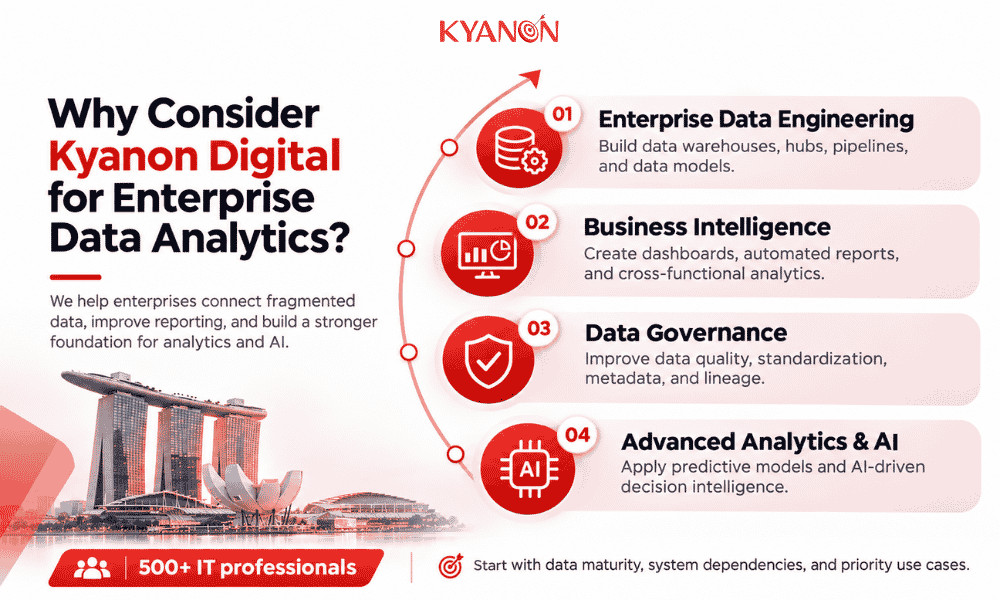
Kyanon Digital’s capabilities include:
- Enterprise data engineering: Data warehouses, data hubs, integration pipelines, and data modeling.
- Business intelligence: Automated reporting, executive dashboards, and cross-functional analytics.
- Data governance: Data quality management, standardization, metadata, and data lineage.
- Advanced analytics and AI: Predictive models, machine learning, and AI-driven decision intelligence.
With 500+ IT professionals and delivery capabilities spanning enterprise engineering, data, and AI, Kyanon Digital offers engagement models ranging from focused data enablement initiatives to end-to-end data and BI transformation.
For organizations uncertain whether to modernize existing reporting tools or invest in a new analytics platform, Kyanon Digital’s approach begins with assessing current data maturity, system dependencies, and priority business use cases.
Enterprise takeaway: Shortlist two or three analytics partners and evaluate them against the same business use case, technical requirements, security controls, and three-year ownership costs. Require a clearly scoped proof of concept, named delivery responsibilities, and measurable acceptance criteria before approving full-scale implementation.
How does Kyanon Digital build an enterprise BI & data warehouse solution for a leading retail corporation?
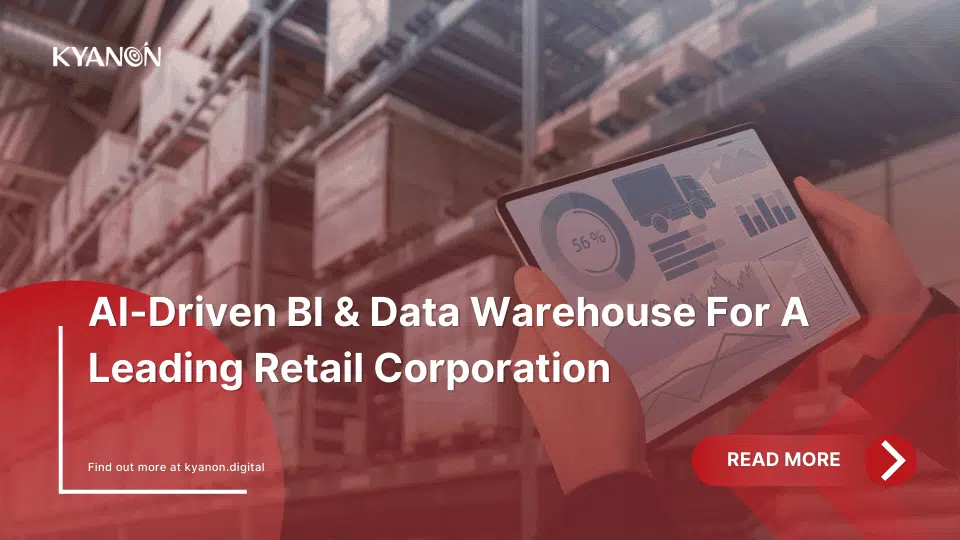
A leading Vietnamese retail corporation operating 193+ stores partnered with Kyanon Digital to modernize fragmented reporting processes and improve enterprise-wide data visibility.
Challenges
- Manual, inconsistent reporting across retail locations.
- Fragmented data without a centralized repository.
- Delayed operational insights for business leaders.
Solution from Kyanon Digital
- Built a centralized data warehouse with standardized reporting.
- Automated report submission and approval workflows.
- Integrated Microsoft Power BI for real-time performance dashboards.
Results and Impact
- Faster reporting and approval processes with fewer manual errors.
- Consistent data and improved reporting accuracy across stores.
- Real-time visibility into store and regional performance.
Enterprise takeaway: The case demonstrates why enterprise analytics investments should address data integration and reporting workflows before focusing on visualization alone. Singapore enterprises facing similar challenges can use these capabilities as criteria when evaluating analytics partners.
Explore the full Kyanon Digital case study.
Conclusion
Choosing an enterprise data analytics solution in Singapore is a long-term technology and business decision, not simply a software purchase.
The strongest approach is to start with a measurable business problem, verify data readiness, and validate technical fit before scaling investment. Expand only when the solution demonstrates reliable data and operational improvements against agreed KPIs.
Is your enterprise data ready for advanced analytics and AI? Connect with Kyanon Digital’s data and analytics specialists to assess your architecture, integration requirements, and opportunities to turn fragmented data into measurable business value.
References
- Personal Data Protection Act and Advisory Guidelines — Personal Data Protection Commission, Singapore.
- Data Protection Trustmark Certification — Infocomm Media Development Authority.
- Cyber Security: Regulations and Guidance — Monetary Authority of Singapore.
- Power BI Pricing — Microsoft.
- BigQuery Pricing — Google Cloud.
- Enterprise Singapore — Enterprise Singapore.



 Create project brief with AI