Evaluating whether your enterprise data architecture is ready for scalable AI requires assessing how your data is stored, governed, and streamed. Traditional data stacks built for historical reporting and BI dashboards often fail to support generative AI, machine learning, and autonomous agents. (Bain & Company)
Traditional enterprise data architectures struggle to scale AI because they were built for historical business intelligence (BI), batch reporting, and structured databases rather than the speed, scale, and multimodal complexity of modern AI workloads.
Key takeaways
- Warns against bolting new AI tools onto legacy data pipelines to avoid fragmented architecture, a bottleneck the Kyanon Digital team frequently sees stall production. This integration only succeeds when organizations first establish a unified semantic layer to give unstructured data proper business context.
- Debunks the myth that enterprises must completely replace legacy infrastructure for AI adoption, a proven reality across the field. An incremental approach works exceptionally well, provided older systems can securely exchange information via standardized APIs and automated pipelines.
- Clarifies why manual data governance fails for modern AI workloads, standing as a critical architectural baseline. To avoid severe compliance risks, automated privacy and access controls must be in place first before deploying agentic models across live enterprise streams.
- Shows that consolidating fragmented operational information into a centralized data hub eliminates reporting silos, a strategy Kyanon Digital’s experience validates in the logistics sector. However, this transition only scales effectively when the foundation is specifically designed for real-time data operations rather than historical batch reporting.
Further reading:
- How Real-Time Data Analytics Prevent Supply Chain Disruptions
- AI-Driven Retail Analytics: From Data to Decisions
- AI-Driven BI for FMCG & Retail Leaders in Singapore
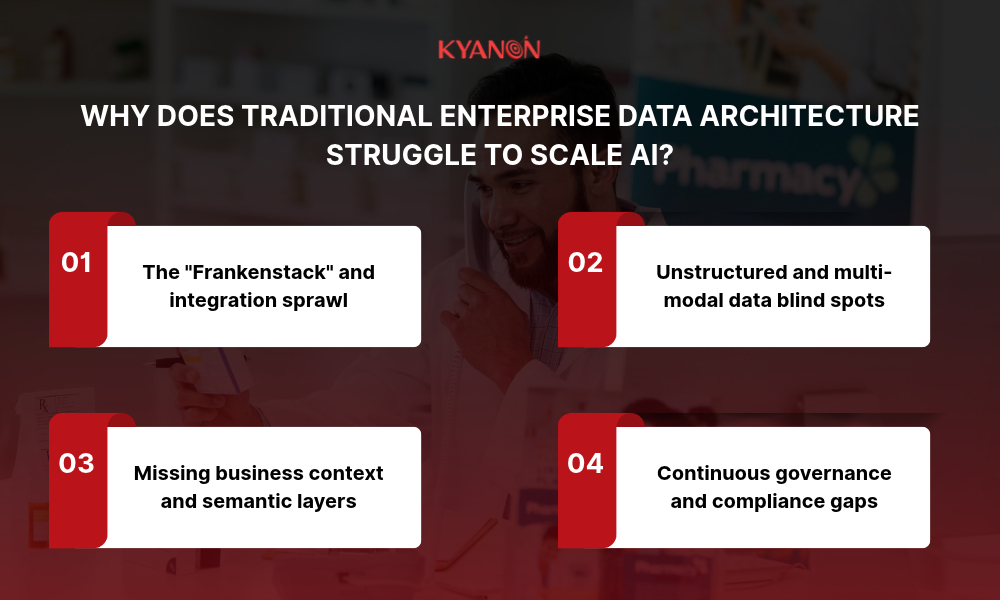
Why does traditional enterprise data architecture struggle to scale AI?
The primary reasons traditional architectures break down include:
The “Frankenstack” and integration sprawl
- Point-to-point silos: Organizations often rely on one-off scripts, legacy APIs, and disparate tools (such as separate pipelines for file transfers, APIs, and event handling) that accumulate massive technical debt.
- Disconnected tools: Instead of a unified platform, companies bolt on vector databases, embedding pipelines, and ad-hoc orchestration layers-creating a fragmented “Frankenstack” where context is rebuilt differently in every pipeline.
Unstructured and multi-modal data blind spots
- Legacy focus on structured data: Traditional data warehouses were designed for rows and columns. Generative AI heavily relies on unstructured data-audio, video, images, and long-form documents-which legacy systems never indexed, stored, or governed properly.
- Conflicting sources: Without centralized information retrieval, contact centers and enterprise AI agents pull conflicting answers or outdated data for the same prompt.
Missing business context and semantic layers
- Lack of semantic consistency: Technical accuracy (completeness and timeliness) is not enough for AI. AI models need a semantic layer-the proprietary definitions, business logic, and relationship mappings that give data meaning.
- Pilot vs. production gap: Many AI pilots succeed in a controlled sandbox using clean, offline, manually scrubbed data sets. Once pushed to production across live enterprise streams, these underlying data inconsistencies quickly surface and stall the project.
Continuous governance and compliance gaps
- Unenforced policies at scale: Traditional data governance was handled manually or post-hoc. AI-especially agentic AI and LLMs-requires real-time, automated context and continuous governance that legacy platforms cannot orchestrate.
- Privacy and authority risks: Traditional architecture often fails to answer basic enterprise questions: Which system holds the authority for this data? How is it allowed to be used? Who maintains it?

What does an enterprise data architecture need to scale AI?
To scale AI effectively, an enterprise data architecture must move beyond traditional single-purpose reporting and build an agile, trusted, and high-performance foundation. (Gartner)
Unified data platforms for connected enterprise information
A unified data platform connects information across business systems, reducing data silos and enabling consistent access to structured and unstructured data. Approaches such as data lakehouses can support both traditional analytics and modern AI workloads without requiring enterprises to replace every existing system.
Semantic layers and metadata management for trusted AI context
Semantic layers establish consistent business definitions, while metadata management provides context about data sources, ownership, relationships, and quality. These capabilities help AI applications interpret enterprise information accurately and generate more reliable insights.
Modern data integration and APIs for real-time AI operations
Modern integration architecture connects enterprise applications through standardized APIs, automated pipelines, and real-time data flows. This enables AI applications to access updated information and interact with operational systems more effectively.
Embedded data governance, security, and compliance
Data governance should be integrated into the architecture through access controls, data lineage, privacy protection, and audit mechanisms. Singapore enterprises should consider PDPA obligations and responsible AI practices when designing these controls.
For agentic AI, the IMDA Model AI Governance Framework provides guidance on four key areas: risk assessment, human accountability, technical controls, and end-user responsibility.
Open and composable architecture for long-term AI flexibility
An open and composable architecture allows enterprises to integrate different data platforms, AI models, and technologies without becoming dependent on a single vendor. Using open standards, modular components, and interoperable APIs helps businesses adapt to evolving AI requirements while minimizing technology lock-in.
According to Bain & Company, modern data platforms must evolve to support changing analytical and AI workloads.
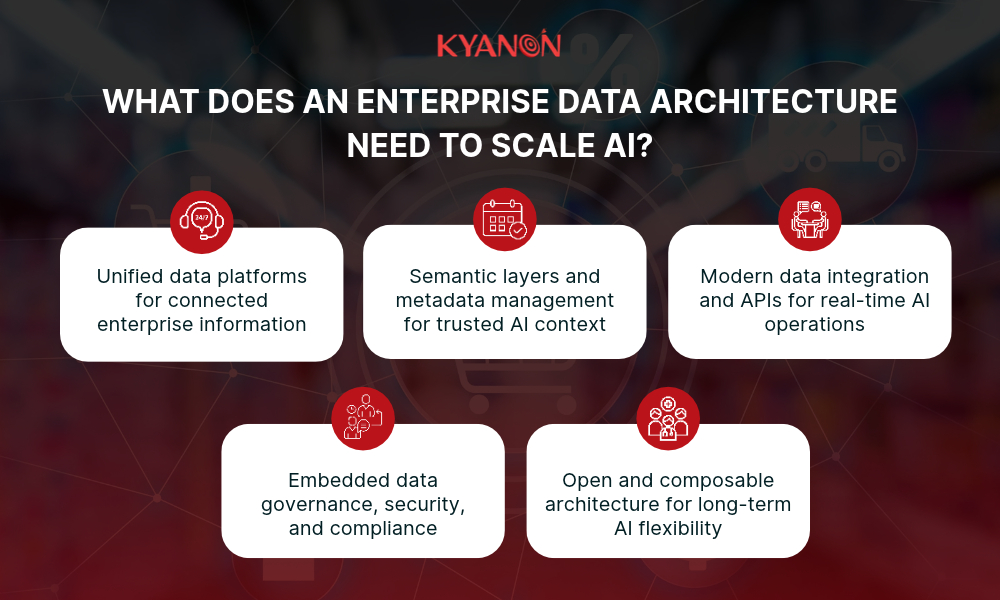
Ultimately, these five capabilities provide a foundation for scaling AI while maintaining data reliability, operational efficiency, and long-term architectural flexibility.
How can enterprise leaders assess their data architecture readiness for AI?
Enterprise leaders can assess their data architecture readiness for AI by evaluating core technical, semantic, and governance dimensions using structured diagnostic frameworks.
Five dimensions of enterprise data architecture readiness
|
Assessment dimension |
Questions business leaders should ask |
|
Data quality and accessibility |
Can AI applications access accurate, relevant, and sufficiently complete data across business systems? |
| Architecture and integration |
Can existing infrastructure support structured, unstructured, batch, and real-time data workloads? |
|
Data context and metadata |
Are business definitions, metadata, and data lineage sufficiently documented for AI systems to interpret information correctly? |
| Governance and security |
Can the organization control, monitor, and audit how AI applications access and use enterprise data? |
|
Operations and scalability |
Can the architecture support growing AI workloads without excessive latency, costs, or operational complexity? |
Once gaps are identified, enterprises should prioritize improvements based on business impact, technical dependencies, and investment requirements. Rather than replacing the entire infrastructure, organizations can adopt a phased modernization approach:
- Prioritize critical gaps: Address data quality, integration, and governance issues affecting priority AI use cases.
- Modernize incrementally: Strengthen existing platforms, pipelines, and APIs before introducing additional technologies.
- Measure business outcomes: Track improvements in data accessibility, processing time, AI performance, operational efficiency, and infrastructure costs.
A professional data architecture assessment partner like Kyanon Digital can help enterprises evaluate these dimensions, define modernization priorities, and develop a practical roadmap for moving from AI experimentation to scalable deployment.
How can Kyanon Digital help build an enterprise data architecture for scalable AI?
Scaling enterprise AI requires a data foundation that connects business systems, delivers trusted information, and supports secure AI implementation. As an enterprise digital transformation and AI engineering partner, Kyanon Digital helps organizations modernize data architecture, integrate enterprise applications, and turn data capabilities into practical AI solutions.
Case study: Building an AI-powered data hub for a leading port and logistics operator
Data Hub & BI Analytics for Vietnam’s Largest Port & Logistics Operator
The client, one of Vietnam’s largest port and logistics corporations, struggled with fragmented operational data, siloed customer information, and manual reporting processes. These limitations prevented leadership from accessing timely insights across its nationwide operations.
Kyanon Digital’s solution:
- Developed a scalable Data Hub to centralize operational information and enable real-time data sharing.
- Established a centralized data catalog to improve data consistency and management.
- Implemented AI-powered BI reporting to provide actionable operational insights.
Business impact:
- Improved data integration and reduced information silos.
- Reduced manual reporting effort and human errors.
- Increased leadership visibility through real-time BI dashboards.
- Established a scalable data foundation for future analytics and AI initiatives.
Read the full case study: Data Hub & BI Analytics for Vietnam’s Largest Port & Logistics Operator
Conclusion
A scalable AI strategy starts with a strong enterprise data architecture. By addressing data silos, modernizing infrastructure, strengthening governance, and improving integration, businesses can move beyond isolated AI pilots toward enterprise-wide adoption.
Is your current data architecture limiting your AI ambitions? Talk to Kyanon Digital to assess your data foundation and build a practical roadmap for scalable AI and measurable business outcomes.
References
- Rearchitecting the Data Platform for the AI Era – Bain & Company
- How to Architect Your Enterprise Data Stack for AI at Scale – Gartner
- Updated Model AI Governance Framework for Agentic AI – Infocomm Media Development Authority (IMDA)
- Data Protection Obligations under the PDPA – Personal Data Protection Commission (PDPC)
- AI-Ready Data Architecture – EY
- Strengthen Your Architecture Before Scaling AI – IBM
- Data Hub & BI Analytics for Vietnam’s Largest Port & Logistics Operator – Kyanon Digital



 Create project brief with AI