


Retail supply chain digitalization in Singapore helps retailers connect inventory, procurement, warehousing, fulfillment, and demand data to improve visibility, efficiency, and resilience. The right approach depends on business priorities, existing systems, and digital maturity.
For retail and eCommerce brands, the challenge is knowing where to start, whether with an integrated ERP, a warehouse management system (WMS), or AI-powered demand forecasting, while managing implementation costs and risks.
This guide explores key digital supply chain solutions, digital maturity assessment, available government support, and practical strategies to help Singapore retailers build more connected, efficient, and scalable operations.
How to assess your retail supply chain’s digital maturity
Technology adoption alone does not indicate digital maturity. Many organizations have implemented AI, cloud, and automation tools without fully embedding them into decision-making and daily operations. True maturity depends on how well technology, processes, and team capabilities work together to improve business outcomes, including forecast accuracy, inventory optimization, service levels, and supply chain agility.
Use the following matrix to identify your current maturity stage based on operational and technical capabilities.
Maturity stage | Business signals (Operations) | Technical signals (IT/Systems) |
| Manual/Fragmented | Inventory relies on spreadsheets or manual stocktakes, with frequent stockouts, overstocking, and reactive decisions. | POS, inventory, and accounting systems operate separately, with limited data sharing. |
Connected | Teams have near-real-time visibility into inventory and order status across channels. | Core systems such as ERP, WMS, and POS are integrated through APIs or middleware, creating a more unified data source. |
| Automated/Predictive | Demand forecasts inform purchasing and staffing decisions proactively. | AI/ML models support automated replenishment and inventory allocation. |
A deeper assessment should cover four areas: data and visibility across suppliers, inventory, and sales channels; process automation for routine tasks such as invoicing and order fulfillment; infrastructure connectivity between legacy and modern systems; and digital skills that enable teams to use operational data effectively.
To evaluate these areas, define the assessment scope, gather evidence from system data and operational metrics, and score each capability against a consistent scale. Use the results to identify gaps and prioritize improvements based on business impact and operational readiness.
Address foundational gaps before adopting advanced AI. Improve data quality and system connectivity first, then introduce further automation or AI-driven forecasting where the underlying processes and data are ready.
Which 3 digital solutions does every Singapore retail brand actually need?
Progressing through the maturity stages requires the right digital solutions to connect retail operations, streamline fulfillment, and improve decision-making and customer engagement.
Solution category | What it solves | Best for | Maturity stage unlocked |
| Omnichannel Retail ERP | Unifies inventory, orders, POS, and finance across online and offline channels. | Retailers managing multiple sales channels and store locations. | Manual/Fragmented → Connected |
Cloud-based Warehouse Management System (WMS) | Improves picking, packing, fulfillment, and stock visibility across warehouses and retail locations. | Retailers managing warehouses, multiple locations, or 3PL partners. | Connected → Automated |
| AI-enabled demand forecasting and smart engagement tools | Predicts demand, helps reduce overstock and stockouts, and supports personalized customer assistance and automated content creation. | Retailers with seasonal or SKU-heavy inventory and growing digital engagement needs. | Connected → Automated/Predictive |

How to implement each solution category – what it actually involves
Retail supply chain digitalization is most successful when implemented in phases rather than attempting a complete technology overhaul. Many Singapore retailers invest in advanced AI or automation tools only to discover that fragmented data and disconnected systems limit their effectiveness.
A more practical approach is to build a modern digital supply chain layer by layer. Start by creating a single source of truth for inventory and orders, then optimize warehouse execution, and finally leverage data for predictive decision-making. Each stage builds on the previous one, reducing implementation risk while delivering measurable business outcomes.
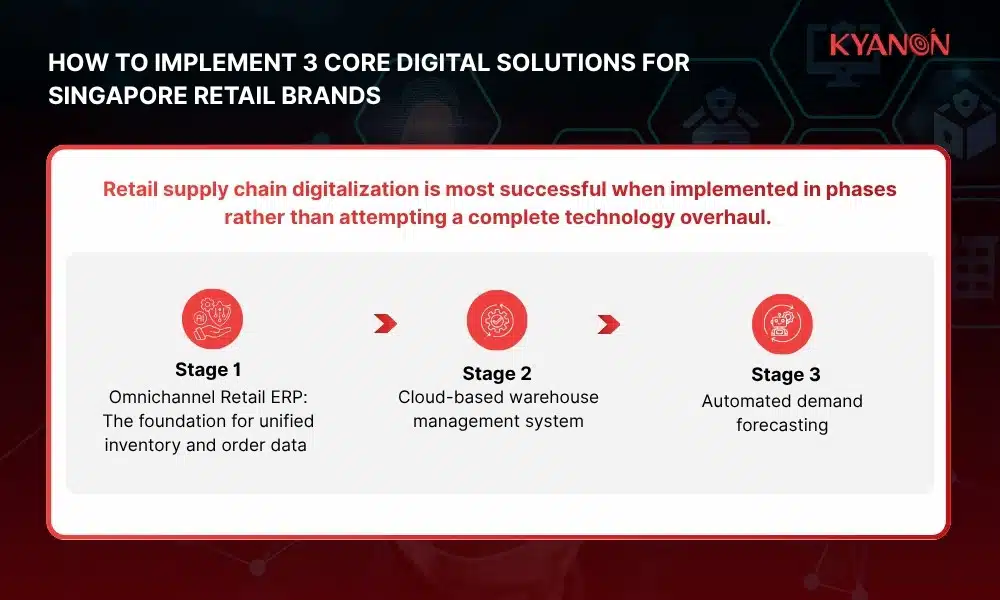
Stage 1 – Omnichannel Retail ERP: The foundation for unified inventory and order data
An omnichannel retail ERP centralizes inventory, orders, finance, and customer data across physical stores, marketplaces, and eCommerce into a single source of truth. This eliminates inconsistent stock information and enables real-time visibility across all sales channels.
- Best for: Retailers running disconnected POS, eCommerce, and inventory systems.
- Business perspective: Disconnected systems often result in inventory discrepancies, overselling, delayed fulfillment, and poor purchasing decisions. A unified ERP improves inventory accuracy and enables faster, data-driven decision-making across departments.
- Technical perspective: Implementation focuses on standardizing master data (especially SKUs) and integrating existing POS and eCommerce platforms through APIs instead of replacing every system. Clean, consistent data is essential for future warehouse automation and AI capabilities.
- What to watch for: Evaluate the total cost of ownership, including data migration, integration, user training, and change management, not just software licensing. Choose an API-first ERP that can easily integrate with future WMS, CRM, and forecasting solutions.
Stage 2 – Cloud-based warehouse management system
A cloud-based Warehouse Management System (WMS) provides real-time visibility into inventory locations, warehouse operations, and order fulfillment. It streamlines receiving, picking, packing, and shipping while improving inventory accuracy.
- Best for: Retailers with owned warehouses, multiple storage locations, or heavy 3PL coordination.
- Business perspective: A WMS reduces fulfillment errors, shipping delays, and manual processes that impact customer satisfaction, especially during peak shopping periods like 11.11 and 12.12.
- Technical perspective: The WMS should integrate seamlessly with ERP, eCommerce platforms, and logistics providers through APIs. Integration capabilities are often more important than feature count.
- What to watch for: Ensure the platform can scale during seasonal demand spikes without requiring major infrastructure upgrades.
- Verdict: A cloud WMS becomes essential when warehouse complexity and order volume outgrow manual processes.
Stage 3 – Automated demand forecasting
Automated demand forecasting uses historical sales, inventory data, seasonality, and other business signals to predict future demand and recommend replenishment decisions.
- Best for: Retailers with seasonal demand or large SKU catalogs.
- Business perspective: Forecasting helps reduce the two biggest inventory risks: stockouts, which lead to lost sales, and overstock, which ties up capital and increases markdowns.
- Technical perspective: Forecast accuracy depends on clean, consistent data from the ERP and WMS. This is why forecasting should be implemented after the foundational systems are in place.
- What to watch for: AI forecasting requires sufficient historical data. Many retailers need 6–12 months of clean operational data before forecasting models deliver reliable recommendations.
- Verdict: Demand forecasting offers the greatest long-term cost savings, but only when built on a solid ERP and WMS foundation.
How to choose the right digitalization path for your retail brand
There’s no one-size-fits-all approach to retail supply chain digitalization. The right investment depends on your operational readiness, business priorities, customer friction points, and existing technology stack. Before selecting a solution, ask these three questions.
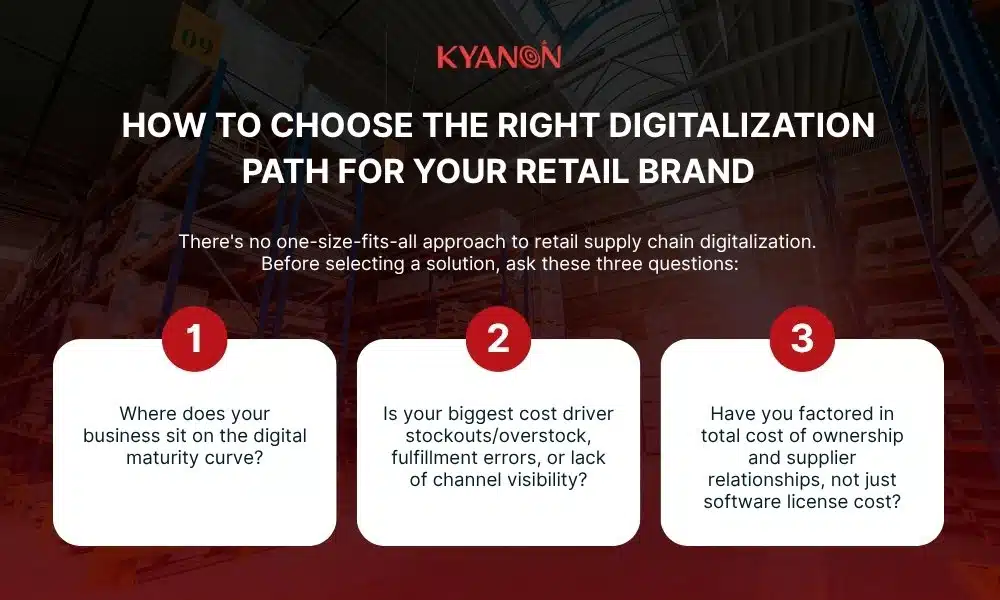
Where does your business sit on the digital maturity curve?
Start by assessing your data foundation and operational readiness. If inventory data remains fragmented across spreadsheets, POS systems, and eCommerce platforms, implementing AI forecasting too early may deliver limited value.
Build capabilities in sequence:
- Fragmented inventory data → Start with Omnichannel ERP
- Manual warehouse operations → Add a Cloud-Based WMS
- Reliable operational data → Introduce Automated Demand Forecasting
The implementation sequence often matters more than the software vendor you choose.
Which operational bottleneck has the greatest business impact: inventory inconsistencies, fulfillment inefficiencies, or poor cross-channel visibility?
Prioritize the solution that addresses your most pressing business issue.
Business challenge | Recommended priority |
| Inventory inconsistencies and poor cross-channel visibility | Omnichannel ERP |
Fulfillment delays, picking errors, warehouse inefficiencies | Cloud-Based WMS |
| Frequent stockouts, overstock, and inaccurate purchasing decisions | Automated Demand Forecasting |
Most Singapore retailers don’t need to implement all three solutions simultaneously. Addressing the highest-impact bottleneck first helps prioritize investment and deliver business value sooner.
Have you considered the total cost of ownership and long-term integration requirements, not just software licensing?
Software licensing is only one part of the investment. Retailers should also account for:
- Data migration and system integration
- Employee training and change management
- Ongoing maintenance and vendor support
- Future scalability and integration requirements
While government grants can reduce upfront costs, long-term success depends on selecting solutions that integrate well with your existing ecosystem and can scale as your business grows.
Successful digitalization requires integrating new solutions with existing POS, eCommerce, ERP, and logistics systems without disrupting daily operations.
At Kyanon Digital, we help Singapore retailers modernize supply chain operations through intelligent automation while maximizing existing technology investments. Rather than replacing legacy systems, we focus on building connected, scalable solutions that improve inventory visibility, fulfillment efficiency, and operational performance.
Ready to digitalize your retail supply chain? Contact Kyanon Digital to discuss your digital transformation roadmap.
Case study: Scaling Singapore retail operations with intelligent supply chain automation with Kyanon Digital
Client overview
A leading Singapore-based retail enterprise operating a multi-supplier omnichannel business across physical stores, eCommerce, and B2B wholesale channels. Although the company already used SAP and ERP systems, supplier document processing, inventory synchronization, and financial reconciliation remained largely manual, limiting operational scalability.
Challenges
The retailer struggled with high-volume manual processing of supplier invoices and delivery documents, three-way reconciliation between goods receipts, invoices, and ERP records, inconsistent inventory across sales channels, ghost inventory, and slow finance reconciliation. These issues reduced inventory accuracy, delayed fulfillment, and increased operational costs.
Solutions
- Implemented an AI-powered supply chain automation platform integrated with the client’s existing SAP, POS, and omnichannel systems.
- Automated supplier invoice and document processing using AI-powered OCR.
- Introduced automated three-way reconciliation between purchase orders, goods receipts, and invoices.
- Enabled real-time inventory synchronization across suppliers, warehouses, retail stores, and eCommerce channels.
- Modernized supply chain operations without replacing existing enterprise systems, preserving previous technology investments.
Business impact
- Reduced manual data entry by 90%.
- Cut supplier invoice processing time from days to under 30 minutes.
- Automated three-way reconciliation, improving financial accuracy and operational efficiency.
- Reduced omnichannel inventory discrepancies by over 80%.
- Improved inventory visibility, working capital management, and supplier payment cycles.
- Scaled supply chain operations without increasing headcount.
Explore the full case study here: Scaling Singapore retail operations with intelligent supply chain automation.
What trends are shaping retail supply chain digitalization in Singapore?
As Singapore’s retail sector continues to embrace digital transformation, businesses are focusing on connecting systems, strengthening supply chain resilience, and achieving measurable operational outcomes. The following trends highlight key developments shaping this transition.
Cost reduction and measurable business outcomes
Retailers are investing in digital supply chain solutions to address rising operating costs, improve productivity, and deliver measurable business outcomes, rather than simply modernize their technology stack. According to McKinsey, 93% of major distributors have made significant digital investments. Real-time inventory visibility and omnichannel execution are increasingly important capabilities for managing operations across channels. As a result, ROI discussions are becoming more data-driven, helping finance leaders evaluate technology investments against clear business outcomes.
Government support for retail digitalization
Singapore supports retail digitalization through initiatives such as IMDA’s CTO-as-a-Service (CTOaaS) and the refreshed Retail Industry Digital Plan (IDP), developed by IMDA and Enterprise Singapore. The updated IDP guides retailers in adopting digital solutions across key business touchpoints, with a stronger focus on AI. Eligible businesses may also access implementation support and grants, subject to scheme requirements.
Flexible, API-enabled architectures improve system integration
Retailers are increasingly prioritizing flexible technology architectures that connect ERP, WMS, demand forecasting, POS, eCommerce, CRM, and logistics systems through APIs. Rather than replacing every core platform, this approach allows businesses to extend or update individual components as operational needs evolve. It can improve flexibility, support faster innovation, and reduce dependence on a single vendor.
Digital supplier collaboration strengthens supply chain resilience
Retailers can improve supply chain visibility by digitally connecting suppliers, warehouses, logistics providers, and procurement teams. Where implemented, shared data and coordinated purchase order management and replenishment can help businesses respond to disruptions, reduce delays, and manage inventory risks.
AI-driven demand forecasting supports proactive inventory planning
As retailers improve the quality and integration of their operational data, AI-powered demand forecasting can help anticipate seasonal demand, guide replenishment, and identify potential stock imbalances earlier. More advanced workflows may also support automated decisions, subject to data quality, business rules, and appropriate human oversight.
How Kyanon Digital helps a leading Singapore retailer digitalize supply chain operations
Client overview
A leading Singapore-based retail enterprise operating a multi-supplier omnichannel business across physical stores, eCommerce, and B2B wholesale channels. Although the company already used SAP and ERP systems, supplier document processing, inventory synchronization, and financial reconciliation remained largely manual, limiting operational scalability.
Challenges
The retailer struggled with high-volume manual processing of supplier invoices and delivery documents, three-way reconciliation between goods receipts, invoices, and ERP records, inconsistent inventory across sales channels, ghost inventory, and slow finance reconciliation. These issues reduced inventory accuracy, delayed fulfillment, and increased operational costs.
Solutions
- Implemented an AI-powered supply chain automation platform integrated with the client’s existing SAP, POS, and omnichannel systems.
- Automated supplier invoice and document processing using AI-powered OCR.
- Introduced automated three-way reconciliation between purchase orders, goods receipts, and invoices.
- Enabled real-time inventory synchronization across suppliers, warehouses, retail stores, and eCommerce channels.
- Modernized supply chain operations without replacing existing enterprise systems, preserving previous technology investments.
Business impact
- Reduced manual data entry by 90%.
- Cut supplier invoice processing time from days to under 30 minutes.
- Automated three-way reconciliation, improving financial accuracy and operational efficiency.
- Reduced omnichannel inventory discrepancies by over 80%.
- Improved inventory visibility, working capital management, and supplier payment cycles.
- Scaled supply chain operations without increasing headcount.
Explore the full case study here: Scaling Singapore retail operations with intelligent supply chain automation
Why choose Kyanon Digital for retail supply chain digitalization in Singapore?
Expertise Trusted by Fortune 500 Clients
With a presence in Singapore and extensive experience supporting regional and global businesses, Kyanon Digital helps Singapore enterprises build, modernize, and scale software solutions across their digital ecosystems. Our experience spans complex software engineering and digital transformation projects for enterprises, Fortune 500 companies, and organizations across APAC.
A World-Class IT Team
Our 500+ consultants and engineers bring expertise across software engineering, technical architecture, project management, QA, DevOps, cloud, data, and AI/ML. With delivery capabilities across Vietnam, Singapore, Thailand, Australia, and MalaysiaAPAC region, we combine local business understanding with scalable engineering resources to support Singapore-based clients.
Enterprise-grade quality & delivery
Our ISO 9001-certified quality management system supports consistent delivery, structured engineering processes, and continuous improvement. We apply Agile methodologies and quality assurance practices throughout the software development lifecycle, from planning and architecture to development, testing, deployment, and ongoing optimization.
Uncompromising Security
With ISO 27001-certified information security management, Kyanon Digital integrates security considerations throughout the software development lifecycle. This helps Singapore businesses manage data protection, access control, application security, and operational risks while developing and modernizing enterprise software.
Conclusion
Choosing the right retail supply chain digitalization approach in Singapore depends on your operational priorities, existing systems, and business goals. A phased strategy combining connected data, warehouse optimization, and AI-powered demand forecasting can help improve efficiency, reduce implementation risks, and build more resilient operations.
If you are evaluating your retail supply chain digitalization strategy, discuss your requirements with Kyanon Digital to explore scalable solutions that improve operational performance and support long-term growth.
References
Nearly All Retailers Have Now Implemented AI, But Many Are Still Waiting to See Business Value — TechRadar, 2026.
Where Value Is Won and Lost in Distribution — McKinsey & Company, 2026.
Scaling Singapore Retail Operations with Intelligent Supply Chain Automation — Kyanon Digital, 2026.









 Create project brief with AI