

For most Singapore SMEs with standard direct-to-consumer needs, Shopify is the more practical choice for faster launch and simpler operations. Magento Open Source or Adobe Commerce is better suited to businesses requiring deeper customization, complex B2B workflows, or greater backend control.
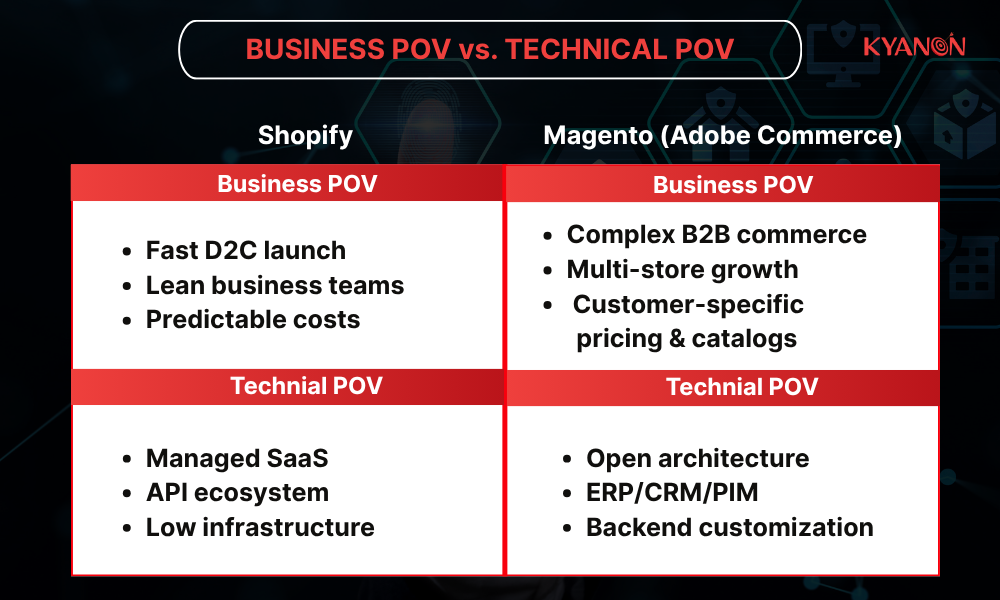
Shopify offers managed hosting, straightforward store management, and ready-made integrations. Magento provides more flexibility for complex catalogs, multiple storefronts, and ERP, CRM, or PIM integrations, but typically requires more technical resources.
This guide compares Shopify vs. Magento for Singapore e-commerce across total cost of ownership, local payment options, integration requirements, and scalability to help you choose the right platform for your business.
Key takeaways
- Shopify suits Singapore SMEs and D2C brands seeking faster launches and simpler store management.
- Magento Open Source and Adobe Commerce fit businesses requiring complex B2B workflows, deeper customization, and advanced integrations.
- Total cost of ownership includes platform fees, development, hosting, integrations, and ongoing maintenance.
- Singapore businesses should assess local payment methods, logistics, GST, PDPA, and regional expansion needs.
- Kyanon Digital’s perspective: Choose a platform that supports your next 12–24 months of growth without adding unnecessary costs or technical debt.
- Kyanon Digital helps businesses select, develop, and integrate scalable e-commerce solutions aligned with their needs.
Further reading:
- Omnichannel eCommerce Solutions for Business Growth
- Biggest Software Trends in Retail & eCommerce for 2026
- The Best E-commerce Platforms: Pros & Cons
- Web Development Services
How Kyanon Digital compared Shopify and Magento for Singapore businesses?
A business owner and an IT team evaluate e-commerce platforms differently. Business leaders usually focus on launch speed, operating cost, and revenue opportunities. Technical teams are more concerned with architecture, integrations, security, and long-term maintainability.
Criteria | Business owner lens | Technical / IT lens |
Time to launch | Days to weeks vs. significantly longer | Setup complexity, dev resourcing required |
Total cost of ownership | Monthly subscription vs. upfront dev spend | Hosting, maintenance, and security patching cadence |
SG payment & logistics fit | PayNow, GrabPay, NETS, local couriers | API/plugin integration effort and ongoing maintenance |
Customization & scalability | Multi-store SEA expansion, B2B pricing tiers | Codebase ownership, backend flexibility, and dev dependency |
| Ongoing maintenance | Included vs. self-managed | Developer dependency, security patching cycle |
| Data/code ownership | Control over customer data and storefront logic | Platform lock-in risk, export/portability options |
Disclaimer: This evaluation framework reflects operational priorities and best practices observed across enterprise e-commerce implementations in Singapore and APAC.
Kyanon Digital’s perspective: The right platform is not the one with the longest feature list. It is the one that supports the business’s next 12–24 months without creating unnecessary cost, technical debt, or operational dependency.

Shopify vs Magento at a glance
The main difference between Shopify and Magento is the balance between operational convenience and architectural control.
According to Adobe, Magento Open Source is a self-managed open-source e-commerce platform, while Adobe Commerce is available across SaaS, PaaS, and on-premises deployment models.
Platform model and business fit
Feature | Shopify | Magento Open Source/ Adobe Commerce |
Platform model | Fully hosted SaaS | Open-source, licensed SaaS, PaaS, or on-premises options |
Typical launch path | Days to weeks for a standard store | Weeks to months, depending on migration and customization |
Technical resources | Basic stores can operate without a dedicated developer | Usually requires experienced developers or an implementation agency |
Best suited for | SMEs, D2C brands, new market launches, and standardized commerce | Complex B2B, large catalogs, multi-brand operations, and deep integrations |
Customization | Themes, apps, APIs, and headless storefront options | Greater backend and architecture control |
Core platform control | Shopify manages the underlying platform | Greater source and infrastructure access, depending on the product and deployment |
Cost and maintenance
Cost factor | Shopify | Magento Open Source/ Adobe Commerce |
Platform price | Basic S$29/month, Grow S$99/month, Advanced S$399/month with annual billing; Plus from US$2,300/month | Magento Open Source has no license fee; Adobe Commerce uses custom quote-based pricing |
Hosting | Included | Separate for Magento Open Source; included or shared depending on Adobe Commerce deployment |
SSL and core infrastructure | Managed by Shopify | Merchant-managed, shared, or Adobe-managed, depending on deployment |
| Security updates | Core platform updates managed by Shopify | Responsibilities vary across Open Source, PaaS, SaaS, and on-premises |
Additional costs | Themes, apps, custom development, and payment fees | Implementation, hosting, extensions, integrations, upgrades, and technical support |
Note: Shopify’s published Singapore prices are US$29, US$99, and US$399 per month for annual billing. Monthly billing is higher. Adobe does not publish a fixed Adobe Commerce license floor and instead provides customized pricing.
Singapore payments, logistics, and B2B
Capability | Shopify | Magento Open Source / Adobe Commerce |
Local & Platform Payments | Supports cards, Apple Pay, Google Pay, and Shop Pay natively. PayNow, GrabPay, ShopeePay, and Atome are available without custom code via the native HitPay integration. | Payment capabilities vary by gateway. Local methods like PayNow and GrabPay require plugins, extensions, or APIs (e.g., HitPay provides a ready-made Magento plugin). |
Local Logistics | Native App Store integrations are readily available for local Singapore couriers like Ninja Van and EasyParcel. | Usually connected through extensions, APIs, or custom connectors, depending on fulfillment complexity. |
B2B pricing | Up to three B2B catalogs on Basic, Grow, and Advanced; unlimited catalogs on Plus. | Adobe Commerce supports customer-specific catalogs and pricing at an enterprise level. |
Advanced procurement | Company accounts, catalogs, payment terms, and draft-order workflows. | Company hierarchies, purchase approvals, quotes, requisition lists, and payment on credit. |
Regional expansion | Shopify Markets and multiple expansion stores on Plus. | Localized storefronts, multi-site architecture, and regional catalog control. |
Shopify vs Magento: Which platform fits your business stage?
Choosing between Shopify and Magento depends on your business size, growth plans, and operational complexity. The table below highlights which platform fits each business stage.
Business stage | Recommended platform | Why it fits |
| Startup or new online store | Shopify | Fast launch, managed infrastructure, and low technical overhead. |
Growing D2C brand | Shopify / Shopify Plus | Scalable SaaS, regional selling, and app integrations. |
| Standard B2B wholesale | Shopify | Company profiles, catalogs, and payment terms. |
Enterprise with complex B2B workflows | Adobe Commerce | Advanced pricing, approval hierarchies, and negotiated quotes. |
| Enterprise with complex integrations | Adobe Commerce | Greater backend control and flexibility for custom logic and ERP/PIM integration. |
Kyanon Digital’s perspective: Choose a platform for your next 12–24 months of growth. Start with Shopify for speed and simplicity; consider Adobe Commerce when complex workflows and customization justify the added technical investment.
Shopify ecommerce platform: What it is and when it works
Shopify is a hosted e-commerce platform that lets businesses build and manage online stores without handling server maintenance or core platform updates.
Its centralized dashboard supports product, inventory, order, customer, and marketing management across online and physical sales channels.
When does Shopify work best?
Shopify suits businesses that prioritize fast launches and simple store management over full backend control.
It is a good fit for:
- Startups testing product-market fit.
- SMEs without in-house developers.
- D2C brands expanding into new markets.
- Retailers connecting online and physical stores through Shopify POS.
- Growing businesses using Shopify Plus for high-volume sales, international expansion, or wholesale.
Its subscription model includes hosting and core infrastructure. Businesses should still budget for apps, themes, payment processing, and custom development.
What should businesses know about Shopify’s technical capabilities?
Shopify manages hosting, software updates, and server security. Developers can extend the platform through themes, apps, APIs, and headless commerce tools such as Hydrogen.
Custom development may still be needed for ERP, CRM, PIM, or warehouse integrations; complex product configurations; specialized loyalty workflows; checkout customization; and platform migration.
Unlike self-hosted Magento Open Source, Shopify does not provide the same level of control over the underlying platform.
What are Shopify’s advantages and limitations?
Shopify offers operational simplicity and fast deployment, but businesses should weigh these benefits against its customization limits and potential additional costs.
Advantages | Limitations |
| Fast launch with managed infrastructure | Less control over core backend behavior |
Easy store management for non-technical teams | Complex workflows may require apps or custom development |
| Extensive app and integration ecosystem | App subscriptions can increase costs |
Online and physical retail support through Shopify POS | Multi-brand or multi-ERP setups may be harder to govern |
| Shopify Plus supports advanced scaling and wholesale needs | External payment providers may incur additional transaction fees |
Is Shopify suitable for Singapore businesses?
Shopify Payments supports eligible payment methods in Singapore, including cards and digital wallets. Third-party providers such as HitPay may add local payment options, depending on availability and configuration.
Apps such as Ninja Van and EasyParcel can support shipping, labels, and tracking. Businesses should verify that their required payment, logistics, and inventory workflows are supported before choosing the platform.
Magento Open Source and Adobe Commerce: What they are and when they work
Magento Open Source is a free, self-hosted e-commerce platform that gives developers access to its core source code. Merchants manage hosting, security, maintenance, and technical operations.
Adobe Commerce is the paid enterprise platform, offering advanced commerce capabilities and deployment options including cloud-based and on-premises models. It suits businesses that need more complex workflows, enterprise support, or managed cloud services.
Business owner perspective
Magento becomes relevant when standard SaaS configurations cannot support how a business sells, prices, fulfills, or manages customers.
Typical use cases include:
- Customer-specific catalogs and negotiated B2B pricing.
- Complex account structures and purchasing permissions.
- Quotation and approval workflows.
- Large product catalogs and multiple storefronts.
- Multi-country selling across languages and currencies.
- Custom inventory and order-routing logic.
- Deep ERP, CRM, PIM, and procurement integrations.
Magento Open Source suits businesses with technical resources to manage and customize the platform. Adobe Commerce is better suited to enterprises that need integrated B2B capabilities, enterprise support, or managed cloud options.
Technical perspective
Magento Open Source provides broad source-code access and control over hosting and infrastructure. This flexibility supports custom commerce logic but requires ongoing technical management.
A Magento implementation may require:
- Solution architecture and PHP development.
- Cloud infrastructure and database management.
- Security patching and extension updates.
- Automated testing and performance optimization.
- Monitoring, incident response, and release planning.
Adobe Commerce provides additional enterprise capabilities, official support, and service-level agreements (SLAs), depending on the product and contract. Its cloud service manages more of the infrastructure and update cycle, while other deployment models involve different levels of operational responsibility.
Singapore market fit
Magento can connect to Singapore payment gateways through extensions, provider plugins, or APIs. For example, HitPay provides a Magento integration for local and international payments. The level of implementation and maintenance effort depends on the chosen provider and setup.
Businesses can also deploy eligible Magento editions on infrastructure in Singapore. However, local hosting alone does not guarantee PDPA compliance. Data flows, access controls, retention policies, vendors, and operational processes must also be assessed.
What are Magento and Adobe Commerce’s advantages and limitations?
Magento offers flexibility and control, but requires more technical ownership than a fully hosted platform.
Advantages | Limitations |
| Broad backend customization and source-code access with Magento Open Source | Greater developer dependency |
Flexible deployment and integration options | Hosting, maintenance, and security responsibilities vary by edition |
| Support for complex catalogs and multi-store commerce | Implementation and upgrade cycles can be lengthy |
Built-in advanced B2B capabilities in Adobe Commerce | Magento Open Source may need extensions or custom development for similar workflows |
| Enterprise support and SLAs with eligible Adobe Commerce contracts | Adobe Commerce licensing is quote-based and depends on contract terms |
AI-powered search, recommendations, and merchandising capabilities in eligible Adobe Commerce products | Extension conflicts and poor architecture can increase maintenance costs |

How to choose between Shopify and Magento for your Singapore store

Three questions can help narrow the choice based on launch speed, operational complexity, and total cost of ownership (TCO).
Strategic Question | Choose Shopify when… | Choose Magento / Adobe Commerce when… |
| Question 1. How quickly do you need to launch, and who will operate the platform? | You need a fast launch and a non-technical team can manage daily operations. | You have dedicated developers or an agency and need greater architectural control. |
Question 2. Does the business need genuine B2B or multi-store complexity? | Standard D2C or B2B workflows, catalogs, and payment terms meet your needs. | You need complex procurement, company hierarchies, custom pricing, or multi-brand storefronts. |
| Question 3. What is the realistic year-one Total Cost of Ownership (TCO)? | You prefer subscription-based costs, budgeting for apps, themes, payment fees, and integrations. | You can fund hosting, development, extensions, security, maintenance, and upgrades, or Adobe Commerce licensing. |
Magento Open Source has no software license fee, but hosting and maintenance still cost money. Shopify offers more predictable base subscriptions, but apps, custom integrations, and Shopify Plus can increase total costs.
What should Singapore businesses check before choosing an e-commerce platform?
Use this checklist to assess local integrations, technical readiness, and long-term costs before choosing a platform.
Business requirements
- Payments: Verify PayNow, PayLah!, and BNPL options such as Atome through providers like HitPay or Stripe, where available. Compare domestic and international transaction fees.
- Logistics and sales channels: Check Singapore courier, pickup/locker, and cross-border shipping support, plus inventory sync with Shopee, Lazada, and physical POS systems.
- Tax and accounting: Confirm GST-inclusive/exclusive pricing and integration with Xero or QuickBooks.
- Cost and scaling: Model costs at current and projected order volumes, including payment fees, apps, and integrations.
Technical requirements
- Performance and regional selling: Test mobile checkout under peak traffic and verify multi-currency support for Southeast Asian markets.
- System integration: Validate connections with ERP, CRM/CDP, PIM, and warehouse systems, including bidirectional sync where needed.
- Security and compliance: Review PDPA controls, including cookie consent, explicit opt-ins, and data retention. For self-hosted platforms, assess Singapore-region hosting and CDN options.
- Reliability: Confirm contractual uptime SLAs and clarify security patching and maintenance responsibilities.
Ownership and implementation partner
- Data and migration: Confirm data export options, future migration costs, and dependencies on proprietary apps or extensions.
- Partner capability: Verify relevant platform certifications, implementation experience, and post-launch support.
- Business fit: Assess catalog complexity, B2B/B2C workflows, existing systems, regional requirements, and internal technical resources before selecting a platform.

Working with a platform-agnostic implementation partner
A credible Shopify ecommerce agency or Magento implementation partner should assess the business before recommending a platform. Kyanon Digital works across Shopify Plus, Shopify development, Magento Commerce, Magento Open Source, custom e-commerce, and omnichannel integration. This enables the recommendation to begin with business architecture rather than a predetermined platform.
Connect with Kyanon Digital for more information about our: Omnichannel eCommerce Solutions for Business Growth
What trends are shaping e-commerce platform decisions in Singapore?
E-commerce platform decisions are increasingly shaped by social-first discovery, profitability, AI-enabled shopping, and unified retail operations. Businesses need to assess how well a platform supports customer acquisition, operational efficiency, and long-term growth.
Trend | Why it matters | Business impact |
| Social commerce and live selling expand | Shoppers increasingly discover products through social platforms, creator content, and livestreams. | Evaluate social channel integrations, inventory synchronization, and checkout performance during traffic spikes. |
Marketplace-to-D2C strategies gain importance | Businesses balance marketplace reach with the margins and customer relationships offered by brand-owned stores. | Assess first-party data capture, loyalty capabilities, and integrations across marketplaces and owned channels. |
| AI becomes more operational | AI supports product discovery, recommendations, customer service, and merchandising, while agentic commerce is an emerging development. | Prioritize integration with business data, workflows, and customer systems over standalone AI features. |
Unified retail and fulfillment become priorities | Customers expect consistent inventory, flexible delivery, and connected online and offline experiences. | Check POS and marketplace synchronization, multi-courier integrations, and support for local delivery and pickup options. |
| Deployment models and architecture require trade-offs | SaaS, PaaS, self-hosted, and headless approaches offer different levels of control, flexibility, and maintenance responsibility. | Match the architecture to customization needs, internal technical resources, scalability, and total cost of ownership. |
Local payments and financial integrations matter | Singapore businesses need convenient local payment options and reliable connections to finance systems. | Verify PayNow and other relevant payment methods through supported providers, compare transaction fees, and assess accounting, ERP, and InvoiceNow integration needs. |
These trends should guide platform evaluation rather than dictate a single choice. Shopify may suit businesses prioritizing faster deployment and simpler operations, while Magento Open Source or Adobe Commerce may better fit businesses requiring deeper customization or complex commerce workflows. The right choice depends on actual requirements, integration availability, and total cost of ownership.
How Kyanon Digital delivers a comprehensive e-commerce solution for a high-end luxury consumer goods brand
While this case study from Kyanon Digital is not a direct Shopify vs Magento comparison, it illustrates the types of commerce complexity that should influence platform choice: loyalty integration, CRM/ERP synchronization, omnichannel data, personalized promotions, and scalable customer engagement.
For simple D2C storefronts, this level of architecture may not be necessary at launch. For enterprise retail or luxury brands, these integration requirements are exactly where platform flexibility and implementation expertise become critical.

Challenges:
- Fragmented loyalty and customer data: A lack of a centralized system for managing loyalty rewards, promotional campaigns, and customer profiles prevented the brand from executing cohesive, long-term retention strategies.
- Blind spots in consumer behavior: Limited visibility into customer preferences, purchasing habits, and engagement history restricted the marketing team’s ability to deliver data-driven, personalized luxury experiences.
- Siloed omnichannel touchpoints: Operating without a unified platform connecting mobile, website, and physical retail stores created customer journey friction, compounded by a critical need to integrate with existing CRM and ERP systems.
Solutions:
- Gamified loyalty and personalization app: Engineered a premium, intuitive mobile loyalty application featuring tiered memberships (Silver, Gold, Platinum), reputation points, and referral reward programs tailored specifically to a high-end clientele.
- Real-time promotional engine: Built dynamic promotional tools and automated behavioral triggers (such as high-value purchases, birthdays, or inactivity) to instantly deploy targeted campaigns, customized vouchers, and exclusive member perks.
- Omnichannel and CRM/ERP synchronization: Unified digital and physical store interactions under a single customer account while seamlessly connecting core CRM and ERP systems to centralize behavioral data and ensure real-time synchronization.
Results and impact:
- Deepened customer retention and LTV: Delivering gamified rewards, automated behavioral triggers, and exclusive member benefits significantly increased repeat purchases and strengthened brand affinity among high-value shoppers.
- Frictionless omnichannel journeys: Enabling customers to seamlessly earn, track, and redeem rewards across mobile apps, websites, and physical retail counters created a unified and effortless luxury shopping experience.
- Data-driven operational agility: Centralizing customer engagement history across core business systems empowered marketing teams with holistic behavioral insights for smarter targeting and laid a scalable foundation for future regional expansion.
Explore the full case study here: Comprehensive E-Commerce Solution For A High-End Luxury Consumer Goods Brand.
Why choose Kyanon Digital for Shopify or Magento development in Singapore?
Expertise Trusted by Fortune 500 Clients
With a presence in Singapore and extensive experience supporting regional and global businesses, Kyanon Digital helps Singapore enterprises build, modernize, and scale software solutions across their digital ecosystems. Our experience spans complex software engineering and digital transformation projects for enterprises, Fortune 500 companies, and organizations across APAC.
A World-Class IT Team
Our 500+ consultants and engineers bring expertise across software engineering, technical architecture, project management, QA, DevOps, cloud, data, and AI/ML. With delivery capabilities across Vietnam, Singapore, Thailand, Australia, and MalaysiaAPAC region, we combine local business understanding with scalable engineering resources to support Singapore-based clients.
Enterprise-grade quality & delivery
Our ISO 9001-certified quality management system supports consistent delivery, structured engineering processes, and continuous improvement. We apply Agile methodologies and quality assurance practices throughout the software development lifecycle, from planning and architecture to development, testing, deployment, and ongoing optimization.
Uncompromising Security
With ISO 27001-certified information security management, Kyanon Digital integrates security considerations throughout the software development lifecycle. This helps Singapore businesses manage data protection, access control, application security, and operational risks while developing and modernizing enterprise software.
Conclusion
Choosing between Shopify and Magento for a Singapore e-commerce business depends on your operational needs, technical resources, integration requirements, and growth plans. Shopify offers faster deployment and simpler operations for many SMEs, while Magento Open Source and Adobe Commerce provide greater flexibility for businesses with complex catalogs, B2B workflows, or advanced customization needs.
If you are evaluating your e-commerce platform strategy, discuss your requirements with Kyanon Digital to explore the right platform, integration approach, and scalable architecture to support long-term growth.
References
Adobe Commerce implementation playbook — Adobe Experience League, 2026.
Comprehensive E-Commerce Solution for a High-End Luxury Consumer Goods Brand — Kyanon Digital, 2025.








 Create project brief with AI