

Supply chain analytics helps Singapore businesses scale by turning fragmented supplier, inventory, logistics and ERP data into faster operational decisions. It is most valuable when growth is increasing reconciliation, stock discrepancies and planning effort. If the underlying data is incomplete, poorly governed or inaccessible, fixing that foundation should come first.
As suppliers, SKUs and channels multiply, manual coordination can become the real growth constraint. The business decision is therefore whether to add an analytics layer around existing systems or defer until data quality and integration are ready.
Key takeaways
- Start with the bottleneck: prioritize analytics when reconciliation effort, inventory discrepancies or cross-system visibility worsen as volume grows.
- Integrate before replacing: ERP can remain the system of record while analytics connects ERP, POS, warehouse and supplier data.
- Kyanon Digital recommends tying each use case to an operational decision, owner and baseline KPI, not building dashboards first.
- A verified Kyanon Digital Singapore retail project shows that SAP, POS and omnichannel systems can be extended rather than replaced.
What is supply chain data analytics?
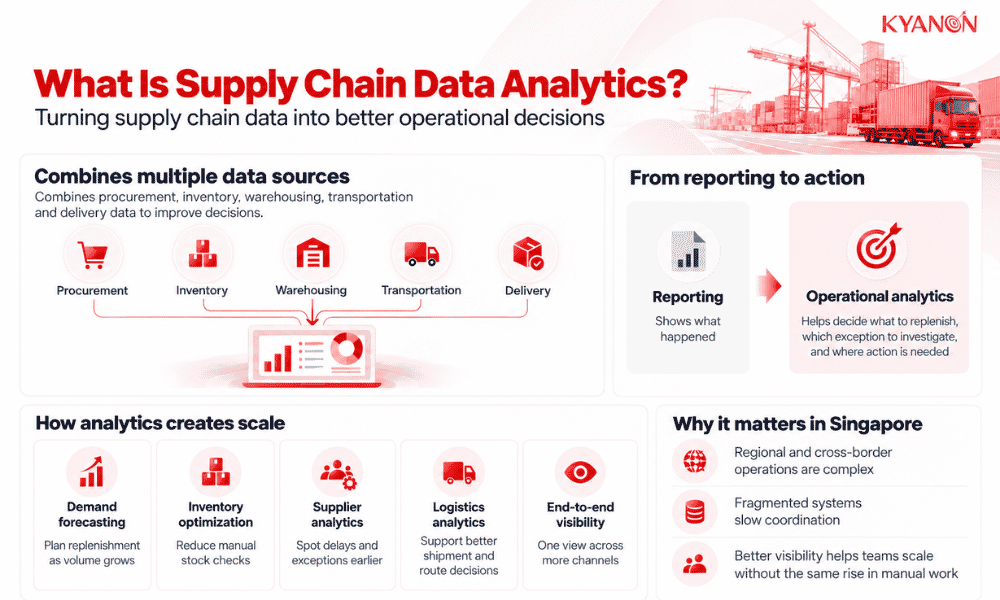
Supply chain analytics combines data from procurement, inventory, warehousing, transportation and delivery to improve decisions. IBM’s 2026 guidance describes descriptive, diagnostic, predictive and prescriptive analytics using sources including ERP, warehouse, transport, sales and supplier systems.
The practical distinction is simple: reporting shows what happened; operational analytics should help someone decide what to replenish, which exception to investigate, or where risk requires action.

How does supply chain analytics actually create scale?
Analytics creates scale when each additional order, supplier or channel does not create the same increase in manual coordination.
Capability | What it does | Scaling effect |
Demand forecasting | Estimates future demand | Supports replenishment as volume grows |
| Inventory optimization | Tracks stock and reorder conditions | Reduces manual stock reconciliation |
Supplier analytics | Monitors lead time and delivery | Surfaces supplier exceptions earlier |
| Logistics analytics | Combines shipment and route data | Supports transport decisions at higher volume |
End-to-end visibility | Connects data across systems | Creates one view across more channels |
Why this matters in Singapore
Enterprise Singapore identifies supply chain visibility with data and resilient operations with automation as key logistics opportunities. It also highlights common data infrastructure as a way to reduce fragmented, paper-based information flows. For Singapore businesses coordinating regional suppliers and cross-border operations, information flow between systems and partners can therefore become a scaling constraint.
PDPA obligations matter where analytics processes personal data, such as identifiable customer, employee or driver records; they do not automatically apply to every operational dataset. PDPC’s 2026 advisory also stresses safeguards and thorough testing during data and system migrations.
How can enterprises integrate supply chain analytics into existing systems?
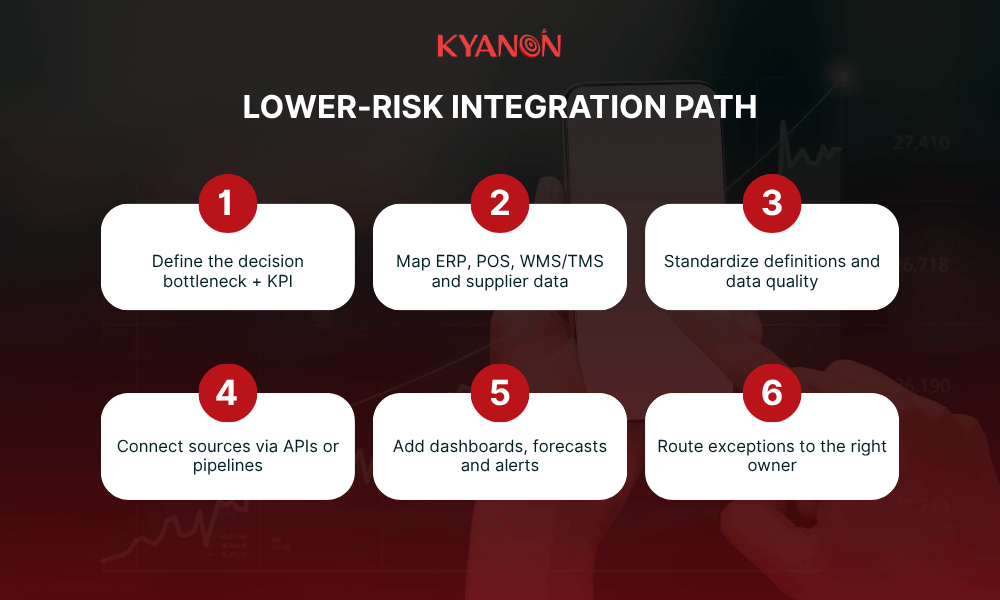
A lower-risk sequence is usually:
- Define one decision bottleneck and baseline KPI.
- Map the required ERP, POS, WMS/TMS, supplier and spreadsheet data.
- Standardize definitions, ownership and quality rules.
- Connect sources through APIs, pipelines or an event layer.
- Add dashboards, forecasts or alerts after the data is trustworthy.
- Route exceptions to the workflow owner.
When evaluating supply chain analytics services, favor a scope that works with the existing technology estate before assuming a platform replacement is necessary. Kyanon Digital’s Data Analytics & Business Intelligence services cover integration, data hubs and warehouses, governance, BI and predictive analytics. If teams spend more time stitching data together than acting on it, a bounded data-enablement scope is usually the more defensible first move.
What business value can supply chain analytics deliver?
Measure value as an operating change, not as “more dashboards.”
- Lower supply-chain risk: track lead-time variance, fulfillment exceptions and inventory discrepancies.
- Improve demand and inventory decisions: compare stockouts, excess stock and replenishment performance against a baseline.
- Strengthen planning: track forecast error, plan adherence and manual planning effort before expanding predictive models.
If the insight does not change a procurement, replenishment, routing or exception-management decision, the analytics is not yet operationalized.
How to evaluate supply chain analytics success?
Define the KPI, decision owner and action before implementation. Inventory teams may track stockout and discrepancy rates; procurement may track lead-time variance and exception cycle time; planning teams may track forecast error and manual planning effort.
Dashboard usage and model accuracy are supporting signals, not business outcomes by themselves.
How Kyanon Digital scaled supply chain operations for a Singapore retailer
Challenges
- Thousands of supplier invoices, delivery orders and inventory transactions crossed a regional supplier network.
- SAP and ERP systems existed, but reconciliation and inventory synchronization remained manual.
- Retail, e-commerce and B2B inventory data was frequently out of sync.
Solution from Kyanon Digital
- Connected an event-driven platform to existing SAP, POS and omnichannel systems.
- Automated supplier-document extraction and multi-way reconciliation.
- Built near-real-time inventory synchronization with human review for lower-confidence exceptions.
Results and impact
- Manual data-entry time fell 90%.
- Supplier invoice processing fell from days to under 30 minutes across thousands of daily documents.
- Omnichannel inventory-discrepancy incidents fell more than 80%.
The sequencing lesson is more important than the individual metrics: the retailer did not need to replace SAP to scale the workflow; it needed trusted data, integration and automation around the existing system of record.
View the Singapore supply chain automation case study
Conclusion
Supply chain analytics is worth scaling when manual coordination, inconsistent inventory data or slow exception handling has become a measurable growth constraint. Start with one decision, one owner and one baseline KPI; expand only when reliable data produces a better operating outcome.
Planning a supply chain analytics initiative? Speak with Kyanon Digital’s data and analytics team to define the first integration scope, required data foundation and success measures.
References
- Supply Chain Analytics: Examples, Applications & Use Cases — IBM, 2026.
- Logistics — Enterprise Singapore, accessed 2026.
- PDPA Overview — Personal Data Protection Commission.
- Advisory on Common Data Protection Lapses and Recommended Measures — Personal Data Protection Commission, 2026
- Scaling Singapore Retail Operations with Intelligent Supply Chain Automation — Kyanon Digital.
- Data Analytics & Business Intelligence Services — Kyanon Digital.






 Create project brief with AI