
What is a 360-Degree Customer View?
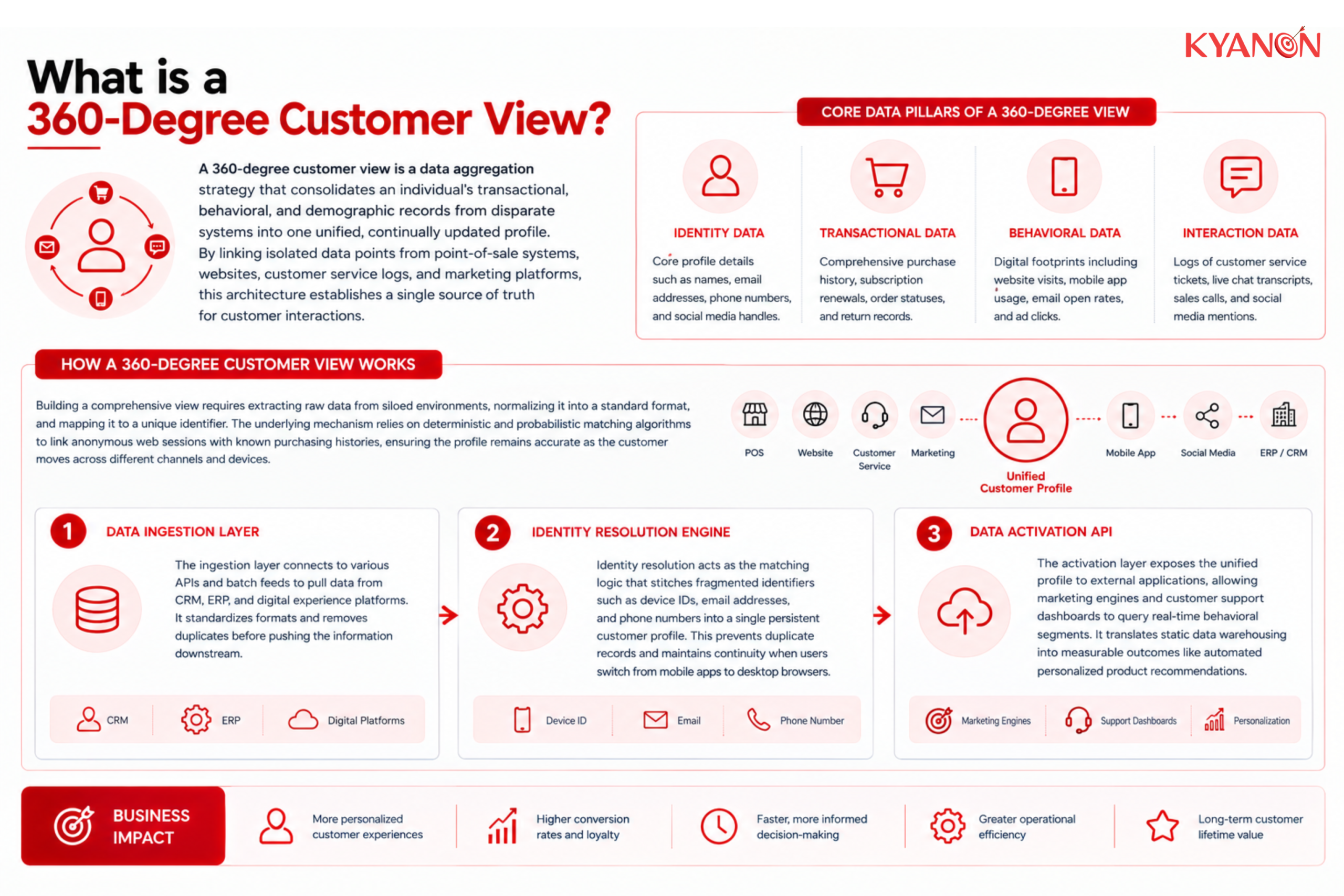
A 360-degree customer view is a data aggregation strategy that consolidates an individual’s transactional, behavioral, and demographic records from disparate systems into one unified, continually updated profile. By linking isolated data points from point-of-sale systems, websites, customer service logs, and marketing platforms, this architecture establishes a single source of truth for customer interactions.
Core Data Pillars of a 360-Degree View
- Identity Data: Core profile details such as names, email addresses, phone numbers, and social media handles.
- Transactional Data: Comprehensive purchase history, subscription renewals, order statuses, and return records.
- Behavioral Data: Digital footprints including website visits, mobile app usage, email open rates, and ad clicks.
- Interaction Data: Logs of customer service tickets, live chat transcripts, sales calls, and social media mentions.

How a 360-Degree Customer View Works
Building a comprehensive view requires extracting raw data from siloed environments, normalizing it into a standard format, and mapping it to a unique identifier. The underlying mechanism relies on deterministic and probabilistic matching algorithms to link anonymous web sessions with known purchasing histories, ensuring the profile remains accurate as the customer moves across different channels and devices.
Data Ingestion Layer
The ingestion layer connects to various APIs and batch feeds to pull data from CRM, ERP, and digital experience platforms. It standardizes formats and removes duplicates before pushing the information downstream.
Identity Resolution Engine
Identity resolution acts as the matching logic that stitches fragmented identifiers-such as device IDs, email addresses, and phone numbers-into a single persistent customer profile. This prevents duplicate records and maintains continuity when users switch from mobile apps to desktop browsers.
Data Activation API
The activation layer exposes the unified profile to external applications, allowing marketing engines and customer support dashboards to query real-time behavioral segments. It translates static data warehousing into measurable outcomes like automated personalized product recommendations.
360-Degree Customer View vs Customer Data Platform (CDP)
While a 360-degree customer view is the strategic architectural goal of unifying data, a Customer Data Platform (CDP) is the packaged software solution often purchased to achieve that goal.
|
Dimension |
360-Degree Customer View | Customer Data Platform (CDP) |
| Nature | Architectural strategy & data framework |
Packaged software / SaaS platform |
|
Primary function |
Consolidating data into a single source of truth | Ingesting, organizing, and activating data |
| Upfront complexity | High (Requires custom integration planning) |
Moderate to High (Depending on vendor lock-in) |
|
Best for |
Defining enterprise data governance goals | Marketing and CX teams needing execution tools |
| Cost model | Strategic architectural investment |
Vendor licensing (OpEx) |
When to Consider a 360-Degree Customer View
Consider building a 360-degree customer view if:
- Customer data fragmentation is causing your marketing campaigns to retarget users with products they have already purchased in-store.
- Your service agents lack context during support calls because transaction histories and web browsing logs are stored in disconnected legacy systems.
- You are planning to implement predictive AI models for behavioral segmentation but current datasets are too polluted with duplicates to yield accurate training results.
It may not be the right priority if:
- Your organization operates a single-channel, high-volume transactional model where customer retention relies entirely on lowest-price utility rather than ongoing relationship management.
Why a 360-Degree Customer View Matters for Enterprise Retail & FMCG
Fragmented data architecture directly inflates total cost of ownership (TCO) by forcing IT teams to maintain redundant integrations across separate systems, while simultaneously decreasing conversion rates due to disjointed customer experiences. Implementing a unified profile architecture eliminates integration bottlenecks, allowing product teams to shorten time-to-market for new personalized digital services.
Deloitte’s 2026 Retail Industry Outlook found that 67% of retail executives expect to have AI-driven personalization capabilities within the next year, while its 2025 Consumer Products Outlook found that 70% of consumer products executives see precision analytics as a way to improve marketing ROI.
Common Misconceptions
We need 100% complete data tracking every digital footprint before we can launch our 360 view
Reality: Chasing absolute completeness causes scope creep and analysis paralysis, expanding data integration projects into endless technical debt. Businesses generate measurable outcomes faster by unifying high-value core identifiers first, as forcing omniscient tracking heavily clashes with modern privacy regulations and data compliance guidelines.
Identity resolution is just a matter of matching email addresses across our different databases
Reality: Mapping data across multiple ID types, varying granularities, and distinct streaming sources causes simplistic mapping models to break down quickly. Collecting data from everywhere without validating legitimacy often results in databases heavily polluted with duplicates or invalid contacts.
Every department needs access to the exact same massive, comprehensive customer profile
Reality: Overwhelming context hinders operations; a support agent needs immediate billing and product context, not a massive log of every website link the customer clicked over the past six months.
Capturing a user’s entire transaction history tells us everything we need to know about them
Reality: Traditional systems excel at capturing transactional data, like what was bought and when, but this data rarely tracks consumer motivations, purchasing drivers, or the emotional context behind a transaction.
How Kyanon Digital Applies a 360-Degree Customer View
Kyanon Digital builds 360-degree customer view platforms for enterprise clients in retail, banking, and FMCG as a foundational CX infrastructure investment. Serving organizations across Vietnam, Singapore, Thailand, ANZ, and Malaysia, our engineering teams focus on deep implementation rather than just consulting. We integrate disparate transaction systems, CRM databases, and real-time digital touchpoints into structured data frameworks, prioritizing measurable outcomes such as reduced TCO and accelerated time-to-market for digital initiatives.
Explore our Customer data platform and personalization services.

 Create project brief with AI