
What is 5-Star Review Architecture?
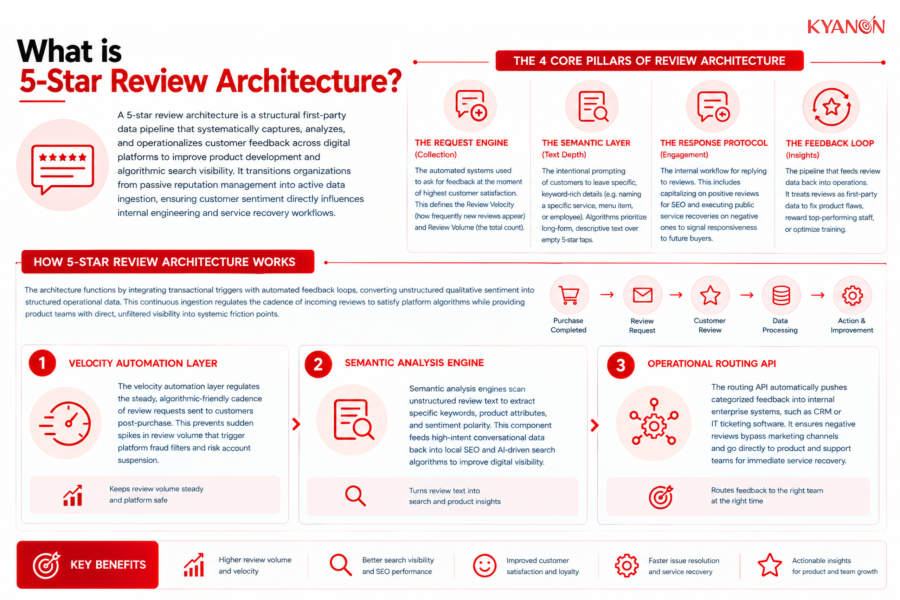
A 5-star review architecture is a structural first-party data pipeline that systematically captures, analyzes, and operationalizes customer feedback across digital platforms to improve product development and algorithmic search visibility. It transitions organizations from passive reputation management into active data ingestion, ensuring customer sentiment directly influences internal engineering and service recovery workflows.
The 4 Core Pillars of Review Architecture
- The Request Engine (Collection): The automated systems used to ask for feedback at the moment of highest customer satisfaction. This defines the Review Velocity (how frequently new reviews appear) and Review Volume (the total count).
- The Semantic Layer (Text Depth): The intentional prompting of customers to leave specific, keyword-rich details (e.g., naming a specific service, menu item, or employee). Algorithms prioritize long-form, descriptive text over empty 5-star taps.
- The Response Protocol (Engagement): The internal workflow for replying to reviews. This includes capitalizing on positive reviews for SEO and executing public “service recoveries” on negative ones to signal responsiveness to future buyers.
- The Feedback Loop (Insights): The pipeline that feeds review data back into operations. It treats reviews as first-party data to fix product flaws, reward top-performing staff, or optimize training.

How 5-Star Review Architecture Works
The architecture functions by integrating transactional triggers with automated feedback loops, converting unstructured qualitative sentiment into structured operational data. This continuous ingestion regulates the cadence of incoming reviews to satisfy platform algorithms while providing product teams with direct, unfiltered visibility into systemic friction points.
Velocity Automation Layer
The velocity automation layer regulates the steady, algorithmic-friendly cadence of review requests sent to customers post-purchase. This prevents sudden spikes in review volume that trigger platform fraud filters and risk account suspension.
Semantic Analysis Engine
Semantic analysis engines scan unstructured review text to extract specific keywords, product attributes, and sentiment polarity. This component feeds high-intent conversational data back into local SEO and AI-driven search algorithms to improve digital visibility.
Operational Routing API
The routing API automatically pushes categorized feedback into internal enterprise systems, such as CRM or IT ticketing software. It ensures negative reviews bypass marketing channels and go directly to product and support teams for immediate service recovery.
5-Star Review Architecture vs Traditional Review Management
Both approaches address public-facing customer sentiment, but differ entirely in systemic integration and data utilization.
Dimension | 5-Star Review Architecture | Traditional Review Management |
| Strategic objective | First-party data pipeline | Surface-level public relations |
Data utilization | Cross-departmental (Product, IT, CX) | Marketing and sales only |
| Integration depth | High (APIs, CRM, Ticketing) | Low (Standalone SaaS dashboard) |
Velocity control | Automated, continuous pacing | Ad-hoc batch email campaigns |
| Platform compliance | Strict (TOS aligned, ungated) | Risky (Prone to review gating) |
When to Consider 5-Star Review Architecture
Consider a 5-star review architecture if:
- Your product engineering teams lack direct, structured visibility into why recent digital releases are causing customer churn.
- You rely on local SEO or conversational search where detailed, semantic review data dictates visibility and ranking against competitors.
- Your current feedback mechanism causes sudden, massive spikes in review volume that trigger algorithmic penalties or listing suppressions.
It may not be the right priority if:
- Your enterprise operates strictly under business-to-business non-disclosure agreements where public platform reviews are contractually prohibited.
Why 5-Star Review Architecture Matters for Enterprise Commerce
Structuring customer feedback directly impacts customer acquisition costs by fueling organic search algorithms, while simultaneously identifying critical product failures before they scale. Treating reviews purely as marketing assets ignores their utility as a primary diagnostic tool for business operations.
The importance of this capability is increasing as shoppers rely on reviews throughout the digital purchase journey. BrightLocal’s 2026 research found that 97% of consumers read reviews for local businesses, while 93% have made a purchase after reading reviews.
Common Misconceptions
We must delete negative feedback because a flawless 5.0 rating is the ultimate conversion driver
Reality: Consumers suspect censorship or fake reviews when they encounter a perfect 5.0 rating, as conversion rates actually peak in the 4.2 to 4.7 star range where authenticity feels highest. Negative reviews highlight systemic product failures or service bottlenecks that internal teams need to fix.
Let’s push a massive post-purchase email blast today to flood platforms with hundreds of 5-star reviews
Reality: A sudden, massive spike in review volume triggers fraud filters, leading to algorithmic penalties, suppressed listings, or complete account suspensions. A healthy architecture demands consistent, automated review velocity that mirrors natural human behavior.
We should use a screening form so only happy customers are directed to leave a Google review
Reality: This practice, known as review gating, explicitly violates major platform terms of service and can result in your entire review history being purged overnight. Modern architectures capture unbiased feedback across the entire customer base while mastering public service recovery.
A quick 5-star tap with no text is just as valuable as a written review
Reality: Search algorithms heavily favor semantic richness, meaning reviews containing specific product attributes or location details boost SEO significantly more than empty ratings. Text-heavy reviews provide the exact data needed for platforms to display your business in conversational or AI-driven search results.
How Kyanon Digital Applies 5-Star Review Architecture
Kyanon Digital incorporates 5-star review architecture principles directly into our CX maturity assessments for enterprise clients across Southeast Asia. We evaluate your current feedback mechanisms to identify algorithmic risks, bridging the gap between isolated marketing tools and core IT infrastructure. Our technical teams build continuous first-party data pipelines that route structured sentiment data straight to product owners, prioritizing actionable service recovery and measurable conversion improvements over vanity metrics.
Explore our Customer Data Platform & Personalization services.

 Create project brief with AI