
What is CSAT (Customer satisfaction score)?
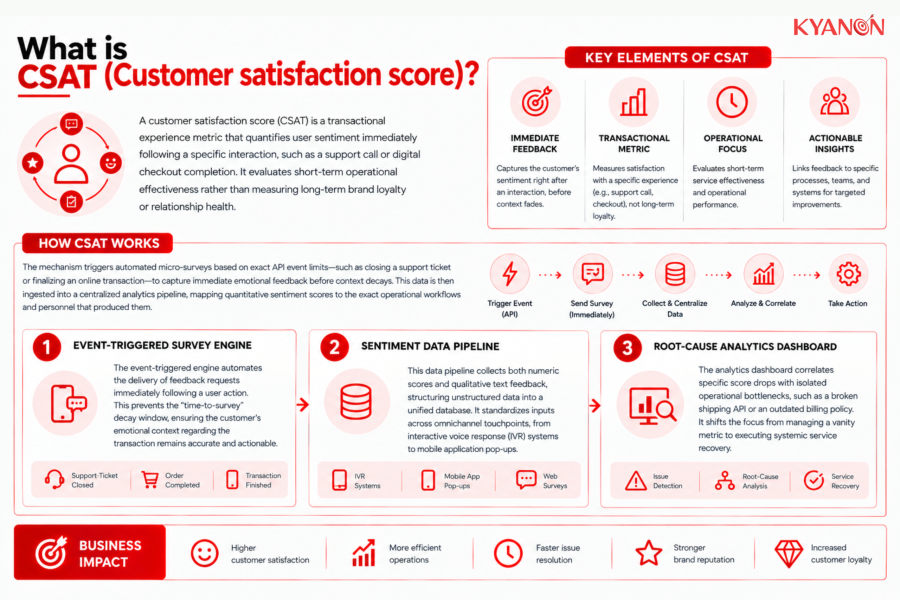
A customer satisfaction score (CSAT) is a transactional experience metric that quantifies user sentiment immediately following a specific interaction, such as a support call or digital checkout completion. It evaluates short-term operational effectiveness rather than measuring long-term brand loyalty or relationship health.
How CSAT works
The mechanism triggers automated micro-surveys based on exact API event limits-such as closing a support ticket or finalizing an online transaction-to capture immediate emotional feedback before context decays. This data is then ingested into a centralized analytics pipeline, mapping quantitative sentiment scores to the exact operational workflows and personnel that produced them.
Event-Triggered Survey Engine
The event-triggered engine automates the delivery of feedback requests immediately following a user action. This prevents the “time-to-survey” decay window, ensuring the customer’s emotional context regarding the transaction remains accurate and actionable.
Sentiment Data Pipeline
This data pipeline collects both numeric scores and qualitative text feedback, structuring unstructured data into a unified database. It standardizes inputs across omnichannel touchpoints, from interactive voice response (IVR) systems to mobile application pop-ups.
Root-Cause Analytics Dashboard
The analytics dashboard correlates specific score drops with isolated operational bottlenecks, such as a broken shipping API or an outdated billing policy. It shifts the focus from managing a vanity metric to executing systemic service recovery.

CSAT vs NPS (Net Promoter Score)
Both metrics capture customer sentiment, but they differ entirely in their timeframe and predictive operational scope.
Dimension | CSAT | NPS (Net Promoter Score) |
| Measurement scope | Transactional (Specific event) | Relational (Overall brand health) |
Timing of delivery | Immediate post-interaction | Periodic (Quarterly/Annually) |
| Predictive value | Short-term operational friction | Long-term loyalty and churn risk |
Core question asked | “How satisfied were you with X?” | “How likely are you to recommend us?” |
| Best used by | Support, product, and IT operations | Executive and marketing leadership |
When to consider CSAT
Consider implementing csat if:
- Your technical support resolution times are technically decreasing, but qualitative complaints regarding agent efficacy or rushed solutions are simultaneously increasing.
- You recently deployed a new digital checkout interface and require immediate, transaction-level feedback on UI friction before scaling it across the entire enterprise.
- Your operational leadership demands a quantifiable baseline to measure the immediate performance impact of a recent backend software migration on front-line customer interactions.
It may not be the right priority if:
- Your primary strategic objective is tracking long-term brand loyalty and calculating aggregate customer lifetime value across a multi-year subscription lifecycle.
Why CSAT matters for Enterprise Operations
Relying exclusively on high-level relationship metrics masks isolated process failures within individual departments or digital channels. Implementing a transactional measurement framework allows technical and operational leaders to pinpoint exact friction points-such as a flawed self-service authentication portal-preventing minor technical defects from escalating into systemic customer churn.
PwC’s 2026 analysis emphasizes that customer experience and operational performance increasingly depend on integrating technology, data, and workflows. It notes that organizations need to move beyond efficiency metrics and understand whether changes actually improve support effectiveness and customer outcomes.
Common Misconceptions
If a customer gives us a 5-star rating on their support ticket, they are loyal and won’t churn
Reality: Satisfaction is a dangerously low bar; a customer can appreciate a polite agent who reset their password quickly but still abandon the brand due to high pricing or a poor core product. This metric solely evaluates sentiment about a specific transaction, not long-term loyalty to the brand.
Our 95% positive score proves our entire customer base is extremely happy with our service
Reality: These surveys suffer from severe selection bias, typically attracting only highly frustrated users looking to vent or highly enthusiastic brand advocates. Furthermore, customers often rate the friendliness of the agent rather than the efficacy of the technical solution, artificially inflating operational performance data.
We need to penalize any support agent whose average scores fall below our strict 90% target
Reality: Forcing front-line staff to chase numerical targets leads to toxic operational behaviors, such as agents begging customers for good ratings before hanging up. A drop in the metric is an indicator of an underlying process or product defect that requires structural fixing, not an invitation to micromanage personnel.
We send our feedback surveys out every Friday for all the tickets closed that week, which is perfectly fine
Reality: Transactional sentiment decays rapidly, and if an issue is resolved on Tuesday but the survey arrives on Friday, the emotional context is entirely lost. Customers will either ignore the delayed outreach entirely or rate it poorly simply out of annoyance at the delayed notification.
How Kyanon Digital applies CSAT
Kyanon Digital implements csat measurement frameworks for enterprise clients as a critical component of comprehensive CX analytics programs. Serving organizations across Vietnam, Singapore, Malaysia, Thailand, ANZ, and Malaysia, our engineering teams focus on connecting transactional scores directly to core operational drivers. We construct automated data pipelines that funnel qualitative feedback straight to IT and product owners, bypassing superficial reporting to enable rapid service recovery, reduce friction, and lower the total cost of ownership (TCO) of your digital operations.
Explore our services:

 Create project brief with AI