
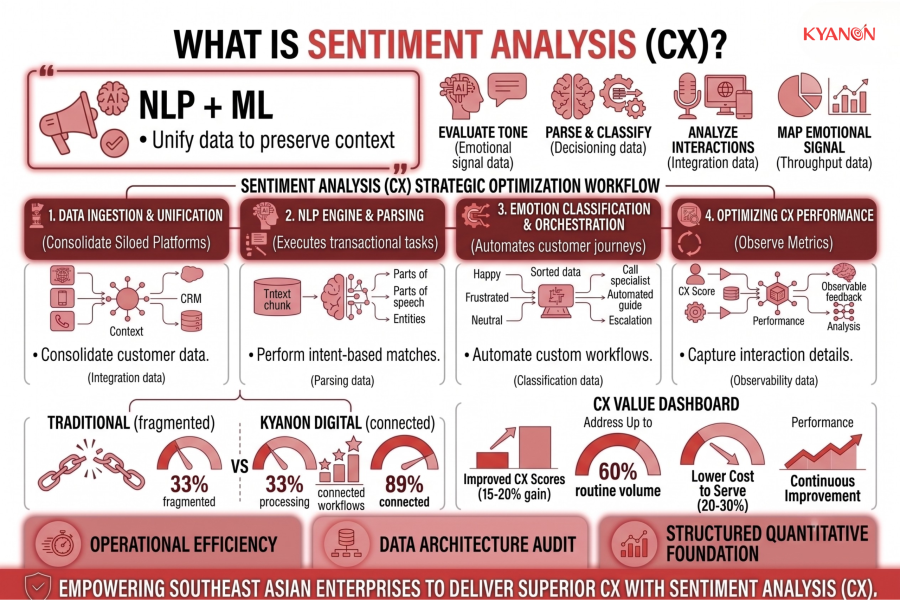
What is Sentiment Analysis (CX)?
Sentiment Analysis (CX) is the process of using natural language processing (NLP) and machine learning algorithms to automatically evaluate, parse, and classify the emotional tone expressed in unstructured customer interactions across digital and voice touchpoints.
How Sentiment Analysis (CX) Works
Enterprise sentiment analysis helps businesses understand how customers feel by turning large volumes of customer interactions, such as messages, reviews, calls, and support conversations, into clear CX insights.
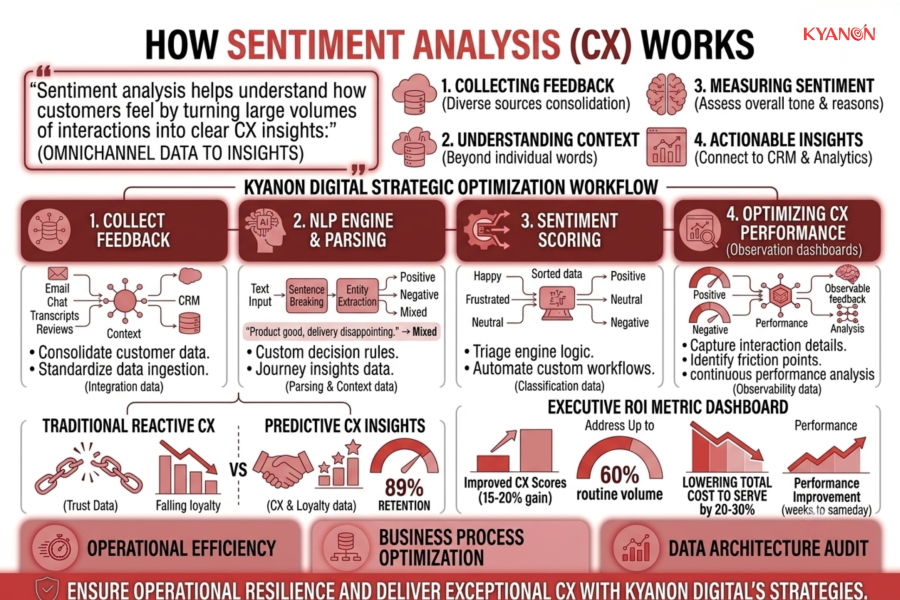
The process typically follows four simple stages:
Collecting Customer Feedback
The system brings customer feedback together from different channels, including:
- Customer service chats and emails
- Call transcripts
- Online reviews and social media
- Surveys and other feedback channels
The information is then cleaned and organized so it can be analyzed consistently across channels and languages.
Understanding What Customers Mean
The system looks beyond individual words to understand the context and intent behind a customer’s message.
For example, it can distinguish between:
- “The delivery was great.” → Positive
- “The delivery was late again.” → Negative
- “The product is good, but the delivery was disappointing.” → Mixed
This helps reduce misunderstandings when customers use different expressions, negative wording, or industry-specific terms.
Measuring Customer Sentiment
Each interaction is assessed based on its overall tone, such as:
- Positive – customer is satisfied or expressing appreciation
- Neutral – customer is asking for information or sharing feedback without strong emotion
- Negative – customer is frustrated, dissatisfied, or reporting a problem
The system can also identify common reasons behind the sentiment, such as delivery issues, product quality, pricing, or customer service.
Turning Insights Into Action
The results can be connected to CRM and analytics platforms, giving customer-facing teams a clearer view of CX trends.
For example:
- Flag negative interactions that may need immediate attention
- Help support teams prioritize frustrated customers
- Identify recurring customer complaints
- Track changes in customer sentiment over time
- Give managers a broader view of customer experience

Comparative Analysis: Traditional CSAT Surveys vs. Real-Time Sentiment Analysis (CX)
Dimension | Traditional CSAT Surveys | Real-Time Sentiment Analysis (CX) |
| Data Source | Post-interaction survey responses | 100% of unstructured omnichannel touchpoints |
Response Coverage | Low sample size (typically < 5% response) | Total coverage of all active interactions |
| Feedback Timing | Delayed, post-event reporting | Instant, real-time conversational processing |
Metric Depth | Explicit, numerical ratings | Nuanced emotional tone and intent context |
| Operational Trigger | Retrospective manual escalation | Automated real-time workflow interventions |
Why Sentiment Analysis (CX) Matters
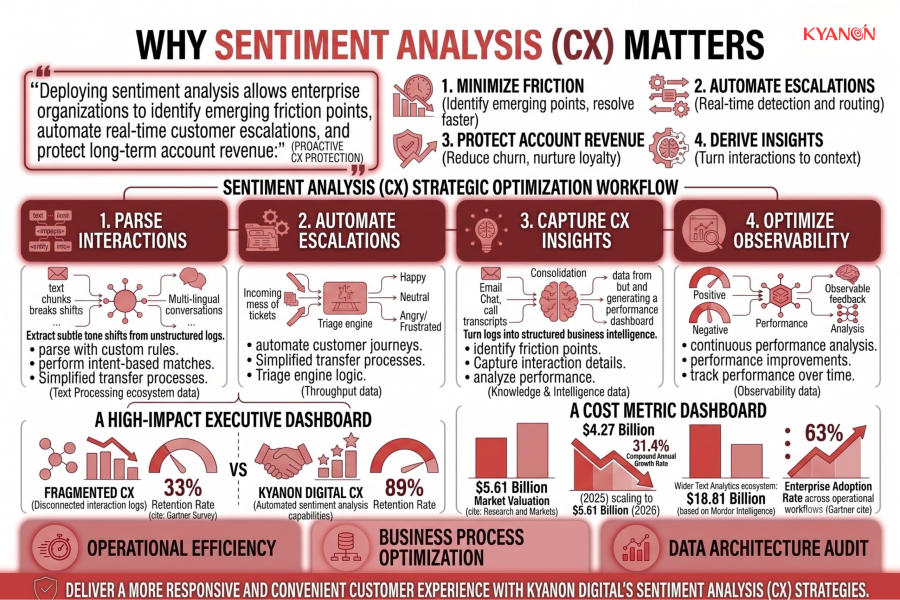
Deploying sentiment analysis allows enterprise organizations to identify emerging friction points, automate real-time customer escalations, and protect long-term account revenue.
According to a report by Research and Markets, the global sentiment analytics systems market reached USD 5.61 billion in 2026, scaling from USD 4.27 billion in 2025 at a 31.4% compound annual growth rate. This investment cycle reflects a broad shift toward integrating real-time emotion tracking natively into enterprise CRM platforms and cloud data architectures. Furthermore, research from Gartner indicates that 63% of enterprise CX teams have fully implemented automated sentiment analysis capabilities into at least one core operational workflow.
Underlying these capabilities is a rapidly expanding text processing ecosystem. Industry analyses from Mordor Intelligence show that the broader text analytics ecosystem reached USD 18.81 billion in 2026. Integrating generative AI and deep natural language understanding allows technical teams to parse multi-lingual conversations and extract subtle tone shifts, transforming unstructured support logs into structured business intelligence.
Common Misconceptions
It knows exactly how my customers feel
Sentiment tools evaluate linguistic patterns and vocabulary choices rather than human emotions. When a customer uses heavy sarcasm, such as typing “Oh, great. Another delay. Fantastic.”, a basic system misinterprets positive keywords like “great” and “fantastic” as high satisfaction. Organizations must view sentiment scores as broad directional indicators rather than absolute emotional assessments.
Once we turn it on, we can stop doing surveys
Sentiment scores identify negative sentiment spikes across customer conversations, but they rarely reveal the underlying operational root cause. While automated scoring flags rising customer frustration, pinpointing whether the issue stems from software outages, shipping delays, or poor agent conduct requires targeted follow-up surveys and human review.
It is 100% accurate and automated
Out-of-the-box sentiment models typically achieve only 55% to 65% accuracy because human language is inherently subjective and contextual. Achieving high classification accuracy requires continuous domain tuning, custom vocabulary training, and human-in-the-loop validation to ensure the software understands industry-specific phrasing.
We only need to track the text in support tickets
Restricting analysis to written support tickets creates significant blind spots across the customer base. Highly dissatisfied customers frequently churn without ever submitting a ticket, while vocal users express frustration across public review sites and social channels. Comprehensive monitoring requires analyzing sentiment across all communication touchpoints, including social media, product reviews, and phone transcripts.
How Kyanon Digital Applies Sentiment Analysis (CX)
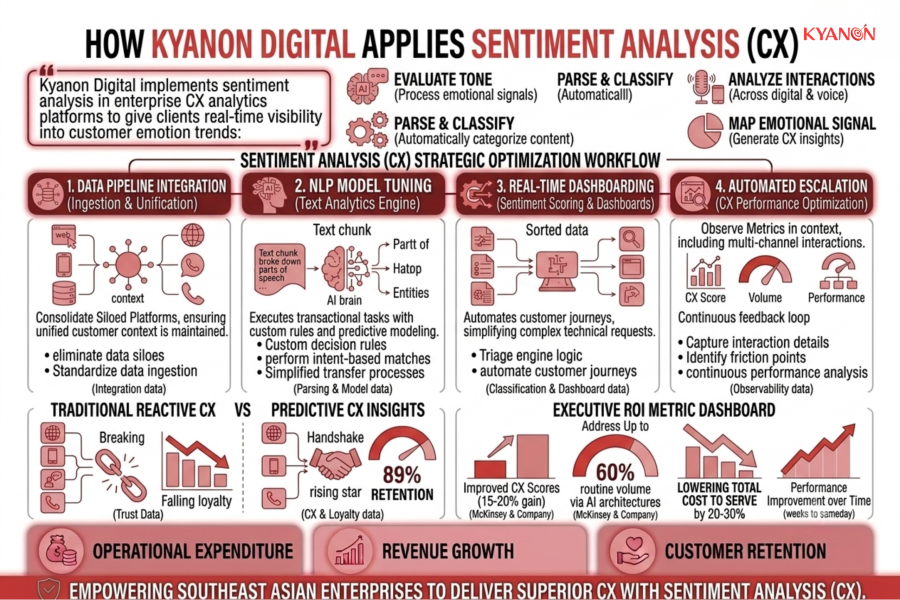
Kyanon Digital implements sentiment analysis in enterprise CX analytics platforms to give clients real-time visibility into customer emotion trends. We build end-to-end data pipelines, integrate advanced NLP models into custom CRM workspaces, and design automated escalation triggers that empower customer operations teams to address friction before churn occurs.
Explore our services:

 Create project brief with AI