
What is brand experience?
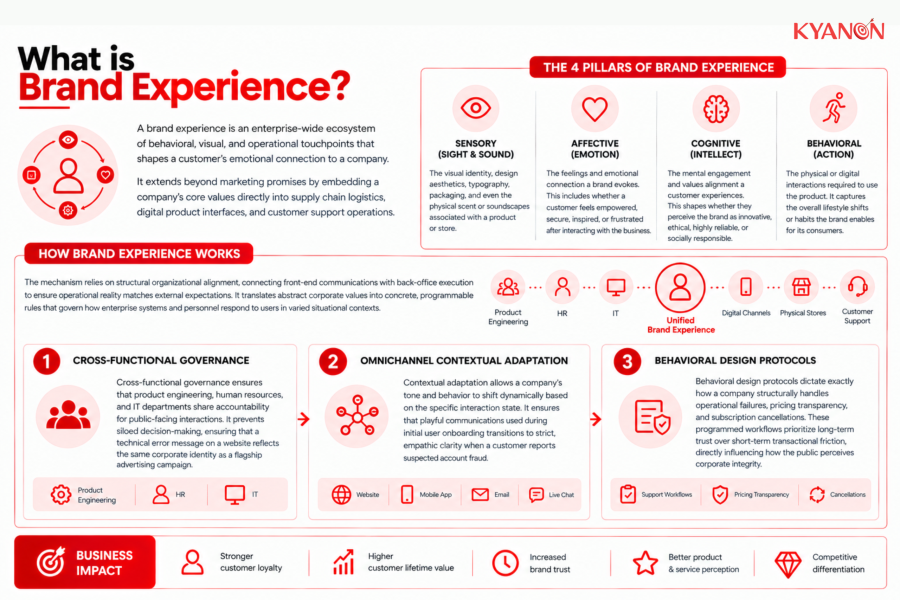
A brand experience is an enterprise-wide ecosystem of behavioral, visual, and operational touchpoints that shapes a customer’s emotional connection to a company. It extends beyond marketing promises by embedding a company’s core values directly into supply chain logistics, digital product interfaces, and customer support operations.
The 4 pillars of brand experience
- Sensory (Sight & Sound): The visual identity, design aesthetics, typography, packaging, and even the physical scent or soundscapes associated with a product or store.
- Affective (Emotion): The feelings and emotional connection a brand evokes. This includes whether a customer feels empowered, secure, inspired, or frustrated after interacting with the business.
- Cognitive (Intellect): The mental engagement and values alignment a customer experiences. This shapes whether they perceive the brand as innovative, ethical, highly reliable, or socially responsible.
- Behavioral (Action): The physical or digital interactions required to use the product. It captures the overall lifestyle shifts or habits the brand enables for its consumers.

How brand experience works
The mechanism relies on structural organizational alignment, connecting front-end communications with back-office execution to ensure operational reality matches external expectations. It translates abstract corporate values into concrete, programmable rules that govern how enterprise systems and personnel respond to users in varied situational contexts.
Cross-Functional Governance
Cross-functional governance ensures that product engineering, human resources, and IT departments share accountability for public-facing interactions. It prevents siloed decision-making, ensuring that a technical error message on a website reflects the same corporate identity as a flagship advertising campaign.
Omnichannel Contextual Adaptation
Contextual adaptation allows a company’s tone and behavior to shift dynamically based on the specific interaction state. It ensures that playful communication used during initial user onboarding transitions to strict, empathetic clarity when a customer reports suspected account fraud.
Behavioral Design Protocols
Behavioral design protocols dictate exactly how a company structurally handles operational failures, pricing transparency, and subscription cancellations. These programmed workflows prioritize long-term trust over short-term transactional friction, directly influencing how the public perceives corporate integrity.
Brand experience vs Customer Experience (CX)
Both disciplines shape public perception, but they evaluate distinct layers of the interaction lifecycle.
|
Dimension |
Brand experience | Customer Experience (CX) |
| Primary focus | Emotional connection and identity |
Functional efficiency and usability |
|
Metric of success |
Customer Lifetime Value (CLV), Price premium | Task completion rate, Hold times |
| Operational scope | Enterprise-wide (HR, IT, Supply Chain) |
Specific interaction touchpoints |
|
Emotional depth |
High (Aligns with personal values) | Moderate (Focuses on ease of use) |
| Execution ownership | Co-authored by all departments |
Often managed by dedicated support teams |
When to consider brand experience
Consider brand experience if:
- Your marketing campaigns generate high initial traffic, but customers churn immediately upon discovering your post-purchase software interface lacks the sophistication promised in your advertisements.
- You operate in a highly commoditized market where functional utility is identical across competitors, necessitating emotional differentiation to maintain pricing margins.
- Internal departmental silos cause your mobile app, physical retail stores, and call centers to project entirely different communication tones and policies.
It may not be the right priority if:
- You operate a purely transactional, white-label wholesale manufacturing organization where B2B buyers evaluate suppliers exclusively on raw material cost and delivery speed.
Why brand experience matters for Enterprise Organizations
Fragmented corporate identities directly accelerate customer churn and increase customer acquisition costs (CAC). Aligning marketing promises with functional operational reality generates a measurable price premium, allowing businesses to avoid margin-eroding discount wars while driving organic word-of-mouth acquisition.
PwC’s 2025 Customer Experience Survey, covering 5,511 consumers and 406 executives, found that 29% of consumers had stopped using or buying from a brand because of poor customer experience, either online or in person. PwC also found that 70% of executives said customer expectations were evolving faster than their organizations could adapt.
This makes brand experience a revenue-protection issue. A strong brand promise has limited commercial value if the actual experience across digital channels, customer service, stores, or post-purchase support does not deliver on it.
Common Misconceptions
Our marketing department owns the brand, so they are entirely responsible for the brand experience
Reality: Marketing only controls the promise of the brand, while the actual interactions are co-authored by product, customer support, IT, and supply chain. If a luxury fashion retailer runs a high-budget ad campaign but its website crashes during checkout or the packaging arrives torn, the entire ecosystem is compromised.
BX and CX are the exact same thing, just different acronyms
Reality: Customer experience focuses on the optimization of specific touchpoints and functional efficiency, whereas the broader framework infuses purpose and identity into those interactions. A digital onboarding process can be functionally flawless but completely forgettable and devoid of personality.
Maintaining a consistent brand means forcing every single channel to look and sound exactly the same
Reality: A mature framework values cohesion over absolute uniformity, requiring a company’s tone to dynamically adapt to the user’s situational reality. Forcing playful humor into a technical error message regarding a locked account will deeply frustrate the user rather than delight them.
We just need to update our typography and website animations to fix our brand perception
Reality: Consumers judge a company by how it behaves, not just how it looks visually. Intentionally designing how your software handles technical mistakes, how transparently you communicate delays, and how easily you allow users to cancel subscriptions impacts public perception far more than a logo redesign.
How Kyanon Digital applies brand experience
Kyanon Digital helps enterprise clients design and deliver consistent brand experiences across digital channels as part of omnichannel transformation programs. We establish structural alignment between front-end digital interfaces and backend fulfillment systems for organizations across Vietnam, Singapore, Thailand, ANZ, and Malaysia. Our engineering and strategy teams configure technology stacks that reflect your core corporate identity while actively reducing total cost of ownership (TCO) and accelerating time-to-market.
Explore our User Experience (UX) Design Services.

 Create project brief with AI