
What is a customer journey map?
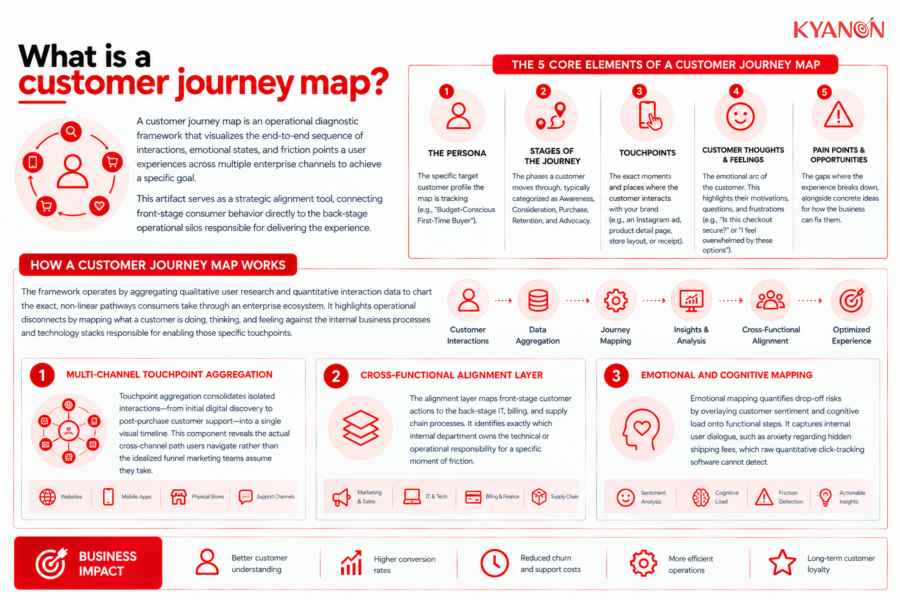
A customer journey map is an operational diagnostic framework that visualizes the end-to-end sequence of interactions, emotional states, and friction points a user experiences across multiple enterprise channels to achieve a specific goal. This artifact serves as a strategic alignment tool, connecting front-stage consumer behavior directly to the back-stage operational silos responsible for delivering the experience.
The 5 core elements of a customer journey map
- The Persona: The specific target customer profile the map is tracking (e.g., “Budget-Conscious First-Time Buyer”).
- Stages of the Journey: The phases a customer moves through, typically categorized as Awareness, Consideration, Purchase, Retention, and Advocacy.
- Touchpoints: The exact moments and places where the customer interacts with your brand (e.g., an Instagram ad, a product detail page, a physical store layout, or an automated receipt).
- Customer Thoughts & Feelings: The emotional arc of the customer. This highlights their motivations, questions, and frustrations at each stage (e.g., “Is this checkout secure?” or “I feel overwhelmed by these options”).
- Pain Points & Opportunities: The gaps where the experience breaks down, alongside concrete ideas for how the business can fix them.

How a customer journey map works
The framework operates by aggregating qualitative user research and quantitative interaction data to chart the exact, non-linear pathways consumers take through an enterprise ecosystem. It highlights operational disconnects by mapping what a customer is doing, thinking, and feeling against the internal business processes and technology stacks responsible for enabling those specific touchpoints.
Multi-Channel Touchpoint Aggregation
Touchpoint aggregation consolidates isolated interactions-from initial digital discovery to post-purchase customer support-into a single visual timeline. This component reveals the actual cross-channel path users navigate rather than the idealized funnel marketing teams assume they take.
Cross-Functional Alignment Layer
The alignment layer maps front-stage customer actions to the back-stage IT, billing, and supply chain processes. It identifies exactly which internal department owns the technical or operational responsibility for a specific moment of friction.
Emotional and Cognitive Mapping
Emotional mapping quantifies drop-off risks by overlaying customer sentiment and cognitive load onto functional steps. It captures internal user dialogue, such as anxiety regarding hidden shipping fees, which raw quantitative click-tracking software cannot detect.
Customer journey map vs Service Blueprint
Both frameworks analyze the customer experience, but they focus on different depths of organizational visibility and execution.
Dimension | Customer journey map | Service Blueprint |
| Primary focus | Customer actions and emotional states | Internal processes and system architecture |
Perspective | Outside-in (The customer’s view) | Inside-out (The business’s operational view) |
| Level of detail | High-level touchpoints and sentiment | Deep backend workflows and employee actions |
Best for | Identifying CX friction and drop-offs | Fixing broken internal delivery systems |
| Target users | Product, Marketing, and CX leaders | IT, Operations, and Engineering teams |
When to consider a customer journey map
Consider a customer journey map if:
- Your enterprise is initiating a large-scale digital transformation program but lacks data on which legacy touchpoints actually drive the highest customer churn.
- Departmental silos cause your users to experience a highly disjointed handoff between digital e-commerce checkouts and physical offline fulfillment centers.
- Your conversion rates are stalling despite high top-of-funnel traffic, indicating hidden behavioral friction in the mid-funnel consideration phase that quantitative analytics cannot explain.
It may not be the right priority if:
- You operate a strictly commoditized, single-touchpoint B2B wholesale model where buyers make purchasing decisions exclusively via automated API price indexing without multi-step evaluation.
Why a customer journey map matters for enterprise digital transformation
Failing to accurately map the consumer path leads IT and engineering teams to over-invest in digital features that do not resolve actual user friction, rapidly inflating the total cost of ownership (TCO). Establishing a validated, data-backed journey baseline ensures that capital expenditure is directed precisely at the operational silos causing the highest revenue leakage.
PwC’s 2025 Customer Experience Survey, based on 5,511 consumers and 406 executives, found that 70% of executives believe customer expectations are evolving faster than their organizations can adapt, while 29% of consumers reported stopping use or purchase because of poor customer experience. PwC specifically recommends analyzing every step of the customer journey to identify friction and using real-time data and AI to improve critical moments.
Common misconceptions
The journey is a straight, predictable line, so we just need to design a linear funnel from awareness to purchase
Reality: Customers loop, skip stages, and stall; they might read a review, look at pricing, drop off for three months, and then buy immediately via a retargeted ad. Effective mapping accounts for a complex web of interactions rather than an idealized, strict linear pipeline.
We know our product best, so our internal product owners and marketing directors can just map this out based on our assumptions
Reality: Mapping without validated customer research-like user interviews, support tickets, and heatmaps-merely produces a visual diagram of internal company biases. If Sales, Product, and Customer Success are not involved, you will miss the critical operational silos where customers actually experience friction.
Once the design team finishes creating the map and presents it to the board, the project is done
Reality: Consumer behavior, technology, and market expectations change constantly. A customer journey map is not a static graphic design project; it is a living, operational framework that requires quarterly or annual updates to accurately diagnose systemic experience failures.
How Kyanon Digital applies a customer journey map
Kyanon Digital uses customer journey mapping as a foundational discovery tool in CX transformation engagements for enterprise clients across Vietnam, Singapore, Thailand, ANZ, and Nordic Europe. Rather than treating mapping as an isolated design exercise, our engineering and strategy teams use these operational frameworks to ensure digital investments are explicitly prioritized by customer impact. We connect front-stage user friction directly to back-stage technology gaps, accelerating time-to-market and reducing TCO by fixing exactly what matters most to your users.
Explore our IT Customer Experience Services.

 Create project brief with AI