
What is funnel analytics (CX)?
Funnel analytics (CX) is the analysis of how a defined population progresses through an ordered set of customer journey stages, identifying conversion rates, drop-off, and time between steps.
How funnel analytics (CX) works
Funnel analytics compares observed events with an explicit sequence and measurement window. Results depend on whether users must enter at the first step, whether intervening events are allowed, and whether analysis counts people, sessions, or accounts.
Stage and population definitions
Define meaningful stages such as application started, identity verified, and application submitted. Keep eligibility, event naming, and deduplication consistent so a tracking change is not mistaken for a behavioral change.
Conversion and elapsed time
Stage conversion equals the population reaching the next stage divided by the eligible population at the previous stage. Overall conversion uses the defined entry population, while elapsed time highlights delays that a conversion percentage alone can miss.
Segmentation and investigation
Compare device, channel, customer type, and error conditions. A drop-off identifies where to investigate; interviews, usability testing, and operational logs help establish why it occurs.
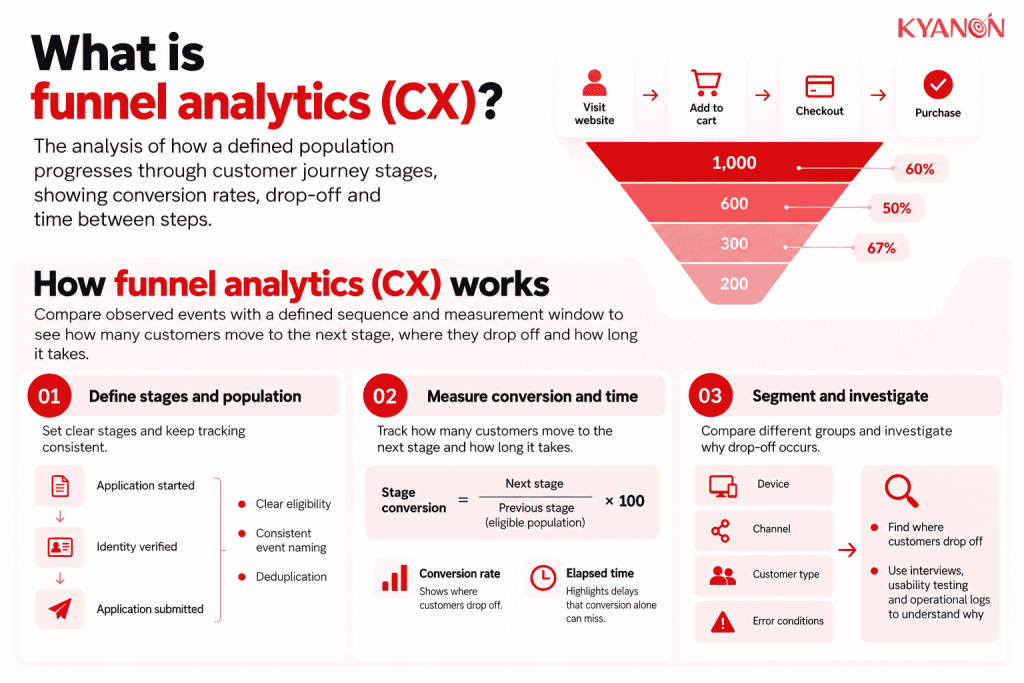

How do you read a conversion funnel?
For a defined cohort, step conversion equals customers reaching the next step divided by customers reaching the current step. Overall conversion uses the first step as its denominator. In an illustrative funnel, 1,000 customers start, 400 reach checkout and 200 purchase: start-to-checkout conversion is 40%, checkout-to-purchase is 50%, and overall conversion is 20%.
Specify event order, counting unit and completion window before comparing results. In Google Analytics, a closed funnel requires users to enter at the first step, while an open funnel allows users to enter at later steps. Users are counted according to the specified sequence. Check missing events and cross-device identity before treating drop-off as customer dissatisfaction. Segment the largest loss by device, acquisition source, or customer type, and use qualitative evidence to investigate why it occurs.
What causes funnel drop-off
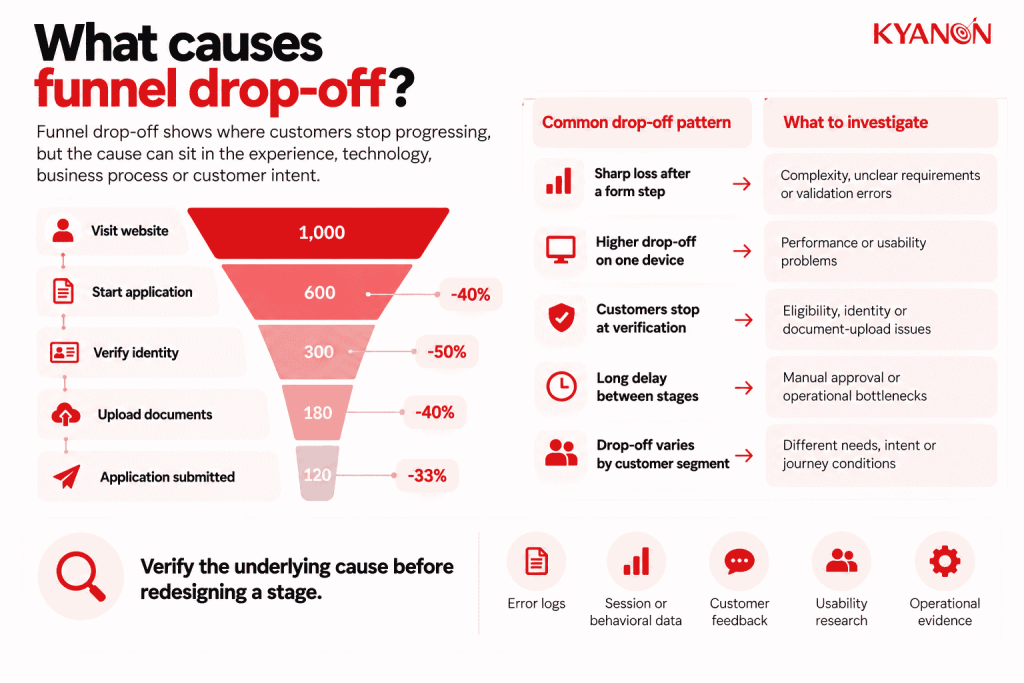
Funnel drop-off shows where customers stop progressing, but not automatically why. The cause may sit in the experience, technology, business process, or customer intent.
Drop-off pattern | What to investigate |
Sharp loss after a form step | Complexity, unclear requirements, or validation errors |
| Higher drop-off on one device | Performance or usability problems |
Customers stop at verification | Eligibility, identity, or document-upload issues |
| Long delay between stages | Manual approval or operational bottlenecks |
Drop-off varies by customer segment | Different needs, intent, or journey conditions |
Before redesigning a stage, verify the underlying cause with error logs, session or behavioral data, customer feedback, usability research, and operational evidence.
How should businesses prioritize funnel drop-offs?
Prioritize funnel drop-offs by business impact and fixability, not percentage loss alone. A smaller drop-off near a high-value conversion may matter more than a larger loss among low-intent visitors.
Evaluate each gap against four questions:
- Volume: How many eligible customers are affected?
- Value: How important is successful completion to the business?
- Cause: Is the loss avoidable or expected customer behavior?
- Fixability: Is there a specific UX, technical, or operational intervention to test?
This turns funnel analytics from reporting into a decision tool: identify the conversion gap, establish its likely cause, prioritize the business impact, and test whether an intervention improves progression.
Funnel analytics (CX) vs. journey analytics
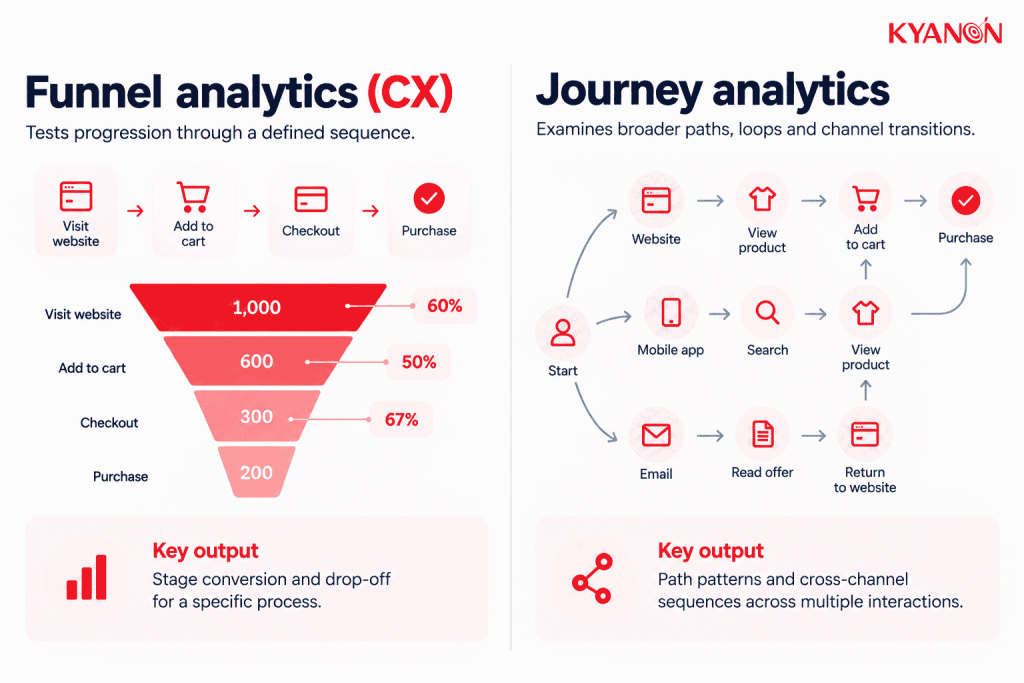
Funnel analytics tests progression through a defined sequence; journey analytics examines broader paths, loops, and channel transitions.
| Dimension | Funnel Analytics (CX) | Journey Analytics |
Structure | Predefined stages | Observed end-to-end paths |
| Question | Where do people stop progressing? | Which paths relate to outcomes? |
Scope | A bounded conversion process | Multiple interactions and processes |
| Typical output | Stage conversion and drop-off | Path patterns and cross-channel sequences |
Best use | Checkout, registration, applications | Service journeys and lifecycle diagnosis |
When to consider funnel analytics (CX)
Consider funnel analytics (CX) when the following conditions affect customer outcomes or operational control:
- A high-traffic website produces fewer completed orders or applications than expected
- Teams disagree about which journey stage creates the largest loss
- A new release changes completion rates, and you need to isolate affected customer groups
It may not be the right priority if:
A detailed funnel may be premature when events are missing or the population is too small for meaningful comparisons. Validate the instrumentation and use qualitative evidence first.
Why funnel analytics (CX) matters for e-commerce and digital services
Funnel analytics helps organizations focus improvement work on measurable progression problems. A useful analysis separates customer intent, technical failure, and process delay instead of treating every abandonment as recoverable revenue.
For example, Kyanon Digital worked with a premium accommodation provider whose fragmented marketing, booking, and service systems created drop-off and limited visibility into booking funnels.

Explore Kyanon Digital’s CX-driven booking and resident experience platform case study.
The resulting CX platform provided visibility into the booking journey so the business could identify friction and continuously optimize conversion. The case illustrates why funnel analytics becomes more valuable when progression data can lead to a specific CX or platform intervention.
Common misconceptions
“The biggest drop-off is automatically the biggest opportunity.”
Reality: Some visitors are researching or fail legitimate eligibility requirements. Prioritize avoidable losses using intent, value, and the feasibility of a fix.
“The funnel tells us why customers leave.”
Reality: The funnel shows a behavioral pattern. Establish the cause with additional evidence before selecting a design or engineering intervention.
How Kyanon Digital applies funnel analytics (CX)
Kyanon Digital implements funnel analytics for e-commerce and digital services by connecting event instrumentation, customer segmentation, and business outcome reporting. Definitions can be aligned across analytics and operational systems so teams can trace a conversion gap to a specific journey condition. The analysis supports a measurable backlog of UX and platform improvements.
Explore Kyanon Digital’s data and analytics services.

 Create project brief with AI