
What is emotional intelligence (CX)?
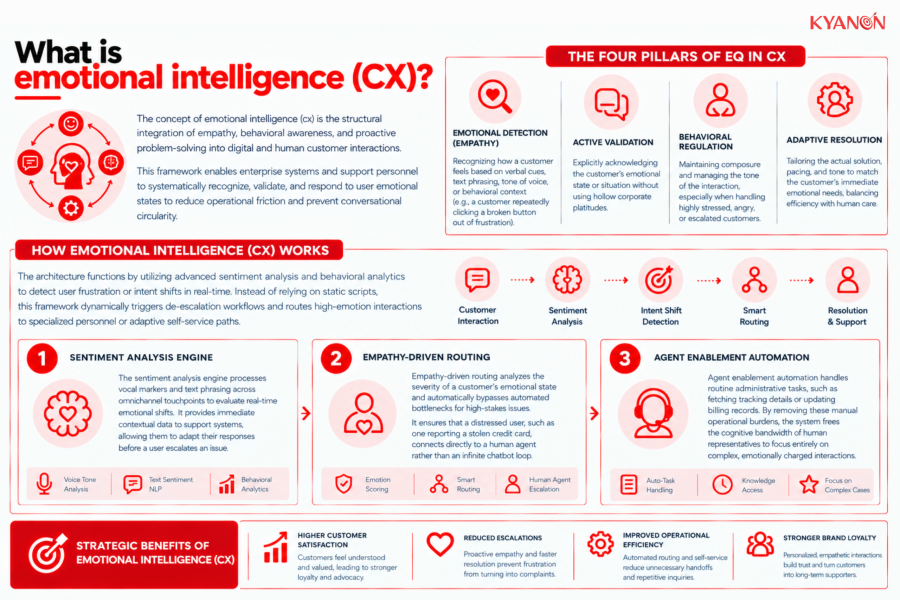
The concept of emotional intelligence (cx) is the structural integration of empathy, behavioral awareness, and proactive problem-solving into digital and human customer interactions. This framework enables enterprise systems and support personnel to systematically recognize, validate, and respond to user emotional states to reduce operational friction and prevent conversational circularity.
The Four Pillars of EQ in CX
- Emotional Detection (Empathy): Recognizing how a customer feels based on verbal cues, text phrasing, tone of voice, or behavioral context (e.g., a customer repeatedly clicking a broken button out of frustration).
- Active Validation: Explicitly acknowledging the customer’s emotional state or situation without using hollow corporate platitudes.
- Behavioral Regulation: Maintaining composure and managing the tone of the interaction, especially when handling highly stressed, angry, or escalated customers.
- Adaptive Resolution: Tailoring the actual solution, pacing, and tone to match the customer’s immediate emotional needs, balancing efficiency with human care.

How emotional intelligence (CX) works
The architecture functions by utilizing advanced sentiment analysis and behavioral analytics to detect user frustration or intent shifts in real-time. Instead of relying on static scripts, this framework dynamically triggers de-escalation workflows and routes high-emotion interactions to specialized personnel or adaptive self-service paths.
Sentiment Analysis Engine
The sentiment analysis engine processes vocal markers and text phrasing across omnichannel touchpoints to evaluate real-time emotional shifts. It provides immediate contextual data to support systems, allowing them to adapt their responses before a user escalates an issue.
Empathy-Driven Routing
Empathy-driven routing analyzes the severity of a customer’s emotional state and automatically bypasses automated bottlenecks for high-stakes issues. It ensures that a distressed user, such as one reporting a stolen credit card, connects directly to a human agent rather than an infinite chatbot loop.
Agent Enablement Automation
Agent enablement automation handles routine administrative tasks, such as fetching tracking details or updating billing records. By removing these manual operational burdens, the system frees the cognitive bandwidth of human representatives to focus entirely on complex, emotionally charged interactions.
Emotional intelligence (CX) vs Superficial Politeness
Both concepts dictate how a business speaks to a customer, but they yield entirely different operational outcomes.
Dimension | Emotional intelligence (CX) | Superficial Politeness |
| Interaction goal | Systemic problem resolution | Delivering scripted apologies |
Customer perception | Validated and understood | Frustrated by corporate friction |
| Operational impact | Reduces conversational circularity | Increases Average Handle Time (AHT) |
Implementation depth | Embedded across UX and personnel | Limited to front-line agent scripts |
| Resolution speed | High (Immediate, decisive action) | Low (Delayed by forced empathy) |
When to consider emotional intelligence (CX)
Consider emotional intelligence (CX) if:
- High-value enterprise clients are escalating complaints to executive levels because they feel automated chatbots completely misunderstand the urgency of their billing issues.
- Your contact center’s First Contact Resolution (FCR) rate is dropping, as customers caught in conversational circularity require multiple follow-up calls to feel their problem is genuinely understood.
- You are deploying AI self-service tools and need to ensure the automated workflows do not accidentally alienate users during high-stress transactional failures.
It may not be the right priority if:
- Your business operates a strictly low-touch, frictionless API-as-a-service model where users exclusively require raw technical uptime rather than consultative, human-centric support.
Why emotional intelligence (CX) matters for enterprise support
Failing to recognize and adapt to user sentiment structurally alienates buyers and accelerates churn, regardless of how functionally efficient a platform appears. Embedding empathetic design across the digital ecosystem directly lowers operational costs by defusing tension early, which prevents follow-up contacts and improves total customer lifetime value.
PwC’s 2025 Customer Experience Survey, covering 5,511 consumers and 406 executives, found that 29% of consumers had stopped using or buying from a brand because of poor customer experience, while 52% stopped because of a bad product or service experience. PwC also found that 86% of consumers consider human interaction moderately or very important in their brand experience.
Common misconceptions
EQ in CX just means our agents need to be nice, smile, and apologize repeatedly
Reality: Superficial politeness or forced, scripted empathy often deeply frustrates customers who are already upset. True empathy relies on active validation and immediate, decisive action; customers want their problem systematically understood and fixed without corporate friction.
Emotional intelligence is completely abstract and cannot be measured or tracked in a contact center
Reality: This capability is highly measurable through advanced sentiment analysis and behavioral analytics software. Companies track specific metrics like Customer Sentiment Scores (CSS) and customer effort reduction by monitoring real-time vocal markers or text phrasing.
Applying EQ slows down resolution times and destroys our operational efficiency
Reality: Contact center executives often fear that forming an emotional connection will spike Average Handle Time (AHT). In reality, applying empathy early defuses tension quickly and prevents conversational circularity, which directly improves First Contact Resolution (FCR) rates and lowers overall operational costs.
AI and automation are the enemies of emotional intelligence
Reality: Artificial intelligence actually acts as an enablement layer for empathetic interactions. By automating routine administrative tasks, technology frees up the cognitive bandwidth of human agents, allowing them to focus entirely on complex, emotionally charged interactions.
How Kyanon Digital applies emotional intelligence (CX)
Kyanon Digital incorporates emotional intelligence (cx) into CX transformation projects, ensuring enterprise clients design touchpoints that are appropriately empathetic across digital and human channels. Operating across Vietnam, Singapore, Thailand, ANZ, and Nordic Europe, our engineering and experience teams build automated routing systems and sentiment analysis layers that prevent user friction. We focus on integrating proactive behavioral awareness into your core architecture, enabling your support teams to systematically defuse tension and accelerate issue resolution without increasing operational overhead.
Explore our CX Transformation services:

 Create project brief with AI