
What is Social Listening?
Social listening is the process of tracking, aggregating, and analyzing unsolicited digital conversations across social media, forums, review platforms, and online communities to uncover actionable business intelligence. By capturing real-time consumer sentiment and emerging market trends, it enables enterprise organizations to optimize customer experience strategies and drive revenue growth.
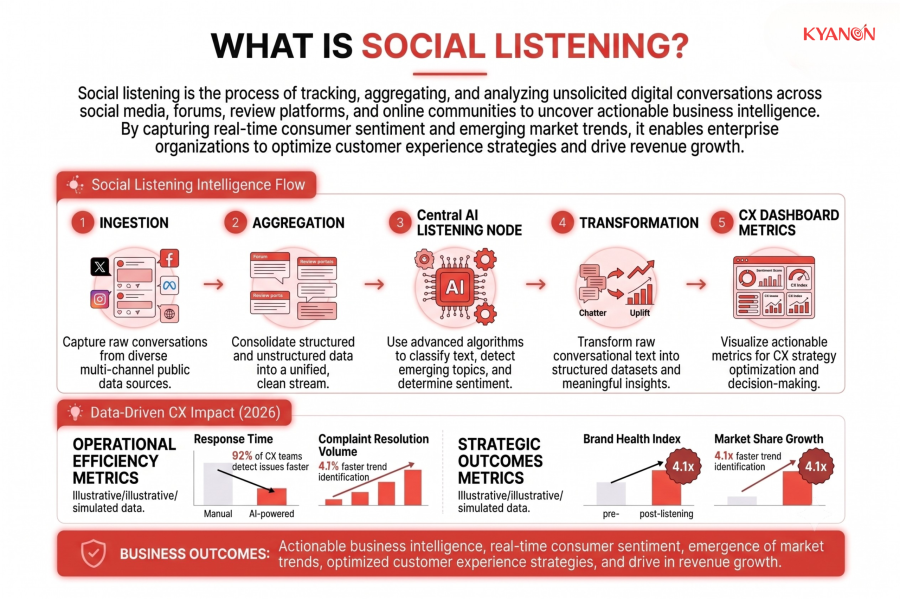
How Social Listening Works
End-to-end technical process flow from raw data ingestion to actionable CX integrations.
Social listening works by systematically gathering public online conversations, filtering out noise, and translating raw human feedback into clear, actionable business insights.
Ingestion & Data Aggregation
Automated systems continuously scan public channels, including social networks, forums, review sites, and message boards, using official data connections (APIs). Key functions include:
- Multi-Source Scanning: Capturing public posts, comments, audio transcripts, and video captions in real time.
- Keyword & Topic Tracking: Filtering data based on specific brand names, products, competitors, or industry keywords.
Natural Language Processing (NLP) & Context Parsing
Advanced language processing models interpret raw text to evaluate human intent and emotion. Key capabilities include:
- Sentiment Classification: Categorizing mentions as positive, negative, or neutral.
- Contextual & Local Parsing: Accounting for local slang, regional accents, and contextual nuances to ensure high analytical accuracy.
Operationalization & CX Integration
Processed data connects directly to internal workflows and business systems to enable immediate action:
- Automated Alerts: Triggering instant notifications for urgent customer service issues or emerging crises.
- Product Roadmap Planning: Feeding unprompted user feedback directly into feature development backlogs.
- Executive Dashboards: Updating strategic management views to support data-backed decision-making.

Comparative Analysis: Social Listening vs. Social Monitoring
Key Differences Between Social Monitoring and Social Listening
Dimension | Social Monitoring | Social Listening |
| Core Focus | Tactical tracking of volume, direct @mentions, and tags | Strategic analysis of underlying sentiment, intent, and cultural trends |
Operational Mindset | Reactive crisis management and direct support responses | Proactive identification of market opportunities and systemic friction |
| Data Scope | Owned social channels and targeted brand notifications | Broad digital web footprint, including unbranded and third-party forums |
Primary Outcome | Speed-to-resolution for specific customer tickets | Multi-departmental strategy alignment (Product, Marketing, CX) |
| Business Impact | Short-term ticket clearance and resolution rate optimization | Long-term brand equity improvement, TCO reduction, and revenue growth |
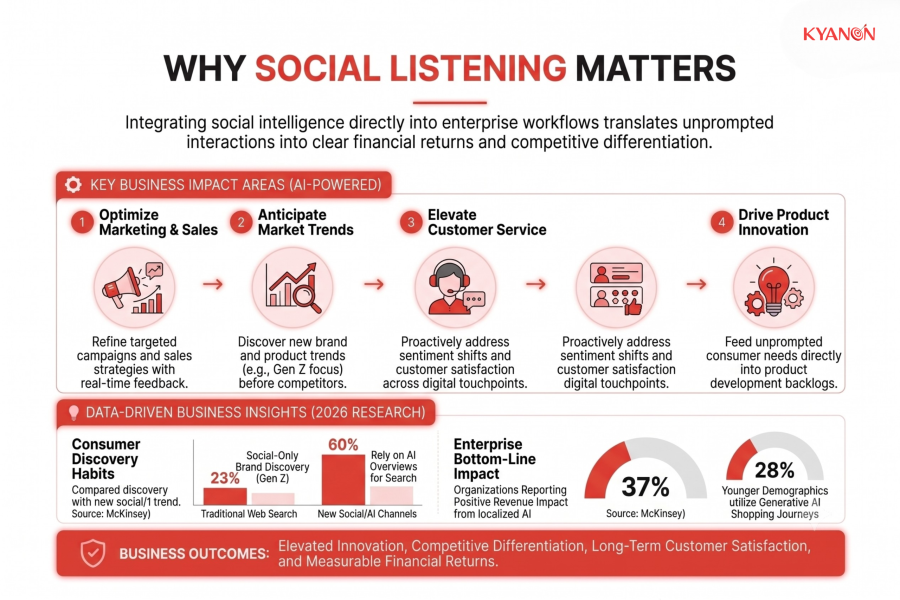
Why Social Listening Matters
Modern consumer discovery and decision-making habits have fundamentally pivoted away from physical storefronts and traditional web searches. State of Consumer 2026 research highlights that 23% of Gen Z consumers discover new brands purely through social channels, while 60% regularly rely on AI overviews positioned at the top of search ecosystems. Furthermore, 28% of younger demographics actively utilize generative AI tools to direct their daily shopping journeys, making social channels the definitive front door for digital commerce.
Integrating social intelligence directly into enterprise workflows translates these unprompted interactions into clear financial returns. According to McKinsey & Company, revenue gains are most frequently attributed to the deployment of AI within marketing, sales, and service operations, with 37% of surveyed organizations reporting clear positive bottom-line impacts from localized business functions. Capturing real-time sentiment shifts enables organizations to elevate innovation, establish competitive differentiation, and drive long-term customer satisfaction metrics across digital touchpoints.
Common Misconceptions
Conflating Monitoring with Listening
Social monitoring is reactive and looks at what happened through basic metric volume. Social listening is proactive, aggregating data to understand the underlying drivers behind consumer behavior, market gaps, and broad cultural shifts.
More Data Equals Better Insights
Sucking in millions of data points does not automatically guarantee strategic clarity. Mass data creates immense noise and pulls in irrelevant context, requiring sophisticated ingestion filtering before analysis can deliver real value.
Automated Sentiment Analysis is Flawless
Software algorithms cannot perfectly gauge every nuance of online conversation. AI still encounters operational challenges with complex human expression, including heavy sarcasm, localized slang, cultural references, and performative posting.
It Replaces Traditional Market Research
Social data reflects the vocal habits of online users rather than an entire customer base. It captures what people choose to state publicly, meaning it should complement, rather than replace, structured focus groups and primary research.
Your Social Followers Shape the Narrative
Audience members on owned corporate channels rarely represent your primary buyer base. Effective social listening scans community-led spaces like Reddit, Discord, and niche forums where raw, uncurated industry discussions take place.
How Kyanon Digital Applies Social Listening
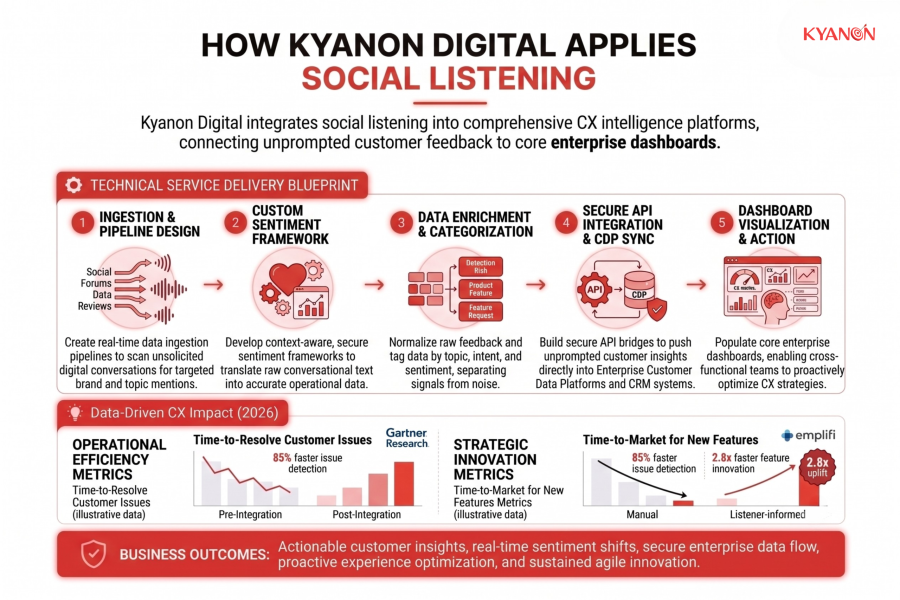
Kyanon Digital integrates enterprise social listening capabilities into comprehensive CX intelligence platforms for consumer-facing enterprises. Our team designs real-time data ingestion pipelines, custom sentiment frameworks, and secure API bridges that feed unprompted customer feedback directly into core enterprise dashboards.
Explore our services:

 Create project brief with AI