
What is eXplainable Gradient Boosting?
eXplainable Gradient Boosting (xGB) is a specialized machine learning approach that combines the predictive power of gradient boosting models with mechanisms that make their decisions transparent, auditable, and understandable to humans. It extends traditional gradient boosting techniques by providing visibility into how individual features contribute to model predictions, helping organizations balance performance with interpretability.
At its core, xGB can be viewed as a hybrid framework that brings together high-performing ensemble models, such as gradient-boosted decision trees, with explainability capabilities. Rather than presenting predictions as opaque outputs, it translates complex decision logic into clear, feature-level contributions that stakeholders can inspect, validate, and trust.
Often described as a bridge between “black-box” machine learning and human understanding, eXplainable Gradient Boosting enables organizations to trace model behavior, understand the factors driving outcomes, and establish greater transparency in AI-driven decision-making. This makes it particularly valuable in environments where accountability, governance, and regulatory compliance are important considerations.

How eXplainable Gradient Boosting Works
eXplainable Gradient Boosting (xGB) works by transforming the outputs of a complex gradient boosting model into a transparent, traceable explanation of how each input variable contributed to a prediction. Rather than treating hundreds of sequential decision trees as an opaque “black box,” xGB decomposes the final prediction into a series of measurable feature contributions that can be inspected and validated by humans.
At a high level, the process begins with a gradient boosting model that learns complex patterns from data through a sequence of decision trees. Once a prediction is generated, explainability mechanisms either analyze the trained model to calculate feature-level attribution scores or use inherently interpretable architectures that expose decision logic directly. The result is a transparent view of which variables increased or decreased the final prediction and by how much.

The Gradient Boosting Ensemble
The foundation of xGB is a gradient boosting architecture such as XGBoost, LightGBM, or CatBoost. Instead of building all decision trees simultaneously, the model trains them sequentially. Each new tree focuses on correcting the prediction errors of the trees that came before it, allowing the ensemble to capture highly complex, non-linear relationships within large datasets.
This iterative error-correction process significantly improves predictive accuracy but also creates a model composed of hundreds or thousands of interconnected decision paths, making the underlying reasoning difficult to interpret without additional explainability mechanisms.
Post-Hoc Attribution Frameworks
To make boosting models interpretable without sacrificing performance, xGB commonly applies post-hoc explanation frameworks such as TreeSHAP after training is complete.
TreeSHAP uses principles from cooperative game theory to calculate how much each feature contributed to an individual prediction. It evaluates the impact of including or excluding a variable across different feature combinations and assigns a precise attribution score, known as a Shapley value, to every input feature.
A key property of this approach is additive attribution: when the baseline prediction and all feature contribution scores are summed together, they exactly reproduce the model’s final output. This provides a transparent and mathematically consistent explanation for every prediction.
Glass-Box Alternatives (EBMs)
In situations where organizations require explainability by design rather than post-hoc interpretation, Explainable Boosting Machines (EBMs) provide an alternative approach.
EBMs achieve transparency by restricting the training process itself. Instead of allowing complex interactions between multiple variables inside the boosting architecture, the model learns the contribution of each feature independently. This isolation prevents hidden interactions and makes the behavior of every variable directly observable.
Because predictions are generated by combining these independently learned feature contributions, stakeholders can visualize exactly how a specific variable influences the outcome using simple charts and graphs. This creates a naturally interpretable model without requiring a separate explanation layer.

eXplainable Gradient Boosting vs Standard Gradient Boosting
Both approaches deliver high predictive accuracy for tabular datasets, but differ in their auditability and architectural constraints.
Dimension | eXplainable Gradient Boosting | Standard Gradient Boosting |
| Regulatory compliance | High (Fully auditable) | Low (Black box) |
Feature correlation handling | High (Via strict isolation or SHAP) | Low (Signal dilution) |
| Upfront complexity | High | Low |
Best for | Credit risk, HR decisioning | Internal operational forecasting |
| Computational overhead | High (Explainer layer latency) | Low (Native inference) |
When to Consider eXplainable Gradient Boosting
Consider eXplainable Gradient Boosting if:
- Your organization operates in a highly regulated sector where automated decisions (like loan approvals or resume screening) require clear, mathematically backed justification for compliance auditors.
- Your data science team must debug complex model drift by identifying exactly which input features are driving sudden shifts in production accuracy.
- You require distinct transparency at the local prediction level to explain specific negative outcomes directly to end-users or customers.
It may not be the right priority if:
- Your primary use case involves low-risk, internal operational metrics (such as server load prediction or log anomaly detection) where raw processing speed and accuracy supersede human interpretability.
Why eXplainable Gradient Boosting Matters for Regulated Industries
In regulated industries such as banking, insurance, healthcare, and financial services, predictive accuracy alone is not enough. Organizations must also demonstrate how and why an AI system arrived at a particular decision. Without clear explanations, even highly accurate models can create compliance, governance, and reputational risks.
eXplainable Gradient Boosting addresses this challenge by combining the strong predictive performance of gradient boosting models with feature-level transparency. Instead of treating predictions as black-box outputs, organizations can trace the specific variables that influenced each outcome, creating a defensible audit trail for regulators, auditors, and internal risk teams.
This capability is becoming increasingly important as AI governance requirements mature. Gartner predicts that by 2028, explainable AI will drive observability investments in 50% of GenAI deployments, up from just 15% today, reflecting the growing need for transparency, accountability, and trust in AI systems. Gartner also notes that explainability helps organizations identify model strengths, weaknesses, likely behavior, and potential bias, making it a critical foundation for secure and scalable AI adoption.
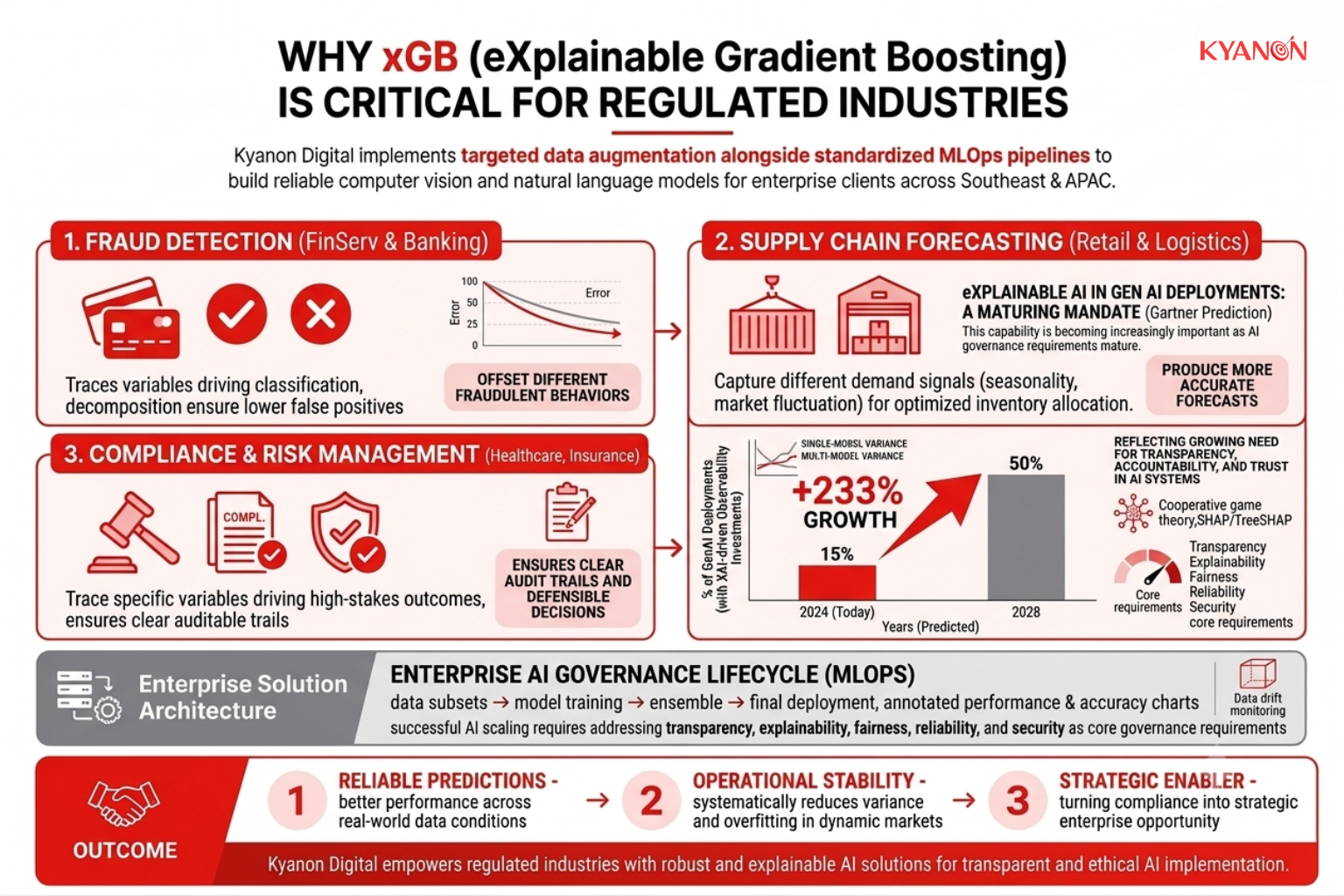
For regulated enterprises, the business impact extends beyond compliance. Explainable models enable faster model validation, stronger governance controls, improved stakeholder trust, and more efficient risk management. Gartner’s AI governance research further emphasizes that successful AI scaling requires organizations to address transparency, explainability, fairness, reliability, and security as core governance requirements rather than optional enhancements.
As a result, eXplainable Gradient Boosting allows organizations to deploy advanced machine learning models while maintaining the transparency and accountability required for high-stakes decision-making, turning explainability from a compliance obligation into a strategic enabler of enterprise AI.
Common Misconceptions
Built-in ‘Gain’ or ‘Weight’ metrics are sufficient to show feature influence
Built-in metrics are highly unstable and often contradict one another by inflating the importance of continuous variables. Bypassing default tree attributes for mathematically consistent frameworks like SHAP is required to avoid prioritizing the wrong variables in business logic.
Because decision trees are transparent, the boosted ensemble is also easy to audit
Gradient boosting builds trees sequentially to predict residual errors, meaning tree #100 only predicts a hyper-specific error correction from the previous 99. Auditing standard boosted trees manually is impossible and mathematically meaningless, requiring the application of post-hoc explainers.
How Kyanon Digital Applies eXplainable Gradient Boosting
Kyanon Digital implements explainable gradient boosting using frameworks like XGBoost paired with SHAP and InterpretML for enterprise clients across Southeast Asia and the US. Our approach focuses on deploying these models in regulated AI use cases, such as credit risk scoring and HR decisioning, ensuring that high-accuracy predictive pipelines maintain the strict model transparency required for compliance and ethical AI governance.

→ Explore our Artificial Intelligence services.

 Create project brief with AI