
What is a flash sale platform?
A flash sale platform is a specialized e-commerce infrastructure designed to process extreme, instantaneous surges in user traffic and transaction volume through aggressive request queueing, edge caching, and asynchronous order processing. This decoupled architecture prevents core system collapse during concentrated promotional events by ensuring the backend only receives the exact number of checkout requests it can safely fulfill.
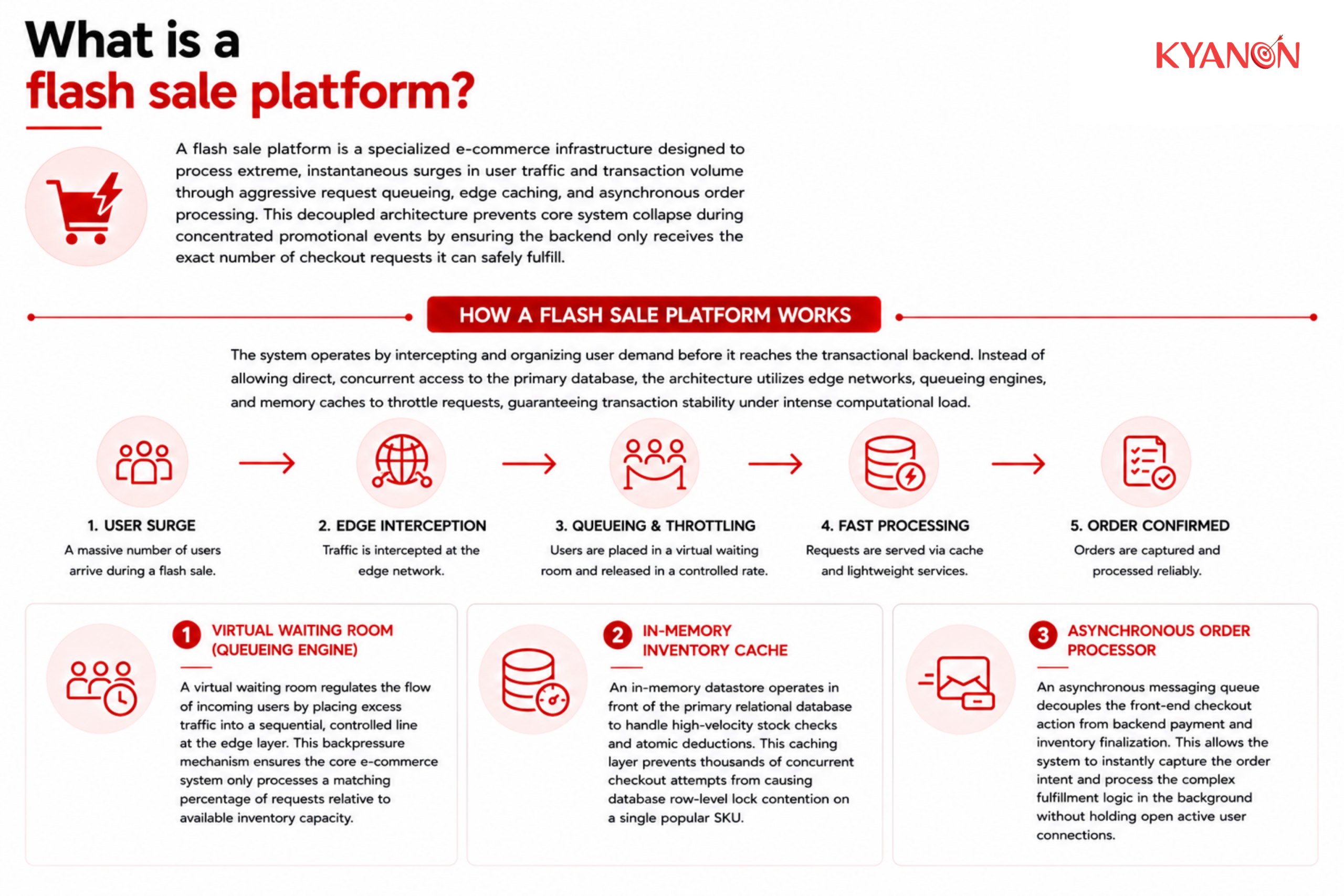
How a flash sale platform works
The system operates by intercepting and organizing user demand before it reaches the transactional backend. Instead of allowing direct, concurrent access to the primary database, the architecture utilizes edge networks, queueing engines, and memory caches to throttle requests, guaranteeing transaction stability under intense computational load.
Virtual Waiting Room (Queueing Engine)
A virtual waiting room regulates the flow of incoming users by placing excess traffic into a sequential, controlled line at the edge layer. This backpressure mechanism ensures the core e-commerce system only processes a matching percentage of requests relative to available inventory capacity.
In-Memory Inventory Cache
An in-memory datastore operates in front of the primary relational database to handle high-velocity stock checks and atomic deductions. This caching layer prevents thousands of concurrent checkout attempts from causing database row-level lock contention on a single popular SKU.
Asynchronous Order Processor
An asynchronous messaging queue decouples the front-end checkout action from backend payment and inventory finalization. This allows the system to instantly capture the order intent and process the complex fulfillment logic in the background without holding open active user connections.

Flash Sale Platform vs Traditional E-Commerce Monolith
Both systems facilitate online transactions, but they differ fundamentally in how they handle sudden, extreme concurrency surges.
Dimension | Flash Sale Platform | Traditional E-Commerce Monolith |
| Concurrency handling | Asynchronous queueing | Synchronous, direct processing |
Database architecture | Decoupled cache and persistent store | Single central relational database |
| Scalability model | Horizontal edge and microservices | Vertical server upgrades (CapEx) |
Best for | High-spike, limited inventory events | Steady, predictable daily traffic |
| Traffic management | Application-level rate limiting | Standard network firewalls |
When to consider a flash sale platform
Consider a flash sale platform if:
- Your brand relies on influencer-driven drops where 80% of monthly sales occur within a highly concentrated two-hour window.
- Your current infrastructure experiences unrecoverable timeouts and cart abandonment when user volume exceeds three times your normal baseline.
- Your engineering team spends days manually pre-scaling servers before every major promotional event, only to still encounter database deadlocks.
It may not be the right priority if:
- Your product catalog consists of high-ticket B2B machinery with long sales cycles and flat, predictable traffic patterns year-round.
Why a flash sale platform matters for retail
Infrastructure failure during a high-visibility promotional window directly destroys projected revenue and permanently increases customer acquisition costs. A Flash Sale Platform helps retailers handle sudden spikes in traffic, transactions, and demand without compromising system performance or customer experience. Unlike standard eCommerce platforms, it is designed for high-volume promotional events where thousands or millions of customers may compete for limited inventory at the same time.
This is particularly important as major retail events can generate enormous transaction volumes. For example, Shopify reported processing $14.6 billion in sales during Black Friday/Cyber Monday 2025, with peak traffic reaching 489 million requests per minute. (Google Cloud)
Common misconceptions
Horizontal scaling solves everything.
Reality: Database locking mechanisms (like row-level locks) create a strict bottleneck when millions of users try to update the exact same product stock row simultaneously, making massive server clusters useless without a cache layer.
Standard DDoS protection is enough to keep us online.
Reality: Traditional security filters look for malicious bot behavior, but flash sales generate “good” traffic from millions of real, frantic humans clicking simultaneously, which requires specialized application-level rate limiting rather than just standard network security.
“Order Placed” means the transaction is immediately complete.
Reality: Flash sales heavily rely on asynchronous processing, meaning a user is told “order is processing” while a message queue handles the inventory deduction and payment verification in the background over the next few minutes.
How Kyanon Digital applies a flash sale platform
Kyanon Digital implements flash sale platforms using composable microservices, distributed edge caching, and virtual queuing systems for enterprise clients across Vietnam, Thailand, Singapore, and ANZ. Our approach focuses on minimizing total cost of ownership (TCO) and protecting conversion rates by ensuring your transactional funnel remains strictly operational during highly publicized regional retail events.
Explore our services:

 Create project brief with AI